أكوان مزدوجة مقابل المادة المظلمة والطاقة المظلمة والثابت الكوني
- **لا توجد ثقوب سوداء. **
من أين يأتي نموذج الثقوب السوداء؟ من معادلة المجال ذات الطرف الثاني الصفري. بشكل متناقض، فإن كائنًا كثيفًا جدًا ينبع من معادلة تم تصميمها في الأصل لوصف مناطق فارغة من الكون. لا يضيف تمدد كير ما يكفي: يصبح الكائن أكثر تعقيدًا فقط. تؤدي الدوران إلى ظاهرة تأثير الإطار الزاوي، مما يعني أن سرعة الضوء مختلفة حسب ما إذا كنت تنظر إلى الأمام أو الخلف بالنسبة للحركة الدورانية. مهما كانت الطريقة المختارة، تصبح الأمور جزئيًا مرضية بمجرد تجاوز الحد ودخوله. في المركز يوجد "الفراغ". لنبدأ بتمرين. دعنا نعتبر المترية 2D (أ). إذا اعتبرنا r كمسافة شعاعية وj كزاوية قطبية، نواجه مشاكل عند r < Rs. ولكن إذا قمنا بإدخال التغيير (ب)، تصبح تعبير المترية (ج). تختفي جميع الأمراض. علاوة على ذلك، يمكن دمج هذه السطح في R3: معادلة الميريديان هي (د). انظر الشكل 25 حيث قمنا برسم مسار. هذا يوضح أن المرض قد يعتمد على اختيار خاطئ للإحداثيات واختيار خاطئ للطوبولوجيا.
في المثال 3D، حسبنا مسارات ميكانيكية مسطحة (انظر الشكل 26) والتي تُProjected في الفضاء العرضي الأصلي (r، q، j). نحصل على "كرة ممر" تربط بين مساحتين إقليديتين 3D. لا شيء داخله. المساحة لـ r < Rs لا تملك معنى فيزيائي. إذا حاولنا حساب مسارات ميكانيكية في ذلك المكان، نحصل على حل تخيلي.

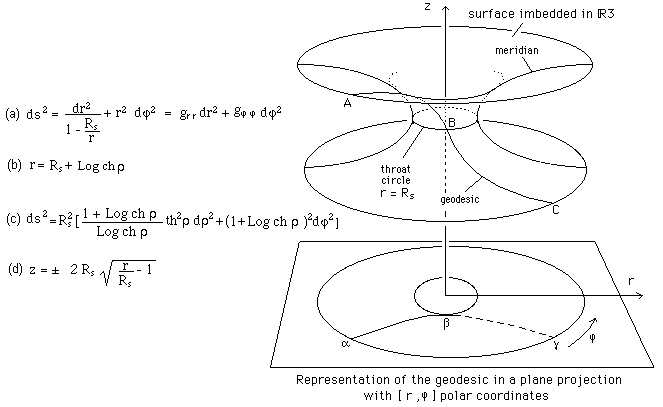
الشكل. 25: مترية سطح 2D مع "جسر" يربط بين طياتين.
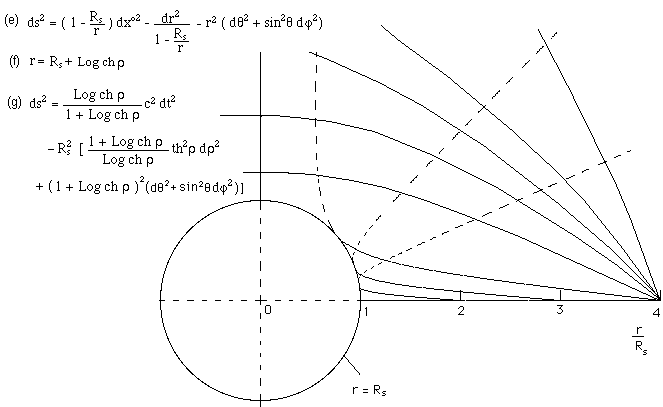
الشكل. 26: سطح مترية 3D مع "جسر فضائي". مسارات ميكانيكية.

بشكل تقليدي، نقدم وقتًا خاصًا s (j) و"إحداثيًا زمنيًا" t (i). دراسة المسارات الميكانيكية الشعاعية تقدم معادلتين تفاضليتين (k) و(l)، حيث تتوافق حلولها مع المنحنيات (m)، الشكل 6.2، المراجع [52].
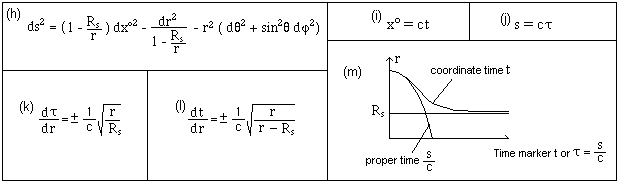
المنحنيات الموضحة في الشكل (m) هي أساس نموذج الثقوب السوداء. نحدد الإحداثي t بالوقت الخاص لمراقب "بعيد"، بحيث يصبح وقت السقوط الحر لجسيم اختبار نحو كرة شوارزشيلد لا نهائيًا بالنسبة له. دعنا نوضح أن هذا كله يرجع إلى اختيار خاص لهذا الإحداثي الزمني. في عام 1925، اقترح إدينجتون مؤشرًا زمنيًا جديدًا (p).

ثم دراسة المسارات الميكانيكية الشعاعية المقابلة.
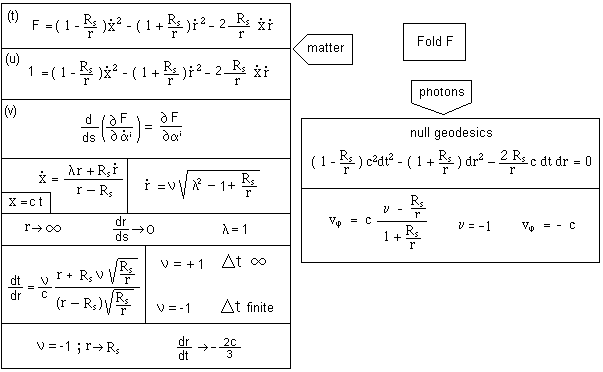
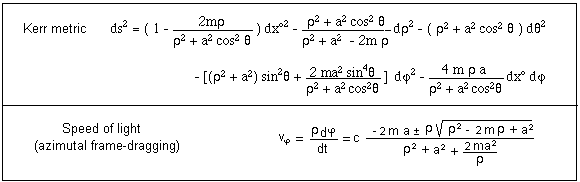
نستخدم معادلات لاغرانج. من اليمين، نرى أن سرعة الضوء التي تتبع مسارات شعاعية لها قيمتان. (ν = -1) تتوافق مع المسارات المركزية: السرعة لها قيمة ثابتة - c. بشكل مشابه (من اليسار)، يعتمد وقت المرور من نقطة بعيدة إلى كرة شوارزشيلد على اتجاه المسارات. وقت السقوط الحر المركزي (ν = -1) ينتهي في فترة زمنية محدودة Dt. على العكس من ذلك، مسار مركزي (ν = +1)، يبدأ من كرة شوارزشيلد، يعطي فترة زمنية لا نهائية، لذلك تؤدي كرة شوارزشيلد إلى أن تكون مثل غشاء ذو اتجاه واحد. هذا يتوافق مع تأثير "الجرavity الشعاعي". هذا ليس سببًا لرفض هذا التفسير لجغرافيا شوارزشيلد. في الواقع، نجد ظاهرة مشابهة في تمدد كير (الجرavity الزاوي). ثم التعبير الكلاسيكي لتمدد كير. نرى أننا نحصل على قيمتين مختلفتين لسرعة الضوء الزاوية. وفقًا لما نعتبره، فإن الضوء يتبع الدوران أو يذهب عكسه.
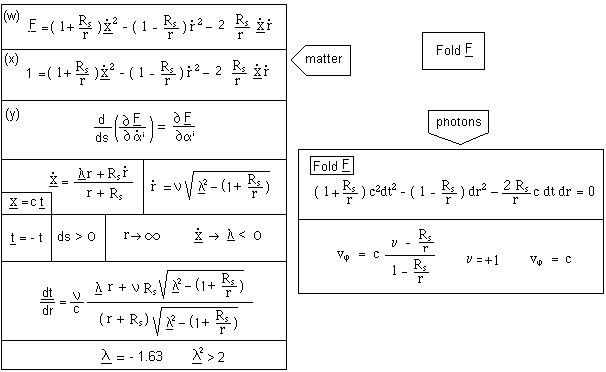
يمكننا تقديم تفسير جديد لجغرافيا شوارزشيلد، من خلال جسر فضائي يربط بين طياتين F و F. إذا كانت الطية F تتوافق مع الطية المزدوجة، فإن الإحداثي الزمني t = - t (التناظر T). وفقًا للقسم 19، نعرف أن هذا التناظر T يصاحبه عكس الكتلة، لذلك عند عبور كرة شوارزشيلد، المعتبرة كسطح ممر، تصبح الكتلة الإيجابية سالبة. الجغرافيا المترافقة، كما عُرضت في القسم 13، تتوافق مع استبدال Rs بـ - Rs. ثم نقدم التغيير التالي لمؤشر الزمن، مشابه لـ إدينجتون:

باستخدام معادلات لاغرانج، ندرس نظام المسارات الميكانيكية الشعاعية ونEstablish رابطًا بين الطياتين.

لكن المسارات العكسية تتطلب وقتًا لا نهائيًا، لذلك فهي مرور واحد من عالم إلى آخر. مرة أخرى، نجد تأثيرًا للجرavity، لكن في الاتجاه المعاكس.
خلال المرور، يبقى تدفق الوقت الخاص غير متغير: ds > O. هذا يجعل نموذج الثقوب السوداء مثيرًا للجدل. في الواقع، وفقًا لهذا التفسير الجديد لجغرافيا شوارزشيلد، يمكن لهذا الجسر الفضائي امتصاص كميات لا نهائية من المادة في وقت قصير جدًا (» 10-4 ثانية). كمقارنة، تقدم تحليلات تعتمد على تمدد كير، على الرغم من أنها أكثر تعقيدًا قليلاً، نتائج مشابهة.
ثم حل أنظمة المسارات الميكانيكية.
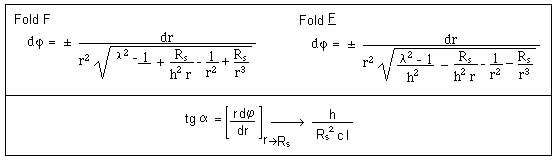
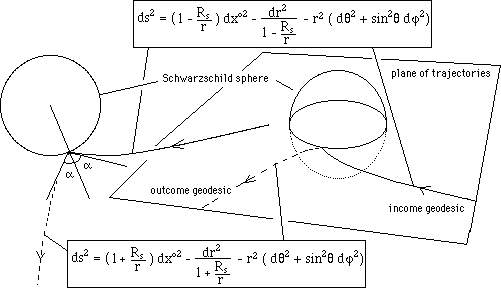
كيف نمثل هذه المسارات؟ يمكننا استخدام الفضاء العرضي الأصلي (r، q، j). نحصل بذلك على نظام المعادلات التفاضلية أعلاه والرسم التوضيحي للشكل 27.
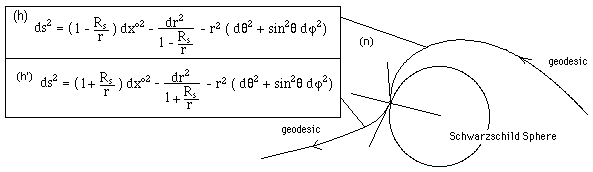
الشكل. 27: مسارات الدخول والخروج.
يبدو أن المسار الميكانيكي "يتمايل" على كرة شوارزشيلد، كما يظهر أيضًا في الشكل 28.
**  **
**
لكن كل ذلك يأتي من تمثيل إقليدي بسيط للمسار. باستخدام التغيير التالي لمؤشر المساحة:
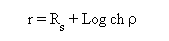
تصبح تعبير المترية المشتركة:
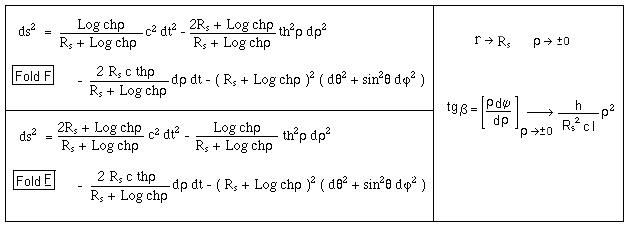
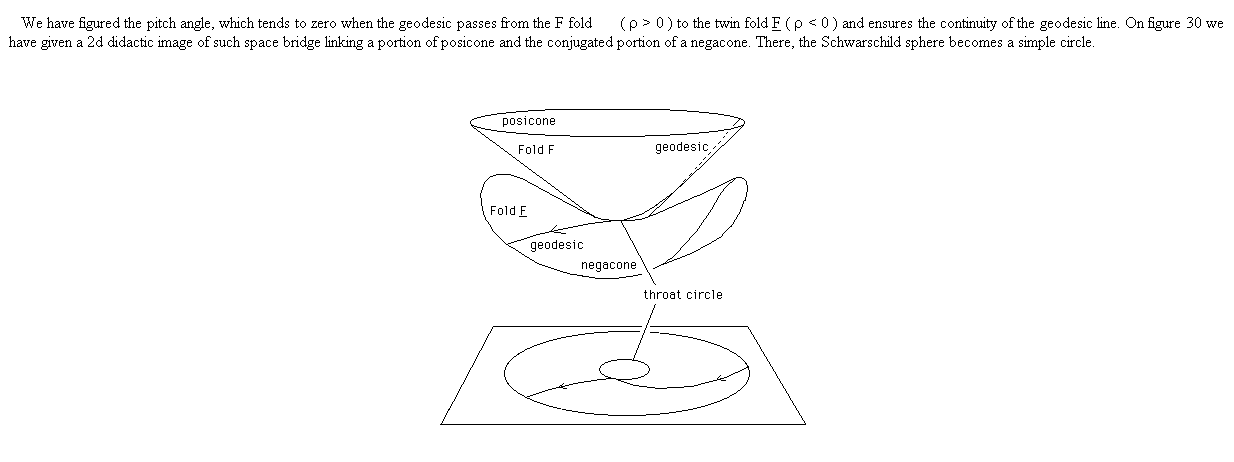
الشكل. 29: صورة تعليمية لجسر فضائي بتدفق سريع.
المراجع.
[1] J.F.Augereau : « إذا انحرفت أشعة الضوء عن المادة المظلمة، فهذا يعني أنها موجودة » (If dark matter bends light rays it shows it does exist). Le Monde، 17 مارس 2000.
[2] مقابلة B.Fort في Ciel et Espace، يونيو 2000.
[3] J.P.Petit : تأثير الكتلة المفقودة. Il Nuovo Cimento، B، المجلد. 109، يوليو 1994، ص 697-710
[4] J.P.Petit، كون الأكوان المزدوجة. Astrophysics and Space Science. Astr. And Sp. Sc. 226 : 273-307، 1995
[5] Zel'dovich Ya.B.، Astrophysica 6. 319 MNRAS 192، 192 (1970)
[6] Doroskhevich A.G. MNRAS 192، 32 (1980)
[7] Klypin A.A & Shandarin S.F. MNRAS 204، 891 (1983)
[8] Centrella J.M. & Mellot A.L. Nature 305، 196 (1983)
[9] Mellot J.M. & Shandarin S.F. Nature 346، 633 (1990)
[10] Shandarin S.F. في هياكل كبيرة للكون، المحرر J.Audouze، M.C. Peleton وA.Szalay، 273. دوردريخت: كولوور (1988).
[11] Kofman.L.A.، Pogosyan D. وShandarin S. MNRAS 242، 200 (1990)
[12] Peebles P.J.E. مبادئ الكونيات الفيزيائية، جامعة برينستون (1993).
[13] M.Myamoto وR.Nagai نشر. Astrom. Soc. Japan 27، 583، 1975
[14] J.Binney وS.Tremaine، "ديناميكية المجرة"، جامعة برينستون، برينستون، 1987. [16] Bahcall J.N وSoneira R.M. APJ. S** 44** ص 73 1980
[17] Bahcall J.N.، Flynn A وGould A. APJ 389 ص 234 1992
[18] B.Lindblad، Handbuch der Physik 53، (1959) 21
[19] C.C. Lin وF.H.Shu : Astrophysics and Gen. Relat. Vol.2 Gordon and Breach Sc. Publ. 1971، ص 235
[20] Toomree A. (1981) بنية وديناميكية المجرات العادية. جامعة كامبريدج، ص 111
[21] Toomree A. وToomree J. (1972) Astrophys. J. 178، 623
[22] A.Toomree، Ann. Rev. Astronom. Astrophys. 15 (1977) 437
[23] E.Athanassoula : التروس والشرائح المُستحثة من الأقران. الجمعية الفلكية الدولية. ندوة رقم 146 (1991)
[24] A.Toomree Astrophys. J. 158 (1969) 89
[25] R.H.Miller وB.F. Smith، Astrophys. J. 277 (1979) 785
[26] F. Hohl، Astrophys. Sp. Sc. 14 (1971) 91
[27] Holmberg E. (1941) Astrophys. J. 94، 385
[28] B. Sundelius وK.J. Donner : المجرات المتفاعلة، ديناميكية المجرات الدائرية (1991) Sundelius نشر. ص 195
[29] S. Engström : السرعات المميزة في المحاكاة العددية.، ديناميكية المجرات الدائرية (1991) Sundelius نشر. ص 332
[30] A.Toomree Ann. Rev. Astron. Astrophys. 15 (1977) 437.
[31] F.Bouchet وL.Hernquist : المحاكاة الكونية باستخدام طرق نظرية شجرية. Astr. Jr Suppl. سلسلة 68، ص 521، 538، 1988.
[32] F.Bouchet، L.Hernquist وY.Suto : تطبيق طريقة إيدوالد على المحاكاة الكونية N-corps. Apj. Suppl. سلسلة 75، ص 231-240، 1991
[33] A.Sakharov : "مخالفة CP وانحياز باريوني للكون". ZhETF Pis'ma 5 : 32-35 (1967) : ترجمة JETP Lett. 5 : 24-27 (1967)
[34] A.Sakharov : "نموذج كوني متعدد الطبقات". مخطوطة معهد الرياضيات التطبيقية، موسكو 1970
[35] A.Sakharov : "نموذج كوني للكون مع عكس متجه الزمن". ZhETF 79 : 689-693 (1980) : ترجمة إلى Sov. Phys. JETP 52 : 349-351 (1980)
[36] A.Sakharov : "البنية الطوبولوجية للجسيمات الأساسية وانحياز CPT" في "مشاكل الفيزياء النظرية"، المكرس لذكرى I.E.Tamm، Nauka، موسكو 1972 ص 243-247
[37] Green M.B. وSchwarz J.H. Nucl. Phys. B181، 502-530 (1981) ؛ B198، 225-268 (1982) ؛ Phys. Lett. B، 444-448 (1982)
[38] Green M.B. Surv. High Energy Phys. 3، 127 (1982)
[39] Gross D.J.، Harvey J.A.، Martinec E. وRohm R.، Phys. Rev. Lett. 54، ص 503-505 (1985)
[40] Kolb E.W.، Seckel D وTurner M.S. : العالم المظلم للنظريات المترابطة، الطبيعة، المجلد 314، أبريل 1984، ص 415-419
[41] P.C.W.Davies وJ.B.Brown : الأوتار الفائقة، جامعة كامبريدج 1988
[42] عبدوس سالم، Nuovo Cimento 5، 299 (1957)
[43] نيمار-أركاني أحمد، سافاس ديموبولوس وجيورجي دفالي : "الأبعاد المخفية للكون"، PLS أكتوبر 2000، العدد 276، ص 56-64
[44] J.P.Petit : تفسير نموذج كوني بسرعة الضوء المتغيرة. الفيزياء الحديثة للرسائل A، المجلد 3، العدد 16، نوفمبر 1988، ص 1527
[45] ** **J.P.Petit : نموذج كوني بسرعة الضوء المتغيرة: تفسير الانزياحات الحمراء. الفيزياء الحديثة للرسائل A، المجلد 3، العدد 18، ديسمبر 1988، ص 1733
[46] J.P.Petit وMaurice Viton : نموذج كوني بسرعة الضوء المتغيرة. المقارنة مع البيانات الملاحظية لـ QSO. الفيزياء الحديثة للرسائل A، المجلد 4، العدد 23 (1989) ص 2201-2210
[47] P.Midy وJ.P.Petit : الكونية الثابتة. المجلة الدولية للفيزياء الحديثة D، المجلد 8 يونيو 1999 ص 271-280
[48] E.A.Milne : النسبية الحركية أكسفورد 1948.
[49] J.D.Anderson، P.A.Laing، E.L.Lau، A.S.Liu، M.M. Nieto وS. Turchev : إشارة للبيانات باينير 10/11، جاليليو ووليس، تسارع غير عادي، ضعيف، طويل المدى. Phys. Rev. Letters: 81 31 أغسطس 1998.
[50] G.J.Stephenson Jr.، T.Goldman، Phys. Rep. 205، 211 (1992) ؛ 216، 343 (1992).
[51] M.N. Nieto وT.Goldman، Phys. Re. 205، 221، 1991؛ 216، 343.
[52] R.Adler، M.Bazin وM.Schiffer : مقدمة في النسبية العامة، ماك غراو هيل بوك، 1975، الفصل 10، القسم 10.5: الحد الكلاسيكي للمعادلات الجاذبة، ص 345.
[53] J.M.Souriau، بنية أنظمة الديناميكية، دو نود 1970، فرنسا وبنية أنظمة الديناميكية. بيركهاوزر إيد. بوسطن-زيوريخ 1997.
[53] J.P.Petit : أكوان مزدوجة بسهام زمنية معاكسة (Enantiomorphic universes with opposite time arrows). تقارير أكاديمية العلوم في باريس، ص 1977
[54] إدينجتون S.A : : مقارنة صيغ ويتهد وآينشتاين. الطبيعة 113 : 192 (1924).
****ملخص المقال
النسخة الأصلية (الإنجليزية)
univers jumeaux contre matiere sombre matiere noire et constante cosmologique
- **Black holes do not exist. **
Where the black hole model does come from ? From the null second member field equation. Paradoxically such very dense object rises from an equation which was initially built to describe empty regions of the Universe. The Kerr metric does not bring so much : the object becomes more complex, thats all. Rotation brings an azimutal frame-dragging phenomenon, which means that the speed of light is different if one looks forward or backward with respect to the spinning movement. Whatever is the technique you choose, the things become frankly pathological when you pass the horizon and get in. At the centre lies the singularity. Let us start with an exercise. Consider the 2d metric (a). If we consider r as a radial distance and j as a polar angle, we get problems for r < Rs. But if we introduce the change (b) the expression of the metric becomes (c). All pathologies disappear. Moreover this surface can be imbedded in R3 : the meridian equation is (d). See figure 25 where we have figured a geodesic. This illustrates the fact that a pathology can depend on a wrong choice of coordinates and on a wrong choice of topology.
In the 3d example we have computed (plane) geodesics ( see figure 26 ) which are projected on the initial (r,q,j) representation space. We get a throat sphere linking two Euclidean 3d spaces. There is nothing inside. Space for r < Rs has no physical meaning. If we would try to compute geodesics in that place, we would find an imaginary solution.
Fig. 25 : 2d metric of a surface with a bridge linking two folds.
Fig. 26 : 3d metric hypersurface with a space bridge. Geodesics.
Classically, one introduce a proper time s (j) and a time-coordinate t (i). Then the study of radial geodesics gives two differential equations (k) and (l), whose solutions correspond to curves (m), fig. 6.2, reference [52].
The curves shown on figure (m) are the basis of the black hole model. One identifies the coordinate t to the proper time of a distant observer so that the free fall time of a test particle, towards the Schwarzshild Sphere become infinite for him. Let us show that this is completely due to this peculiar choice of time coordinate. In [54] 1925 Eddington suggested a new time-marker (p).
Following, the study of corresponding radial geodesics.
We use Lagrange equations. On the right we see that the speed of light, following radial paths has two values. ( nu = - 1 ) corresponds to centripetal paths : the speed has a constant value c. Similarly (left) the transit time from a distant point to the Schwarzschild sphere depends on the orientation of the paths. Centripetal ( nu = - 1 ) free fall time is achieved in finite time interval Dt . Oppositely a centrifugal path ( nu = + 1 ), starting from the Schwarzschild sphere gives an infinite time interval, so that the Schwarzschild sphere works like a one-way membrane. This corresponds to a radial frame-dragging effect. This is not a reason to reject this interpretation of the Schwarzschild geometry. In effect we find a similar phenomenon in the Kerr metric ( azimutal frame-dragging). Next, the classical expression of the Kerr metric. We see that we get two distinct values for azimutal speed of light. Depends if we consider light following the rotation or going backwards.
We can give a new interpretation of the Schwarzschild geometry, through a space-bridge linking two folds F and F. If the fold F corresponds to the twin fold, the time coordinate t = - t ( T-symmetry). From section 19 we know that this T-symmetry goes with a mass-inversion, so that when a positive mass passes through the Schwarzschild sphere, considered as a throat surface, the sign of it becomes negative. The conjugated geometry, as presented in section 13 corresponds to change Rs into Rs. Then we introduce the following Eddington-like time marker change :
Still using Lagranges equation we study the radial geodesics system and build a link between the two folds.
But the inverse paths requires an infinite time, so that it is a one-way passage from a Universe to the other. Here again we find a frame-dragging effect, in the opposite direction.
During the transit the proper time flow is unchanged : ds > O . This makes the black hole model questionable. In effect, according to this new interpretation of the Schwarzschild geometry such space bridge can swallow in a very short time ( » 10-4 sec) unlimited amounts of matter. By the way, an analysis based on the Kerr metric, although a little bit more complicated gives similar results.
Following, the solution of the geodesic systems.
How to figure such paths ? We can use the initial ( r , q , j ) representation space. Then we get the above system of differential equations and the schema of figure 27 .
Fig.27 : Income and outcome geodesics.
The geodesic seems to bounce on the Schwarzschild sphere, as shown of figure 28 too.
** **
But all that comes from such naïve Euclidean representation of the path. Using the following change of space marker :
The expression of joint metrics become :
Fig. 29 : Didactic image of a fast flow space bridge.
References.
[1] J.F.Augereau : « Si la matière sombre dévie les rayons lumineux, cest donc quelle existe (If dark matter bends light rays it shows it does exist). Le Monde, March 17 th 2000.
[2] Interview of B.Fort in Ciel et Espace, june 2000.
[3] J.P.Petit : The missing mass effect. Il Nuovo Cimento, B , vol. 109, july 1994, pp. 697-710
[4] J.P.Petit, Twin Universe Cosmology. Astrophysics and Space Science. Astr. And Sp. Sc. 226 : 273-307, 1995
[5] Zel'dovich Ya.B., Astrophysica 6. 319 MNRAS 192, 192(1970)
[6] Doroskhevich A.G. MNRAS 192, 32 (1980)
[7] Klypin A.A & Shandarin S.F. MNRAS 204, 891 (1983)
[8] Centrella J.M. & Mellot A.L. Nature 305, 196 (1983)
[9] Mellot J.M. & Shandarin S.F. Nature 346 , 633 (1990)
[10] Shandarin S.F. In Large Structures of the Universe, ed. J.Audouze, M.C. Peleton and A.Szalay, 273. Dordrecht : Kulwer (1988).
[11] Kofman.L.A., Pogosyan D. and Shandarin S. MNRAS 242, 200 (1990)
[12] Peebles P.J.E. Principles of Physical Cosmology, Princeton University Press (1993).
[13] M.Myamoto and R.Nagai Publ. Astrom. Soc. Japan 27, 583, 1975
[14] J.Binney and S.Tremaine, "Galactic Dynamics", Princeton University Press, Princeton, 1987. [16] Bahcall J.N & Soneira R.M. APJ. S** 44** p. 73 1980
[17] Bahcall J.N. , Flynn A and Gould A. APJ 389 p.234 1992
[18] B.Lindblad, Handbuch der Physik 53, (1959) 21
[19] C.C. Lin and F.H.Shu : Astrophysics and Gen. Relat. Vol.2 Gordon and Breach Sc. Publ. 1971, p. 235
[20] Toomree A. (1981) The structure and dynamics of normal galaxies. Cambridge University Press, p.111
[21] Toomree A. and Toomree J. (1972) Astrophys. J. 178, 623
[22] A.Toomree, Ann. Rev. Astronom. Astrophys. 15 (1977) 437
[23] E.Athanassoula : Companion driven spirals and bars. International Astronomic Union. Symposium n° 146 (1991)
[24] A.Toomree Astrophys. J. 158 (1969) 89
[25] R.H.Miller and B.F. Smith, Astrophys. J. 277 (1979) 785
[26] F. Hohl, Astrophys. Sp. Sc. 14 (1971) 91
[27] Holmberg E. (1941) Astrophys. J. 94, 385
[28] B. Sundelius and K.J. Donner : Interaction galaxies, Dynamics of Disk Galaxies (1991) Sundelius ed. p. 195
[29] S. Engström : Feature velocitys in numerical simulations. , Dynamics of Disk Galaxies (1991) Sundelius ed.p. 332
[30] A.Toomree Ann. Rev. Astron. Astrophys. 15 (1977) 437.
[31] F.Bouchet and L.Hernquist : Cosmological simulations using theoretical tree methods. Astr. Jr Suppl. Series 68 , pp. 521, 538, 1988.
[32] F.Bouchet, L.Hernquist and Y.Suto : Application of the Ewald method to cosmological N-body simulation. Apj. Suppl. Series 75 , pp. 231-240, 1991
[33] A.Sakharov : "CP violation and baryonic asymmetry of the Universe". ZhETF Pis'ma 5 : 32-35 (1967) : Traduction JETP Lett. 5 : 24-27 (1967)
[34] A.Sakharov : "A multisheet Cosmological Model" Preprint Institute of Applied Mathematics, Moscow 1970
[35] A.Sakharov : "Cosmological Model of the Universe with a time-vector inversion". ZhETF 79 : 689-693 (1980) : Traduction in Sov. Phys. JETP 52 : 349-351 (1980)
[36] A.Sakharov : "Topological structure of elementary particles and CPT asymmetry" in "problems in theoretical physics", dedicated to the memory of I.E.Tamm, Nauka, Moscxow 1972 pp. 243-247
[37] Green M.B. & Schwarz J.H. Nucl. Phys. B181 , 502-530 (1981) ; B198 , 225-268 (1982) ; Phys. Lett. B , 444-448 (1982)
[38] Green M.B. Surv. High Energy Phys. 3 , 127 (1982)
[39] Gross D.J. , Harvey J.A. , Martinec E. & Rohm R. , Phys. Rev. Lett. 54, pp 503-505 (1985)
[40] Kolb E.W. , Seckel D , Turner M.S. : The shadow world of superstring theories, Nature Vol. 314, april 1984 pp. 415-419
[41] P.C.W.Davies & J.B.Brown : Superstrings, Cambridge University Press 1988
[42] Abdus Salam, Nuovo Cimento 5 , 299 (1957)
[43] Nima-Arkani Ahmed, Savas Dimopoulos and Georgi Dvali : "Les dimensions cachées de l'univers", PLS oct 2000 n° 276 pp. 56-64
[44] J.P.Petit : An interpretation of cosmological model with variable light velocity. Modern Physics Letters A, Vol. 3, n°16, nov 1988, p.1527
[45] ** **J.P.Petit : Cosmological model with variable light velocity: the interpretation of red shifts. Modern Physics Letters A, Vol.3 , n° 18, dec. 1988, p.1733
[46] J.P.Petit & Maurice Viton : Gauge cosmological model with variable light velocity. Comparizon with QSO observational data. Modern Physics Letters A Vol.4 , n°23 (1989) pp. 2201-2210
[47] P.Midy & J.P.Petit : Scale Invariant Cosmology. The international Journal of Modern Physics D, Vol.8 June 1999 pp.271-280
[48] E.A.Milne : Kinematic Relativity Oxford 1948.
[49] J.D.Anderson, P.A.Laing, E.L.Lau, A.S.Liu, M.M. Nieto and S. Turchev : Indication for Pioneer 10/11, Galileo and Ulysse Data, an an Apparent Anomalous, Weak, Long-Range Acceleration. Phys. Rev. Letters : 81 31 August 1998.
[50] G.J.Stephenson Jr. , T.Goldman, Phys. Rep. 205, 211 (1992) ; 216, 343 (1992).
[51] M.N. Nieto and T.Goldman, Phys. Re. 205, 221, 1991; 216, 343.
[52] R.Adler, M.Bazin & M.Schiffer : Introduction to general relativity, Mac Graw Hill book, 1975, chapter 10, section 10.5 : Classical limit of gravitational equations, p. 345.
[53] J.M.Souriau, Structure des Systèmes Dynamiques, Ed. Dunod 1970, France & Structure of Dynamical Systems. Birkhauser Ed. Boston-Zurich 1997.
[53] J.P.Petit : Univers énantiomorphes à flèches du temps opposeés (Enantiomorphic universes with opposite time arrows). Comptes rendus de lAcadémie des Sciences de Paris, t. pp. 1977
[54] Eddington S.A : : A comparizon of Witheads and Einsteins formulæ. Nature 113 : 192 (1924).
****ملخص المقال