مشكلة الكتلة المفقودة (ص3)
4) الحل ذو التماثل الكروي
... في عام 1916، استنتج إدينجتون حلًا مستقرًا ذو تماثل كروي، مدمجًا معادلات فلاسو وبوسون. افترض أن الإهلipsoid الخاص بالسرعات يتمتع بتماثل كروي ويتجه نحو مركز النظام.
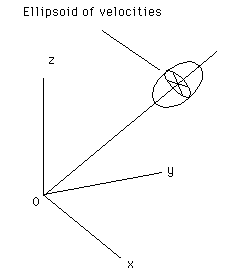
الشكل 1 (ga3114): إهلipsoid السرعات المقابل لحل من نوع إدينجتون.
استنتج إدينجتون العلاقة التالية بين كثافة الكتلة والPotential الجاذب:
(20)
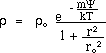
وهي تمثل توزيعًا مستقرًا للمواد في غاز خالٍ من التصادمات، في مجال جاذب Ψ، حيث توازن القوة الجاذبة القوة الضغطية. دعنا نأخذ نفس نوع الحل للمنطقة المقابلة:
(21)
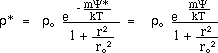
وبالتالي، يجب علينا حل المعادلة التالية:
(22)

نأخذ
(23)
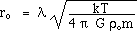
نقدم الكميات التالية بدون أبعاد:
(24)

نحصل على
(24 بيس)
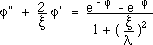
ويمكن حلها باستخدام الحساب العددي. يمكننا أخذ الشروط الابتدائية التالية:
φ'₀ = 0
φ"₀ = 10
λ = 10
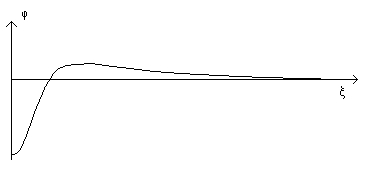
الشكل 2: حل من نوع إدينجتون ذو تماثل كروي. الPotential الجاذب
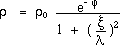
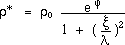
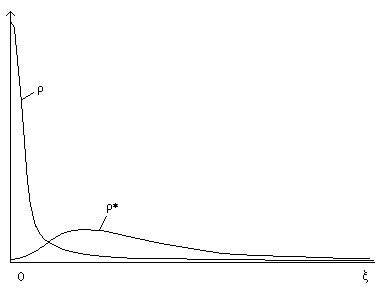
الشكل 3: حل من نوع إدينجتون ذو تماثل كروي. كثافات الكتلة. إذا وُجدت مجموعة في طي، فإن هالو متناثر مرتبط موجود في المنطقة المترافقة للطي الثاني.
النسخة الأصلية (الإنجليزية)
The missing mass problem (p3)
4) Spherically symmetric solution
...In 1916 Eddington derived a spherically symmetric steady-state solution, combining the Vlasov and the Poisson equations. He assumed that the ellipsoid of the velocities was spherically symmetric and pointed towards the center of the system.
Figure 1 (ga3114): Ellipsoid of velocities corresponding to an Eddington-type solution.
Eddington derived the following relation between the mass density and the gravitational potential
(20)
which represents a steady-state distribution of matter in a collision-free gas, in a gravitational potential Ψ, in which the gravitational force balances the pressure force. Let us take the same kind of a solution for the antipodal region
(21)
So that we have to solve the following equation
(22)
Take
(23)
Introduce the following adimensional quantities :
(24)
We get
(24)
which can be solved by numerical computation. We can take the following initial conditions
φ'₀ = 0
φ"₀ = 10
λ = 10
Figure 2 : Spherically symmetric Eddington-type solution. The gravitational potential
Figure 3 : Spherically symmetric Eddington-type solution. Mass densities. If a cluster exists in one fold, an associated diffuse halo exists in the conjugated region of the second fold.