الكون الكون المزدوج الكتلة المفقودة
مشكلة الكتلة المفقودة (ص6)
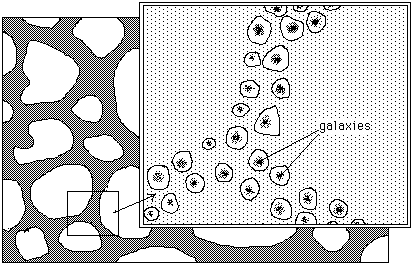
الشكل 14: بنية الحجم الأصغر
7) بعض الملاحظات حول البديهيات.
...تُقدّم النسبية العامة الكلاسيكية وصفًا ماكروسكوبيًا للكون، مُشكّلًا بواسطة المجال الجاذب. ولكن، بشكل أساسي، لا تُراعى الظواهر الكهرومغناطيسية. لربط هذا النموذج الكلاسيكي بالمشاهدات، يجب إدخال البديهيات الإضافية التالية:
-
الكون مملوء بالجسيمات: جسيمات محايدة كتلتها تساوي m، وفوتونات. كلاهما يساهم في المجال.
-
هذه الجسيمات تتحرك على طول خطوط الجيوديسيات للفضاء-الزمن.
-
يمكن لجسيم إرسال إشارة كهرومغناطيسية.
-
يمكن لجسيم آخر استقبال هذه الإشارة الكهرومغناطيسية.
-
هذه الإشارة الكهرومغناطيسية، التي تُحملها الفوتونات، تتبع خطوط الجيوديسيات الفارغة للفضاء-الزمن.
-
يمكن لجسيم كتلي إرسال إشارة جاذبة، والتي تُفترض أنها تتبع خط جيوديسي فارغ.
-
يمكن لجسيم كتلي استقبال هذه الإشارة الجاذبة.
...وبالتالي، بالنسبة لمراقب مكون من مادة، يصبح الكون قابلاً للرؤية بصريًا وفقًا لهذه البديهيات. الفوتونات هي الوسيط الذي ينقل رسالة بصريّة من جسيم كتلي إلى آخر.
...في النموذج الحالي، يُعتبر الكون مغطى بكرة S3، ومحليًا لدينا بنية مشابهة لمتعددة الأبعاد المُحاطة، حيث يجب أن يكون المحاط محدودًا فقط بقيمتين: +1 و-1. ثم نُدخل البديهيات الجديدة التالية.
-
الكون مملوء بالجسيمات: جسيمات محايدة كتلتها تساوي m، وفوتونات. كلاهما يساهم في المجال.
-
الجسيمات الكتلية والفوتونات تتحرك على طول خطوط الجيوديسيات للفضاء-الزمن ولا يمكنها الانتقال من منطقة إلى منطقة متقابلة مُعاكسة لـ S3.
-
يمكن لجسيم كتلي إرسال إشارات كهرومغناطيسية وجاذبة، والتي يمكن أن تستقبلها جسيم كتلي آخر.
-
تنتقل الإشارة الجاذبة على طول خطوط الجيوديسيات للفضاء-الزمن، ولكن أيضًا على طول خطوط الجيوديسيات لـ "طيات الكون المجاورة"، "من خلال بنية المحاط"، بحيث تمتلك الإشارة الجاذبة بعضًا من الخصائص الشمولية، لأنها تعمل في منطقة من المتعددة وفي المنطقة المتقابلة (أو بمعنى آخر، في "المنطقة المجاورة"، إذا اخترنا صورة المتعددة المُحاطة).
-
تُقدم بنية معادلة المجال الجديدة الميزات التالية.
...إذا تم إرسال إشارة جاذبة واستقبالها بواسطة جسيمين "يُعتبران من نفس الطية"، فإن الظاهرة تتوافق مع الوصف الكلاسيكي.
...ولكن يمكن لجسيم كتلي إرسال إشارة جاذبة أن تستقبلها جسيم آخر موجود في المنطقة المجاورة (المنطقة المتقابلة)، أي "من خلال بنية المحاط"، حيث يغير العلامة السلبية في الجانب الثاني من معادلة المجال طبيعة الإشارة، وكأنها أُرسلت من "كتلة سالبة".
- تسير الإشارة الكهرومغناطيسية على خطوط الجيوديسيات الفارغة العادية للمتعددة، ولكنها لا تمتلك هذه الخاصية الشمولية. لا يمكنها الانتقال من طية إلى "الطية المجاورة من خلال بنية المحاط". لكي تنتقل من منطقة من المتعددة إلى المنطقة المتقابلة، يجب على الضوء أن يُكمل نصف دور كامل للكرة S3.
...نعترف بأن هذه الوصف الهندسي المقترح ما زال بسيطًا وغامضًا بعض الشيء. يجب أن يشمل الوصف الصحيح نموذجًا أكثر تفصيلًا، يدمج الظواهر الجاذبة والكهرومغناطيسية، أي نظرية موحدة، والتي لا توجد حاليًا.
...يُشبه الوصف المحلي للمتعددة المُحاطة نموذج كالوза ذي الأبعاد الخمسة، حيث ستكون البعد الخامس محدودًا بقيمتين: +1 و-1، كما اقترحه ألان كونيس سابقًا.
8) تقدير تأثير "الكتلة المفقودة".
تطبيق طريقة الازاحة على معادلات أويلر:
(25) (25')
مع الحل من الدرجة الأولى:
(26) DY = DYo = 0
معادلة بويسون تُعطي:
(27)

(27')
dY = - dY* (28)
Lj هي طول جينز الكلاسيكي
(29)
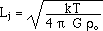
(30)
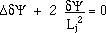
هذه معادلة هيلمهولتز المعروفة.
في المقاربة الكلاسيكية المستقرة، كان لدينا
(31)

...التفاعل مع المنطقة المتقابلة يقلل طول جينز بعامل 1.414، مما يؤدي إلى تأثير تقييد. إذا كان لدينا تركيز إيجابي للمادة dr في طية الفضاء-الزمن الخاصة بنا، فسوف نجد تركيزًا سالبًا dr* في المنطقة المتقابلة المرتبطة، والعكس صحيح. يجب أن يقلل التقييد الناتج عن تأثير المنطقة المتقابلة من الكتلة المطلوبة لتوازن الضغط أو القوة الطاردة المركزية بعامل:
النسخة الأصلية (الإنجليزية)
cosmologie univers jumeaux masse manquante
The missing mass problem (p6)
Figure 14 : Smaller size structure
7) Some comments about the axioms.
...The classical General Relativity proposes a macroscopic description of the universe, shaped by the gravitational field. But, basically, the electromagnetic phenomena is not taken into account. In order to link this classical model to the observations, one has to bring the following additional axioms :
-
The universe is filled by particles : neutral particles with a mass equal to m, and photons. Both contribute to the field.
-
These particles move along geodesics of space-time
-
A particle may send electromagnetic signal
-
Another particle may receive this electromagnetic signal
-
This electromagnetic signal, carried by photons, follows the null geodesics of space-time.
-
A massive particle may send a gravitational signal, which is supposed to follow a null geodesic.
-
A massive particle may receive this gravitational signal.
...So that, for an observer composed by matter, the universe becomes optically perceptible, according to these axioms. The photons are the go-between bringing an optical message from a massive particle to another one.
...In the present model the universe is be considered as a cover of a S3 sphere, locally we have a structure similar to a bundled manifold, whose bundle should be limited to two values : + 1 and -1. Then we introduce the new following axioms.
-
The universe is filled by particles : neutral particles whose mass is equal to m, and by photons. Both contribute to the field.
-
The massive particles and the photon move along the geodesic of space time and cannot cross from a region to the conjugated antipodal region
of S3. -
A massive particle may send electromagnetic and gravitational signals, which can be received by another massive particle.
-
The gravitational signal travels along the geodesics of space-time, but also along the geodesics of the "adjacent folds of the universe", "through the bundle structure" so that the gravitational signal owns some sort of ubiquity, because it acts both in a region of the manifold and in the antipodal region
(or in other terms in the "adjacent region", if we choose the bundled manifold image ). -
The structure of the new field equation brings the following features.
...If a gravitational signal is emitted and received by two particles which "belong to the same fold" the phenomenon identifies with the classical description.
...But a gravitational signal emitted by a massive particle can be received by another particle located is the adjacent region (the antipodal region) , in other terms "through the bundle structure", the negative sign in the second member of the field equation changing the nature of the signal, as if it was emitted by a "negative mass".
- The electromagnetic signal follows the ordinary null geodesics of the manifold, but does not own this property of ubiquity. It cannot cross from a fold to the "adjacent fold through the bundle structure". To travel from a region of the manifold to the antipodal region, light has to do a complete half-turn of the S3 sphere.
...We confess that this proposed geometric description remains primitive and somewhat unclear. A correct description should imply a more refined model, including the gravitational and electromagnetic phenomena, i.e. an unified theory, which does not exist presently.
...The bundled manifold local description is similar to a 5d Kaluza model, in which the fifth dimension would be limited to two values + 1 and - 1, as suggested earlier by Alain Connes.
8) Estimation of the "missing mass effect".
Apply a perturbation method to the Euler equations :
(25) (25')
with the first order solution :
(26) DY = DYo = 0
The Poisson equation gives :
(27)
(27')
dY = - dY* (28)
Lj is the classical Jeans length
(29)
(30)
This is the well known Helmoltz equation.
In classical steady-state approach we had
(31)
...The interaction with the antipodal region shortens the Jeans length by a factor 1.414 so that we have a confinement effect. If we have a positive concentration of matter dr in our space-time fold, we will find a negative dr* in the associated antipodal region, and vive-versa. The confinement of the mass due to the action of the antipodal region should reduce the necessary mass to balance pressure or centrifugal force by a factor :