نموذج كوني بسرعة الضوء المتغيرة
نموذج كوني بالقياس بسرعة الضوء المتغيرة. مقارنة مع البيانات الملاحظية لـ QSO.
جيان-بيير بيت وماريس فيتون (مختبر علم الفلك الفضائي. ممر السيفون. 13012. مارسيليا)
الفيزياء الحديثة للرسائل A، المجلد 4، العدد 23 (1989) ص 2201-2210
ملخص:
...بعد مكمل لمواضيع سابقة حول ثبات القياس لمشغل التصادم بولتزمان، نقارن مجموعة حديثة ومتجانسة من البيانات حول QSO الراديوية، بما في ذلك الأحجام الزاوية والانحناءات للأجسام الجانبية، مع ما هو متوقع من خلال نموذجنا الجديد الكوني بالقياس، أو النموذج الكوني الشائع لفريدمان مع q₀ = 1/2. يُظهر أن النموذج الجديد بالقياس يقدم تطابقًا أفضل بكثير لتوزيع الأحجام الزاوية حسب الانزياح الأحمر، وكذلك الانحناء، بفضل افتراضات بسيطة حول الآليات المرتبطة بتشكيل الشعاع.
- المقدمة
...في المراجع [1] و[2]، هنا بعد المقالة الأولى والثانية على التوالي، قمنا بتطوير نموذج كوني حيث تم جعل جميع الثوابت المعروفة في الفيزياء حرة، لذلك كان علينا إدخال قوانين فيزيائية جديدة، قوانين القياس، لربط هذه الثوابت بشكل مريح:
c (سرعة الضوء)، G (الجاذبية)، h (ثابت بلانك)، mₑ (كتلة الإلكترون)، mₚ، mₙ (كتلة البروتون والنيوترون). تم إثبات أن نظرية النسبية العامة لا تتطلب ثباتًا مطلقًا لـ G و c، بل فقط ثباتًا مطلقًا للنسبة G/c² (ثابت أينشتاين لمعادلة الحقل). وقد أعطى هذا العلاقة الأولى للتوصيل. والآخر جاء من اعتبارات هندسية: افترضنا أن الأطوال المميزة مثل طول جينز، وطول شوارتسشيلد، وطول كومبتون تتبع تغير معلمة المقياس R(t).
بجمع هذه القوانين الفيزيائية الجديدة، حصلنا على العلاقات التالية: (1)
(2)
mₚ = mₙ (كتلة النوكليون) » R
(3)
h » R³/²
(4)
G » 1/R
(5)
V (السرعة) » R⁻¹/²
(6)
ρ » 1/R²
بالإضافة إلى ذلك، وجدنا نموذجًا كونيًا واحدًا بانحناء سالب، مملوءًا بشكل متساوٍ بالفوتونات أو المادة أو خليط من النوعين، مع ضغط غير صفري، ويتبع قاعدة واحدة فقط: (7a)
...في المقالة الثانية، استعرضنا قانون هابل، الذي ناتج عن التغير السنوي لثابت بلانك (الذي تبين أنه يتغير مثل t) وليس عن عملية التوسع. في هذا النموذج بطاقة ثابتة، اعتبارات هندسية جعلت بعض الطاقات المميزة مثل طاقة التأين تتغير مثل R(t)، وتبين أنها متوافقة مع علاقات قياس إضافية تطبّق على الكهرومغناطيسية. ثم ظهر من الممكن استنتاج مسافات مصادر الضوء من بيانات الانزياح الأحمر. تبين أنها قريبة نسبيًا، لقيم معتدلة من z، من القيم الكلاسيكية المستنتجة من نموذج فريدمان مع q₀ = 1/2، لأن النسبة:
(7b)
تبقى قريبة من الوحدة بنسبة 5% فقط لـ z ≤ 2.
- مكمل قصير حول ثبات القياس
...في المقالة الأولى، القسم 5، أظهرنا أن بعض المعادلات الأساسية (فلاسوف، شرودنجر، ماكسويل) ثابتة تحت العلاقات المقترحة للقياس. دعونا نرى أن مشغل التصادم لبولتزمان كذلك.
اكتب هذه المعادلة. (8)
...f هي دالة التوزيع السرعة، g هي السرعة النسبية لجسيمين في لقاء، b هي طول (معامل الاصطدام)، e زاوية. ندخل متغيرات بدون أبعاد، من خلال: (9)
t = t* t؛ f = f* x؛ V = V* w؛ g = V* g؛ r = R* z
Y = (Gm/R*) j؛ b = R* b
دالة التوزيع السرعة المميزة هي: (10)
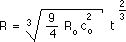
...بما أن العلاقات بالقياس كما هي محددة في المقالة الأولى، فإن Gm/R* تتغير مثل 1/R*. V* تتغير مثل 1/R¹/². m تتغير مثل R* (mV² ثابت). الطاقة kT ثابتة. باختصار f * » R*⁻³/²، وبالتالي: (11)
...تحليل الأبعاد هذا يعطي مصطلحات تتغير على التوالي مثل 1/t*، V*/R* = 1/R³/²، 1/R³/²، مما يعني مرة أخرى: (12)
R* » t*²/³
وبالتالي ثبات مشغل بولتزمان.
- اختبارات ملاحظية.
...بعد هذه الملاحظة القصيرة، ننتقل إلى مقارنة بين نماذج مختلفة وبيانات الراديو على 134 QSO نُشرت مؤخرًا بواسطة بارثيل وميلي [3، هنا بعد BM]، حيث يوضحون أن DSO البعيدة لها أحجام زاوية أصغر، وانحناءات أكبر، وأضواء أعلى من تلك الموجودة بالقرب. ومع ذلك، لا ننوي مناقشة القوى الداخلية المقدمة هنا، لأن الآليات الفيزيائية المرتبطة بإنتاج الشعاعات النسبية لا تزال غير مفهومة تمامًا.
...تبدو الحالة أكثر بساطة فيما يتعلق بحجم الزاوية والانحناء للمصادر الراديوية، حيث تلعب الخصائص الهندسية دورًا رئيسيًا في كلا الحالتين، على الرغم من أننا لا يمكننا تجاهل أن هناك تأثيرات نظامية كبيرة في العمل، ونوجه القارئ إلى المناقشة الشاملة لـ BM حول الآليات المفصلة المضمنة. باختصار:
-
التفاعل مع الوسط بين المجري (MIG) يمكن أن يعطل بشكل فعال الشعاعات الأصلية الموجهة، مما يؤدي إلى تشكيل أجنحة واسعة وضبابية وطويلة: إذا افترضنا أن هذه التأثيرات يمكن أن تغير بشكل كبير توزيع أحجام الزاوية عند انزياح أحمر معين، تم استدعاء آليات أكثر تعقيدًا من قبل BM لشرح انحناء الأجنحة الأكبر الملاحظة عند انزياح أحمر كبير.
-
تأثيرات تطورية محتملة في جميع الآليات الأساسية المضمنة أعلاه، بما في ذلك العمليات بالقياس التي لم تُحدد بعد.
-
خلل ملاحظي مثل مالميست، الذي يُدخل تقليلًا في أحجام الزاوية للـ QSO البعيدة.
...الآن، افترض في هذا المقال أن هذه التأثيرات المحتملة ليست سائدة في البيانات، أي أن توزيع حجم الزاوية والانحناء حسب الانزياح الأحمر يمكن اعتباره اختبارًا جيدًا لتمييز بين نماذج كونية مختلفة، ونظهر أن النموذج الجديد بالقياس يقدم تطابقًا أفضل مع هذه التوزيعات من النماذج الكلاسيكية.
3أ حجم الزاوية.
...يُعتبر حجم الزاوية للأجسام الخارجة عن المجرة غالبًا اختبارًا قويًا للنماذج الكونية. دع المؤشر 1 مرتبط بزمن الإرسال والمؤشر 2 بزمن الاستقبال: بما أن الضوء المرسل من الحواف لمصدر في اللحظة t₁ يتبع مسارات خطية، فإن حجم الزاوية f يتم الحفاظ عليه للمراقب الحالي، لذلك يمكننا كتابة بشكل كلاسيكي، بغض النظر عن النموذج:
(13)
حيث D(t₁) هو قطر المصدر الخطي وd(t₁) هو مسافته المترية.
في النموذج الكلاسيكي لفريدمان مع q₀ = 1/2 (النموذج الشهير لأينشتاين-دي-سيتر)
D(t₁) = D ثابت
R(t₁) = R(t₂) / (1 + z)
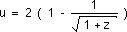
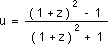
وd(t₁) = R(t₁) u حيث:
(14)
وبالتالي يظهر نوع من المفارقة لأن حجم الزاوية يتبع:
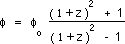
(15)
هذه الدالة تمتلك Minimum عند z = 1.25، ثم تميل إلى النمو بشكل خطي مع z.
الآن، مع النموذج الجديد بالقياس، لدينا
D(t₁) = D(t₂)/(1+z)،
R(t₁) = R(t₂)/(1+z)
وd(t₁) = R(t₁) u أيضًا
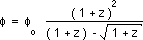
لكن مع:
(16)
وحجم الزاوية يتبع:
(17)
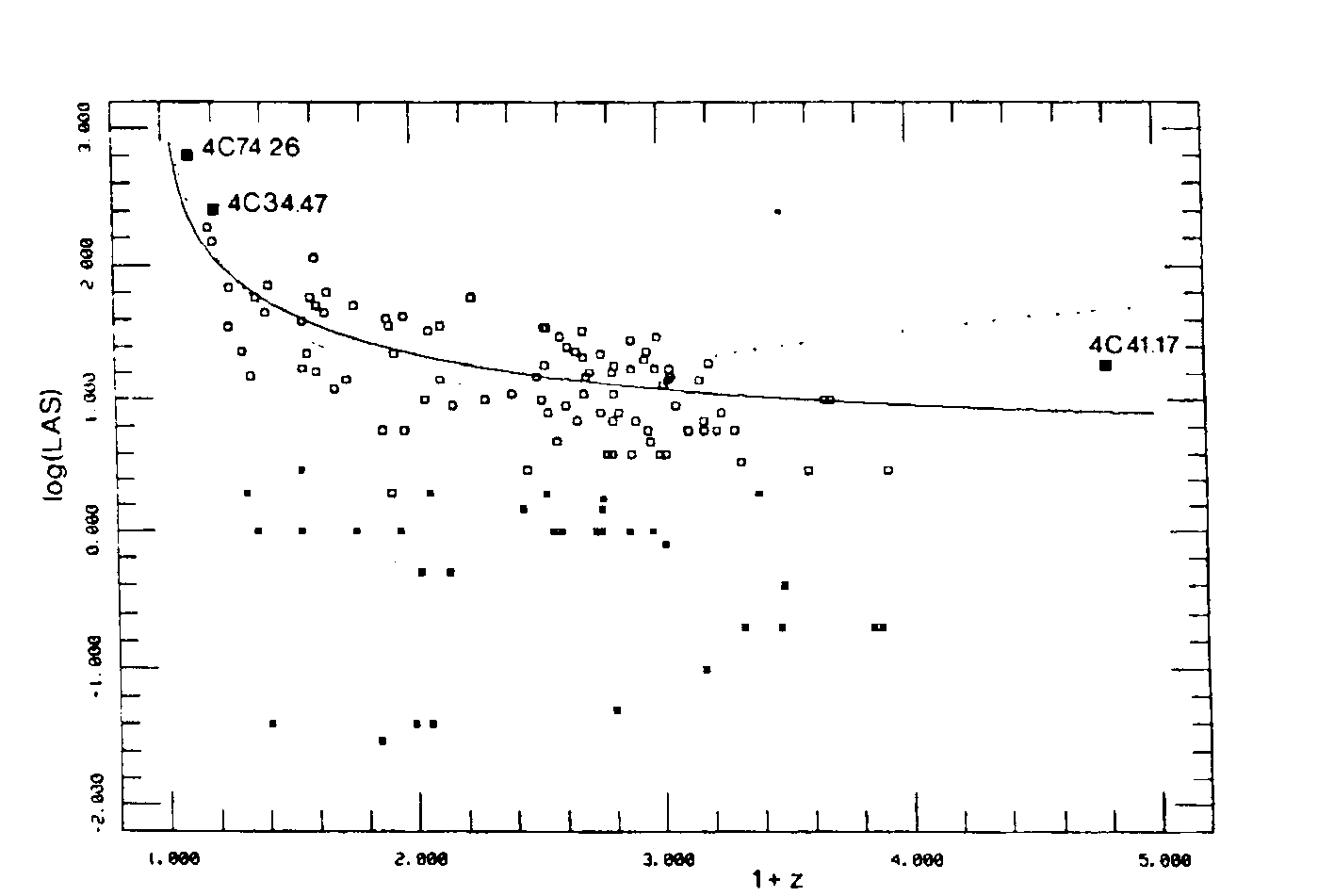
عندما يميل z إلى اللانهاية، يميل f إلى ثابت، سلوك مختلف تمامًا ومتواكب جودة مع البيانات.
(18)
الشكل 18: الحجم الزاوي الأكبر (LAS، بالثواني القوسية)، على مقياس لوغاريتمي حسب الانزياح الأحمر لـ 95 مصدر ممتد بأشكال "T"، "D1" و "D2" (مربعات) و 33 مصدر صغير بأشكال "SSC" (نجمات). تمثل المنحنيتان التكيفات النموذجية بالقياس (الخط المستمر) ونموذج أينشتاين-دي-سيتر (الخط المتقطع) التي تم الحصول عليها للمصادر الممتدة في هذا المقال. تُظهر ثلاث مصادر راديوية أخرى بامتداد كبير كمقارنة. 4C41.17 هي المجرة الأبعد المعروفة حاليًا، 4C74.26 هي أكبر مصدر راديوي مرتبط بـ QSO.
...لمقارنة كمياً جودة التكيف بين النموذجين للبيانات، اكتب f = f₀f(z) حيث f(z) هي دالة مميزة تنبأت بها كل نموذج. تم إجراء انحدارات خطية بين f(z) وبيانات "الحجم الزاوي الأكبر" [LAS بعد BM]، سواءً لعينة كاملة من 134 QSO، أو لعينة مختصرة من 83 QSO حيث تم اختيار فقط مصادر الأجنحة الثنائية، أي تلك ذات الأشكال "T" أو "D1" المحددة من قبل BM، مما استبعد النوى ذات الطيف المائل أو "SSC" والأنماط ذات الأجنحة الأحادية أو "D2"، بهدف اختبار خصائص محتملة مختلفة بين المصادر الصغيرة والممتدة. كانت نتائج الانحدار كالتالي، مع جميع المعاملات الخطية المذكورة وحدود أخطائها RMS معبّرة بالثواني القوسية:
- مع نموذج أينشتاين-دي-سيتر:
F = (28.8 ± 2.9) f(z) - (89.3 ± 20.1)
للمجموعة الكاملة، و:
F = (31.3 ± 3.3) f(z) - (90.5 ± 20.8)
للمجموعة المختصرة.
- مع نموذج القياس:
F = (21.5 ± 2.11) f(z) - (19.1 ± 19.6)
للمجموعة الكاملة، و:
F = (24.3 ± 2.3) f(z) - (17.3 ± 19.8)
للمجموعة المختصرة.
...من الواضح أن النموذج الجديد بالقياس يقدم تكيفًا أفضل بشكل كبير مع البيانات، لأن بغض النظر عن العينة، فإن الحد الثابت المعتدل الذي ينطوي عليه يُعتبر معنويًا بشكل طفيف من الناحية الإحصائية، وبالتالي فإن القيمة (المتوقعة) الصفرية من المرجح أن تكون عالية. الوضع معاكس تمامًا مع النموذج الكلاسيكي، سواء كانت العينة أيًا، لأن الحد الثابت معنويًا بشكل كبير من الناحية الإحصائية وقيمتها الكبيرة والسلبية غير مقبولة من الناحية النظرية، إلا إذا افترضنا أن تأثيرات نظامية قوية، مثل تلك التي تُشتبه بها أعلاه، موجودة في البيانات.
3ب. الانحناء.
...لنوضح أيضًا أن المظهر أكثر انحناءً، أكثر تشويهًا لـ QSO البعيدة المذكورة من قبل BM يمكن تفسيرها بشكل غريب بواسطة النموذج الجديد بالقياس، شرط أن لا يكون ذلك نتيجة لعوامل نظامية مختلفة. بما أننا نفترض في النموذج الجديد أن جميع الطاقات محفوظة خلال عملية القياس الكونية، يمكننا تضمين حفظ طاقة دوران نواة QSO التي تطلق الشعاعات: (19)
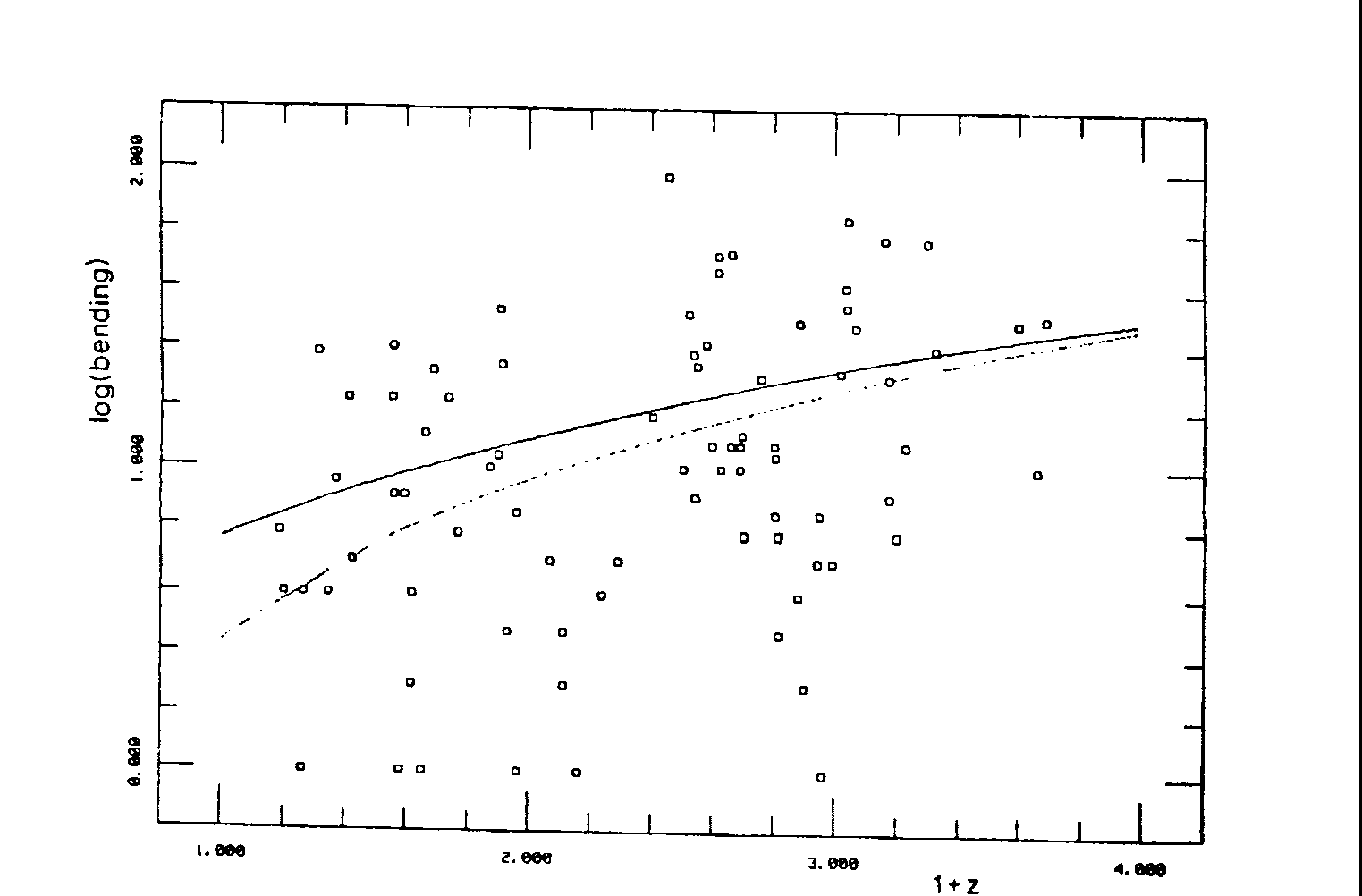
كما m » R، I » R³ و W » R⁻³/² W » 1/t » (1 + z)³/²، في اتفاق غريب مع التكيف بالقانون أحادي البعد الأقل الذي قام به BM على العينة المختصرة (بما أن الانحناء معرّف فقط في هذه الحالة)، أي:
(20)
الشكل 21: الانحناء (بالدرجات) على مقياس لوغاريتمي حسب الانزياح الأحمر لـ 83 مصدر ممتد بأشكال "T" و "D1" فقط، حيث يتم تعريفه. المنحنى المستمر يشير إلى تكيف النموذج بالقياس، مما يشير إلى أن السرعات الزاوية كانت أعلى في الماضي، بينما يمثل الخط المتقطع تكيف القوة القوة لبارثيل وميلي (BM).
...الآن، دعنا نقدم تفسيرًا بسيطًا، ونرجع إلى التحليل الأخير لجريبر [5] حول طبيعة المحركات المركزية في QSO المسؤولة عن معدلات إنتاج الطاقة الضخمة: إذا قبول الحقيقة (i) أن كتل البلازما تُطرد بسرعة كبيرة من المحرك المركزي، بشكل مستمر أو غير مستمر، على طول محور المغناطيسية الدوائي لـ QSO، و(ii) أن هذا الأخير لا يكون عادة متطابقًا مع محور الزخم الزاوي، فإننا نواجه نموذجًا مشابهًا لرشاش مائي دوار، حيث ستتقوس الشعاعات إلى نوع من حلزون أرخميدس، طالما أن التفاعل مع MIG يبقى مهملًا. حتى إذا أصبح هذا التفاعل مهمًا على بعد معين من النواة، ستتوقف الشعاعات عن التوسع هناك، مما يؤدي إلى زيادة الانحناء. وبما أنه لا يوجد سبب لوجود كثافة MIG موزعة بشكل كروي حول QSO، يمكن لهذا التفاعل أن يفسر التماثلات المتكررة الملاحظة في شعاعاتهم، بالإضافة إلى تأثيرات عشوائية على الانحناء الكلي، كما ناقشها BM.
...وبالتالي، كلما كان انزياح QSO الأحمر أعلى، كانت سرعته الزاوية أكبر بسبب عملية القياس الكونية، وبالتالي كان انحناء شعاعاته أكبر.
- الخاتمة.
...لقد ركزنا على خصائص محددة تم تأكيدها مؤخرًا في توزيع أحجام الزاوية والانحناء حسب الانزياح الأحمر لعينة متجانسة من 134 QSO راديوية. وجدنا بشكل مثير للاهتمام أن نموذجنا بالقياس بـ "ثوابت متغيرة" يقدم تكيفًا أفضل مع هذه التوزيعات من نموذج أينشتاين-دي-سيتر الكلاسيكي، شرطًا (i) أن الاتجاهات الملاحظة (أحجام زاوية أصغر وانحناءات أكبر لـ QSO البعيدة) تُؤكد من خلال ملاحظات مستقبلية، (ii) أن هذه الاتجاهات لا تُسيطر عليها تأثيرات أو أخطاء مختلفة، و (iii) أن الافتراضات البسيطة التي قمنا بها حول بعض الآليات المضمنة هي حقيقية. بالإضافة إلى ذلك، تُعد مزيد من الدراسات حول قوة هذه المصادر ضرورية لفهم ما إذا كان نموذج القياس يوفر فهمًا أفضل للاتجاهات الملاحظة، أي أن لـ QSO البعيدة لمعانًا أكبر بكثير من QSO القريبة.
- المراجع.
[1] جيان-بيير بيت: تفسير نموذج كوني بسرعة الضوء المتغيرة. رسائل الفيزياء الحديثة A، المجلد 3، العدد 16، نوفمبر 1988
[2] جيان-بيير بيت: نموذج كوني بسرعة الضوء المتغيرة. تفسير الانزياحات الحمراء. رسائل الفيزياء الحديثة A، المجلد 3، العدد 18، ديسمبر 1988.
[3] ب. د. بارثيل و ج. ك. ميلي: تطور بنية الراديو في الكوازارات: استكشاف جديد للبروتوغالاكسيات؟ - الطبيعة المجلد 333، 26 مايو 1988.
[4] م. إل. نورمان، ج. أو. بيرنز و م. إي. سولكانين: إضعاف شعاعات الراديو الكونية بواسطة الصدمات في الوسط المحيط، الطبيعة 335 (1988) 146.
[5] ه. د. غريبير: أهمية المجالات المغناطيسية القوية في الكون، التعليقات الفلكية 13 (1989) 201.








النسخة الأصلية (الإنجليزية)
cosmological model with variable light velocity
**Gauge cosmological model with variable light velocity. Comparizon with QSO observational data. **
Jean-Pierre Petit and Maurice Viton (Laboratoire d'Astronomie Spatiale. Traverse du Siphon.13012. Marseille)
Modern Physics Letters A Vol.4 , n°23 (1989) pp. 2201-2210
ABSTRACT :
...After a complement to previous papers on the gauge invariance of the Boltzmann collisional operator, we compare a recent homogeneous set of data on radio-QSOs, including angular sizes and bending of lobes, with what is expected from either our new cosmological gauge model or the most commonly accepted Friedman model with qo = 1/2 . It is shown that the new gauge model provides a much better fit to the angular size distribution vs. redshift and similarly to the bending, thanks to crude hypothesis on the mechanisms involved with the formation of jets.
- INTRODUCTION
...In references [1] and [2] , hereafter paper I and paper II respectively, we have previously developped a cosmological model in which all the so called constants of physics were made free, so that we had to introduce new physical laws, gauge laws, in order to link conveniently these constants :
c (velocity of light), G (gravitation), h (Planck's constant), me (electron mass), mp, mn (proton and neutron mass ). It was shown at first that the general relativity theory does not require the absolute constancy of G and c, but only the absolute constancy of the ratio G/c2 (Einstein's constant of the field equation). This brought the first linking relation. The other came from geometric considerations : we assumed that the characteristic lengths like Jeans length, Schwarzschild length and Compton length followed the variation of the scale parameter R(t).
Combining these new physical laws we got the following relations : (1)
(2)
mp = mn ( nucleon's mass ) » R
(3)
h » R3/2
(4)
G » 1/R
(5)
V ( velocity ) » R-1/2
(6)
r » 1/R2
In addition we found a single cosmic model, with negative curvature, indifferently filled by photons or matter or a mixture of the two, with non zero pressure, and obeying the single law : (7a)
...In the paper II we refound the Hubble's law, due to the secular variation of the Planck constant (which was found to vary like t) and not to the expansion process. In this constant energy model, geometrical considerations made some characteristic energies like the ionization energy to vary like R(t), and it was found to be consistent with additional gauge relations applying to electromagnetism. Then it appeared possible to derive the distances of light sources from the red shift data. They were found to be quite close, for moderate z values, to the classical values derived from a Friedman model with qo = 1/2 , since the ratio :
(7b)
remains close to unity within 5 percent for z £ 2 .
- A SHORT COMPLEMENT ABOUT THE GAUGE INVARIANCE
...In the paper I, section 5, we had shown that some fundamental equations (Vlasov, Schrödinger, Maxwell) were invariant under the suggested gauge relations. Let us show that the Boltzmann collision operator is invariant to.
Writing this equation. (8)
...f is the velocity distribution function, g is the relative velocity of two particles in an encounter, b is a length (impact parameter), e an angle. Introduce adimensional variables, through : (9)
t = t* t ; f = f* x ; V = V* w ; g = V* g ; r = R* z
Y = (Gm/R*) j ; b = R* b
The characteristic velocity distribution function is : (10)
...Following the gauge relations as defined in paper I , Gm/R* varies like 1/R*. V* varies like 1/R1/2. m varies like R* (mV2 is constant). The energy k T is constant. To sum up f * » R*-3/2, and hence : (11)
...Such a dimensional analysis gives terms varying respectively like 1/t*, V*/R* = 1/R3/2 , 1/R3/2 , which implies again : (12)
R* » t* 2/3
and hence the invariance of the Boltzmann operator.
- OBSERVATIONAL TESTS.
...After this short parenthesis, let us turn to a comparison of various models with the radio data on 134 QSOs recently published by Barthel and Miley [ 3, hereafter BM] , in which they show that distant DSOs have smaller angular sizes, larger bendings and higher luminosities than those nearby. Note however that we do not intend to discuss the given intrinsic powers here, since the physical mechanisms involved in the generation of relativistic jets are not yet clearly understood.
...The situation is appearently simpler concerning the angular size and bending of radiosources, since geometric properties are mainly concerned a priori in both cases, though we cannot ignore that important systematic effects might be at work and we adress the reader to the related comprehensive discussion of BM on the detailed mechanisms involved. In short :
-
interaction with the intergalactic medium (IGM) can disrupt very efficiently the initially collimated jets, resulting into the formation of large, turbulent lobes (4) of lesser extension : if it is clear that such effects can modify significantly the angular size distribution at a given redshift, more complicated mechanisms have been invoked by BM to explain the stronger bending of lobes observed at large redshifts.
-
possible evolutionary effects in all the elementary mechanisms implicated above, including gauge processes not yet identified.
-
observational bias such as the well-known Malmquist's, introducing an underestimate of angular sizes for distant QSOs.
...Now, let us suppose in this paper that such potential effects are not dominant in the data, i.e. that the distribution of angular size and bending vs. redshifts may be considered as good tests for discriminating between different cosmological models and show that the new gauge model provides better fits to these distributions than do the conventional models.
3a The angular size.
...The angular size of extragalactic objects has often be considered as a powerfull test for cosmological models. So, let the subscript 1 refer to the emission epoch and subscript 2 to the reception epoch : since the light emited by the edges of a source at time t1 follows radial pathes, the angular size f is conserved for a present observer, so that we can write classically, whatever the model :
(13)
where D(t1) is the linear diameter of the source and d(t1) its metric distance.
In the classical Friedman model with qO = 1/2 ( the so called Einstein-de-Sitter's )
D(t1) = D constant
R (t1) = R (t2) / ( 1 + z )
and d(t1) = R (t1) u where :
(14)
and hence some kind of a paradox arises since the angular size obeys :
(15)
This function has a minimum for z = 1.25 , and then it tends to grow linearly with z .
Now, with the new gauge model we have
D(t1) = D(t2)/(1+z) ,
R(t1) = R(t2) / ( 1 + z )
and d(t1) = R (t1) u also
but with :
(16)
and the angular size obeys :
(17)
When z tends to infinity, f tends to a constant, a readily different behaviour and in qualitative agreement with the data.
(18)
Fig 18 : The largest angular size (LAS, in arcsecond), on a logarithmic scale versus redshift for the 95 extended sources with "T", "D1" and "D2" morphologies (squares) and the 33 compact sources with "SSC" morphologiy (asterisks). The two curves represent the fits of the gauge model (continuous line) and the Einstein-De Sitter model (dotted line) derived for extended sources in this paper. Three additional radio-sources of very large extent are shown for comparison. 4C41.17 being the farthest galaxy presently known, 4C74.26 the largest radio-source associated with a quasar.
...In order to compare quantitatively how both models fit the data, let us write f = fof(z) where f(z) is a characteristic function as predicted above by each model. Linear regressions have been performed between f(z) and the "largest angular size" [ LAS after BM ) data, either for their complete sample of 134 QSOs, or for a reduced sample of 83 QSOs in which only two-sided lobes sources were selected, i.e. those with the "T" or "D1" morphologies defined by BM, thus excluding the steep spectrum core or "SSC" and the one-sided lobe or "D2" sources, so as to test for possibly different properties of compact and extended sources. The results of the regressions were as follows, all the given linear coefficients and their rms errors bars being in arc second units :
- with the Einstein-de-Sitter model :
F = ( 28.8 ± 2.9 ) f(z) - ( 89.3 ± 20.1 )
for the complete sample, and
F = ( 31.3 ± 3.3 ) f(z) - ( 90.5 ± 20.8 )
For the reduced sample.
- with the gauge model :
F = ( 21.5 ± 2.11 ) f(z) - ( 19.1 ± 19.6 )
for the complete sample, and :
F = ( 24.3 ± 2.3 ) f(z) - ( 17.3 ± 19.8 )
for the reduced sample.
...It is clear that the new gauge model provides a fairly better fit to the data since whatever the sample, the moderate constant term it implies is marginally significant from a statistical point of view and hence the (expected) zero value is highly probable. The situation is quite opposite with the conventional model, here also whatever the sample, since the constant term is highly significant from a statistical point of view and its large, negative value is unacceptable on theoretical grounds, unless one supposes that very strong systematic effects as those suspected above are at work in the data.
3b. The bending.
...Let us show also that the more bent, distorted appearence of distant QSOs pointed out by BM may be curiously explained by the new gauge model, providing here again that is not an artefact resulting from various systematic effects. Since in the new model it is assumed that all the energies are conserved during the cosmic gauge process, we can include the conservation of the rotational energy of the QSO core emitting the jets : (19)
As m » R , I » R3 and W» R-3/2 W » 1/t » ( 1 + z )3/2, in curious agreement with the one-dimensional lower law fit performed by BM on the reduced sample ( since the bending is only defined in this latter case ), that is :
(20)
Fig 21: The bending (in degree) on a logarithmic scale versus redshift for the 83 extended sources with "T" and "D1" morphologies only, for which it is defined. The continuous curve corresponds to the fit of the gauge model, indicating that angular speeds where higter in the past, while the dotted line represents the power law fit of Barthel and Miley (BM)
...Now let us suggest a crude explanation, refering to the recent analysis of Greyber [5) on the nature of the central engines in QSOs responsible for their tremendous energy production rates : if we accept the figure (i) that the plasma blobs are ejected at high velocities from the central engine, continuously or not, along the magnetic dipole axis of the QSOs and (ii) that this latter is not generally coincident with their angular momentum axis, then we are faced with a model similar to a rotating "garden sprinkler", in which the jets will bend into some kind of a spiral of Archimedes, as long as the interaction with the IGM remains neglectible. And even if this interaction becomes significant at some distance from the nucleus, the jets will stop to expand there, resulting into an increased bending. Since there is no reason why the IGM density would be spherically distributed around QSOs, such interactions could account for the frequently assymetries in their jets together with random effects on the overall bending, as it has been discussed by BM.
...As a consequence, the higher the redshift of the QSO, the higher its angular velocity because of the cosmic gauge process and hence the larger the bending of its jets.
- CONCLUSION.
...We have focussed on specific features recently evidenced in the distribution of angular sizes and bending vs. redshift for an homogeneous set of 134 radio-QSOs. We found interestingly that our gauge model with "variable constants" provides better fits to these distributions than the conventional Einstein-de-Sitter model, providing (i) that the observed trends (smaller angular size and larger bending of distant QSOs) will be confirmed by future observations, (ii) that these trends are not dominated by various effects or artefacts, and (iii) that the crude assumptions wa made on some of the mechanisms involved are real. Also, further investigations on the intrinsic power of these sources are needed to understand if the gauge model provides a better understanding of the observed trends, i.e. that the luminosity of distant QSOs is much greater than for those nearby.
- REFERENCES.
[ 1] J.P.PETIT : Interpretation of cosmological model with variable light velocity. Modern Physics Letters A, Vol.3 n° 16 November 1988
[ 2] J.P.PETIT : Cosmological model with variable light velocity. The interpretation of red shifts. Modern Physics Letters A, Vol.3 , n° 18, December 1988.
[ 3] P.D.BARTHEL & G.KMILEY. Evolution of radio structure in quasars : a new probe of protogalaxies? - Nature Vol 333, 26 may 1988.
[ 4] M.L.NORMAN, J.O. BURNS and M.E. SULKANEN : Disruption of the galactic radio jets by the shocks in the ambient medium, Nature 335 (1988) 146.
[ 5] H.D.GREYBER : The importance of strong magnetic fields in the Universe, Comments Astrophys. 13 ( 1989 ) 201.