26 مارس
2011 :
قارئ،
من CEA، يرسل لي تقريرًا (يوميًا) من معهد الحماية الإشعاعية وسلامة الطاقة النووية (IRSN)، باللغة الفرنسية.
يوضح: «هذا هو المعلومات الحقيقية حول حالة موقع فوكوشيما».
يبدو أن هذا التقرير أقل تفاؤلاً من التقرير الذي قدمه مهندس فرنسي يعيش في الموقع، والذي يعلق على المعلومات المقدمة من الجهات الرسمية اليابانية.
تقرير IRSN من 25 مارس 2011
مقطع:
IRSN
معهد الحماية الإشعاعية وسلامة الطاقة النووية
ملاحظة معلومات
حالة محطات الطاقة النووية في اليابان بعد الزلزال الكبير الذي وقع في 11 مارس 2011
الوضع في 25 مارس الساعة 08:00
حالة المفاعلات
يظل IRSN قلقًا للغاية بشأن الوضع الحالي للمفاعلات 1 و2 و3
(خطر فشل بعض المواد بسبب وجود كميات كبيرة من الملح في الأوعية والغرف المغلقة، وعدم وجود نظام مستدام قادر على إزالة الطاقة المتبقية...). هذه الضعف سيستمر أسابيع أو أشهر، نظرًا للصعوبة.
يقوم IRSN بتحليل
سيناريوهات تفاقم الوضع،
خاصة السيناريوهات الممكنة في حالة انفجار وعاء المفاعل 3.
من الصعب إثبات واقع هذا السيناريو، ولكن التأثير من حيث الانبعاثات الإشعاعية في البيئة يتم أخذها في الاعتبار.
المفاعل 1
تم تعديل معدل توصيل مياه البحر إلى وعاء المفاعل (10 م³/ساعة) للتحكم في درجة الحرارة فوق القلب. يجب أن يسمح هذا المعدل بإزالة الطاقة المتبقية. تم استقرار الضغط المقاس في الغرفة المغلقة. من غير الضروري تفريغ الضغط في هذا الوعاء في المستقبل القريب.
المفاعل 2
يتم توصيل مياه البحر إلى وعاء المفاعل للحفاظ على تبريد القلب، والذي لا يزال جزئيًا خارج الماء. قد تكون الغرفة المغلقة مصابة. لم يتغير الوضع، ولا توجد عمليات تفريغ ضغط لوعاء الغرفة المغلقة في الوقت الحالي. يجب تزويد غرفة التحكم اليوم.
المفاعل 3
يتم الحفاظ على توصيل مياه البحر إلى وعاء المفاعل للحفاظ على تبريد القلب، والذي لا يزال جزئيًا جافًا.
تبدو الغرفة المغلقة غير محكمة الغلق وفقًا لمؤشرات الضغط؛ هذه فقدان الإحكام يعود إلى انبعاثات إشعاعية مستمرة وغير معالجة في البيئة.
توقفت الحرقات التي تم اكتشافها في 23 مارس. يقوم IRSN بتحليل أسباب فشل إحكام غرفة المفاعل 3.
تُعتبر فرضية مُراجعة من قبل IRSN هي احتمال انفجار وعاء المفاعل متبوعًا بتفاعل بين الكوريوم (مزيج من الوقود والمعادن المنصهرة) والخرسانة في قاع الغرفة المغلقة.
يتم تقييم التأثير من حيث الانبعاثات في البيئة.
تم تلوث ثلاثة موظفين في 24 مارس في مبنى توربينات المفاعل 3.
تم إيقاف أعمال مراجعة المواد. تهدف هذه الأعمال إلى استعادة تزويد المفاعل بالمياه العذبة.
المفاعل 4
لا يحتوي قلب هذا المفاعل على وقود.
المفاعلات 5 و6
يتم تبريد المفاعلات بشكل صحيح (القلب والتركيبات في بركة التبريد).
يُذكر أن قلق المهندسين اليابانيين هو أن الملح الموجود في مياه التبريد البحرية يسد الصمامات الكهرومغناطيسية، والتي يمكن التحكم بها فقط عن بعد. قد يكون عطل من هذا النوع له عواقب خطيرة، ومخاوفهم هي العودة إلى تبريد بالمياه العذبة.
إذًا، ما هي الحل؟
لدي معلومات مباشرة،
لنشرها حول آلة Z، التي جمعتها خلال اجتماعين دوليين، في فيلنيوس في عام 2008 وفي جيجو، كوريا، في أكتوبر 2010، وقرب مالكوم هاينز نفسه. نكسس وافقت على نشر هذا المقال، الذي سيُنشر في العدد التالي.
هذه المعلومات ستزيد من الأمل والمخاوف المتعلقة بتقنية جديدة لدرجات حرارة عالية جدًا. دون إفساد جاذبية الموضوع (سيتم كتابة المقال بسرعة):
لقد حقق الأمريكيون 3.7 مليار درجة في عام 2005 في آلة Z في سانديا. واختاروا التطبيقات العسكرية أولًا (قنبلة تفاعل نووي نقي)، وخفوا كل ما يمكن خفوه. مع ZR، زادت الكثافة الكهربائية من 17 إلى 26 مليون أمبير، وتم إبقاء أداء الآلة سرًا الآن.
20 مارس
2011 :
هل من المهم إعداد سلسلة حول هذا الحادث الياباني؟ هناك كوارث كثيرة على الأرض أننا ممتلئون. ما يمكن قوله هو أن هذه الكارثة ناتجة عن فوضى إنسانية أخرى: بناء محطات طاقة نووية بتكاليف منخفضة (وهو ما ينطبق على جميع محطات الطاقة النووية اليابانية) في دولة تُهدَم بانتظام من قبل المد العظيم. خلاف ذلك، بناء محطات طاقة نووية أرخص وتحقيق الربح منها.
عدم الانتباه إلى توصيات خبراء الجيولوجيا الذين طلبوا تعزيز السلامة ضد الزلازل.
الإهمال.
يذهلوننا اليابانيون بتقدمهم الساطع في الروبوتات. في اليابان، تعرف الروبوتات كيف تركب الدراجات، والتحدث، والابتسام. يبنون روبوتات بشرية
تتمتع بالأسلوب، وربما سيتم بيعها، ككلاب صناعية أو مرافقة إلكترونية، للسكان المقيمين في المدن الذين يعانون من الوحدة. هذا يذكرني بفقرة من
أحداث مارسية
لراي بريدبيري، الذي أوصي بشدة بقراءته أو إعادة قراءته.
لكن، في اليابان، لم يُستثمر في روبوتات السلامة القادرة على التسلق على الأنقاض، بل أولاً مصممة بدرع من الرصاص يسمح بالمقاومة لتدفق شديد الإشعاع. اضطرت اليابان لاستيرادها من دول أجنبية.
لقد شاهدنا أحد المسؤولين عن إدارة هذه الإدارة الجريمة، «المُصاب بالعاطفة»، يبكي دموعًا من التمساح (من يرفض الجلوس بجانب موظفي الآلات الذين يقتربون بخطر من المفاعلات لمحاولة تبريدها؟). في اليابان، يظهر المسؤولون السياسيون أو الاقتصاديون، الذين دمروا مئات الآلاف من الناس الأكفاء، بشكل دوري أمام وسائل الإعلام للاعتذار علنًا. المسؤول عن الكارثة النووية يبكي بضع دموع. هذا يحل محل الانتحار التقليدي الياباني، السيبوكو، انتحار بالسكين الباردة.
توضح هذه الفيديو معالجة النفايات الناتجة عن تشغيل مفاعل ماء مغلي، هذه النفايات تُعالج عن بعد وتخزن في بركة ماء، حيث تلعب هذه الماء دور حواجز تُمتص الإشعاعات.
يجب أن تفهم شيئًا. في الصناعة النووية، النفايات الناتجة عن إنتاج الكهرباء، ذات الإشعاع العالي والخطر في التعامل، تخزن ببساطة
بشكل وثيق جدًا مع المفاعل،
في برك مياه عادية. الماء كافٍ لحجب أنواع مختلفة من الإشعاعات. لاحقًا، سيتم نقل هذه النفايات إلى مراكز إعادة معالجة، مثل لا هاج، لاستخراج الوقود المستقبلي لـ... مفاعلات النيوترونات السريعة. هذه النفايات ليست
بشكل مطلق سلبية
وتشكل مادة خطيرة تمامًا مثل محتوى المفاعل نفسه.
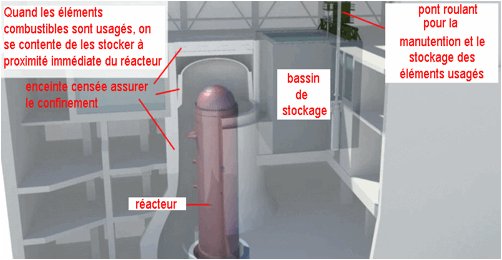
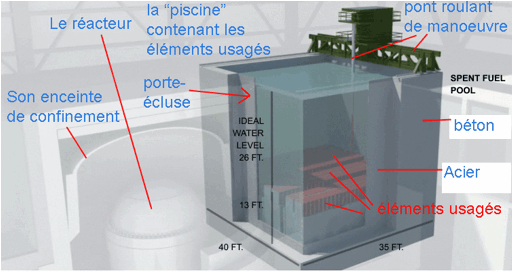
خزان تخزين العناصر المستعملة
هذا الخزان يقع بالقرب الفوري من المفاعل، لأسباب سهولة التعامل.
تقريب من هذه "الهياكل" التي تجمع "القلم":
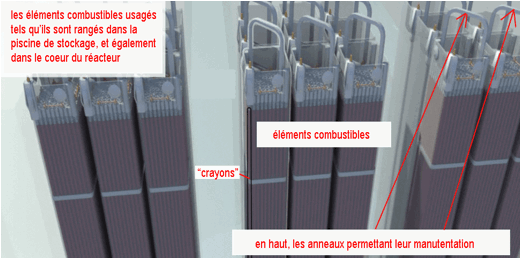
60 "قلم" لكل "مجموعة" في المفاعلات اليابانية
مع قليل من التقريب، يمكننا رؤية التفاصيل على هذه "الأقطاب"،
التي تشكل هذه "الهياكل". إنها أنابيب زيركونيوم (تُعرف أيضًا باسم "غينات")، مملوءة بـ "كرات الوقود": أكاسيد اليورانيوم أو، في حالة "MOX"، مزيج من أكاسيد اليورانيوم وأكاسيد البولونيوم. إذا تبخر الماء الذي تُغمر فيه هذه الهياكل، فإن الحرارة المتبقية الناتجة عن هذه الهياكل، المخزنة في صفوف كثيفة، كافية لتلف أنابيب الزيركونيوم بسرعة وتمكين الكرات من الهروب وتخزينها في قاع الخزان. إلا إذا حدثت ظاهرة انفجارية تنشر هذه المنتجات حول المفاعل.
هذا هو مصدر ما يلي:
http://allthingsnuclear.org/tagged/Japan_nuclear
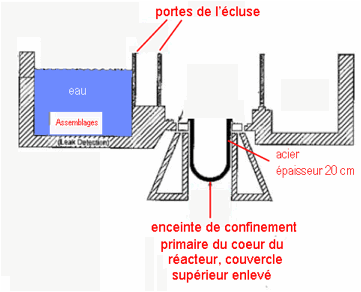
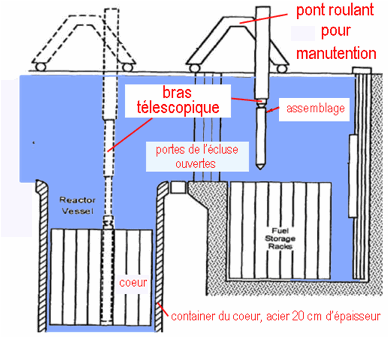
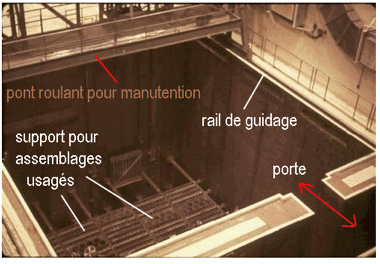
الخزان (هنا، مفتوح) والـ «خزان» مرتبطان ببوابات، مآخذ تعمل
فترة "المفاعل متوقف". ترفع قضبان التحكم، مما يقلل من نشاط المفاعل إلى الحد الأدنى، والذي ليس صفرًا، لأن منتجات الانشطار تستمر في التطور، والانحلال مع إصدار حرارة (60 ميغاواط، عُشر القدرة العادية للتشغيل). يتم فتح مآخذ العزل بين قمة المفاعل وخزان التخزين. يغمر الماء كل المساحة المتاحة. يتم التعامل مع الهياكل الآن تحت الماء، باستخدام الرافعة والذراع التلسكوبي، إما لإزالة الهياكل "المستعملة" أو استبدالها بهياكل "جديدة". في أي حال، إلا إذا أخذت صناعة إعادة المعالجة مثل تلك الموجودة في لا هاج المهمة، ستتم تخزين الهياكل "المستعملة" في خزان قريب، حيث ستستمر في تسخين ماء "خزان تخزين العناصر المستهلكة والخاضعة للنقل لتقديم عناصر جديدة".
التعامل والتركيب، تحت غطاء مائي، حماية إشعاعية
هنا صورة تظهر هذا النوع من التعامل، تم أخذها في محطة طاقة نووية في الولايات المتحدة، محطة براون فيري في ألاباما.
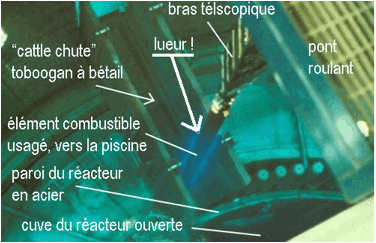
نقل مجموعة مستعملة إلى خزان التخزين
تم اختيار اسم "ممر الماشية" بسبب الشبه بين هذه الجسور والطرق التي تؤدي الماشية إلى المكان الذي سيتم فيه ذبحها.
هذه الصورة تم أخذها من قبل مشغّل الرافعة. تحت أقدامه: الماء الذي يحميه من الإشعاعات.
بضع أمتار أسفل، يمكن رؤية بوضوح الهالة الزرقاء المقابلة لتأثير الإشعاع المنبعث من العناصر "المستعملة". يمكن رؤية أنهم ليسوا ببساطة سلبيين!
هنا صورة أخرى لخزان تخزين لمفاعل أمريكي (ألاباما)، فارغ، قبل الاستخدام.
قبل عدة عقود، زرت مفاعل تجريبي
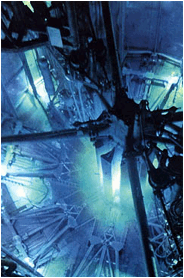
بيغاس
المثبت في
كاداراش.
من خلال هذا الماء النقي، رأينا "كل داخل المفاعل"، محيطًا بهالة زرقاء،
الموجودة عشرة أمتار أسفل.
كان ذلك كأن ترى الموت مباشرة، السم النووي قريب جدًا. سرعة الجسيمات المنبعثة لم تكن أعلى من سرعة الضوء في الفراغ، ولكن أعلى من هذه السرعة
في الماء، الذي يبلغ أكثر من 200,000 كم/ث. النسبة 200,000 / 300,000 = 1.5 تتوافق مع معامل انكسار الماء. كانت الجسيمات منبعثة بسرعة "فوق صوتية" مقارنة بسرعة الضوء في هذا البيئة، ورأينا بوضوح أشياء تشبه "موجات الصدمة"، والتي تتوافق مع ما نسميه
الإشعاع تشيرنكو夫.
في وسط آخر غير الفراغ، يتم تمديد وقت انتقال الضوء بسبب وقت الامتصاص والإصدار للفوتونات من قبل الذرات والجزيئات. ولكن بين ذرتين، تتحرك الفوتونات بسرعة 300,000 كم/ث.
بيغاس
(35 ميغاواط حراري)، مفاعل بحث واختبار، تم تشغيله في
كاداراش في عام 1963، وهو عبارة عن برج ذري حيث يتم اختبار الوقود لمحطات الغاز.
تم تحويل خزان مفاعل بيجاس في عام 1980 لتخزين 2703 حاوية تحتوي على 64 كجم من اليورانيوم 235.
هنا مصادر ما يلي:
http://www3.nhk.or.jp/news/genpatsu-fukushima
http://allthingsnuclear.org/tagged/Japan_nuclear
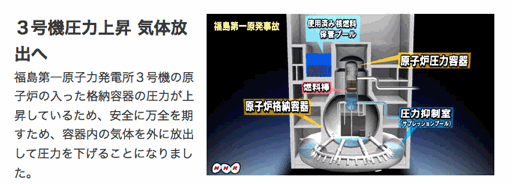
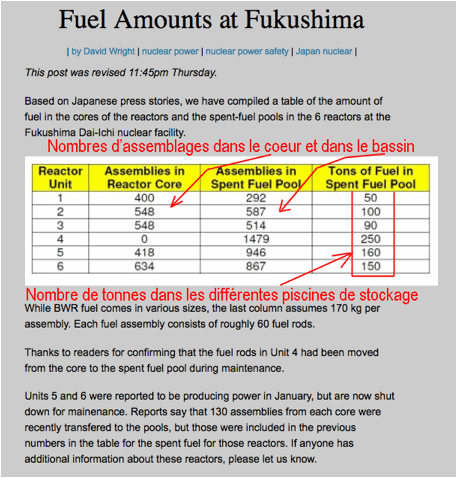
كل عنصر ملحقة (انظر أعلاه) يزن 170 كجم ويحتوي على 60 "قلم". خزان تخزين المفاعل 3 كان يحتوي على نفس عدد العناصر "المستعملة" السامة للغاية مثل... قلبها.
في الأسفل، صورة نُشرت من قبل NHK اليابانية، تشير إلى أن الري (بالماء المالح) يجب أن يتم على ارتفاع 22 مترًا.
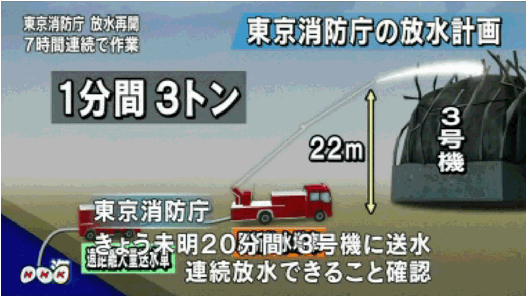
الري للمفاعلات اليابانية يتطلب رمي (الماء المالح) على ارتفاع 22 متر (المصدر: التلفزيون الياباني NHK)
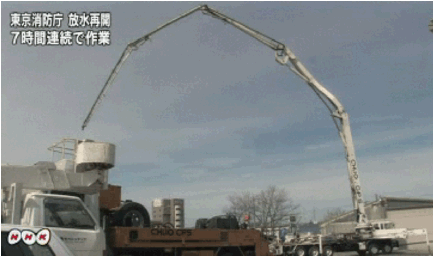
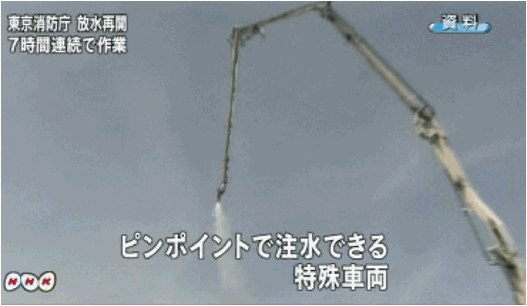
رافعة الري، مثبتة على مركبة متحركة
اختبار هذه رافعة الري
22 مارس 2011:
كما أفاد قارئ، يبدو أنه يدوي ملموس عن بعد، كما يشير هذا الصورة التي أرسلها لي (وأشكره):
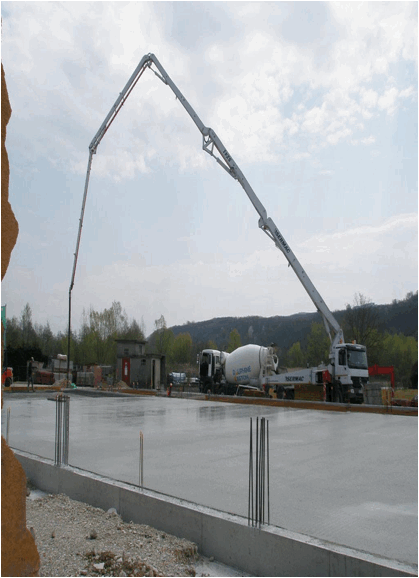
في اليسار، نرى شاحنة خلط الإسمنت مع مزجها الدوار.
بالطبع، يمكن استخدام قضيب كهذا لرمي الماء على ارتفاع 22 مترًا، حيث يكون التبريد أكثر فعالية. إذا تم استخدامه لغمر المفاعل بالإسمنت، فسيكون ذلك أكثر خطورة بشكل واضح. هذا يعني أن تبريد قلب المفاعل، أو أحد قلوبه، قد يتم تدميره.
انتظر...
لا يمكننا التوقع سوى أن الوضع في اليابان ليس بالضرورة أكثر خطورة مما يبدو، عندما نتحدث عن الطاقة النووية (مع ملاحظة أن عدد الضحايا من هذه المد المدمر بلغ 20,000 حتى الآن).
الواقع أن هذه الأحداث تذكرنا بعنف مخاطر الطاقة النووية.
النسخة الأصلية (الإنجليزية)
March 26
2011:
A reader,
from CEA, sends me a (daily) report of the Institute of Nuclear and Radiological
Protection, in French (IRSN)
,
he
precises
''this is the real information about site status of Fukushima''.
This report seems less optimistic that the one
given by a French engineer living on site, and commenting information given by
official Japanese services.
The report of IRSN of March 25th 2011
Extract:
IRSN
Institute
of
Nuclear
and Radiological Protection
Information note
Situation of nuclear plants in
Japan after major earthquake occurred March 11 2011
Point position on March 25 at
08h00
State of reactors
IRSN remains heavily preoccupied
by the actual situation of reactors no 1,2 and
3
( failure
risk of some material because of the presence of massive quantities of salt in
tanks and enclosures, lack of a sustainable system able to evacuate residual
power...). That precariousness should last for weeks or months considering the
difficulty.
IRSN examines
scenarios of possible aggravation of the situation
, notably
conceivable
scenarios in case of
breaking tank of the reactor no 3
. It will be difficult to demonstrate the
reality
of
such
a scenario but impact in term of radioactive rejects in environment is under
consideration.
Reactor no 1
The injection rate of sea water
in the tank has been adjusted (10 m3/h) for controlling temperature above the
core. This rate must permit evacuation of residual power. Pressure measured in
the containment enclosure has been stabilized. It shouldn't be necessary to depressurize
this tank in a very short-term.
Reactor no 2
The injection of sea water in the
tank is maintained for assuring cooling of the core, which stays partially out
of water. The containment enclosure could be damaged. The situation has not
evolved and depressurization operations of tank containment are not necessary
at the moment. The control room should be replenished this day.
Reactor no 3
The injection of sea water in the
tank would be maintained in order to ensure core cooling which stays, however, partially
dewatered.
The containment enclosure seems
to be no more waterproof according to pressure indicators; this loss of seal
would be at the origin of ''continuous'' and unfiltered radioactive discharges in
the environment.
The release of smoke detected in
March 23 has stopped. IRSN analyzes potentials causes of failure of containment
of reactor no 3.
One hypothesis examined
by IRSN concerns the eventuality of a rupture of the tank followed by an interaction
between corium (mixture of fuel and molten metal) and concrete at the bottom of
the containment enclosure.
The impact in terms of rejects in
environment is being examined.
Three
operators have been contaminated March 24 in the turbine building of the
reactor no 3.
Audit works of materials have been stopped. These works aim
to restore a reactor feed in freshwater.
Reactor no 4
The core of this reactor does not
contain fuel.
Reactor no 5 and 6
Reactors are correctly cooled
(core and assembly in cooling pool).
It says that the concern of Japanese engineers
is that salt provided by the cooling sea water blocks solenoid valves, which
are only
controllable
from
afar. A malfunction of this kind could have serious
consequences and their concern is to revert back to a freshwater cooling.
So, what is the solution?
I have hot news, which are information of first
hand,
to communicate about
Z-machine, since I have collected them in two congress internationals, Vilnius
in 2008 and
Jeju
, Korea, October 2010, and close to
Malcom
Haines him-self. Nexus accepted to publish this news
article, which will be released in the next issue.
Those
information will multiply jointly hopes and fears linked to this new technology
of ultra-high temperatures. Without spoiling the charm of this subject (this
news article will be quickly written):
Americans
have
achieved
3,7
billions of degrees in 2005 in Z-machine of Sandia. Opting
for military applications in priority (pure fusion bomb), they misinform
anything goes. With ZR, the electrical intensity increased from 17 to 26 million
amps and performances of the machine are now kept secret.
March 20
2011:
Is it
important to make a serial with this Japanese's accident? There are so many
disasters on Earth that we are saturated. What we can say is that this disaster
is due to another human's bloody thing: building nuclear plants on costs (what
is the case for all Japanese's nuclear plants) in a country periodically
devastated by tsunamis. Otherwise, building cheaper nuclear plants and to make benefit.
Not
paying
attention to recommendations of
seismology specialist who were asking
to upgrade security against earthquakes.
Improvidence.
Japanese astound us with their spectacular
progress in robotic. In Japan, robots know how to ride a bicycle, to talk, to
smile. They build humanoid robots
who
have style, they
will probably be sold, as artificial servant dogs, or electronic escort girls,
to city dwellers suffering from loneliness. It remembers me a chapter of
The Martian Chronicles
of Ray
Bradburry
, that
I highly recommend to read or to reread.
But, in Japan, no
one have invested in security robots, able to climb upon rubble, but above all build
with a lead shielded electronic able to resist against the intense radiation
flux. Japan needed to bring them from foreign countries.
We have seen one of
these people responsible of this criminal bad management, ''overwhelmed by the
emotion'', to shed crocodile tears (but who wouldn't accept to sit nearby machine's
operators who dangerously approach reactors to tempt to cool down them). In
Japan, political responsible or economic
actors, who have ruined hundred of
thousand decent people come periodically in front of media for public
apologizes. The responsible of a nuclear disaster shed few tears. This replaces
the traditional Seppuku, a cold steel suicide.
This video shows arrangement of wastes coming
from the running of a boiled water nuclear reactor, those wastes are
manipulated from a distance and stored in a water pool, this water playing role
of a radiations absorbing shield.
You must understand one thing. In nuclear
industry, the results of activities of electricity production, highly
radioactive and dangerous to manipulate wastes, are simply stored
very close to the reactor,
in ordinary
water pools. Water is enough to block different radiations. Afterwards, those wastes
will be routed to ''reprocessing centers'', like in La Hague, to extract the
future fuel for...Fast Breeder reactors. Those wastes are
not at all passive
and constitute a material as dangerous as the
contents of the reactor itself.
The stock ''pool'' of used elements
This pool is situated in the immediate
neighborhood of the reactor, for reasons of easy manipulations.
A zoom shot on those ''structures'' regrouping
''pencils'':
60 ''pencils'' per ''assembly'' in Japanese's reactors
Zooming a little more, we can see details on
those ''pencils'',
who
constitute those
''structures''. These are zirconium tubes (al
so
called "gines")
, filled with ''fuel pellets'': uranium oxides
or, in the case of the ''MOX'', a mixture of uranium oxide and plutonium oxide.
If water, in which those structures are immersed, is evaporated, waste heat
generated by those structures, stored in compact ranks, is enough to quickly
damage zirconium tubes and allow pellets to escape and gather on the bottom of
the pool. Unless an explosive phenomenon disperses these products around the
reactor.
Here is the source of what follows:
http://allthingsnuclear.org/tagged/Japan_nuclear
The tank (here,
opened) and the ''pool'' are linked by doors, locks acting
Periodically ''the reactor is stopped''. The
control bars are raised, which reduces the activity of the reactor at its
minimum, which is not zero, because products of fission continue evolving,
decomposing while releasing heat (60 megawatts, the tenth of the rated
operating regime). The lock insulating the top of the reactor with the stock
pool is open. Water invades all available space. Handling of the structures is
now operated under water, using the crane and the telescopic arm, either for
removing ''worn'' structures or replacing them by ''new'' structures. Anyway,
unless a reprocessing industry, like La Hague, take over, the ''worn''
structures will be stocked in a proximity pool, where they continuing to warm
water of the ''storage pool of elements consumed and transit for supply of new
elements''.
Handling and assembly, under a blanket of water, radiation shielding
Here is a photo showing such a manipulation,
taken in a reactor set up in the United States, in Brown Ferry's nuclear power
station in Alabama.
Transfer of
an
used assembly to the storage
basin
The ''cattle chute'' name has been chosen
because of the resemblance between those bridges and ways which conduct cattle
to the place where they will be slaughtered.
This photo is taken by the operator of the crane.
Under his feet: the water which protects him from radiations.
At a few meters
below, we clearly distinguish the blue glow which corresponds to the effect of
radiation emitted by ''used'' fuel elements. We can see that it is clearly not
passive!!
Here another photograph of a storage basin for American reactor
(Alabama), empty, before usage.
Few decades ago I visited an experimental pool
reactor
Pgase
installed in
Cadarache
.
Looking through that water, clear, we saw ''all innards of the reactor'',
surrounded by a blue glow,
located
ten meters lower.
It was like seeing death in front, the nuclear poison close. Speed of particles
emitted was not higher than the speed of light, in the void, but higher than
that speed
in water
, which is more
than 200,000 km/s. The ratio 200,000/300,000 = 1,5 corresponds to the
water's
index
of refraction. Particles were then emitted at ''supersonic speed'' towards
speed of light in this environment and we saw clearly things that looked like
'' shockwaves '', this corresponds to what we call ''
Cherenkov radiation
''. In an environment other than void, time of
propagation of light is expanded because of the absorption-emission time of
photons by atoms and molecules. But between two atoms, photons go at 300,000
km/s.
Pgase
(35 megawatts thermal), nuclear reactor of research and tests,
divergence at
Cadarache
in 1963, it is
a
atomic pile where tests are made on fuels for gas cooled piles.
The pool of
Pgase's
reactor
has been converted in 1980 to store 2,703 containers containing 64 kg of
plutonium.
Here are sources of what follows:
http://www3.nhk.or.jp/news/genpatsu-fukushima
http://allthingsnuclear.org/tagged/Japan_nuclear
Each joint element (see above) weighs 170 kg
and contains 60 ''pencils''. The storage pool of the reactor no 3 contained as
much as high toxic ''used'' bars than... his core.
Below is a picture broadcasted by the NHK of
Japan, which indicates that watering (by sea water) must be done at a height of
22
m.
Watering of Japanese's reactors needs to throw (sea) water at a height
of 22 m (source: Japanese TV NHK)
Watering crane, mounted on a moving vehicle
Test of this watering crane
March 22 2011:
as reported by a reader, it seems to
be a remote beam dump concrete, as indicates this picture that he sent to me
(and I thank him):
Seen on the left the concrete truck carrier with
its concrete mixer rotating.
Of course, we can use a pole like this to drop
down water at a height of 22 m, where cooling can be the most effective. If it used
for flooding the reactor under concrete, it would be clearly more serious. This
would signify that body cooling of the reactors, or one of them could be
destroyed.
Wait...
We can only hope, for Japanese, that the situation
is not so critical that it appears, speaking of nuclear (modulo the fact is
that victims of this tsunami amount to 20,000 at this day).
The fact remains that those events make us
brutally realize again the risks of nuclear power.