20 )
Z čeho by mohla být složena dvojčecí hmota.
Teoretická fyzika je již více než 30 let v hluboké krizi. Před mnoha lety bylo publikováno mnoho článků o magnetických monopolech, ale žádný z nich nebyl nikdy pozorován. Existence supersymetrických partnerů ještě nebyla prokázána. Nikdo neví, co je „graviton“. Když se vědci pokusili detekovat rozpad protonu, proton nebyl ochoten spolupracovat. Téměř vše, co nám nové teleskopy přinášejí, zůstává úplnou záhadou. Nikdo neví, co jsou quasary (QSO), gama záblesky ani jak fungují. Obrovské černé díry jsou podivně tiché, atd. Teorie superstrun není nic jiného než nová móda, navzdory tisícům článků publikovaných v této „nové disciplíně“. Svět superstrun je podivné hřiště, na kterém fyzika zdánlivě zoufale chybí. V následujícím textu představujeme první geometrický popis antihmoty. Jak často říkával J.M. Souriau, teorie grup je základním nástrojem, který máme k dispozici pro zpracování fyzikálních jevů. Přirozená akce Lieovy grupy je její koadjointní akce na její Lieově algebře, tak jak ji v roce 1970 zavedl J.M. Souriau [53]. Dimenze grupy G je počet parametrů, od kterých závisí. Je také počtem složek jejího momentu J. Lorentzova grupa L je šestidimenzionální grupa, která má čtyři souvislé komponenty. Zaveďme čtyřprvkovou grupu ω, v jejím maticovém zastoupení (a). Můžeme pak zkonstruovat úplnou Lorentzovu grupu L z její neutrální komponenty Lₙ, prostřednictvím přímého produktu grup (b), kde (c) označuje maticové zastoupení. Nový polopřímý produkt (d) dává Poincarého grupu.
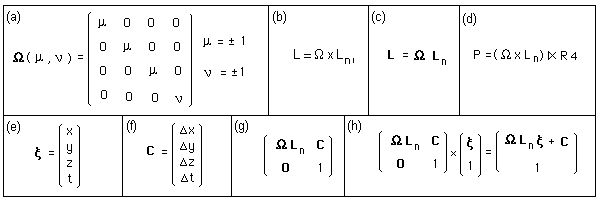
Zaveďme čtyřvektor události (e) a vektor časoprostorového posunu C: (f).
Můžeme dát maticové zastoupení (g) prvku Poincarého grupy. V (h) je definována jeho akce na časoprostoru. Ale tato akce skrývá důležitější akci: koadjointní akci grupy na jejím desetisložkovém momentovém prostoru J (Poincarého grupa je desetidimenzionální).
Souriau zapisuje tento moment ve tvaru:
J = {E, p, f, l},
kde E je energie, p hybnost, f „přechod“ a l spin. Je vhodné zavést, podle Souriaua, antisymetrickou matici M: (a) a čtyřvektor hybnosti-energie P: (b). Výpočet duálu akce grupy na její Lieově algebře dává akci na momentu { (c), (d) }.
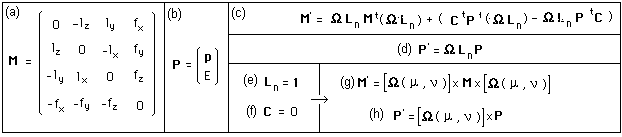
Nyní, pokud chceme zdůraznit symetrie I, P, T a PT, volíme (e) a (f). Koadjointní akce se pak stává { (g), (h) }, což dává:
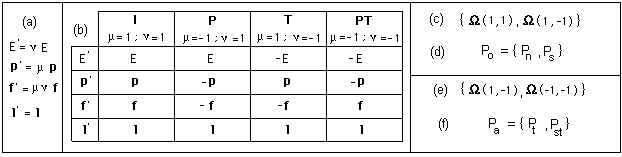
Jak zdůraznil J.M. Souriau v roce 1970, z matic (c) konstruujeme ortochronní podgrupu P₀: (d), složenou ze dvou souvislých komponent: neutrální komponenty Pₙ a komponenty prostorové inverze Pₛ. Prvky těchto dvou komponent nemění znaménko energie E. Naopak, matice (e) produkují antichronní podmnožinu, jejíž prvky mění znaménko energie, takže časová inverze jde ruku v ruce s inverzí energie, tedy s inverzí hmotnosti, pokud ji částice mají. Závěrem vidíme, že negativní hmotnost a negativní energie vznikají z dynamického popisu Poincarého grupy, odkazujícím na relativistické pohyby hmotných bodů.
Nyní rozšíříme Poincarého grupu, uvažujíc:

Zavádíme matice (a) a (b). Poté dáváme maticové zastoupení grupy, působící v (e) na svazku Z₂ × U(1) × ℝ⁴. V (f) získáváme geometrický výraz symetrie C. Pátá dimenze (c) je kompaktní. Takže jakýkoli prvek grupy odpovídající volbám (f) implikuje symetrii vzhledem k indicated line.
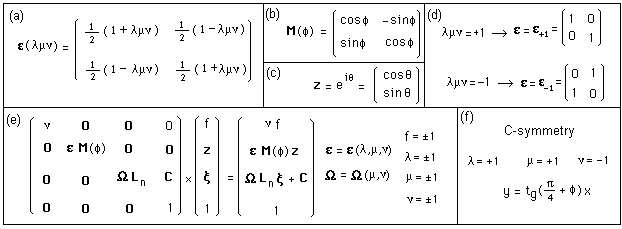
Výpočet koadjointní akce grupy na jejím momentu nevykazuje žádné zvláštní obtíže. Jak zdůraznil Souriau v roce 1970, přidání kompaktní dimenze q jde ruku v ruce s dodatečným kvantovaným skalárem, identifikovaným s elektrickým nábojem q. Akce na část momentu odpovídající Poincarého grupě se nemění. Akce na elektrický náboj dává:

Částice jsou popisovány pomocí orbit grup. Některé mají pozitivní energii, jiné negativní. f lze považovat za index záhybu.
f = +1 označuje záhyb F,
f = –1 označuje záhyb F̅.
Získáváme tak dvojčecí geometrickou strukturu. Akce je jednoduše:
f′ = n f.
To lze shrnout na obrázku 21:
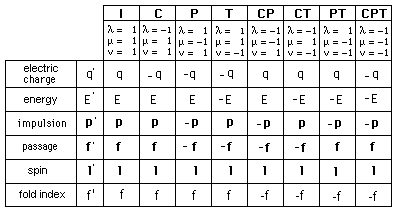
Obr. 27: Dopad symetrií na složky momentu.
Všimněme si, že (ν = –1) označuje antichronní prvky grupy. Částice a její pohyb odpovídají konkrétnímu prvku momentu. Antichronní prvky transformují ortochronní pohyby na antichronní a obrátí hmotnost a energii. Jelikož časoprostor je složen ze dvou oddělených záhybů F a F̅, setkání částic s opačnou energií lze vyhnout, pokud umístíme částice s pozitivní energií do jednoho záhybu (například F) a částice s negativní energií do jeho dvojčecího záhybu F̅. Tento fyzikální popis je konzistentní s vlastnostmi grupy.
- Symetrie PT a symetrie CPT.
Jak zdůraznil Souriau v roce 1970, každá symetrie zahrnující transformaci T obrátí energii a hmotnost. Pokud uvažujeme normální částici, s hmotností m a elektrickým nábojem q, její CPT symetrická má negativní energii a hmotnost. Feynman ukázal, že PT symetrická částice se chová jako antihmoty; avšak, podle výsledků Souriaua, ta má negativní hmotnost a energii. Z výše uvedeného jsme zkonstruovali nový popis Vesmíru jako složeného ze dvou dvojčecích entit. První je záhyb F, předpokládaný jako náš, naplněný hmotou a Diracovou antihmotou, C-symetrický vzhledem k prvnímu. Ve druhém záhybu F̅ platí dualita hmoty a antihmoty také. Jeho hmota je CPT-symetrická vzhledem k naší, zatímco jeho antihmota odpovídá Feynmanově. Celkově jsou oba záhyby CPT symetrické. To je v souladu s počátečními myšlenkami Sacharova ([33] až [36]). Práce autora, věnovaná kosmologii dvojčecího Vesmíru, byla publikována v roce 1977.
- Model prchající neutronové hvězdy: alternativa k modelu černé díry.
Klasicky kritičnost neutronové hvězdy spočívá na geometrické kritičnosti. Sféra konstantní hustoty, obklopená vakuem, může být popsána dvěma spojenými Schwarzschildovými metrikami (vnitřní a vnější). Tyto výrazy byly uvedeny v sekci 7. Stávají se kritickými, když se poloměr neutronové hvězdy blíží k jeho příslušnému Schwarzschildovu poloměru. Tolman, Oppenheimer a Volkov odvodili (viz [52], eq. 14.22) slavnou „TOV rovnici“, dávající tlak v závislosti na radiální vzdálenosti v neutronové hvězdě.
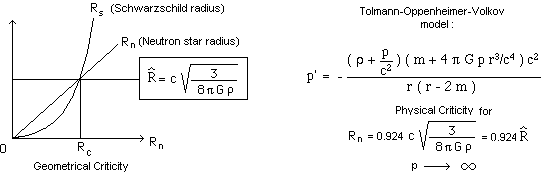
Obr. 28: Vlevo, geometrická kritičnost; vpravo, fyzikální kritičnost.
Výpočet ukazuje, že před dosažením geometrických podmínek nastane fyzikální kritičnost: tlak jde k nekonečnu ve středu hvězdy (vlevo).
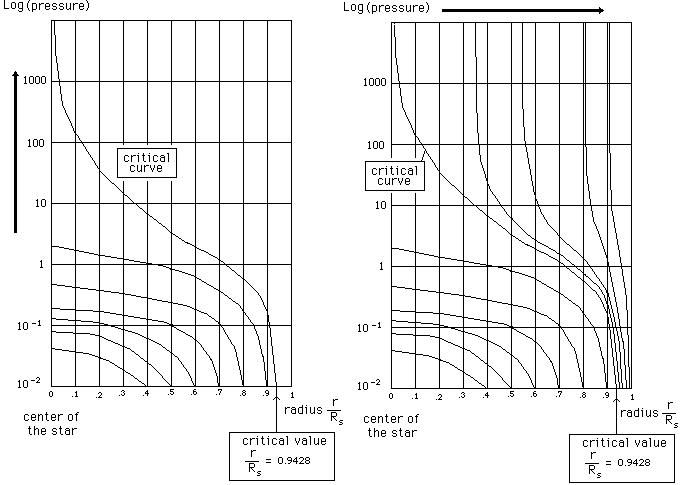
Obr. 29: Tlak v závislosti na radiální vzdálenosti v neutronové hvězdě.
Nyní formulujeme určité hypotézy. V sekci 15 jsme se pokusili popsat prvotní stav Vesmíru, jdouc zpět v jeho minulosti. Abychom vysvětlili jeho velkou homogenitu, zavedli jsme variaci fyzikálních konstant během radiační éry. Toto zkoumání zůstává však velmi riskantní. Pouze jsme se pokusili přinést nové perspektivy na otázku: „Co se stane, když se díváme do vzdálené minulosti Vesmíru?“. Myslím, že nemáme všechny klíče. Dovolím si však vyjádřit názor: myslím, že když tlak dosáhne kritické hodnoty (kterou je třeba stanovit), náš Vesmír se stane spojeným se svým dvojčetem, které, jak A. Sacharov naznačil, „spočívá v jeho minulosti“. Ačkoli je to stále nejasné, uznávám, že jde o hypotézu, myslím, že náš vesmír interaguje se svou minulostí, která by se rozkládala podél jakéhosi mostu časoprostoru. Sacharov si myslel, že náš Vesmír a jeho dvojče jsou spojeny. Dodávám, že by interagovali trvale, všude, v každém čase. Proto se zdá, že šipka času je v dvojčeti obrácena, jak ukazuje sekce 19. Proto se zdá, že dvojčecí atomy mají negativní hmotnost a odpuzují naše. Pro nás žijí jednoduše obráceně v čase, a podle prací Souriaua, jejich zdánlivá hmotnost je negativní.
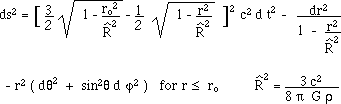
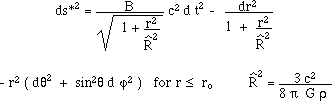
Analogicky předpokládám, že když je fyzikální kritičnost dosažena ve středu neutronové hvězdy, lokální hodnoty fyzikálních konstant se drasticky změní. Taková podmínka by „reprodukovala“ lokálně podmínky „Velkého třesku“. Otevřel by se prostorový most, sající hmotu relativistickou rychlostí. Tento „jemný scénář“ by nastal, když tok hmoty způsobený hvězdným větrem společníka dosáhne kritických podmínek ve středu hvězdy. Stacionární stav by pak mohl být geometricky popsán pomocí čtyř Schwarzschildových metrik. Pro záhyb F:
Pro adjacentní, konjugovanou oblast dvojčecího záhybu F̅:
Lze studovat geodetické systémy a spojit je prostřednictvím prostorového mostu, jehož jediným parametrem je jeho plocha. Miniaturní prostorové mosty by mohly absorbovat hmotu pocházející z hvězdného větru společníka, protože blízko něj je hustota obrovská a rychlost relativistická. Na obrázku 24 je pedagogický 2D obraz modelu.
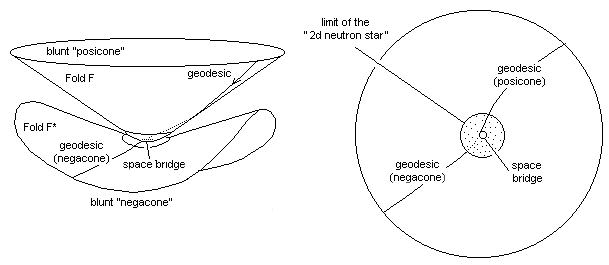
Obr. 30: Pedagogický 2D obraz prchající neutronové hvězdy (SNS).
Violentní příliv hmoty, způsobený například intenzivnějšími erupčními jevy společníka nebo fúzí dvou neutronových hvězd tvořících binární systém, by mohl způsobit rychlé otevření prostorového mostu, jak je naznačeno vpravo na obrázku 24. Vysvětlení gama záblesků by mohlo spočívat zde. Tento model zpochybňuje model černé díry. Uvidíme dále, proč je tento model diskutabilní. Něco není v pořádku s tímto modelem černé díry. Je příliš málo kandidátů a všichni vědí, že malá chyba v odhadu vzdálenosti může proměnit takové kandidáty na černé díry v jednoduché neutronové hvězdy. Neexistuje žádný nezpochybnitelný důkaz o jejich existenci. Věří se v to jednoduše, zvykem. Vždy se říkalo: „Co byste si mohli představit jiného?“. Podívejte se na začátek článku. Zmiňovali jsme číslo novin Le Monde, ve kterém Fort a Méillier prezentovali barevnou 3D mapu temné hmoty, a novinář, nadšený, tituloval [1]: „Temná hmota existuje: odchyluje světelné paprsky“. Ale co „temné shluky“ [2], objevené těmi samými výzkumníky, které „přitahují a odchylují světelné paprsky, ale zdánlivě odpuzují běžnou hmotu“? Pokud je to potvrzeno, byly by složeny, jak naznačuje Fort, výhradně z „exotické hmoty“. A pokud jsou, co to je? Co akcelerace kosmických sond [49], kterou rozložení temné hmoty nemůže vysvětlit? Dnes je třeba najít obrovské černé díry ve středu galaxií, aby se ospravedlnily dynamické parametry těchto oblastí. Ale tito obři zdánlivě jsou velmi tichí, jako Spící krásky, že ano? Někteří naznačili, že by šlo o „syté černé díry“. Jak dlouho budeme ještě zkoušet řešit nové problémy inventováním nových jmen?
Shrnutí článku ---
Original version (English)
20 )
What twin matter could be made of.
Theoretical physics is in a big crisis since mode than 30 years. A lot of papers were published many years ago about magnetic monopole, but no one appeared. The existence of supersymetric partners has not been proved yet. Nobody knows what a graviton could be. When scientists tried to evidence the protons decay, this last did not cooperate. Almost all that new telescopes bring is still e complete mystery. Nobody knows what are QSO, gamma flashes and how it works. Giant black holes are strangely silent, and so on. Superstring is nothing but a new fashion, in spite thousands papers published in this new field. Superstring world is a strange play field in which physics seems desperately absent. In the following we give the first geometrical description of antimatter. As J.M.Souriau
uses to say, group theory is the most basic tool we have to deal with physical phenomena. A natural action of a Lie group is its coadjoint action on its Lie algebra, as introduced by J.M.Souriau in 1970
[
53]. The dimension of a group G
is the number of parameters it depends on. This is also the number of components of its moment
J. The Lorentz group L is a six-dimensional group, which owns four connex components. Introduce the four elements group omega
, in its matrix representation (a). Then we can built the complete Lorentz group
Lfrom its neutral component
L n
, through a direct group product (b), where (c) is the matrix representation. A new semi-direct product
(d) gives the Poincaré group. Introduce the event-quadrivector
(e) and the space-time translation vector
C: (f).
We can give a matrix representation (g) of the Poincaré element. In (h) its action on space-time. But this one hides a more important action : the coadjoint action of the group on its ten components moment space
J(the Poincaré group owns ten dimensions).
Souriau writes this moment
: J = {
E ,
p
,
f
,
l } E
is the energy,
p
the impulsion,
f
the passage an
l
the spin. It is convenient to introduce, following Souriau, an antisymmetric matrix
M: (a) and the quadrivector impulsion-energy
P: (b)
. The calculation of the dual of the action of the group on its Lie algebra gives the action on the momentum { (c) , (d) }.
Now, il we want to evidence symmetries
I , P , T
and
PT
we choose (e) and (f). The the coadjoint action becomes { (g) , (h) } , which gives :
As pointed out in 1970 by J.M.Souriau, with the matrixes (c) we build the orthochron subgroup
P o
: (d), composed by two connex components : the neutral one
P n
and by the space-inversion component
P s .
The
terms of these two components do not inverse the sign of the energy
E. Conversely, the matrixes (e) produce the antichron subset, whose terms inverse the sign of the energy, so that time-inversion goes with energy inversion, i.e. mass-inversion, if the particles own one. As a conclusion we see that negative mass and negative energy arise from the dynamic Poincaré group description, referring to relativistic mass-point movements. Now, we are going to extend the Poincaré group, considering :
We introduce the matrix (a) and (b). Then we give a matrix representation of the group, acting (e)
on a bundle
Z 2 x U
(1)
x R4
. In (f) we get the geometrical expression of the C-symmetry. The fifth dimension (c) is compact. Then any element of the group corresponding to choices (f) implies a
symmetry with respect to the indicated straight line. The calculation of the coadjoint action of the group on its momentum shows no peculiar difficulty. As pointed out by Souriau in 1970 the addition compact dimension
q
goes with a quantified additional scalar, identified to the electric charge q. The action on the part of the moment corresponding to Poincaré does not change. The action on the electric charge gives :
Particles are describes in terms of orbits of the group. Some own a positive energy and others a negative one. f can be considered as a fold index.
f = +1 refers to fold F
f = -1 refers to fold
FWet get a geometrical twin structure. The action is simply :
f =
n f
This can be summarized on figure 21.
Fig.
27 :
Impact of symmetries on the momentum components.
Notice that (
nu = - 1 ) refers to antichron terms of the group. A particle and its movement correspond to a peculiar element of the momentum. Antichron terms transform orthochron movements into antichron ones and reverse mass and energy. As space time is composed by two separate folds F and
F, encounters of opposite energy particles can be avoided if we put positive energy particles in one fold, F for example, and negative energy in its twin fold
F. This physical description is consistent to the group properties.
PT-Symmetry and CPT-symmetry .
As pointed out by Souriau in 1970, all symmetry which includes a T-symmetry reverse the energy and the mass. If we consider a normal particle, with mass m and electric charge q , its CPT-symmetrical owns negative energy and mass. Feynman showed that the PT-symmetrical of a particle behaved as an antiparticle, but, according to Souriaus result, it owns negative mass and energy.. From above, we have built a new description of the Universe as composed by two twin entities. The first is a fold F, supposed to be ours, filled by matter and Dirac-antimatter, C-symmetrical with respect to the first. In the second fold
Fthe matter-antimatter duality holds too. Its matter is CPT-symmetrical with respect to ours, while its antimatter identifies to Feynman one. As a whole, the two folds are CPT symmetrical. This goes with initial Sakharovs ideas ( [33]
to [36]
). The initial work of the author, devoted to twin Universe cosmology, was published in 1977.
Leaking neutron star model : a challenger to black hole model.
Classically the criticity of a neutron star is based on a geometrical criticity. A constant density sphere, surrounded by void can be described by two linked Schwarzschild metric (internal and external). These expressions have been give in section 7. Both become critical when the neutron stars radius tends to its associated Schwarzschild radius. Tolmann, Oppenheimer and Volkov derived ( see
[
52], eq. 14.22 ) a famous TOV equation giving pressure versus radial distance in a neutron star.
Fig.
28 :
Left, geometrical criticity. Right : physical criticity.
The calculation shows that, before the geometrical conditions are reached, a physical criticity occurs : pressure tends to infinite at the centre of the star (left).
Fig
. 29 :
Pressure versus radial distance in a neutron star.
We are going now to make assumptions. In section 15 we tried to describe the primitive stage of the Universe, going backward in its past. In order to explain its great homogeneity we introduced a variation of the constants of physics, during the radiative era. By the way, this exploration is still very hazardous. We only tried to give new insights on the question : what happens when we look at the distant past of the Universe ?. I think we dont own all the keys. I will just expression an opinion. I would think that when the pressure reaches a critical value (to be determined) our Universe becomes linked to its twin which, as A.Sakharov suggested lies in its past. Although it is still confused, I admit, I think that our universe interacts with its past, which would extends over some sort of space-time bridge. Sakharov Thought that our Universe and its twin were linked. I add they would be interacting, everywhere, all the time. Thats for the arrow of time is found to be reversed in the twin, from section 19. Thats for the twins atoms seem to own a negative mass and repel ours. For us, they just live backward in time, thats for, according to Souriaus works, their
apparent mass
is negative. By analogy I would think that when physical criticity is reached at the centre of a neutron star, the local values of the constants of physics change drastically. Such condition would reproduce locally the Big Bang conditions. A spaced bridge would open, sucking matter at relativistic velocity. Such soft scenario would occur when the matters flux due to the solar wind of a companion star achieves critical conditions at the centre of the star. Then a steady state can be geometrically described, using the four Schwarzschild metrics. For fold F :
For the adjacent, conjugated region of the twin fold
F:
One can study the geodesic systems and link them, through a space bridge whose single parameter is its area. Tiny space bridges can absorb the matter corresponding to stellar wind of a companion star, for, close to it, the density is enormous and the velocity relativistic. On figure 24 a 2d didactic image of the model.
Fig.
30 :
2d didactic image of a sleaking neutron star
(SNS).
A violent inflow of matter, due for example to more eruptive phenomena of a companion star or to the fusion of two neutron stars, forming a binary system, could produce fast opening of a space bridge, as suggested on the right of figure 24. The explanation of gamma bursts could lie there. This
model challenges the black hole model. We will see further how this last is questionable. Something goes wrong with this black hole model. There are too few candidates and everybody knows that a slight error about distance evaluation can convert such black holes candidates into simple neutron stars. There is no undeniable proof of their existence. People only
believe
in. They always said : what could you imagine else ?. Look at the beginning of the paper. We evoked the issue of the Journal le Monde in which Fort and Meillier presented a coloured 3d map of dark matter and the journalist, enthusiastic, titled
[ 1 ]
: The dark matter does exist : it bends the light rays. But what about the dark clusters
[ 2 ]
, discovered by the same people, which attract the light rays, bend it, but apparently repel the ordinary matter. If this is confirmed they would be made, as suggested by Fort, exclusively of exotic matter, and if they are, what is that stuff ? What about the acceleration of the space probes [
49], that a dark matter distribution cannot explain ? Today people
need
to find giant black holes at the centre of galaxies, in order to justify the dynamical parameters of such regions. But these giants seem very silent, like sleeping beauty, dont they ? Some suggested they could be satiated black holes. How long time will we try to answer new problem just inventing new
name ?
Paper's Summary ---