υδροκινητήρας σύστημα pentone περιβάλλον
Δύο χρόνια μετά
28 Οκτωβρίου 2006
Βλέπω ότι περισσότερες από διακόσιες χιλιάδες άνθρωποι έχουν διαβάσει αυτή τη σελίδα, τουλάχιστον το παρακάτω αρχείο. Δεν έχω πειράξει αυτό το κείμενο, που χρονολογείται από το 2004. Εμφανίζεται η φωτογραφία του Christophe Tardy και, από κάτω, ο τρακτέρ του Jean-Louis Millet. Ο Christophe συνεργάστηκε με τον David Dieulle, ο οποίος βελτιστοποίησε αυτό το σύστημα αύξησης της απόδοσης καύσης μέσω ηλεκτροδυναμικής κατάλυσης και το μετέτρεψε στο SPAD. Αυτό που είχα σκεφτεί επιβεβαιώνεται. Όταν γίνεται εισαγωγή του μείγματος καύσης, η δημιουργούμενη υποπίεση αναρροφά αέρα σε ένα «bulleur», ένα δοχείο νερού που θερμαίνεται από τη διέλευση των καυσαερίων. Δημιουργείται ένα ζεστό ομίχλη που κυκλοφορεί τότε μεταξύ δύο κυλινδρικών τοιχωμάτων. Όπως σε ένα σύννεφο καταιγίδας, αυτή η ομίχλη φορτίζεται με ηλεκτρισμό. Τότε αναμιγνύεται με το καύσιμο ενός diesel. Το ηλεκτρικό πεδίο που δημιουργείται από τις μικροσταγονίδια σπάει τις μεγάλες μόρια του καυσίμου, αυξάνοντας την απόδοση καύσης και μειώνοντας τη ρύπανση μέσω της απελευθέρωσης των μη καμένων υλικών.
Η ιδέα κάνει δρόμο, αργά. Η αυτοκινητοβιομηχανία δεν εκτιμά τους Ρομπέν των Δασών των κινητήρων εσωτερικής καύσης, που παλεύουν γενναία. Τα πράγματα πρέπει να γίνονται σύμφωνα με τους κανόνες. Οι εφευρέτες λαμβάνουν διπλώματα ευρεσιτεχνίας, και στη συνέχεια αφήνουν τους κατασκευαστές, τους οποίους τα κρατούν «για όσο χρόνο χρειάζεται». Πρέπει στη συνέχεια να δημιουργηθεί toda μια αλυσίδα κερδών, σε όλα τα επίπεδα. Αλλιώς, πού θα πάει; Αν τα diesel εξέβαζαν καθαρά αέρια, ποιος θα αγόραζε καταλύτες;
Τα έξοδα σε καύσιμα, οι οικονομίες, η ρύπανση;
Οι καταναλωτές γαβγίζουν και η αυτοκινητοβιομηχανία περνάει.
Πριν διαβάσετε ή ξαναδιαβάσετε αυτό το αρχείο για αυτόν τον «υδροκινητήρα», και ενώ περιμένετε την έναρξη της λειτουργίας του δικτυακού τους τόπου, ρίξτε μια ματιά στο φυλλάδιο του Christophe και του David:
Ο «Υδροκινητήρας»
23 Νοεμβρίου 2004
Paul Pentone, εφευρέτης του GEET, φυλακισμένος στις 21 Αυγούστου 2005
Συνέχεια αυτής της υπόθεσης στις 9-12-05
Ο δικτυακός τόπος της «Οικολογικής Μηχανικής»
Εδώ και μήνες, ο φίλος μου Christophe Tardy, μηχανικός, μου ζητούσε να έρθω να δω τις υλοποιήσεις που είχαν κάνει κάποιοι από τους φίλους του, σχετικά με τον «αντιδραστήρα Pantone».

Christophe Tardy, μηχανικός και «Pantone man» (μεταξύ άλλων) που εξοπλίζει ένα R5 σε ηλικία.
Επομένως, έκανα μια πρώτη επαφή με αυτούς τους sympatikous τεχνίτες. Η απάτη αποκλείεται, δεδομένης της απλότητας των συναρμολογήσεων. Μπόρεσα να εξετάσω δύο οχήματα, και τα δύο τροφοδοτούμενα με ντήζελ: έναν τρακτέρ και ένα όχημα Mercedes.
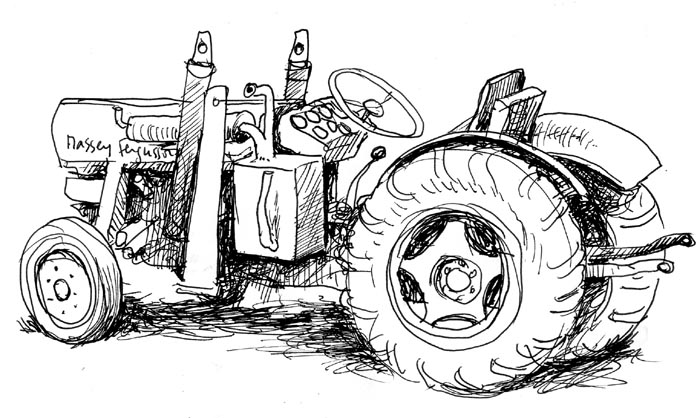
Ο τρακτέρ εξοπλισμένος από τον Jean-Louis Millet, από το Mérindol, με ένα σύστημα Pentone, ευκρινώς ορατό στα αριστερά του πίνακα οργάνων. Μετά από τηλεφωνική κλήση στις 25/11/04: μείωση της κατανάλωσης από 4 σε 2 λίτρα την ώρα (0,75 λίτρα νερού για 2 λίτρα ντήζελ).
Ακόμα και λαμβάνοντας υπόψη τον ενθουσιασμό των «activists» αυτής της νέας υπόθεσης, φαίνεται ότι τα οχήματα εξοπλισμένα με τέτοιες διατάξεις βλέπουν την κατανάλωσή τους μειωμένη σε πολύ σημαντικές αναλογίες. Μπόρεσα να κάνω, με το diesel όχημα, μια δοκιμή ρύπανσης με ένα απλό χαρτί κουζίνας τοποθετημένο μπροστά από την έξοδο του σωλήνα καυσαερίων. Παρατηρείται μια πολύ καθαρή διαφορά. Τοποθετήστε ένα τέτοιο χαρτί μπροστά από τον σωλήνα καυσαερίων ενός diesel οχήματος, μια μαύρη κηλίδα εμφανίζεται πολύ γρήγορα. Όταν το σύστημα Pantone είναι συνδεδεμένο, αυτό το αποτέλεσμα μειώνεται considerablely. Είδα αναλύσεις ρύπανσης που έγιναν σε εργαστήρια, οι οποίες αναφέρουν μια πτώση greater από το μισό. Τέλος, έβαλα κυριολεκτικά τη μύτη μου δέκα εκατοστά από την έξοδο του σωλήνα καυσαερίων του Mercedes ενώ ο «αντιδραστήρας» του λειτουργούσε και έκανα δύο τρεις αναπνοές. Είναι ... surprisingly, abnormally breathable.
Σύντομα, υπάρχει ένα πρόβλημα Pantone, για το οποίο πρέπει να ασχοληθούμε. Δεδομένης της spectacular αύξησης των αποδόσεων και της μείωσης της ρύπανσης, η υπόθεση είναι σημαντική, ακόμα και αν μέχρι τώρα έχει κυρίως διαχειριστεί από enthusiastic τεχνίτες.
Πήρα σημειώσεις και ελπίζω να μην κάνω λάθη, αλλιώς οι αναγνώστες μου θα τα επισημάνουν αμέσως, όπως συνήθως.
Τι είναι ένας κινητήρας εσωτερικής καύσης; Είναι ένα σύστημα όπου εισάγεται σε ένα θάλαμο καύσης ένα μείγμα καυσίμου-οξειδωτικού. Καύσιμο: διάφορα και ποικίλα υδρογονάνθρακες, σε μορφή αεροζόλ ή αερίων. Οξειδωτικό: ο αέρας του Θεού. Στην περίπτωση του βενζινοκινητήρα, η ανάφλεξη επιτυγχάνεται με την触发 (trigger) ενός ηλεκτρικού τόξου μεταξύ των δύο ηλεκτροδίων ενός «μπουζί». Στην περίπτωση του diesel, η καύση είναι αυθόρμητη, ως αποτέλεσμα μιας αρκετά σημαντικής συμπίεσης (λόγος συμπίεσης: 20). Και στις δύο περιπτώσεις, η εξωθερμική χημική μετατροπή πραγματοποιείται μέσω καύσης και όχι έκρηξης (detonation).
Διαφορά μεταξύ καύσης και έκρηξης (detonation):
-
Σε μια καύση υπάρχει ένα μέτωπο καύσης που ξεκινά από ένα σημείο ανάφλεξης, από το μπουζί σε έναν βενζινοκινητήρα, ή από διάφορα σημεία ανάφλεξης στο diesel. Θα πρέπει να έρθω σε επαφή με τον παλιό μου φίλο Antonio Oppenheim, που ήταν διευθυντής του τμήματος καύσης στο Berkeley (τώρα συνταξιούχος).
-
Σε μια έκρηξη (detonation) (για παράδειγμα initiated by a spark plug), η εκδήλωση θερμότητας είναι τόσο βίαιη που σχηματίζεται ένα κύμα σοκ. Η αύξηση της θερμότητας downstream of this wave είναι αρκετή για να προκαλέσει την καύση νέων μορίων. Ένα «κύμα έκρηξης» (detonation wave) είναι έτσι «auto-propelled» στο αέριο. Στους βενζινοκινητήρες προσθέτουμε ένα «αντι-εκρηκτικό» (anti-detonant) (&&& SVP, πώς παίζει ο μόλυβδος τον ρόλο του αντι-εκρηκτικού;). Ένας αναγνώστης μας enlightens on the fact that detonation is not desirable in engines. According to him, two reasons: mechanical deterioration and temperature rise.
Φαίνεται ότι αποκαλούμε λανθασμένα τους κινητήρες αυτοκινήτων «κινητήρες έκρηξης». Ο όρος «κινητήρας εσωτερικής καύσης» θα ήταν πιο κατάλληλος, καθώς μια έκρηξη (explosion) proceeds by detonation. Υπάρχει κύμα σοκ. Αλλιώς πρόκειται για inflammation.
Για να συμπληρωθεί αυτό το αρχείο, θα ήταν καλό οι μηχανικοί, οι φοιτητές, να παρέχουν ακριβή αριθμούς. Δεν έχω τίποτα regarding, for example, βενζινοκινητήρες. Δεν ξέρω τίποτα, είμαι fresh και απλώς προσπαθώ να σκεφτώ με το δικό μου bagage of physicist and fluid mechanic. What happens in the cylinders is a matter of chemical kinetics. Θα θέλαμε να έχουμε ακριβή αριθμούς, particularly regarding the percentage of unburned fuel that passes into the exhaust pipe. Not everything burns in the cylinders, for various reasons. Not everything has time to burn first. There must have been an optimization carried out for a long time. The combustion speed is higher the higher the density and temperature of the medium, thus the pressure at the end of the piston's upward stroke. There must be limitations related to mechanical and thermal constraints.
Ένας ονόματι C. Martz παρήγαγε αριθμούς και υπολογισμούς σε ένα site (http://quanthomme.free.fr/pantone/martz/PageC_Martz.htm). Πρόκειται για ένα diesel σύστημα.
- Υποδεικνύει ότι ένας diesel injector sends into the cylinder a mixture under a pressure of 0.7 bar and a temperature of 150°C.
- The upward movement of the piston compresses this mixture, raising its temperature to 400°C under a pressure of 15 bars (the compression ratio is 20).
- After combustion, the temperature would be raised to 1000°C and the pressure to 80 bars. The descent of the piston, until the gas is evacuated by a valve system, brings this temperature (exit) back to 400°C and the pressure to 1.5 bar.
At this stage, we would like to know precisely the combustion efficiency (the percentage of unburned fuel). This is a question I had never asked myself. But the pollution inherent to the operation of an internal combustion engine stems from:
- The diffusion into the atmosphere of unburned hydrocarbon molecules.
- The diffusion of chemical compounds created during combustion processes. &&& We would like to have data and figures on pollutants regarding gasoline engines and diesels.
A «catalytic converter» is a system that acts on unburned fuel. According to my friend Elio Flesia, it ensures the transformation of CxHy compounds into CO2.
Incidentally, and we will see later why, I would like students or teachers from the Superior School of Aeronautics in Toulouse (from which I graduated) to give us the combustion efficiencies of various combustion systems: piston engines, turbojets, ramjets. When I was a student at the School, turbojets with «fans» did not exist. They are now standards in airliners. They increase propulsive efficiency.
A turbojet ejects hot gas at supersonic speed. The thrust it produces is only the resultant of pressure forces exerted on the entire machine. The nozzle is designed to transform heat into speed, with the best possible efficiency. Ideally, one would eject into the ambient air a cold gas, totally «expanded». A rocket ejecting gas under a density Q and an ejection velocity V gives a thrust that is simply Q V. Therefore, it is advantageous to obtain the highest possible ejection velocity. However, we then encounter a paradox.
The energy originates initially from the thermal agitation speed of molecules, from their individual kinetic energies. The nozzle channels these speeds along the axis (Read «L'aspirisouffle» in CD Lanturlu 1). But this does not mean that by ejecting carefully expanded gas, into the ambient air, we have exhausted all its energy resources. The air is ejected at speed V, and the plane flies at speed v. There is a speed difference (V - v). This represents lost energy that will be converted downstream of the plane into turbulence, and ultimately into heat (to warm the little birds).
We tried to recover this energy, first by switching to a turboprop system, coupling the turbojet axis to a simple propeller, with a reducer. Propellers turn slower than the turbines of jet engines. A plane equipped with a turboprop is the «Pilatus Porter», well known to parachutists. But two problems remained. The gear reducer consumed energy, and there were losses at the blade tips (inherent to propeller operation) in the form of marginal vortices. The solution finally emerged with the «fan» of modern planes, which consists of increasing the diameter of the first stages of the bladed compressor. This system, placed upstream of the combustion chambers, has two functions.
- It initiates the necessary compression so that combustion occurs sufficiently quickly in the combustion chambers.
- It accelerates the ambient air; the blades then play the role of enclosed multi-propellers, operating with better efficiency, the enclosure reducing losses by turbulence, by marginal vortices.
It is good to give the reader some ideas on this point, as we will return to it one day when we address the problem of wind turbines, enclosed or not, the former bringing a useless nuisance in the form of noise and infrasound and remain very bulky. But this, as Kipling would say, is another story.
Let us return to our modern airliners with fans. The result downstream is multiple. Two flows exit the aircraft.
- The jet from the turbojet, fast.
- The annular jet from the fan.
The two mix. As a result, the fluid is ejected downstream at a speed V', lower than the speed V, at the exit of the engine. The mass flow rate is higher. Let us say that the engine ejects a flow Q at a speed V. The fan produces Q' at a speed V' < V.
Far behind, everything has mixed and we have a flow Q" = Q' + Q, with an intermediate speed V" between V and V'. We gain in propulsive efficiency. There is then a very interesting secondary effect. Downstream of the engine, the hot gas, very turbulent, from the turbojet nozzle is surrounded by a sheath of cold air. The speed of propagation of sound waves is different in the two media. This results in an effect of «acoustic refraction». Sound waves bounce off this sheath of cold air exactly as light rays produce a mirage effect at the interface between two layers of air of different temperatures, which have different refraction indices. These engines are thus much less noisy, the noise being directional, along the axis of the engine jets, the sound energy being attenuated by absorption in the sheath of cold air.
Engineers have done their best to increase the various efficiencies, but it is obvious that an airliner works optimally only at a given altitude and configuration (cruise altitude). Military planes, which must operate at variable altitudes, are equipped with variable geometry nozzles to eject their gas well along the axis. Otherwise, at too low an altitude, the jet is pinched and a shock wave system is created. At too high an altitude, the jet expands and a component of the velocity perpendicular to the flight axis appears, which does not contribute to propulsion.
We would like to have data and figures &&& regarding current planes, the type of fuel used, combustion efficiencies, the form of pollution generated and its effects (it is hard to see how airliners could be equipped with «catalytic converters»).
Let us return to the problem of catalysis. This can be surprisingly effective. I heated myself in Aix for years with simple gas bottles, the gas being burned on a catalyst, in the form of a plate. The efficiency of combustion, producing carbon dioxide CO2 and water vapor H2O, must have been almost total since one could sleep practically without ventilation, without being bothered by odors. Unless I am mistaken, catalytic combustion also allows chemical reactions to be carried out at lower temperatures (&&& figures please).
We find this theme with the catalytic converter of cars, with a more or less long lifespan (&&& temperature in a functioning catalytic converter, please. Types of catalyst poisons? Efficiencies of these converters? Residual pollution?).
Do we use a catalytic combustion mode of hydrocarbons using water?
The answer is yes and in many cases, for example when we have to burn «heavy oils» in thermal power plants, hydrocarbons containing complex molecular assemblies. This was also the case when, in the 1950s, post-combustion appeared in military planes. It consists of injecting kerosene downstream of the combustion chambers (exit temperature: 2000°C), downstream of the turbine (whose blades, which do not withstand more than 1500°C, must be cooled), in the nozzle, exploiting a residual excess of oxygen. The thrust of the engine can then be increased by 17 to 30%. We also proceed to an injection of a mixture of water and methanol in the engines of 747s at takeoff, for a fairly short time. I remember that we spoke then of «post-combustion systems with water injection». &&& I would like to know, incidentally, the combustion efficiency of these plane engines. What is the percentage of unburned fuel?
When I was twelve years old, during a visit to the aviation salon which was held at the time in Paris, at the Grand Palais, I asked an American presenter what the water was for in post-combustion systems, a fairly recent introduction. He answered me that it allowed breaking hydrocarbon molecules and improving combustion.
As far as I know, the energy released comes only from the combustion of kerosene and not from this ... water which, having moreover the possibility of becoming electrically charged, plays the role of a catalyst. (&& other questions in passing, addressed to engineers: how does water actually act in this type of post-combustion. Is there electrification of the medium? Does water play a role simply because of the dipolar nature of its molecule?). A reader clarifies to me that for example in the case of water injection at takeoff, at the entrance of the combustion chambers of a 747, its vaporization has the effect of cooling the mixture at the moment of this «full throttle» operation. My friend Jean-Claude Mitteau, who had also attended Supaéro with me, indicates that B-52s also had a system involving water injection, but personally I do not remember it.
I pass (finally) to the schematic description of the Pentone engine.
To access the initial patent (1998!)
You will have to re-click on the US5794601 patent number to access the pdf file
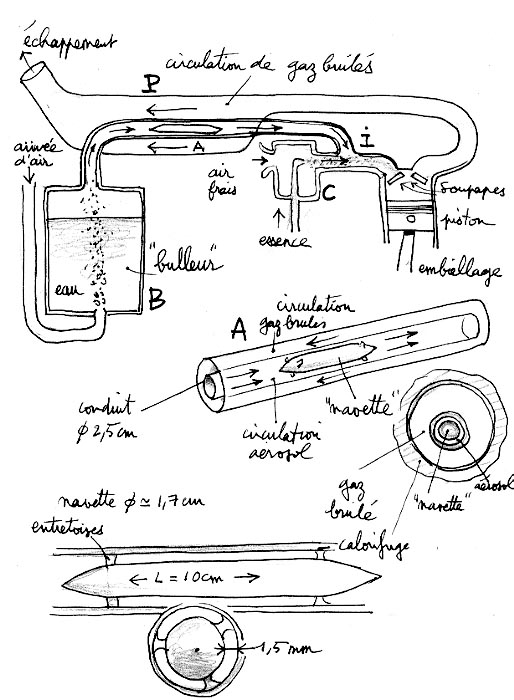
Pentone assembly, schematic
We have taken a configuration associated with a gasoline engine, but the diesel system is not different in principle. I have taken notes. If there are errors, on the dimensions, for example, those who showed me their realizations in Mérindol will correct them. Note that in the initial diagram of Paul Pentone's patent, the right is reserved to add fuel to the water in the «bulleur».
-
At B, a «bulleur». Air is sucked by the engine cylinder, during the downward phase. This depression causes, sucks both dry air, which is mixed, in the carburetor, with fine droplets of gasoline, and air passing through the «bulleur». All this is obviously carefully insulated and cleverly made «compact». The water that the bubbles pass through is hot. The air in these bubbles is charged with water vapor. It seems to me that this enrichment in water vapor by «bulleur» seems more effective than that resulting from the spray of an aerosol (water droplets). Indeed, in aerosol spraying, the enrichment of air in water vapor decreases the size of the droplet, thus the contact surface on which evaporation occurs, whereas in the «bulleur» it remains constant.
-
This mixture (to be analyzed, to be defined) then passes through a «Pantone reactor» which is a section where two circulations, in opposite directions, occur. In our drawing, the air enriched in water vapor (with droplets?) circulates from left to right, while the exhaust gas from the cylinder circulates in a sleeve, from left to right. On the thermal balance level, this can only be beneficial. But in this Pantone reactor there is a fixed part, shaped like a cylinder completed by two conical ends, located in the central tube and held by braces, which forces this air enriched in water vapor to circulate in the space between two cylinders, 1.5 mm apart, if my memories are correct.
-
At I, this «treated in the reactor» mixture mixes with the mist of air plus gasoline from the carburetor.
The result is that:
- Consumption is reduced.
- Pollution is also reduced. A reader reports his own testimony, having witnessed the operation of a diesel tractor equipped with a Pantone system, saying that «the result was spectacular», simply by observing that the gas at the exhaust pipe exit became transparent, whereas in normal operation it spewed quite a bit of smoke.
In his site (http://quanthomme.free.fr/pantone/martz/PageC_Martz.htm), C. Martz develops a hypothesis and performs calculations. He starts from the idea that in this «Pantone reactor» the water molecules are dissociated and it would be the combustion of hydrogen that provides the energy. To specify that in the process, starting from liquid water, energy must first be supplied to vaporize it (latent heat of vaporization), then to dissociate it, if dissociation occurs.
Where would the initial energy come from? Martz supposes that it is energy recovered using the calories brought by the exhaust gas. But the balance does not fit. According to his calculations, there is ... too much energy to explain such an increase in efficiency, or such a reduction in gasoline (or diesel) consumption. Fans of the Pantone reactor then engage in many speculations about «a mysterious energy that could be present in the air or in the water». We even hear discourses that go as far as cold fusion or «quantum vacuum energy».
Let us try to find an explanation perhaps less romantic but simpler. We know that an engine (gasoline or diesel) does not have a combustion efficiency of 100% (&&& figures, please). I am told that the overall efficiency of a gasoline engine would be around 30%. A bit more for diesels and truck engines. Anything that could increase this efficiency would be welcome. It seems to me that we find here an idea similar to this ancient water injection in turbojet post-combustions. In my opinion, we do not perform the cracking of water, but that of ... hydrocarbons. I do not know the percentage of unburned fuel, in the exhaust pipes of gasoline engines or diesels, but it must be significant. There is therefore exploitable energy at the exit of the cylinder of an internal combustion engine. This imperfection of combustion is responsible for pollution. It also explains why we fight against it using «catalytic converters», sites of exothermic reactions, which perform an «external post-combustion» outside the cylinder, representing lost energy. I would like, incidentally, to know the efficiency of such systems.
In the Pentone system, besides this action of water molecules to break complex hydrocarbon molecules, something much more interesting could intervene: a possible electrification of a two-phase medium (water enriched with water vapor and populated with micro-droplets).
This leads us to consider how nature creates strong electric fields in ... storm clouds. In a storm cloud, a cumulonimbus, the updraft speeds are high, up to 80 m/s according to the Météo-France site. There is then a double circulation, or even a triple circulation.
- Ice crystals descend.
- Air charged with humidity rises.
- Water droplets descend (this is called ... rain).
According to the Météo-France site
http://www.meteo.fr/meteonet/decouvr/dossier/orages/ora.htm
electrification would come from collisions between ice particles and water droplets. Extracted from this same site, here is what the result would be:

Electrification of a storm cloud
But in other sites like http://metamiga.free.fr/Meteo_applique/Electrisation/electrisation.htm, we read that the mechanism of charge appearance in a storm cloud would be more complex, with a tripolar distribution (...) and charge transfers between ice crystals of different sizes. This dissonance shows that in fact the exact process of this electrification is not perfectly known.
These opposite circulations lead to a separation of electric charges, generating very strong electric fields. In a cloud, breakdown occurs, we read, when the field is between 100,000 volts per meter and one megavolt per meter. The storm cloud thus transforms into a dynamic capacitor. The separation of charges is maintained by the upward movement. The only way to «discharge this capacitor» is to ground it, that is to say «to the earth». To do this, a conductive line is needed, and this forms in the shape of an electric arc. This is lightning. There is breakdown, disruption, creation of a very thin, highly ionized channel, heated by Joule effect. This heating is so intense that the sudden dilation of said channel gives birth to a shock wave called thunder. There is visible lightning, outside the cloud, but the entire cloud-capacitor is traversed by mini-arcs that strive to restore its electrical neutrality, partially, since the same cloud can function several times. Add, according to what we have read, that the operating mode of a storm cloud, whose upper part, rising up to 8000 meters, reaches the stratosphere, seems both very complex and imperfectly known. It does not matter: the upward movement of humid air recharges the capacitor, etc. It is a multi-shot capacitor, which stops functioning when the upward movement of air diminishes.
I wonder if this «Pantone reactor» does not function on this scheme, with electrification of this mist of air and water droplets sent downstream of the carburetor. If this were the case, the created electric field would have a very effective effect on combustion, playing the role of a catalyst. This would explain the very noticeable decrease in pollution. Normal: more fuel is burned.
In my opinion (but I may be wrong), the remarkable efficiency of the «Pantone engine» would come from the fact that it implements an extremely clever electrodynamic catalysis. It could be called more adequately:
Electrodynamic catalysis system
It is less romantic than vacuum energy or energy hidden in water, but it seems more rational. It is obvious that all this could be the subject of very simple, cheap research, feasible in any technical school. But I end up losing hope of seeing «people» react. Many readers who read my pages consume them more than passively. No one has built remote-controlled models of Egyptian and Peruvian ships (I will have to do it myself). The «Language of the Heart» project has been read by 8000 people, but apart from wise advice from linguists, there is not many people working, although this theme has already produced a perfectly concrete and feasible project (conversion of messages in progress in airports into animated sequences, «animated gifs». I am only waiting for the product of the work of computer scientists to create them, quickly).
In general, I indicate to you an infallible way to identify an academic:
He drives with the handbrake
Therefore, one should not be surprised that Pantone systems were born in the hands of tinkerers, simple mechanics, amateurs of all kinds. It is too simple for it to interest scientists. Farmers have not remained insensitive to substantial possibilities of savings. The Massey-Ferguson whose drawing appears at the top of the article would consume 2 liters of diesel per hour instead of four, tells me its owner!
I think that this idea of using a mist of water vapor as a catalyst, possibly with electrification, is interesting and could have industrial applications far exceeding the lawn mower, the tractor, the revival of an aged vehicle. Despite an obvious reduction in consumption and pollution, what attracted a certain distrust towards the «Pantone reactor» (the name is not well chosen) is the myth of the «water engine». We still hear people say:
- It continued to function while the tank was empty. So it functioned on pure water.
In an empty tank, vapor remains. This is a mixture of air and the most volatile hydrocarbons, composed of the simplest molecules. A mixture that has had all the time to become most intimate. Therefore, it seems to me that this mixture should a priori offer a better combustion efficiency. &&& Here again, all lights are welcome. I would like to know how long an engine using gasoline or diesel vapor contained in its tank can function.
If I have seen correctly, I would have somewhat destroyed the myth of the «water engine», but an interesting idea would remain, on which I hope we will work as soon as possible. Christophe Tardy has bought an aged R5 and plans to equip it. We will therefore learn more about this subject thanks to him.
My friend Jacques (from Venelles, Bouches du Rhône) says that to perform «bench tests» with proper measurements, the best would be to equip a generator. He has one, which runs on gasoline, that he would be ready to make available for these tests. Powerful enough, it could be coupled to an electric radiator. It would thus be possible to measure the power obtained at the exit, according to the different configurations, with or without Pentone system, obtaining precise measurements of the consumption-to-power ratio, at different operating regimes.
We saw above that the system was coupled to the engine at the carburetor exit. Jacques notes that disconnecting this supply of air enriched in water vapor modifies the richness of the mixture. I have not seen how the system was coupled to a diesel engine. Jacques recalls the diesel engine diagram.
Fuel (diesel) is brought by a pump producing a pressure commonly reaching 200 bars (up to 500 bars, it seems, in some advanced devices). Fuel injection is done through a nozzle, closed by a needle held pressed by a calibrated spring. When compression is sufficient, the needle lifts and lets escape tiny droplets of diesel which quickly mix with the fresh and turbulent air admitted thanks to the valve. At the end of compression, this mixture ignites spontaneously. In a diesel system, the Pentone device, not shown, is in principle placed at the air intake level.

Diesel engine (schematic)
If there is electrification, one can wonder if this will not create nitrogen oxides, thus generating new pollution. We note in passing that nitrogen oxide NO is the molecule which, in the air, has the lowest ionization potential, giving free electrons most easily or, inversely, NO+ ions, but the pollutant is NO2 which, mixed with water, gives nitric acid NO3H («acid rains»).
All this is to be considered, measured, quantified, which should not be very complicated. Some tinkerers have made voltage measurements and obtained values and amperages. But without error, these were «transverse» voltages, according to directions perpendicular to the axis of the «reactor». It is the axial field that we would like to know. But beware: measurement of EMF in a two-phase fluid or a plasma, if there is a plasma, is not without pitfalls. Beware of the «screening effect» (spherical shielding). One can also make simple electrical conductivity measurements, extend the study by changing materials for the coaxial tubes.
It is specified that the circulation of burned gases must be in the opposite direction to that of the water mist. This would argue in favor of an electrification of the medium and not a simple thermal transfer, which would then be independent of the direction of gas flow. But, as Jacques immediately points out to me, how to maintain this polarization of the system when the tubes and elements of this section are metallic, constituting «isopotentials»?
There are those who put ... magnets. Well, why not?
Will we one day couple this ultra-simple gadget to the end of a powerful thermal power plant? I would like to live long enough to see this. Why a certain delay in the interest shown to this thing?
Info from a reader:
Paul Pantone
This inventor filed an international patent No. US005794601A1 for his multi-fuel processor Geet (Global Environmental Energy Technology), he worked alone and without the help of merchants with a mercantile and greedy spirit. To make himself credible, he had the excellent idea to distribute for free the plans to equip any engine under 20 hp, that of a lawn mower in this case. In this way, you will be able to verify the information transmitted to you, for a cost under 65 euros, by manufacturing your kit from materials you will find in all hardware stores, in the plumbing section. You can access the site describing the patent and see the original diagram via Jean-Claude Naudin's site: http://jlnlabs.imars.com/bingofuel/pmcjln.htm - Patented? Good, but if there were valid industrial applications, would this not have left tangible traces in our economy?
- It is too simple.
- If it worked, it would have been known for a long time.
- It was not invented by a polytechnic engineer.
- This research originated outside recognized university bodies (Cf Egyptology).
- Major car manufacturers are not involved.
- If consumption is reduced, goodbye to taxes on petroleum products.
- Until now we did not understand how it could work («what I do not understand cannot work»).
A question, when God invented clouds, had he immediately thought of lightning?
For my part, I will continue to help with my lights the sympathetic tinkerers, idealists at their hours, who mount this type of gadget on their vehicles and tractors. Nowadays, utopians are rare. In any case, in the current world, when one has some knowledge in science, I think the best thing to do, to try to anticipate upcoming catastrophes, is to put some neurons on renewable energies. This is what I intend to do in the future.
A few hours later.
Reactions to my paper are already numerous. I will become «my own devil's advocate». My intention is not to transform myself into an activist for the «water engine» cause but to try to see if there is not an interesting idea here, to be developed.
A question, for example: does this catalyzed carburation work at all regimes? In Mérindol, I did not have the presence of mind (we stayed little time) to ask these people what were the percentages of water and diesel consumed?
Another thing: a guy told me on the phone earlier:
- I saw a «water engine» work in the seventies. It worked effectively, on a 2CV engine, but only at idle. When we wanted to «push» the engine, it did not work anymore.
I would therefore like to know more about these energy savings and reduced consumptions. At this stage, I would say: even if the use were limited to a particular regime, this could suit tractors which are not confronted with accelerations and restarts. Same for boat engines and many types of engines whose speed ranges are narrow (generators). If pollution could be reduced interestingly at idle, this would interest the automotive industry and vehicle use in urban areas, in traffic jams. All this is to be clarified and will be.
I believe we are emerging from an idea that I think false, that of the «engine functioning on water», which indeed made headlines thirty years ago. The idea of experimenters was to put as much water as possible and some models worked with 25% gasoline and 75% water. And some aimed for 100% pure water ...
I had earlier the editor-in-chief of an automotive magazine who told me «I must say that it happened to me to notice that my car engine worked a bit better when I crossed a region richer in humidity». And if I call upon my memory, I also had, rightly or wrongly, this impression. Did the mist admitted into the carburetor have a catalyst role?
What is an advantage, in the Pantone system, is the idea that this mist is probably electrically charged.
November 23, 2004: Go see Naudin's site which reports tests performed on a lawn mower:
http://jlnlabs.imars.com/bingofuel/pmcjln.htm

J.L. Naudin's lawn mower, equipped. ---
27/11/04: Very useful information, transmitted by Rémy Lebene
who is in the region of Carcassonne, professor in a technical high school with teachers, BTS, CPI, MAI. He has a gasoline generator, like my friend Jacques, who has a 45 KW generator, weighing 300 kilos, and is willing to lend it to the eco-group of Jean-Louis Millet, from Mérindol (between Avignon and Pertuis). He is «the man of the Massey-Ferguson tractor», at the top of the page.
Rémy Lebene sends us a combustion course, in pdf. He writes:
Attached is a small thermodynamics course on engines where we see that efficiencies cannot exceed 50%. If we recover the heat from the engine to break molecules into ions, the efficiency should logically rise. The whole thing is to manage quantities, especially in variable regimes. If we draw the parallel with fuel cells which function with a gasoline-type fuel (C8H18 roughly), we see that it is necessary to heat and add water to obtain hydrogen (H2). The efficiency then rises to 70% max. The GEET principle must achieve the same but with less costly technology and especially adaptable on any vehicle. This is, in my opinion, the only explanation for the decrease in consumption.
His email: remy.labene_at_free.fr
Jean-Louis Millet's group organizes in Mérindol, as every year, a sort of «ecology festival», on June 5 and 6. We will go there and I will give one or several conferences. Mérindol has a hall that can accommodate 400 people. Millet tells me that last year 6000 people attended their event. I find they have a very good spirit. Nowadays, when one has some neurons lying around, one does not know too well how to use them. I think that ecology, energy savings, new energies constitute a very interesting field of reflection and investigation, and I would even say: priority. We will therefore approach people who have these concerns, more and more. This festival in Mérindol is a way to mark the occasion. Several engineer and researcher friends as well as my old friend Elio Flesia, who handles contacts with industry and labs at CNRS, will join.
There are certainly many readers who visit my site and who have come once or several times to the Sciences Frontière festival, created by journalist Jean-Yves Casgha more than twenty years ago. This festival, which began at the winter sports station of Puy Saint Vincent, then continued in Cavaillon, is now in a state of crisis. It traditionally took place during the last week of January that did not contain a day of February. This meeting place was the pretext for people from very diverse horizons to meet and exchange ideas, and it also allowed the general public to meet them and discuss with them. I was one of the «founding fathers» of this festival from its creation, as well as Jacques Benveniste, Rémy Chauvin, the evolution specialist Louis David, the late Michel Bounias, Rémy Chauvin, to name only a few.
But this festival gradually drifted and, to finally, according to Benveniste's own terms, purr. I think there is nothing more to expect from such an event. Benveniste and I had agreed last year not to participate anymore. Same observation for the magazine «Sciences Frontière», which lacks ... vitamins.
There were also very unpleasant things. Casgha, for example, had involved us in the affair of underground nuclear tests in Gardanne. He was the one who put us on this track. We went to the front line, took risks and got hits (heavy conviction during a defamation trial). Casgha, courageous but not reckless, did not come to any of the two hearings (the second corresponding to the appeal). When I asked him, for these two legal confrontations, to mobilize the press environment, he did not move, he did strictly nothing.
Moreover, he was not present at Benveniste's funeral, who had nevertheless brought him so much in twenty years. He had «his radio show». But we thought he could very well have broadcast a recorded cassette there and tell his guests of the day to come back later. On the other hand, he devoted a later show to Jacques's memory, interviewing Jacques Testard, well-known biologist and researcher, colleague and long-time neighbor of Benveniste at Inserm in Clamart (Benveniste camped in barracks, in the courtyard, while Testard had offices in the main building). Coincidence: Testard did not come to our friend's funeral either and only had a rather weak text read where he acknowledged «that he had not perceived the needs and calls for help of his friend». Every time Benveniste performed an experiment, he warned Testard. If he had simply been a witness, he could have reported in writing a success (or a failure) and his moral weight (and media weight) would have strongly weighed against the dishonorable attacks Benveniste suffered for many years. But he prudently stayed on the sidelines watching his friend struggle and ... finally drown before his eyes.
My readers are therefore warned: they will not see me at the Sciences Frontière festival, wherever it takes place, and we are a certain number who have made this choice.
That being said, the niche was interesting and corresponded to a real need: that of a place of free discussion, outside scientific frameworks. Perhaps Mérindol, in June, could constitute the core of an analogous event?
November 28, 2004: People wonder about the possibilities of powering vehicles with rapeseed oil. Here are some figures, communicated by a reader.
1 hectare of rapeseed allows producing: 1.6 tons of meal (healthy food for animals without GMOs and without animal flours) sellable at 1F/t and 800 liters of oil. With a classic consumption (8l/100 approx), 1,200,000 hectares corresponding to all fallow lands currently would allow powering 1 million vehicles. With 4 million hectares (hypothesis of the Terres Énergie plan for independent biofuels), we could supply 3,260,000 cars, or about 25 million vehicles if, as per my previous email, we brought consumption down to 1l/100 per hybrid+pentone engine on oil.
There are 60 million vehicles in France, so this is not enough, but we can widely imagine that 4 million hectares x the number of countries equivalent to France would make the happiness of Third World producers, rather than for example cultivating tobacco, or other.
On the other hand, and here I am a bit dry, but there are more than 2000 plant species containing oil, it would be necessary to find a species with high yield, with a freezing point not too low (< -10°C), not necessarily edible.
December 7, 2004: A remark from a reader:
In large capacity petrochemistry, pure water vapor is used as a catalytic element in cracking furnaces (800°C, 2 to 3 bars) for diesel, gasoline and gas oils to obtain lighter hydrocarbons (ethylene and propylene, methane...) usable for the manufacture of plastics. This undoubtedly explains in part the better performances of «water» engines.
NICOLAS Gerard
August 9, 2005
Hello,
After reading your «article» concerning water engines and/or other processes of the «Pantone» type (page moteur_a_eau1.htm on your site), I wished to clarify to you that EDF used water injection in certain gas boilers, among others, at the Artix plant (fed by the LACQ complex - gas production - and dismantled about twenty years ago). This had the effect of increasing boiler efficiency, decreasing consumption and pollution. Water was injected directly under high pressure.
William Connes ---
September 1, 2005: Paul Pentone in prison since August 21!
http://pesn.com/2005/08/21/9600153_Paul_Pantone_in_Custody
********http://geet-pantone.com/index.html
PAUL PANTONE, THE INVENTOR OF GEET, THROWN IN PRISON ON AUGUST 21!!!!
Paul Pantone is currently incarcerated at SLC. He tried to avoid an arrest warrant being issued against him until August 22, the date of his appearance before the court. His wife Molly recently left him and had him arrested. According to him, she is recovering his assets and moving his belongings and is trying to leave the city before he benefits from an acquittal. How to interpret all this? Paul feared that hostile powers to his projects would use Molly to discover his ideas and secrets. His greatest concern is that the Minister of Justice of Utah obtains a criminal charge against him, to sink him.
If this is the case, Paul will lose all rights on his patents and GEET will be a thing of the past.
One of the convenient ways to bury innovative ideas while appropriating the work of their authors.
December 9, 2005
: After inquiries, Paul Pentone was thrown in prison for not responding to a summons from justice, all this coming from the fact that
his own lawyer
had judged it intelligent to falsify the summons date on the document. Even his wife Lolly could not then visit him. Pentone is counter-attacking.
In legal battles, Pentone will not be the first, nor the last client that his own lawyer has put in the mess.

--- ****
November 19, 2005
. Message from a reader:
Hello ... I allow myself to make a small remark on your theory regarding steam injection to improve combustion. I work at the chemical plant in Berre and I confirm the fact that steam is injected to crack hydrocarbon molecules. For example, at the Aubette steam cracker, steam is used at 107 bars and high temperatures.
To produce this steam, boilers are fed with fuel (heavy fuel oil and distillation residue) via a steam spray at 20 bars. Your theory seems attractive to me and deserves to be studied .. I will document myself and try to communicate to you the results and my personal conclusions ....
Thank you for your work.
Laurent LANFRANCHI
La Couronne
Martigues
For those who read English and want to know more:
http://pesn.com/2005/08/21/9600153_Paul_Pantone_in_Custody
Go to the beginning of the file
Return to Guide Return to Home Page
Number of consultations since November 23, 2004: