cosmologie des univers jumeaux Cosmologie des univers jumeaux (p 4) .
...Examinons schématiquement la situation. Considérons une distribution homogène de matière antipodale. Dans cette distribution, nous trouvons, en certains endroits, des trous dans lesquels les galaxies s'installent.
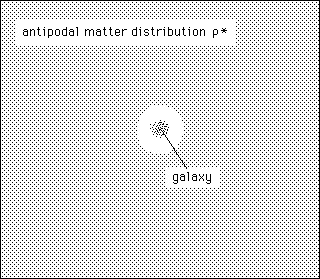
Figure 11 : Une galaxie s'installant dans un nuage homogène de matière antipodale.
Un trou dans une distribution de masse négative produit un effet de lentille gravitationnelle positif.
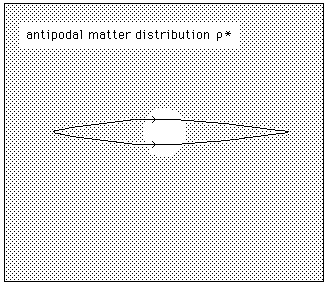
Figure 12 : Effet de lentille gravitationnelle positif induit.
Qualitativement, cela équivaut à l'effet produit par une sphère homogène de masse positive. Voir la figure 13
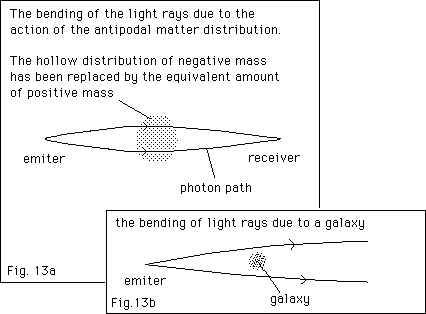
Figure 13. - 13a : Effet de lentille gravitationnelle positive dû à la distribution de matière antipodale (agissant comme une masse négative). Nous avons remplacé le vide par une masse positive équivalente. Comparaison avec la lentille positive due à une galaxie (Fig. 13b).
...Classiquement, on utilise la lentille gravitationnelle pour évaluer la masse dite invisible contenue dans une galaxie. On dit souvent : « la matière noire existe dans notre galaxie : nous la mesurons, à travers l'effet de masse manquante ». Dans ce modèle cosmologique jumeau, un fort effet de lentille ne devrait pas être une preuve de l'existence de masse invisible dans une galaxie, mais pourrait résulter de l'action de la matière antipodale environnante invisible, dont on pourrait évaluer l'effet à partir des effets mesurés. Voir la figure 14.
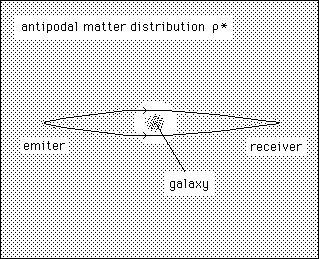
Figure 14 : Combinaison des deux effets de lentille gravitationnelle positive dus à la galaxie et à la matière antipodale environnante.
...Dans notre galaxie, la masse nécessaire pour empêcher l'explosion due à la force centrifuge est d'environ dix fois supérieure à la masse observée. Si l'effet de confinement est dû à l'action de la matière antipodale invisible environnante, cela signifie que l'effet de cette matière invisible est important. Cela pourrait être général dans la région de l'Univers où nous vivons. Alors, toutes les galaxies voisines pourraient être entourées de halos denses de matière antipodale, et les effets de lentille gravitationnelle observés seraient principalement dus à la matière antipodale qu'à elles-mêmes.
...Le modèle fondé sur l'équation (1) apporte une nouvelle perspective sur le problème de la masse manquante [1] et sur la très grande structure de l'Univers. Ce travail s'appuyait sur l'hypothèse de faible champ et de faibles vitesses, et faisait référence à un Univers quasi-stationnaire, à l'échelle cosmologique, par rapport à l'espace et au temps. Pour compléter ce modèle cosmologique, nous devons maintenant étudier l'évolution de l'Univers dans son ensemble.
Version originale (anglais)
twin universe cosmology Twin Universes cosmology (p 4) .
...Let us schematize the situation. Consider an homogeneous distribution of antipodal matter. In this distribution we find, in some places, holes in whicht the galaxies nest.
Figure 11: A galaxy nesting in an homogeneous cloud of antipodal matter.
A hole in a distribution of negative mass produces a positive gravitational lensing effect.
Figure 12: Induced positive gravitational lensing effect.
Qualitatively this equivalent to the effect due to an homogeneous sphere of positive mass. See figure 13
Figure 13. - 13a : Positive gravitational lensing effect due to the distribution of antipodal matter (acting like a negative mass). We have replaced the hollow by an equivalent amount of positive mass. Compared positive lensing due to a galaxy (Fig. 13b).
...Classically one use the gravitational lensing to evaluate the so-called invisible mass contained in a galaxy. People uses to say : "the dark matter exists in our galaxy : we measure it, through the missing mass effect". In this twin cosmological model a strong lensing effect should not be a proof of the existence of invisble mass in a galaxy, but could be due to the action of the invisible surrounding antipodal matter, which could be evaluated from the measured effects. See the figure 14.
Figure 14 : Combination of the two positive gravitational lensing effect due to the galaxy and to the surrounding antipodal matter.
...In our galaxy the mass necessary to prevent the explosion by centrifugal force is about 10 times higher that the observed mass. If the confinement effect is due to the action of surrounding invisible antipodal matter, it means that the effect of this invisible matter is important. This could be general in the region of the universe we live in. Then all the neigbour galaxies could be surronded by dense halos of antipodal matter, and the observed gravitational lensing should be mostly due to the antipodal material than to the galaxies themselves.
...The model based on the equation (1) gives a new insight on the missing mass problem [1] and on the very large structure of the Universe. This work was based on the low field and weak velocities hypothesis and refered to a quasi-steady Universe, at cosmologic scale, with respect to space and time.In order to complete this cosmological model we have now to study the evolution of the Universe as a whole.