Untitled Document
Comment on this chapter 1:
Praise be to God
June 27, 2010
The most elementary prudence prevents me from reproducing the full content of the book on my website, which I would have liked to do. However, I am not prevented from mentioning the content of the chapters, by quoting short passages. I encourage my readers to purchase the book on the secondhand market, as I did myself. I will conclude with a general assessment of the book's content.
Amos Oz says that he could not reproduce the entire content of the statements, which often lasted several hours of hearings, conducted between October and November 1982. He limited himself to taking notes and reproducing the summary of the statements, which he does with a certain literary talent. He specifies that all these texts were immediately published, except the last one, in the Israeli magazine Davar, from November 1982 to January 1983.
Let's start with the first chapter "Praise be to God", which could have been titled:
** Welcome to Talmud City**
We are in a neighborhood of old Jerusalem. The streets are filled with pious Jews, dressed in their black coats. Oz tells us that he frequented this neighborhood in his childhood and at that time, besides this population of orthodox Jews, there were Jews of all tendencies and origins. There were members of the Haganah (the future IDF), of Irgun (the future Mossad), representatives of the British administration and of the Jewish Agency. He seems to refer to a period prior to 1947. Born in 1939, he was eight years old at the time of the creation of the State of Israel and these memories must be immediately before that time. He adds in particular that some distributed brochures denouncing the cruelty of Zionism or discussing the origin of the Arabs.
He tells us that today (1982) everything has changed. In the streets, the dominant language is Yiddish, that of the Jews from Central Europe. Posters call for the strictest observance of Talmudic rules. He writes "I feel claustrophobic. I want to run away." He describes a world reminiscent of that of Jews two centuries ago, as one could see in Central Europe, reconstructed here identically, completely cut off from the rest of the world. The only thing that modifies this scenery, which seems immutable, is, he says, the presence of a young Arab sweeping the sidewalk.
Posters invite passersby to go to Talmudic schools. As he says later, two characters emerge from these speeches: Hitler and the Messiah. Politically, the manifesto is summarized as: (Shimon) Peres on the lantern, (Mennahem) Begin in power. These Jews live in anticipation of the coming of the Messiah.
Oz talks about the school he attended as a child, where his teachers praised the feats of Joshua and Samson. Page 16, he even quotes the phrase summarizing the teacher of one of his masters: "a good goy is a dead goy." A vast program aiming to exterminate 999/1000 of humanity.
This school, he says, has been replaced by an institution called "Massora" and it is indicated that the teaching delivered there is neither Zionist nor anti-Zionist, but Jewish.
For the personalities interviewed by Oz, the entire life, private and public, can only be directed by the Torah. Any legislation can only come from the Torah. Consequently, the State of Israel and the Israeli constitution, not fully identifying with the principles of the Torah, are rejected. Daily life is ruled by the Torah, each member of the community having to take the advice of a rabbi, who in turn, etc... up to the top of a pyramid occupied by one or more "sages".
A* Today in Jerusalem, there are about 150,000 Haredim. Bnei Brak is a suburb of Tel Aviv, also consisting of 150,000 of these ultra-orthodox. In Ashdod, south of Tel Aviv, there are still 50,000 Haredim. In New York, the Haredim are mainly grouped in Brooklyn. For these Haredim, the State of Israel was destroyed by the will of God. Wanting to recreate it is a sin. Only the Messiah would have the power to do so. Over time (2010), a shift has occurred among these Haredim, some deciding to join the Zionist movement. Conversely, some groups, such as the Neturei Karta, the Edah Haredit or the Satmar Hassidim, are still very strongly anti-Zionist.*
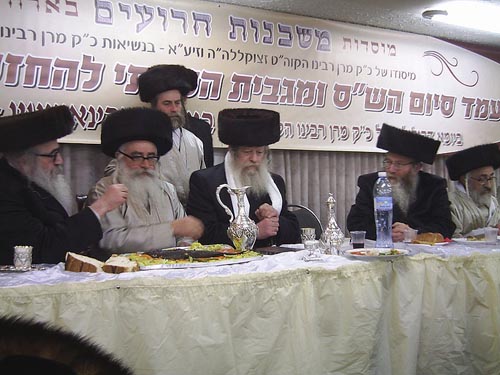
Rabbis of the Edah Haredit
The reader is encouraged to read what Wikipedia tells us about the "men in black", the Haredim. Far from being a minority group, they are becoming increasingly important in the Hebrew state due to a rapidly increasing birth rate, linked to religious prescriptions ("be fruitful and multiply"). There were 5% Haredim among Israeli Jews in 1999. According to the statistics office, they would represent 25% of Israeli children in 2006.
Back to chapter 1 of Amos Oz's book. It says: "On the roof, Arab workers from the municipal services are working, sent by the Zionist power to replace tiles." The teaching is centered on the Pentateuch (the first five books of the Old Testament). Oz asks if secular teachings are also delivered. Of course, he is told: arithmetic, calligraphy, geometry. But natural sciences are not, because "he who wants too much takes nothing".
The fact that the manual work done by Arabs seems normal to the locals. The notion of history is limited to the exodus from Egypt, the events reported in the Old Testament, so that students understand that when Divine Providence acts, it does so in an instant. Regarding the history of the rest of the world, Oz hears "that the goyim take care of their own affairs. We are the people."
You read well: "the people." For these people, other peoples of the earth simply do not exist, grouped together in the indistinct mess of non-Jews, the goyim. The outside world to this community, centered on the Torah and the Talmud, is only corruption and plunder. "Worse than the Arabs!" We are in 1982 and such a speech may seem surreal. From this neighborhood, whose evolution I do not know since 1982, Zionism is not even considered. Words of command remain such as "prohibition of participation in impious elections", "the daughter of Israel must dress decently", "alert to impious archaeological excavations, which come to dig up the bones of our fathers!". For these people, the words war, censorship, inflation, Likud, Labor, Eurovision, El-Al, are devoid of any meaning. They live outside the world, outside of time, without really working, simply benefiting from subsidies that pass through multiple subsidies from their schools and charitable institutions.
And Amos Oz concludes this chapter by saying that he is excluded...