GEOMETRIC RECREATIONS
Polyhedral representation of a cusp point, calculation of its concentrated curvature.
Polyhedral representations of various surfaces.
Permutation of cusp points on a Cross-cap.
Transformation of a "right" Boy's surface into a "left" Boy's surface, via the Roman surface of Steiner.
"Right-left" inversion of a Boy's surface.
Jean-Pierre Petit
Research Director at CNRS
1988–1999 ---
Abstract:
We present some elements enabling the representation of points of concentrated curvature: "posicones," "negacones," and their polyhedral equivalents: "posicoins" and "négacoins," which allow constructing polyhedral representations of various surfaces and recovering their total curvature. Thus, the polyhedral representation of the Roman surface of Steiner consists of four cubes joined along their edges, making it more comprehensible. A polyhedral representation of Boy's surface was previously given in Topologicon, 1985, Belin Editions, pages 48 and 49, in the form of a cut-out to be assembled. Page 46 also featured polyhedral representations of the torus and the Klein bottle. Polyhedral representations of the Cross-cap are provided. The total curvature of various immersions of the projective plane into R³—Boy's surface, Cross-cap, Roman surface of Steiner—is equal to 2π. The polyhedral representation of cusp points, considered as points of concentrated curvature, allows for a very simple calculation of this curvature. The Cross-cap, Roman surface of Steiner, and Boy's surface appear as "multiple faces" of a single object: the projective plane. Since this is not immediately obvious at first glance, we construct geometric transformations that allow transition from one to the other. We start with the Cross-cap, transform it into the Roman surface of Steiner by creating two additional cusp points (i.e., applying the generic modification "creation-destruction of cusp points" in this direction), then transform the Steiner surface into Boy's surface via the merging of pairs of cusp points. As a side note, using the fact that the standard embedding of the sphere can be transformed into its antipodal embedding (sphere inversion), we show that the two cusp points of a Cross-cap can be swapped through a sequence of immersions, illustrating the fact that these two points are equivalent.
PREAMBLE:
The reader will find here general elements also present in the introduction of Geometrical Physics A (definitions of posicones, negacones, etc.). If you wish to skip this section, simply [click here](#POSICOINS ET NEGACOINS).
If you draw a triangle on a plane composed of straight line segments, the sum of the angles at the vertices equals π. These straight lines on the plane can be obtained differently: by gluing strips of any adhesive tape onto the surface without folding. We then call these plane paths "geodesics." You can draw geodesic curves on any surface using this method, for example on a car's wing or hood.
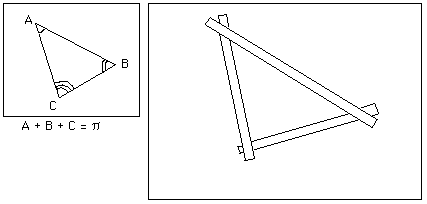
Figure 1: A triangle regarded as a set of three geodesics of the plane
POSICOINS AND NEGACOINS
Make a cut in a plane and rejoin the two edges. Then draw a triangle using your tape, composed of three geodesics of this cone.
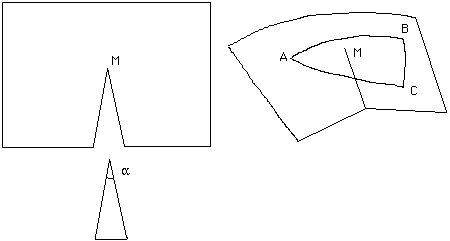
Figure 2: Construction of a posicone.
By separating the two flaps of the surface along the previous cut (Figure 3), you will easily see, using a protractor, that the sum of angles A, B, and C equals π plus the cut angle α. This deviation from the Euclidean sum we call curvature, and we say the triangle "contains" a certain amount of angular curvature α. This deviation will be the same regardless of the triangle, provided it contains the cone's apex. If it does not contain the apex, the sum will be π. We say the curvature is concentrated at the apex M of the cone, which is thus a "point of concentrated curvature." Since the sum of angles exceeds the Euclidean sum, we say this curvature is positive. Thus, from this perspective, a plane would be a surface with zero curvature.
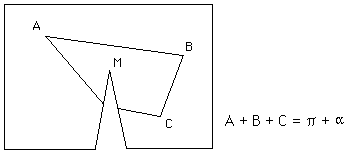
Figure 3: The posicone laid flat.
This curvature is additive. If you glue together several such cones corresponding to angles α, β, γ, you can draw all sorts of triangles composed of geodesic arcs. If the triangle encloses three points corresponding to concentrated curvatures equal to α, β, γ, then the sum of its angles at the vertices will be: π + α + β + γ.
One can consider a surface with positive curvature as a sphere composed of an infinite number of "posicones." Instead of having curvature concentrated at distinct points, we have curvature uniformly distributed over the entire surface. We say the sphere is a surface with "constant curvature" (or "constant angular curvature density").
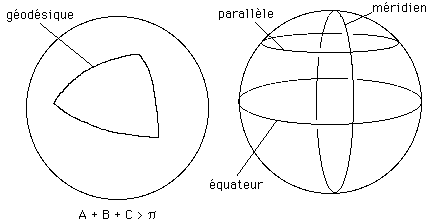
Fig. 4: A triangle composed of three geodesic arcs.
On the sphere, geodesics are "great circles." The equator and meridians are great circles, and thus geodesic arcs of the sphere. However, you won't succeed in creating a parallel using adhesive tape. Parallels are not geodesics of the sphere. The sum of the angles of a triangle drawn on a sphere depends on the ratio between the area of the triangle and the area of the sphere. The sum of angles of a very small triangle will be very close to π.
A triangle whose area is one-eighth of the sphere's surface area would have an angle sum:
A + B + C = 2π
A great circle of the sphere can be considered a "triangle," provided we place its three vertices... anywhere on the circle. The sum A + B + C will be 3π. It contains half the surface area of the sphere.
What is the maximum possible deviation? We cannot say "enlarge" the triangle beyond this great circle, because beyond that, the lengths of the geodesic arcs forming its sides would decrease and even tend toward zero.
When we have enclosed the entire surface of the sphere, we obtain:
A + B + C = 5π = π + 4π
We say the total curvature of the sphere is 4π.
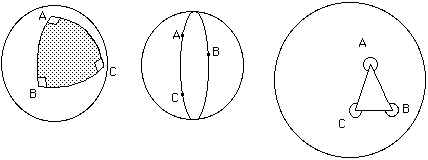
Fig. 5: Sum of angles. Triangle composed of geodesic arcs of the sphere.
The amount of curvature contained in a triangle corresponds to a simple rule of three:

We will now create a "negacone" by inserting an angular sector α into a plane, as shown in Figure 6.
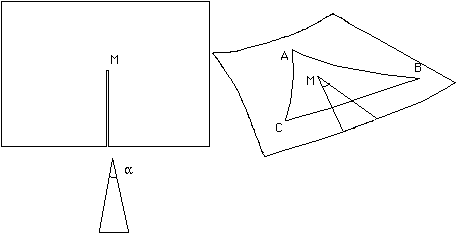
Fig. 6: A "negacone"
When we remove the angular sector, we obtain this:
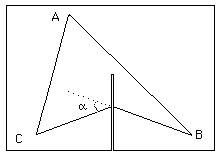
Fig. 7: The negacone laid flat.
The sum of the angles of the triangle is A + B + C = π − α.
We say this surface is a negacone possessing a point of concentrated, negative curvature. This curvature is also additive. By combining a surface with a juxtaposition of small posicones and small neg...