Flying Wings of the Horten Brothers
The German Secret Weapon
../Horten.htm@3_4_09
The Germans became interested in the concept of flying wings as early as the late 1930s. The concept of a machine reduced to a single wing had been introduced by Alexander Lippisch. The brothers Walter and Reimar Horten began working on flying wings as early as the late 1920s (around the same time as another pioneer, the American John Knudsen Northrop). Below is one of the few photos of Reimar Horten:
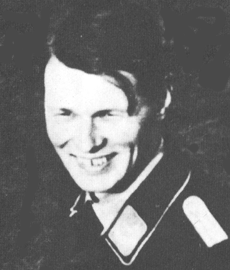
Reimar Horten
Different prototypes (twin-engine, propeller-driven) were built at the end of the 1930s, and the designers of these flying machines were also their test pilots. The first flights date back to 1937. Of course, the war strongly accelerated these researches. The Horten VII, which you will find an "artist's view" below, was built and tested in flight in 1943.
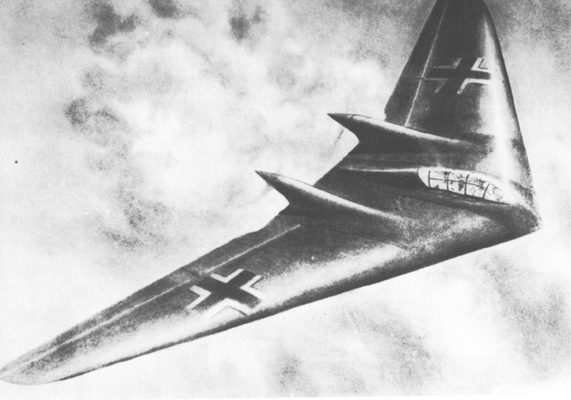
The Horten VII in flight
The photo below shows the aircraft in flight.
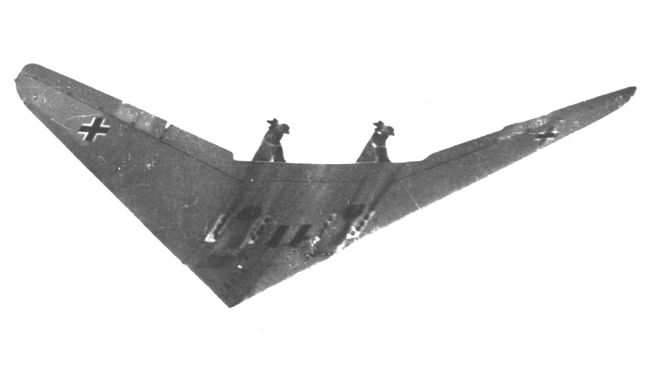
The Horten VII in flight.
In December 1944, the Germans were still working tirelessly on these strange aircraft, the goal being to develop twin-engine fighter-bombers equipped with Jumo turbojets. The elegance of the lines of these aircraft is visible in the following photo showing the Horten IX V1 and its pilot, Heinz Scheidhauer.
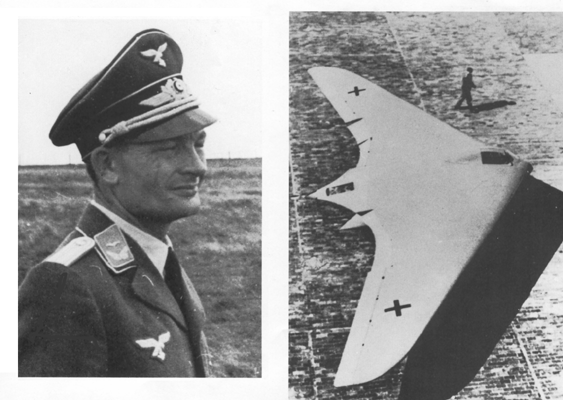
Heinz Scheidhauer, test pilot of the Horten IX V1 (Göttingen 1944)
At this stage, they were gliders intended to test the aerodynamic qualities of the aircraft, whose tests were conducted near the city of Göttingen. Below is a three-view plan of the Horten IX V3, also known as the Horten 229, a single-seat fighter-bomber, the culmination of the project. You can clearly see the arrangement of the two axial compressor turbojets, the front landing gear hatch serving as an aerodynamic brake, and on the top view, the small rectangular windows at the wingtips indicating the location of the "lift destroyers" (spoilers), designed to give the aircraft its maneuverability.
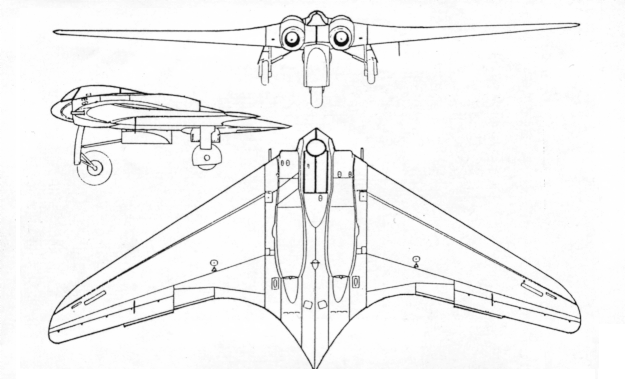
The Horten 229, single-seat fighter-bomber
If such an aircraft had been deployed against England, which had acquired a major advantage in the air war by acquiring radar at that time, the Ho 229 would have been completely invisible. The Germans knew this and we can consider them as the inventors of the stealth concept, which was rediscovered much later by the Americans. The Horten IX V2, also a twin-engine aircraft, was built and tested in February 1945 but was destroyed during testing. The following photo shows the aircraft under construction, in a simple garage intended to accommodate three vehicles. (At that time, Germany was the target of intense bombing). You will notice the extreme purity of the machine's lines.
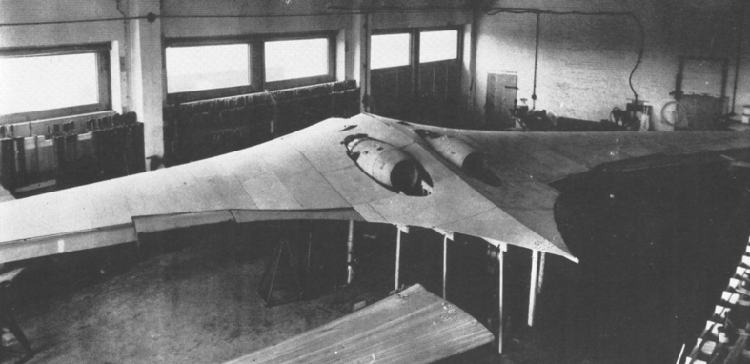
The Horten IX V2 under construction, in a simple garage.
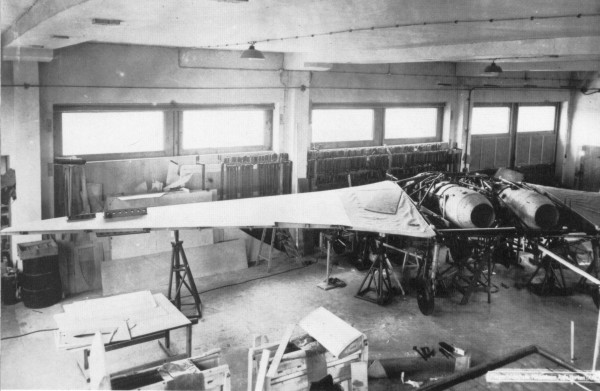
On the left, emerging from the wing, the "spoilers" allowing roll control by increasing drag.
System that allowed the Horten wing to do without a vertical stabilizer and made it the first stealth bomber in the world
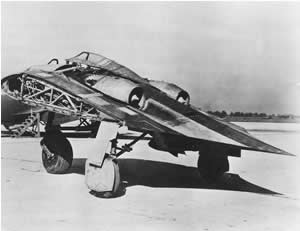
The central body of the Horten IX, viewed from the three quarter rear
When American troops invaded the area, at the time of the collapse of Nazi Germany, they came across the prototype of the Horten IX V3 (the Ho 229), below, which was immediately transported to the United States in the greatest secrecy. In fact, this aircraft was never shown to the public, perhaps because this vision would have shown the German genius in aerodynamics and the advancement of its technicians in this field, towards the end of the war, whose activities were fortunately interrupted by the lack of raw materials and the devastating effect of the intense bombing. The first twin-engine flying wing fighter-bomber therefore rusts, partially dismantled, in a hangar in Silver Hill, Maryland.
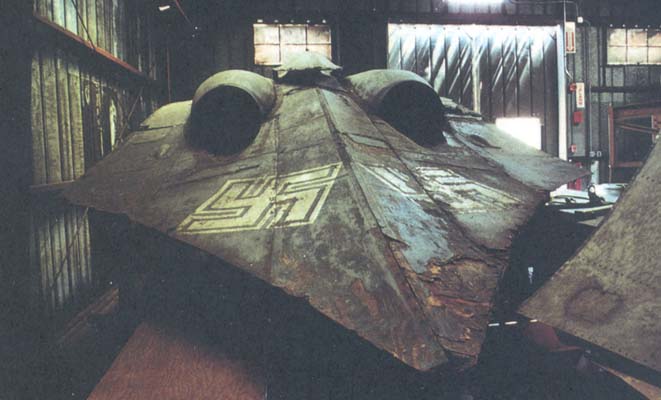
The twin-engine fighter-bomber Horten IX V3 (rear view and canopy in rear position)
in a hangar in Silver Hill, Maryland.
Here are other views of the same aircraft:
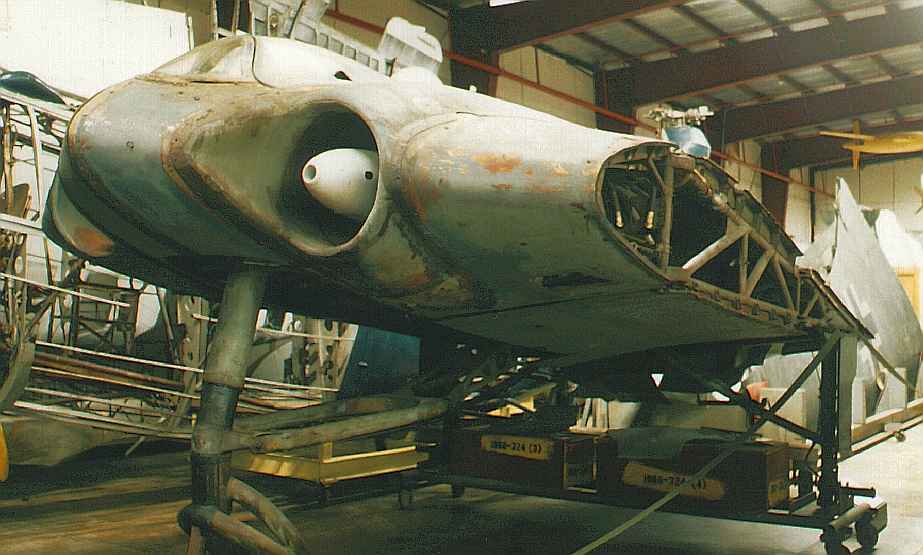
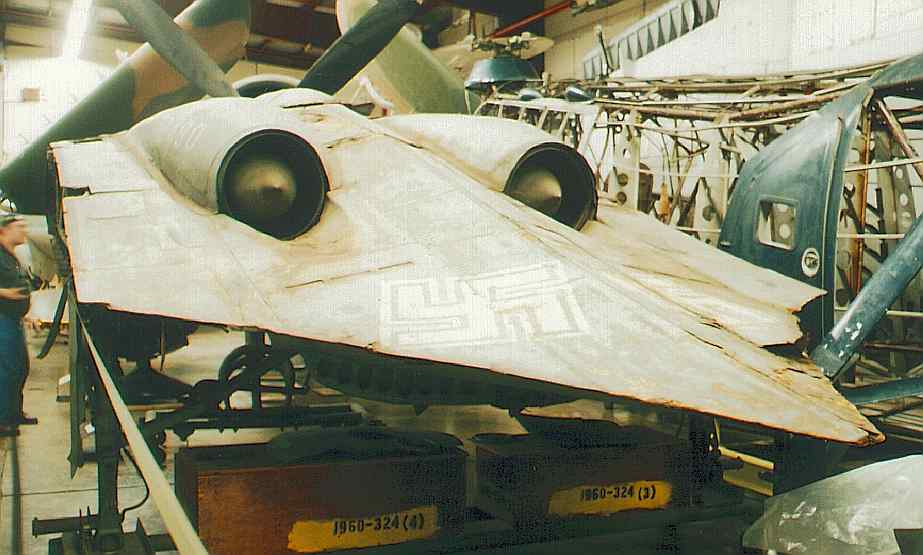
Here is a photo of the cockpit of the aircraft, taken from above, which shows that the aircraft's covering was ... made of wood (stealth!).

The cockpit of the flying wing, viewed from above
Link to the file dedicated to the flying wings designed by Jack Northrop in the United States
Noted by a reader, Daniel Aramini, the site http://aerostories.free.fr/constructeurs/horten/index.html which gives more details on this story of the flying wings of the Horten brothers.
May 15, 2009: Another site dedicated to the Horten wings: http://jpcolliat.free.fr/ho9/ho9-1.htm
JP Colliat site: http://jpcolliat.free.fr
May 15, 2009: Another site dedicated to the Horten wings: http://www.nurflugel.com/Nurflugel/Horten_Nurflugels/horten_nurflugels.html
--- ****
http://einestages.spiegel.de/static/topicalbumbackground/4028/traum_vom_tarnbomber.html
Published in the electronic edition of "Spiegel" on May 11, 2009. Flying Wing: Hitler's Dream of a Stealth Bomber. No fuselage, no tail - yet it flies: For Hitler, two German brothers developed the first combat flying wing. The absurd construction was the beginning of stealth technology: a coating of carbon dust made the Horten IX invisible to radar.
By Ulrich Jaeger The catastrophe occurred during takeoff from an airfield near Oranienburg. On February 18, 1945, one of the two engines of the twin-engine fighter "Horten IX" failed. Before test pilot Erwin Ziller could reach the rescue runway, the jet hit the ground and flipped; Ziller died in the wreckage.
With the crash near Oranienburg, almost three months before the collapse of the Hitler empire, the great flying dream of the brothers Reimar and Walter Horten broke. From the glider models they made in 1928 as students in Bonn, to the prototypes they created as officers of the air force towards the end of the "Third Reich," the two passionate builders worked on their idea of the ideal plane: the flying wing without fuselage or tail.
The brothers successfully experimented with planes with or without engines, and built with the Horten IX the first and only jet-powered flying wing in aviation history. They dreamed of a passenger plane without a tail for transatlantic flights and sketched a supersonic flying wing. The pilots were to sit in a cockpit filled with water to protect themselves from the forces due to acceleration in turns and an altitude of 12,000 meters.
Flying wing bomber on the way to New York For the head of the Luftwaffe, Reich Marshal Hermann Göring, the Horten brothers developed the concept of a long-range flying wing bomber equipped with six jet engines. It was supposed to terrorize New York with its bombs and perhaps regain the advantage in the lost war. On April 1, 1945, five weeks before the end of the war, according to Göring's absurd plans, the construction of the bomber should begin near Kahla near Weimar.
According to experts, no pioneer of aviation from the previous century contributed as much to the development of flying wings as the tireless workers from Bonn. Convinced that the aerodynamics of flying wings surpass conventional planes with fuselage, wings, and tail, they sketched and developed more than two dozen flying wings.
Indeed, this concept offers significant advantages. While conventional aircraft use up to 50% of their surface for lift, flying wings can use 90%. Fuel economy compared to fuselage aircraft ranges between 10 and 25% according to aerodynamicists.
Spin trouble However, these desired effects have some nice side effects. Because as the prototypes evolved, flying wings tend to be unstable. If a conventional aircraft loses altitude in turbulence, it gains speed. The wing thus generates more lift. The aerodynamic alternation brings the aircraft back to a stable horizontal flight on its own.
Flying wings do not have this intrinsic stability. In principle, it would be possible to make them stable with an ingenious construction, according to Hamburg aerodynamicist Harmut Zingel. In practice, however, jet-powered flying wings are only maneuverable with a computer as a co-pilot, as with modern passenger aircraft. Like modern military aircraft, whose on-board computer constantly corrects the flight path, making the aircraft maneuverable.
Thus, and until today, only one jet-powered flying wing is operational. The American stealth aircraft B-2 "Spirit" maneuverable thanks to computer assistance. The long-range bomber of the U.S. Air Force made its first flight in 1989. Its particularity of being almost invisible to radar is also due to its flying wing shape - a feature that already haunted the Horten brothers in military use.
Cockpit with wings In the early 1930s, when they were working on their first glider model in the parental bedroom, the students had only the aerodynamics of the unusual aircraft in mind. It had nothing more than two wings and a small cabin, in which the pilots had to lie on their stomachs.
In July 1933, their "Horten I" took off from the airfield of Bonn/Hangelar. This unusual glider for its time was accelerated by a strong enough elastic to propel it 50 or 100 meters further at an altitude of 2 or 3 meters.
Towed by a car, the Hortens reached an altitude of 30 meters in their glider, made slight turns and thus were able to cross the entire airfield. The flights, noted Reimar, served him and his brother "for learning" the unusual flying machine. They also made takeoffs after being towed by an airplane and worked on optimizing the flight control.
Hannah Reitsch was too light The development advanced so quickly that the H I was ready in June 1934 to obtain official approval and thus participate in a large flight day in Bonn/Hangelar. In the competition with conventional gliders, the flying wing showed its excellent qualities and won a construction prize of 600 Reichmarks.
The H I was followed in 1935 by the H II. Equipped for takeoff with a 20 HP engine, the flying wing named "Habicht" [ndT: in French, a kind of hawk, a raptor close to the falcon] was propelled by a rear propeller. Thus, the brothers brought the first powered flying wing into the air and at the same time created a category of aircraft later called motorized gliders.
When the German pioneer aviatrix Hannah Reitsch flew on a Habicht equipped with a 60 HP engine in 1938, she made criticisms. Her arms were too short to reach the landing gear lever. But above all, she criticized, "The HII reacts excessively and unkindly when the flight controls are moved in an uncoordinated manner." This did not surprise the constructor Reimar Horten, because the pilot was simply too light: "H. Reitsch," to explain the reasons for this unkind flight behavior, "did not have the minimum weight required for a pilot, so the center of gravity was too far back." "Jumos" for the special command IX Still in the same year, on the eve of the Second World War, the Hortens tried the "Horten V," a twin-engine successor to their H II. The H V was in a way the propeller predecessor of the only jet-powered combat flying wing ever built, the "Horten IX." Walter, like Reimar, was already an air force officer of the Reich at that time, both qualified fighter pilots.
By the end of August 1943, Reich Marshal Göring placed an order with the brothers. They had to develop a "1000-1000-1000" fighter-bomber with the powerful Jumo 004 engines developed by the Junkers company: a fighter capable of carrying 1000 kg of bombs at a speed of 1000 km/h over a distance of 1000 km.
Under the designation "Special Command IX," the development of the "Horten IX," also called Ho 229, began in Göttingen. The builders also thought about the radar signature of the aircraft according to Reimar Horten's proposals. It is already better than that of conventional aircraft, because the fuselage has a large reflective surface - an aircraft that lacks rear surfaces is harder to locate.
Carbon dust + glue = invisible However, Reimar, according to his own statements, wanted more: a layer of glue mixed with carbon dust should absorb the radar waves and thus make the combat aircraft almost invisible to the British and American radars. Indeed, the Americans later made their own ghost bomber with a special coating and the arrangement of the engines and their exhaust gases.
The brothers Horten already thought about an ejection seat for the pilot. Here too, the form of their construction meets the technology. While ejection seats of traditional fighter aircraft must be propelled to a certain height to avoid contact with the tail, a simple solution was sufficient for the Ho 299.
The seat was catapulted out of its position in the cockpit by a spring, a pull parachute was supposed to save the pilot from his aerial emergency. Why Erwin Ziller did not use the rescue seat on the fatal day in February remains a mystery even for Reimar Horten.
Despite the failure of the test flight, the Horten IX left its mark in aviation history. During their advance towards Berlin in the last months of the war, American soldiers discovered parts of the Ho IX at various production and test sites. Thus, a complete central fuselage with engines was found in Friedrichsroda, elsewhere almost completed wings would have been found.
All the parts found by the Americans were immediately sent to the USA. Because there, the aircraft manufacturer Northrop had already been researching the concept of flying wings since the 1940s. In the early 1950s, he was able to successfully conduct test flights of his XB-35, whose results eventually led to the development of the stealth bomber B-2. Thus, the only jet-powered flying wing ever built in series still carries today the legacy of the Horten brothers.
Translation Antoine Paques
Noted by Bernard Dropsy: a site that offers kits to build different types of flying wings (Horten, Northrop).
http://bellimelgroup.com/products.htm
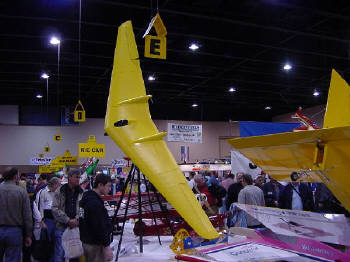
It also features what seems to be "the largest scale model in the world." A motorized reproduction of a Northrop wing: seven meters...
April 3, 2009: What if Hitler had had the bomb?
Nazi technoscience has fascinated many, to the point that ufology sites continue to suggest that scientists working for Hitler may have had ... flying saucers. But without going that far, what modesty when it comes to mentioning the speed, the very genius of the engineers that this megalomaniac was able to inspire!
One of the greatest heroes, who history has neglected, may be Werner Heinsenberg, the inventor of one of the main pillars of quantum mechanics: the uncertainty principle.
The controversy regarding the German bomb
Back to the beginning of the file "The German Secret Weapon"
February 8, 2006: The smallest scale models in the world
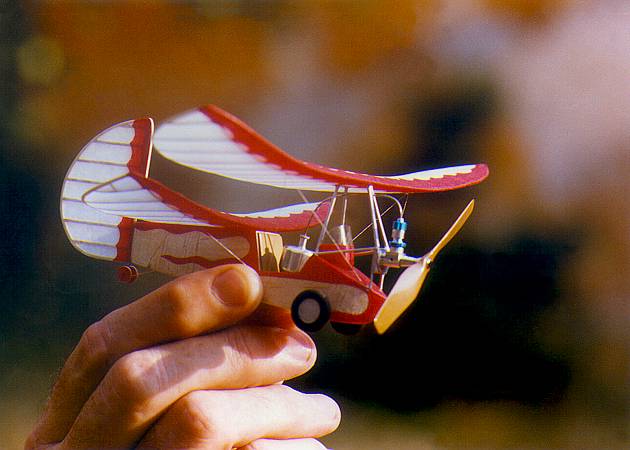
I didn't know where to put this mini-file. I found it amusing to mention these achievements after presenting, above, "the largest scale model in the world." Their construction was possible with the emergence of a CO2-powered engine, with increasingly smaller displacements. Almost half a century ago, it was the Cox company that produced these mini-engines, whose displacement already reached 0.4 cc. There, I imagine it must be even smaller. A reader may perhaps specify the brand and displacement, the weight of this engine. In any case, here are two achievements, which fit in the palm of a hand.
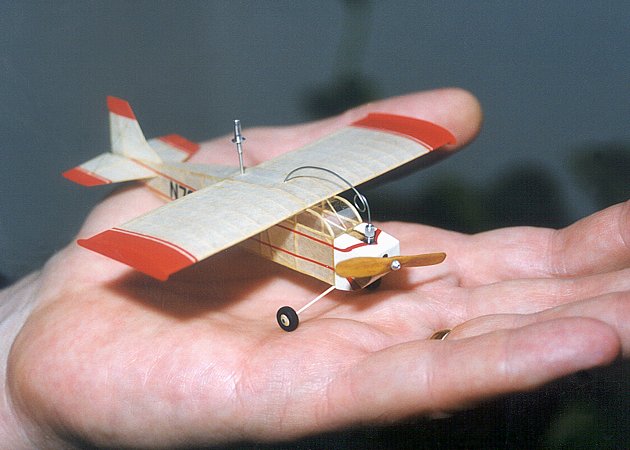
**This one is inspired by the famous "Pour du Ciel" invented in the 1930s by the French Mignet **
Found by Patrick: go to
the engines made by this Czechoslovak company Gasparin
To the page dedicated to Northrop flying wings
Back to Guide Back to Home Page
Views of this page between October 22, 2001 and February 8, 2006: 38,822