History of Jack Northrop's Flying Wings
The Saga of Northrop's Flying Wings
John Knudsen Northrop (later nicknamed "Jack" Northrop) left school in 1913 with only a high school diploma. In 1916, at the age of twenty, he worked as an automobile mechanic in Santa Barbara, not far from a workshop where the brothers Allan and Malcolm Loughead (whose name would soon be re-spelled Lockheed) were drafting plans for their future flying boat, the F-1. Noticed by the two brothers, the young Northrop was quickly integrated into their team and renamed "house engineer." In 1927, the first monoplane with a high wing designed by the young Northrop—unbraced and without a fuselage—flew for the first time: the famous Lockheed Vega, greatly appreciated by renowned pilots such as Amelia Earhart, and which achieved immediate commercial success. It could carry four passengers at 170 km/h over a distance of 900 kilometers. Subsequently, Northrop founded his own company.
From the beginning of the war, Northrop envisioned the potential of aircraft devoid of any tail or fuselage. Thus, he designed the N-1M. This aircraft is one many of you have seen, as it served as the model in a scene from the movie "Raiders of the Lost Ark":
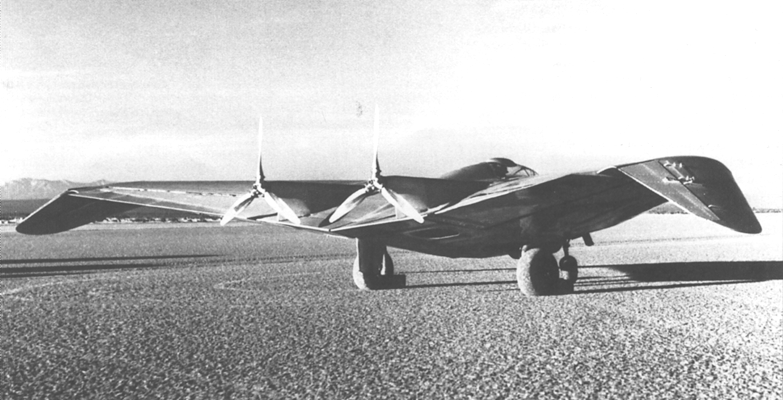
The Northrop N-1M (1940)
Twelve meters in wingspan, powered by two 65-horsepower engines, constructed from mahogany wood, the N-1M was intended to explore the performance potential of flying wings. A "variable-geometry" aircraft, the N-1M could adjust its dihedral angle and wing sweep (here shown in the lowered position) on the ground during pre-flight preparations. Before building the aircraft, Northrop conducted tests in a large dance hall in Pasadena. He dropped a 35-centimeter model from a balcony at the highest point and began testing his carefully balanced model’s ability to recover from spins. Von Karman, an aerodynamicist who would later become famous, took notes from the audience.
- "Since the model always recovered to normal flight before hitting the ground, we left reassured."
The N-1M was therefore built, and flight testing began.
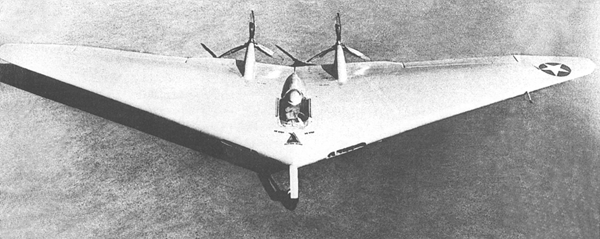
The Northrop N-1M with wings fully deployed.
Despite its relatively weak powerplant, this first aircraft performed satisfactorily. Northrop abandoned his initial idea of lowered wing tips, which may have been inspired by watching birds in flight. Over the following three years, the aircraft evolved to achieve greater aerodynamic refinement, as seen in the N-9M, which completed around a hundred flights in 1943.
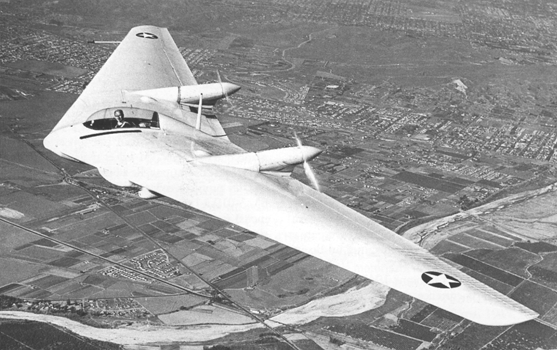
The Northrop N-9M in flight, 1943
In fact, this was a flying model of a massive long-range bomber. This aircraft could reach 400 km/h and climb to an altitude of six thousand meters. After the Japanese attack on Pearl Harbor on December 7, 1941, the Americans sought to develop long-range bombers capable of reaching Japan from distant bases. Thus, the first phase of the project was born: the four-engine YB-35, each engine producing three thousand horsepower.
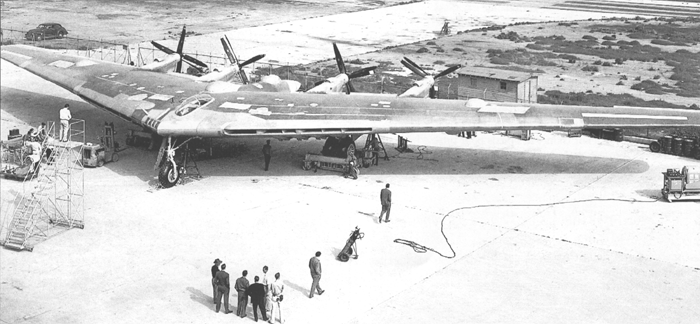
The Northrop YB-35 with its eight counter-rotating propellers completed in... 1946. Wingspan: 52 meters (the same as its successor, the B-2).
Why such a delay in building this aircraft? The reasons were multiple. Stability and spin recovery issues had already appeared at the model stage, with the N-9M. The aircraft turned out to be heavier and less aerodynamic than expected. In Europe, by 1944, having access to forward bases allowed the simple B-17s to bomb Germany effectively. In the war, the recapture of islands located north of Japan enabled the B-29 Superfortresses—responsible for dropping the first atomic bombs in the final days of the conflict—to bomb Japan. Additionally, the emergence of the first jet engines signaled the end of propeller-driven propulsion. In the USA, this transition, though delayed, was rapid and dramatic. Thus, the YB-49 project was born: a YB-35 equipped with eight turbojets, which first flew in 1947.
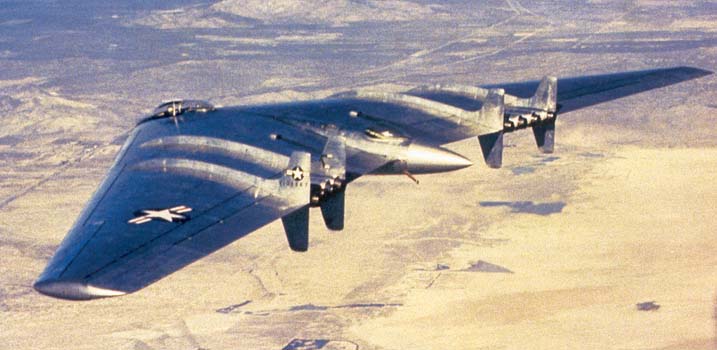
The Northrop YB-49 octojet, the first American stealth aircraft.
Flight testing of the YB-49 was not without difficulties from the very first flights. The weak point of such aircraft was their behavior during stalls—a phenomenon in which a portion of the wing ceases to generate lift. On these wings, these regions were unstable and tended to migrate toward the wingtips, causing an immediate spin. This is why the YB-49 was fitted with "fences" (barriers), clearly visible in the photograph, ending in ineffective rudder-like ailerons. Unfortunately, these barriers did not extend all the way to the leading edge and thus proved ineffective at preventing spins.
Meanwhile, the Americans discovered the concept of stealth. Indeed, every time the giant flying wing approached the airfield serving as its destination, radar operators were unable to detect it. During its twenty-fifth mission, the second prototype was lost. Since the aircraft was flying without escort, the exact cause of the accident remained unknown. The Air Force then demanded additional tests to analyze the aircraft's flight characteristics, its stall behavior, and its ability to recover from spins. That is when things went wrong. At the end of 1948, during a stall test at an altitude of 9,000 meters, the YB-49 appeared to pitch up sharply on its short tail, then plunged toward the ground, spinning like a dead leaf. The pilot managed to recover only at 2,500 meters. From a military standpoint, the flying wing proved to be a poor bomber due to its unstable flight characteristics. The bomb dispersion circles on the ground were twice as large as those of the venerable Superfortresses.
The Cold War had given rise to the famous Strategic Air Command in the USA. The need for long-range bombers resurfaced. The Air Force then opted for the Convair B-36, a propeller-driven "Stratofortress," as the first intercontinental strategic bomber:
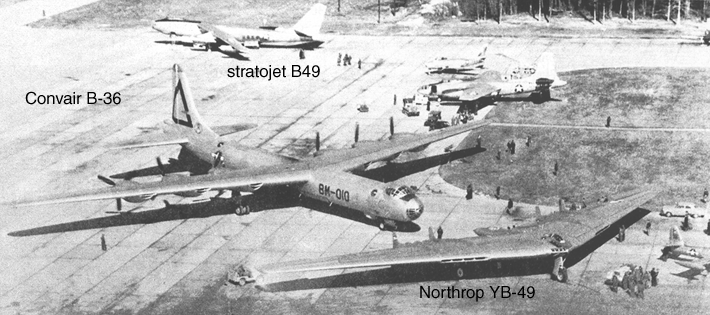
In the same photo: the "Stratofortress B-36," the Northrop YB-49, and the Stratojet B-49.
In the foreground, the Northrop YB-49, which was abandoned in favor of the quadruplex Stratojet B-49 as a medium-range bomber. Before long-range missiles became dominant, the B-52 eventually replaced the B-36. These are the aircraft seen in the famous film "Dr. Strangelove." All photos are extracted from a special issue of AIR FAN No. 57, June 1998. Aifan nanavia, 48 Bd des Batignoles, 75017 Paris. The last, little-known photos are truly astonishing. In 1949, Harry Truman was highly enthusiastic about the YB-49 flying wing. During a demonstration flight, he requested that the aircraft fly over the White House "so people could see what I want to buy!" he said.
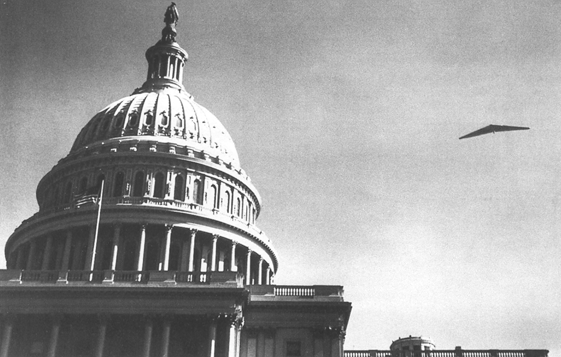
On February 15, 1949, the YB-49 flew over the White House.
The second image shows eleven of the thirteen YB-35s built, currently undergoing transformation...