Untitled Document
The Lover of Mamy Wata
January 25, 2013
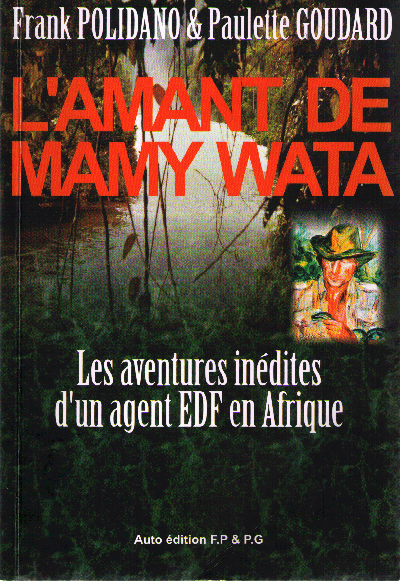
Book by Frank Polidano
Died suddenly on March 25, 2013, from a lightning-fast lung infection
She is everywhere, in all countriesThe Contaminated France
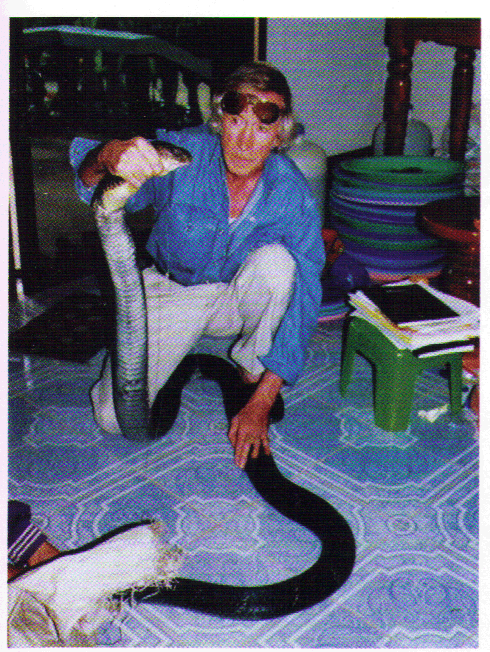
| I | t is an self-published work. You can obtain this book by sending a check of 25 euros to the name of his brother-in-law, Henri Goudard, Lotissement Les Chênes, 64 rue des Eoliennes, 05230 la Bâtie Neuve. | Shipping is included. | I | t is rare that I write a reading note on a book. I have to really connect, and in any case, I would never do it out of friendship, to "do a favor." | U | a friend sent me Frank Polidano's book, and I immediately replied | - I'm telling you right away that I'm not sure I'll write a note on this book. | M | but here, I connected, I admit it. The book is well written. The chapters are uneven, not because of a fluctuation in literary quality, which is good, but because sometimes the subject doesn't lend itself well. It's easier to tell an anecdote involving people than to describe a landscape, a river descent, or a light plane flight. | N | don't be bothered by the poor quality of the illustrations. The photographs in this self-published work are generally poorly reproduced. The scan below will show you. The photo shows the author holding a royal cobra several meters long, one of the two most dangerous species in the world (the other being the African black mamba, both being deadly and capable of exceeding 5 meters). This is just part of the life of this all-around man who, after finishing his career as an EDF engineer, in charge of the exploration and construction of hydroelectric dams in Central Africa, started a reptile farm in Vietnam, from which he extracted venom from his inmates, highly prized in the pharmaceutical industry (for example, involved in the design of anticoagulants). The export is then in lyophilized form, hence the title of his email address | Frank Polidano, holding a large royal cobra, deadly. | F | rank has no children. He wrote this book to leave a memory for his friends and nephews. Many names are mentioned, so those people will take pleasure in recognizing this book-journal. Obviously, this is not what will interest the average reader who stumbles upon this book. | A | part from this literary overload, what can one take from this reading? The testimony of a Frenchman who spent a large part of his life in Africa and traveled from city to city, from site to site, from woman to woman. As he told me on the phone just now: | - Africa, you never get over it. | Q | what do we, Europeans, know about it? Nothing. Africa is a human jungle, an ant hill. It has its high places, its paths, its areas of light and sun and its shadowy areas. We, the "high culture" countries, have ours. Simply, ours are better hidden, more insidious. Instead of delivering drugs and poisons, one by one, we do it by poisoning large masses of people, with our "media." And when something disturbing emerges, they make sure it is smothered as quickly as possible. I remember the "suicide" of a French official, who shot himself... two bullets in the head. And a journalist explained to us that sometimes a bullet can get stuck in the barrel, and is expelled by the second one!! | P | icture 9/11, an affair so well buried that it seems not even worth talking about, so much the public has accepted that we are fitted with headphones and solid goggles. | P | icture the recent speeches of Osamu Motojima and Geneviève Fioraso, our new minister of higher education and research: | - We would be crazy to miss ITER. We are going to conquer the sun! | (Too strong! There, I give up....) | D | espite everything, what happens in Africa, we have lived it in our past. How many kings, notables, heirs have died after putting on a simple pair of gloves, victims of transcutaneous poisons? | I | t was a few years ago that an ex-DGSE agent, met in Dubai, who was not worth the rope to hang him, told me about the evocation of the assassination of an African head of state, too uncooperative for the taste of Westerners and big companies. They had painted a transcutaneous-acting drug on the pilots' sleeves of his plane. Shortly after takeoff, the pilots, feeling unwell, lost control of the aircraft, which crashed. It was enough for an agent, presenting himself as a journalist, to visit the wreckage later and wipe away all traces of the poison with a simple cloth. | &&& | &&& | F | ollies of all that? | . Here, we poison on a large scale, with GMOs, with radioactive waste that we intend to store underground, after having dumped extraction residues under the asphalt where children play. See | . | S | imply, in Africa, all of this is done in the open, in the most natural way possible. You can say "it's part of the culture." In Africa, the use of poisons also serves as a means of pressure, like the mafia in Italy. In Polidano's book, you will read the story of a white man, married, who had a nice lover in Africa. Suddenly, she becomes pregnant. We only know that the man refuses to marry her, not even because he is already married, which he had hidden from his companion, but refuses to pay a little money to the family, as compensation for the "gift" she will leave when returning to France. | A | t that point, what do the girl's parents do, in desperation? They go to the local witch doctor, who provides a drug administered to the man, turning him into a vegetable, to the point that he has to be repatriated. Frank, learning of the news, gets involved. The girl confesses. The culprit is repatriated, and, in exchange for the compensation requested, which is added to the "witch doctor's fees," the latter provides the antidote that quickly restores our man to health, and he returns to France, more dead than alive. | Read about this in episodes 3 and 4 of the excellent Bourgeon BD series "Les Passagers du Vent" | In this case, "Le Comptoir de Juda" and "l'Heure du Serpent." | E | n truth, in terms of pharmacopoeia, the Westerners are children, with their big pharmaceutical laboratories, compared to the Africans. We have antidepressants, from which one can become dependent. | - Be careful, the doctors will tell you, if you stop abruptly, boom! | I | t is logical that there exist | depressants | , psychotropic drugs that make one | apathetic | (without will), which allow the surroundings to sign anything, a fictitious debt acknowledgment, a transfer of property. These anxiogenic drugs can even push fragile beings to end their lives. The perfect crime, committed by people no one would suspect...