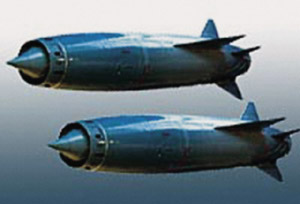
Russian MHD torpedo technology
Annex 3: American MHD torpedo
The study of this torpedo began in the early seventies. It became operational in 1980. At the time, its speed was 1000 knots. Today, it must be close to 1500 to 1800 knots. The principle is very simple.

In water, surface drag is 1000 times higher than in a gas like air. This limits the speed of torpedoes using conventional propellers to 65 knots. During the sixties, advanced navies developed rocket-propelled torpedoes. In addition, a generator injected hot gas at the stagnation point. This immediately transformed the water into steam. The torpedo could then move inside this kind of gaseous bubble. The corresponding American torpedo, named "Supercav," is capable of reaching 300 knots. Similar performance for the equivalent torpedo built at the same time by the Russians, called "Sdqwal." But an MHD torpedo can go much faster. Electrical energy is produced by a wall generator, coupled to the nozzle of a solid-propellant rocket. This electrical energy feeds an MHD wall accelerator that covers the entire surface of this one-meter-diameter machine and draws in water very efficiently. Russia and the United States are the only countries in the world to possess MHD torpedoes, which gives them a considerable strategic advantage. China would like to possess such a weapon. It attempted to buy it from Russia. A demonstration was planned, using the Russian submarine "Kursk," where a Chinese general, transported by helicopter, was to board. The Americans, warned by their secret services, sank the Kursk using a British submarine that approached nearby and fired a special delayed-action weapon. Two minutes later, the Kursk lay on the bottom at a depth of 107 meters. The nuclear cruiser "Peter the Great" sent an ultrasonic message to the Kursk, causing all its doors to close so that all crew members were locked in.
In reality, it is very surprising that no one among the crew attempted to escape alone, using their standard individual equipment. Next, the standard European equipment, produced by a British company:

This equipment is very complete. A rubber boat is placed in a bag attached to the man's left leg. After inflation, the man can sit inside and easily withstand the cold.

If no one used such equipment, from a moderate depth, this confirms that the Russian submarine Kursk was locked. A small submarine attempted to recover the Chinese general and the captain of the Russian submarine. But a mutiny occurred, causing many deaths. The evacuation of the Chinese VIP was abandoned. The flagship cruiser Peter the Great warned all vessels present in the area that anyone wishing to approach the Kursk would be immediately sunk. Putin let a hundred men die.
Later, the Russians brought the submarine back to a port. Its torpedo room was cut open and destroyed in order to conceal the large size of the MHD torpedo tubes (one meter in diameter). They removed all sophisticated equipment such as anti-torpedo systems and, of course, the famous Granit missiles: