October 11, 2004
Updated on October 15, 2004
April 2005
:
I take a look at this page: it has been viewed twelve thousand times.
It was a project and, I believe, a great idea. I thought, in the troubled situation we are currently in, that one of the urgent things to do would have been to equip people with a means of communicating with each other, beyond the barrier formed by their languages. I remain convinced that a team of motivated people could have, in a few years, come up with a tool that could, for example, be connected to a communication software like MSN Messenger (a work done by the Israelis, bought at a high price by the richest man in the world: Bill Gates).
I had given a first direction, intended to show that one could create a sort of entirely ideographic meta-language, "translatable". The example was that of messages delivered in airports, in the style:
- Due to bad weather conditions, flight AF 254 is suspended. Passengers are requested to present themselves at terminal C with their ticket and passport. An attendant will take charge of them and direct them to a hotel in the city where they will stay until their transportation to the city of &&& becomes possible.
Such a message could be entirely coded in ideograms, with fixed images and animations, which could be displayed on a large panel in all airports around the world, which would not prevent the same message from being displayed at the bottom in "usual languages". At the limit, this project could have been commercially viable. Those who would have developed it and to whom I would have willingly given all rights could have sold it to airlines, or to a consortium of airlines, or granted an operating license to airports. These messages are limited in number.
Only one reader claimed to have formed a "team", done something. I had personally committed to making, very quickly, the drawings and animated gifs that make up the "bricks" of this completely ideographic language. All of this dragged on for six months. I waited in vain, nothing came. It should have been finished by the end of January, then the end of February. Today, it's not even mentioned anymore. I think it's another project that is "dead", definitively.
On the other hand, I received many comments, advice or even questions from readers who asked me:
But how are you going to
develop your project. How do you plan to manage such and such a problem?
Simple observation.
We can close this chapter (you can read the rest if you like. Personally, I have lost interest in this issue due to the lack of response) with a humorous note, but by showing that a relatively sophisticated message, a sentence with a subject, a verb and a direct object, imagined by a Russian, could turn out to be directly understandable by ... hundreds of millions of people. See for yourself:
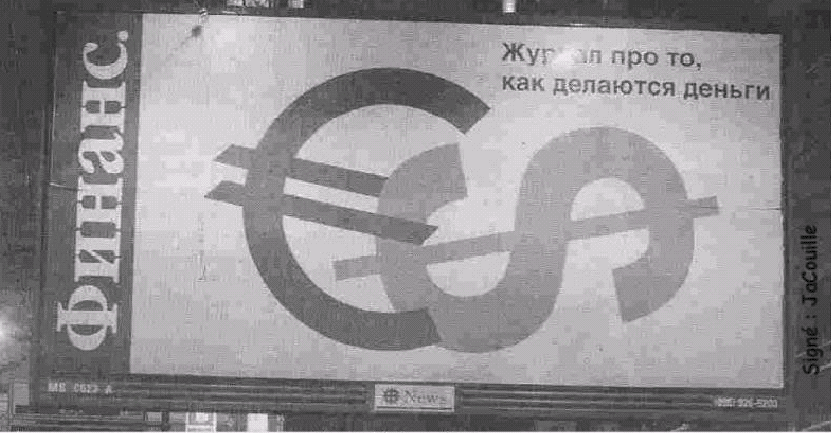
Indeed, when everything is ruined, when efforts have proven futile, one can always say "better to laugh about it".
But, for me, it's a somewhat sad laugh.
The general idea
Be realistic, consider the impossible
Ten years ago
I had imagined the concept of ANTIBABEL. It was well before I opened this site. Six years ago, when I created this one, I installed a page describing the idea. People read it, but few reacted. Some wrote to me: Is an Internet site designed to make people react?
Yes, this one is.
By creating it, I discovered, like you, things I hadn't imagined the extent of. Indeed, for twenty years I had known the capacity of the human mind to invent weapons of destruction, either specific or mass. I even wrote a book on the subject: "Les Enfants du Diable". What does the devil have to do with it? It's simply the code name of the army, in scientific circles. Since the publication of this book, in 1995, by Albin Michel (it had been written ten years earlier and "lived" another ten to twenty years before that), things have not changed much. Year after year I have installed files on my site, informing my readers of the sauce they may one day be seasoned with. Would you like to be neutralized by a
Taser
, or manipulated remotely by
microwave brushes
, anesthetized, put to sleep, numbed? Would you prefer to be cooked like chickens by mini-bombs, "bucky balls", etc....
Tiring.
Do you remember Martin Luther King, and his famous speech:
I had a dream
I had a dream
Today I want to dream. Don't you?
Our planet is the site of a phenomenon called "Life". This has shaped its habitat, modified the initial atmosphere, resulting from volcanic emissions. It was able to settle, expand. Phenomenologically speaking, Life tends to become more complex and to expand its relational field. It sometimes creates strange vehicles, like insects, which appeared at the same time as flowering plants, to carry plant seeds further. Other seeds are structured in a way to resist the gastric juices of birds that swallow them and can thus be transported even further. The genetic message has thus spread everywhere life could settle. Animals had a rudimentary technology. Volatiles, like our chickens, swallowed stones to crush their food. Some birds use twigs to fish insects from tree holes, on which they cling imprudently. There are crabs that stick different objects they find on their way on their shell, with a mucus they secrete, to camouflage themselves. The list is fairy, infinite.
But suddenly appears a strange animal, a biped, which develops these "technological attributes" far beyond anything any animal had done before. Ten thousand years later, it has forged hundreds of thousands of strange objects, for all purposes. Some allow it to transform its food before swallowing it. This is called cooking. Others protect it from the cold, the sun. Others carry it to all corners of the Earth. Others allow it to communicate using electromagnetic waves. Thanks to these, it can transport visual, auditory sensory impressions to the other side of the world. The Earth has become a tiny garden where people can communicate from distant parts of the globe. I received this morning a message from a woman who had read
the text
where I asked people who had been moved by the death of my friend Jacques Benveniste to send a letter to the address of the laboratory he had created. She replied that she would have liked to do it but that, from where she lived, the mail did not go through.
She was writing from Ulan Bator, Mongolia.
She could not write, nor receive a Western radio or television, but Internet, yes.
Ulan Bator! .......
Yes, that's where we are. Words, emotions can cross tens of thousands of kilometers, instantly. Before the different national powers, who are doing their best, cut these immaterial threads that connect us, we form an immense, planetary network.
But why? Telecommunications are just one facet of technology, which is just an extension of the living, of the "natural". Technology, which animals had millions of years before us, is just a new expression of the phenomenon of life. Incidentally, it has connected us all together.
But why technology?
Let's reverse the question: what can we do with technology and cannot do with the biological? Search......
Keep in mind this phenomenology of Life: to expand its relational field, to become more complex. It's simply a
fact
, observable, undeniable. Why is it so? Our purpose is not to answer this question. Let the philosophers deal with it. Let's just try to extrapolate the idea. Today, the Earth, we have circled it. Logically, we still have to go further. Towards the solar system? A bit limited. I am one of those who believe that interstellar travel will one day be possible, and not by enclosing entire populations in huge cylinders, as O'Neil, to send them, at a peaceful subluminal speed, to spread in all directions of the galaxy, on one-way trips, without even having the possibility to send a postcard to friends. I believe that interstellar travel will one day be possible by taking a "twin universe" where the speed of light is higher, respecting the principle "you cannot go faster than the speed of light in the sheet of the universe where you are moving".
If one day these travels become reality, only technology would have made them possible. Going further, I would even say that ... this was its function. Indeed, no bird, however large its wings, could ever cross light years.
But the technological attribute presents risks. Its development is rapid, infinitely faster than that of biological structures. Microprocessors develop faster than neural connections. It is with the stacking of our successive brains, structured like a Russian doll within our skull, that we manage our dangerous technological attributes. There is reptilian, primitive mammalian in each of us.
Dangerous.
Therefore, this animal called "man" had to be endowed with an additional, regulating attribute. Something that would allow to control this development, this new form of evolution "technological", otherwise "hyper-teleological" (from teleos, goal, and hyper, beyond). A "transcendence of purpose". It was necessary to have an attribute that would allow man to consider the consequences of his actions. This is not
intelligence
, which is only the ability to reprogram oneself, to "create code" to become more efficient in pursuit of a goal, whatever it may be.
The regulating attribute is called the
moral conscience
.
Not to be confused with the simple
consciousness of existence
. But in fact, there is no clear boundary. Let's say that the level of moral consciousness of man, compared to that of the animal, is in the ratio of their technological developments. Man is equipped to become conscious of his responsibilities, which are today on a planetary scale. Sakharov expressed this very well in his Nobel Prize speech, in the passage where he writes:
Thousands of years ago, human tribes suffered from great deprivation in their struggle for existence.
It was then important, not only to wield a club, but to have the ability to think intelligently, to take into account the knowledge and experience accumulated by the tribe and to develop links that would establish the basis for cooperation with other tribes.
Today, the human race must face an analogous challenge. Several civilizations could exist in the infinite space, among which societies that could be wiser and more 'performant' than ours.
I support the cosmological hypothesis according to which the development of the universe repeats an infinite number of times on the 'next' or 'previous' pages of the book of the universe.
Nevertheless, we must not minimize our sacred efforts in this world, where, like weak lights in the darkness, we have emerged for an instant from the darkness of unconsciousness into material existence. We must respect the demands of reason and create a life worthy of ourselves and of the goals we barely perceive.
Andrei Sakharov
Moral consciousness is an attribute that is supposed to allow man not to self-destruct with the dangerous technological tool he has in his hand at the end of his evolution and whose purpose is to allow the living process to continue, always with the same fixed idea: to expand the relational field, the next step being to establish contact with other life-bearing systems, located tens or hundreds of light years from the star where it resides. It is very close to discovering the techniques related to interstellar travel and this state leads to discreet surveillance by neighbors who have already crossed this threshold and wonder if this new member of the club will behave properly. Logically, exchanges will take place, enriching. In what form? We don't know. One day, vehicles built on Earth will take off towards distant systems. At that moment, will man be the passenger of these or ... just a driver of a kind of cosmic carriage.
A nice program. But something is wrong with us. Technology has developed well, but there was an accident. A planet of the solar system collided with the Earth while it was already well formed, with cooled magma, calm. Normally, life and technology could have developed there, as elsewhere, on a single continent, devoid of relief; inhabited by a single human ethnicity, dialoguing with a single language. The absence of natural barriers would have meant that this population, modulo some inevitable historical turbulence, would have been equipped with a minimum of political, social, ecological stability. Of course, this Earth would have been culturally, biologically and ethnically less rich, but more stable. You know the principle of Sa Forderie, in the Best of All Worlds:
Identity equals stability
Common sense, home, the ability to reason about effects and causes would have settled in with luck before the heavy technological tools appeared, which would have allowed them to be directed towards the true goal and not to continue foolishly waging war. But we were not lucky. A wandering star hit us, giving rise to the Moon as an ejection. All this kinetic energy had to be eliminated. It warmed our magma. The original flat continent, like the hand, broke up, giving rise to plate tectonics, mountain ranges, creating natural barriers, isolating ethnic groups from each other. And here we are today, on the eve of building our interstellar caravels, very occupied with resolving ethnic conflicts that go back several centuries, sometimes even several millennia. It turns out that power has fallen into the hands of the most foolish among us, like offensive grenades that would have ended up in the hands of eight-year-old children.
Humans also have a character that puts them in the greatest danger of disappearing. In their vast majority, they have a resigned, lazy nature. It is their history that has turned them into sheep. They only dream of entrusting their fate to leaders, political or religious. To make things worse: they do not all speak the same language, always because of this damned plate tectonics, the cause of our richness, but also of all our evils. So, even when they are animated by the best intentions in the world, they do not understand each other. Misunderstandings ravage our planet. The fear of the other, whom we do not know, reigns supreme.
As it is, honestly, I don't know if we can get out of this. What could we do, which would give us a slight chance of not ending up so badly?
What you may have discovered, by reading pages of this site, is that lies corrode the planet more than ever. I say it, I repeat it:
Learn to think for yourself, or others will do it for you
The corollary is also to exchange with others, to go towards others, to learn to know them, directly, without intermediaries, without politicians, without elected officials, without spokespersons, without journalists going "to collect information", since today it is technically possible, thanks to the Internet, to software of "chat", discussion like "MSN Messenger". But for that, you have to speak the same language. This is what is missing. The automatic translation software has made progress, but remain poor in terms of needs. It is strictly impossible to throw a text equivalent to a newspaper article into a translation software without risking catastrophic misunderstandings, harmful. Yet, for decades, many people have tried to improve these tools.
I say: there is a solution, which I have simply outlined in the ANTIBABEL file. This project name does not please us, by the way. If this one were to come to life, it would be the result of a global collaboration. But in Mongolia, they don't know what the Tower of Babel is. We then looked for a project name that could find an echo in all languages and one of us suggested:
The Language of the Heart
Do not be afraid of words. If we get out of this cursed planet, it is because the hearts of men will have taken over, will have expressed themselves. This "heart" is also this planetary consciousness that dictates the obvious: if we do not play the mutual aid, the solidarity, the unconditional brotherhood, we are lost. Any man on Earth knows very well what we are talking about when we put these words together. There must be a flow. There must be a wall that separates men, this wall of languages, so that they can speak from
heart to heart.
What they will say to each other: that's their problem. We are only technicians. Can we create, in urgency, this
human phone
that allows all men of the Earth to communicate, directly, without intermediaries,
in a reliable way
. In your opinion, this project is
vital
,
prioritary
.
But how to succeed where so many others have failed?
By taking the problem differently and using the immense resources that today's techniques offer us.
In terms of automatic translation, what is problematic is the version, not the theme.
Taking the problem differently: When we speak or write, we proceed in two steps. We first develop ideas, feelings, wishes, questions, whatever, then we formulate them, each in their language. The mistake of linguists has been to think that one could "feed a computer" by providing it with ... sentences and that it could then manage to understand them, analyze their meaning, then transcode them into another language.
When you think about it, languages are fabulous communication tools, complicated as soon as you go beyond the simplest sentences. If I write:
I realize that.....
it's simply absurd. An automatic translation system is an immense machine charged with translating absurd forms into other absurd forms. How can one be surprised that something is always missing, that thoughts, messages emerge distorted, even reversed. Translate: impossible mission.
I think that when you don't laugh a little from time to time, you can't do something really serious. I propose you
a moment of relaxation
.
Having done that, by which end to start? I don't remember who said that when you undertake something, you immediately have against you:
-
Those who do the same thing
-
Those who do the opposite
-
Those who do nothing.
I know that as soon as I wanted to draw attention once again to this ANTIBABEL idea, I immediately attracted comments like:
-
But, how will you do with the Chinese, the Koreans?
-
Do you know that there are very important grammatical differences between different languages?
-
How will you translate the poetic nuances?
-
And for Basque?
It is important to know what goal you are pursuing. For now, automatic translation software envisages the translation of any speech, on any topic. I think that we should go from simple to complex, take the whole history of languages from the beginning and be inspired by it. The goal is to transmit messages carrying meaning, information. For poetry, the elegance of style, we will see later (in addition, a reliable translation software, even if it respects the meaning of the messages, could introduce a certain connotation ... surreal, a poetry specific to the computer, unexpected, unpredictable). When a man writes, what is most important to him? What would be his reaction if someone told him "if you accept to play the game we are offering you, your speech will be immediately
translatable
in 25 languages".
In such a project, nothing prevents you from limiting yourself to a finite number of languages from the same trunk, where the forms of thought overlap sufficiently.
To dialogue is to exchange
signs
, in all possible forms. These signs can be fixed images, with or without colors, or animations, or sound sequences, or all at once. In the construction of languages, we see that man, often, started from a representation that was a simple drawing. If you think about the news I gave you to read, you can go back to the Chinese ideograms mentioned. The skin is represented by "a skin drying on poles". But when you speak, you can evoke millions of possible objects. Take two dictionaries, linked to two different languages, for example Czech and Portuguese. What do they have in common?
The images, the plates that illustrate them
I open my Larousse dictionary. On one of the pages I find the drawing of a cetacean called a narwhal. All I can claim is that there is a high chance that this image, this representation of this animal is present in dictionaries in practically all the usual languages of the world. In English, this animal is called
unicorn whale
(a whale with a single horn).
Creating a translation machine would consist of building a very large database with the maximum number of possible objects, represented by
fixed images
. What you need to fix in your head is the immense capacity of contemporary computers. And what you need to keep in mind is that this capacity will only grow. Central memory, computing speed, display finesse, capacity of external memories.
I have experienced microcomputing at its very beginning, when a hard disk of 2 megabytes (equivalent to 20 5-inch disks!) was as big as a suitcase. I worked on micros running at 2 megahertz, displaying images in "high resolution" composed on a matrix of 180 by 140 points, I think. With three different colors! Images more refined, created at the cost of hours of calculation, expensive, represented 2 megabytes (the "screen pages" of an Apple II represented 8 kilobytes). These images, which seemed very sophisticated to us, could be displayed on screens that were not within reach of the average person and these display systems were controlled by special memories, of high capacity or "rasters". I remember the first computer-generated images shown on television, where one saw "wireframe" images (without hidden parts removed) showing a dishwasher spinning on the screen. I remember the first image of a "mobile" hand, where one saw the fingers bending, a sequence that made the audience swoon with admiration. I remember these expensive images where one could discern a grid through a glass. I remember my first "spark" printer, which burned a sheet of metal paper from a 10 cm wide roll, creating characters point by point according to a 6 by 8 matrix or something like that. For today's young people, these tools are inconceivable, comparable to abacuses.
We are still in an era where reality has entered the machine. The human eye does not have infinite resolution. I believe that if you present an image on a screen of 2000 by 3000 points, that is, composed of six megapixels, the human eye is no longer able to distinguish them. The slightest laser printer outputs 600 points per inch. An inch is 25 millimeters. So each point represents half a tenth of a millimeter. What human eye is capable of seeing something like that? The "staircase" effect has disappeared.
Thus all the "usual" objects can easily enter the machine and these images then become common for all languages.
A language is not composed only of objects. It also contains verbs. Many, in a given set of languages, can find a gestural or image-based translation. Tell yourself that to express yourself, you have the right to anything you can imagine, as an image, animations, sounds. That's a lot of things. A real "Meccano".
In fact, try to put yourself in the shoes of an illiterate deaf-mute. Try to think like Harpo, the character from the Marx Brothers. There are gestures, otherwise universal, at least common to a large number of cultures, to say I, him, we, together, go, towards, here, yes, no, ....
Beyond that, one can play the concept of signifier and signified, dear to Jacques Lacan. In the sentence:
A man is a man
The word "man" first refers to an adult, male, belonging to the human species and the second refers to its "traditional" attributes.
How to go from the signifier to the signified? With a "determinative" ideogram. Let the men agree. We have finally created road signs that have been adopted in a respectable number of countries. It is enough to imagine a way of presenting a linguistic object in a particular color, in a way that the reader is encouraged to consider not the object itself but what it means, provided that this signifier is the same in the N languages or cultures considered.
Take, for example, the "no entry" sign. On one hand, it is a red circle with a horizontal white bar. But on the other hand, this means "direction forbidden". One can agree, by extension, to say that this image means "forbidden" by extension.
This being said, what to do with peoples who have neither roads nor road signs? Take the image of the illiterate deaf-mute. There will always be an image, a gesture, an animation that makes you understood.
Does this mean that you will have to express yourself through gestures? That would be extremely cumbersome. That's not what I mean. The important thing is that the computer "understands" what you wanted to say.
What I want to evoke in this text is that we are far from having begun to exploit the immense "linguistic resources" offered by the computer in its multimedia aspect. I don't have a miracle solution to present. It's a huge project that would require the collaboration of linguists, computer scientists, people who speak several languages.
I want to highlight another aspect. Our young people today are born with "a screen in front of their eyes and a keyboard or a mouse under their fingers". Spontaneously, computer users have created and used "emoticons" static, still very primitive. The HTML language does not impose on a user the presence of these visual or auditory signs, but allows them to appear at will, simply by moving the mouse pointer over a word, a sentence, in a given area of the page. Iconographic translations or animations can then appear at will. What can be conjectured is that a large number of "propositions", in the logical sense of the term, of messages can be coded in a "non-linguistic" way. The essential thing is to eliminate all ambiguity. The idea is that reliability is more important than elegance, the essential thing being to produce messages
translatable
in N given languages.
Introduce the concept of translatability
A linguist could object that sentences are not independent of each other, that the whole is more than the sum of its parts, that context plays a big role. Indeed. All of this remains very primitive, but I am convinced that individuals could become familiar with such systems. It is not about creating a new language, like Esperanto. It is about introducing, inside the computer, a multimedia coding system that allows to validate the entry of a message. Using this meta-language, the computer indicates to the user that it has understood, for example, the meaning of a word. The big problem with languages is that the same word can correspond to many different meanings. In French, the word
pas
can have the following meanings. Let's cite the Larousse.
pas
: [noun]
Movement that a man, an animal, makes by putting one foot in front of the other.
Trace of a foot on the ground.
Manner of walking.
Movement that a dancer performs with his feet.
Fragment of a ballet performed by one or more dancers.
The slowest pace of a horse.
Length of a step.
Narrow and difficult passage.
Strait.
Threshold.
Distance separating two consecutive turns of a helix or two consecutive threads of a screw.
Associated with another word:
With big steps: quickly
With measured steps: slowly.
With stealthy steps: silently.
To pace back and forth: to go and come.
To make a mistake: to slip while walking.
In a figurative sense:
To make a mistake.
To take the first steps: to make advances
To take the plunge: to finally decide.
To walk with giant steps: to make rapid progress
Bad step: dangerous place. Figuratively: difficult situation
To put someone in line: to bring someone to reason
Accelerated step... No weapon... Cadenced step... No charge... No run... No nut, no gear... No double... No road... No shot (...) ... Not lost...
From this step: at this very moment
Step by step: slowly
As an adverb:
It is used to express a negation.
All this for three miserable little letters of an alphabet.
In the ANTIBABEL file, it was suggested that as soon as a user started entering a sentence, he should assemble it by specifying its grammatical structure. Then, drop-down menus would offer a precise meaning for each word, to be validated (this would mean, in the example mentioned earlier, that the computer would type
pas1
or
pas2
,
pas3
and so on). It is also possible to imagine that with a "right-click," the computer, for each word, would present a juxtaposition of icons, possibly animated or with sound (when the mouse cursor is over them). Just as one can compose a "semion," a semantic element, with several words, one could compose icons within a single "cartouche." The computer could then produce a "resultant" icon, combining the two. In the reverse approach, for "someone who doesn't understand," an icon could be decomposed into several icons presented in a cartouche. All of this leads us to an extraordinary capacity for semantic decomposition.
We can clearly see what is emerging from all of this:
Allowing illiterates to express themselves
One thing is certain: the same percentage of geniuses and fools exists among people who can read and write and among those who cannot. They could then compose their message in an ideographic way, using icons and a cartouche system, linked by "verbs," "conjunctions," represented also as ideograms or animations. Once the sentence is formed, the illiterate person could check that the message was correctly entered by listening to it, synthesized into sound.
In fact, this consists of having the human perform, at the entry of their message, all the work that we try, without success, to assign to a computer by submitting a formed sentence.
It must analyze it, discover its grammatical structure, apply a large number of rules specific to each language (in French, a "type pauvre" is not a "pauvre type"). It must associate words, discover conceptual structures.
All of this seems feasible to me. It seems to be an area of investigation that deserves attention. We are certainly not aware of the number of icons we already manipulate in our text processing software, in our programs. In the past weeks, I was at a friend's house. I admit that I rarely read user manuals, especially that of my mobile phone. I had vaguely heard a friend talking about a sort of "instinctive typing" a year ago, a concept I didn't understand at the time and, I admit, didn't pay much attention to. It took my friend Jacques, an IT specialist, to explain it to me.
-
You see, on your phone, you only have twelve keys. Some have a sequence of letters: ABC DEF GHI JKL MNO PQRS TUV WXY
-
Yes, and to type an R, I press the PQRS key twice.
-
Imagine that you want to type the word IMAGE, which is composed of five letters. You just have to press the five keys that contain these letters and your phone will display the most probable word that matches these letters.
-
Oh really?
-
Try...
I pressed the keys, one after another, and I got:
IIN
HOC
IMAG
IMAGE
All of this would make a ten-year-old child laugh, who is already juggling with all of this. But imagine that thirty years ago you presented a typewriter with twelve keys to a typist, explaining the same way, that when she types a short word and the meaning doesn't suit her, she can make other words appear by "pumping" on another key, designed for that purpose.
We can imagine that an input involving icons, images, animations, and sounds could lead to even more sophisticated juggling. All of this recalls the story of the gorilla Koko, who had been taught the sign language of the deaf. Knowing the signs for "necklace" and "finger," he saw the researcher woman who took care of him. When he saw her with a ring, he formed "necklace" and "finger." Yes, a ring is a "finger necklace."
In iconographic research, one can imagine trees in which people (illiterates) could move quickly. In drawing or image processing software, the magnifying glass means "zoom in." But it can also mean "detail." The "lasso" allows you to select a subset in an image. In the representation of a human body, an illiterate person could display a human body, then focus on a detail, a hand. An iconographic representation, possibly animated, or even a simple color, would illustrate the concept of "defined" or "undefined." This approach could then lead to:
The index
A finger
The fingers
etc....
Intuitively, I would say that a message creation software, working this way, would not be more complicated than a utility like Photoshop. It's all a matter of motivation. It's obvious that a graphic designer juggles with Photoshop, which is their work tool. The average amateur only uses a tiny part of the possibilities of this real "factory."
If it turned out that a message creation software could really allow effective and rich communication with people speaking other languages than the speaker's, the motivation could follow. It would be essential that this structure be open and that the software could constantly be enriched by new contributions. These multilingual speech creation techniques could be taught. Essential point: this technique would not impose any language as "dominant" (as English tends to become).
We believe that something can come out of all this. We can consider two goals. Instant translation in a "chat," which would be equivalent to equipping a software like MSN Messenger with an automatic translation system that would allow several people to communicate, each speaking a different language. The other idea is the possibility of designing documents, articles, and even books, that "exist" immediately, due to the way they were created, in N languages.
There is certainly a lot of money to be made. Let's say that this software or this set of software could be compared, for languages, to what image creation and synthesis software have become.
What will happen now? I don't know. It is possible that your talented and imaginative people might be tempted by the adventure. It's a "project without a master," without nationality. MSN Messenger was born in the hands of four students from Tel-Aviv. Hearing it, these four boys would no longer have future problems. What I hope is that beyond this project, men from different countries, different cultures, different beliefs, could speak to each other without intermediaries. This page is a seed I sow. I am, I remain an incurable utopian, because I know that it is in utopia that reality is hidden. The rest is just a dangerous illusion.
It will take or it won't take.
The world is getting worse and worse. I think that such a project could have major importance in a world that is becoming one of all dangers, all confusion. I don't know if we will be heard. My friend Ledoux told me that people have their own little problems. Many have serious enough problems to not be able to get their head out of the furrow where they lie. Rafarin "outsources" left and right. Outsourcing sounds like dismantling, dismembering. I don't know who invented this word. Segala, this "son of an ad," maybe?
I admit I hadn't thought of that. I imagined that one day Polish engineers and technicians would come to live in France, accepting salaries much lower than ours. I didn't think that companies would be exported, in bulk, leaving our employees behind. Twenty years ago, fools or liars talked about a leisure civilization that would become a civilization of unemployment. Some said, "In France, there will remain the services." Others speculated that workers, practicing "telework," could calmly stay at home instead of being brainwashed in public transport. But today, even the services themselves are being outsourced left and right. When you call any service, you are surprised to get someone who speaks French with a slight accent. The explanation is simple: they are in Romania and work for a quarter of a French salary, for equivalent work. Europe was undoubtedly inevitable, but this is what it is becoming, at a crazy speed. A friend told me he heard a French boss say, "We will continue outsourcing until French workers accept to work with the same salaries as the Poles." As companies, in France, there will remain only the fools, the unrealistic ones, who wanted to build in their own country and will face rapid bankruptcy, lacking the tools of work with Turkish workers, Romanian secretaries, and Polish transporters. These will be crushed by these social contributions that will support millions of people heading towards a leisure civilization, that is, towards unemployment.
Sometimes young people ask me what profession they could orient themselves towards. I would tend to tell them: choose something that cannot be outsourced. Plumbing, for example. I think I would have been a plumber.
What shocks me most is the rapid decline of our media, which are nothing more than machines to anesthetize, to lie, to hide, in a surreal world where Alfred Jarry had predicted the emergence of machines to brainwash.
Do you know how to kill a daisy? Simple: you pull off its petals one by one. Each time, the other petals don't notice. Do you know how to boil a frog? Simple. You put it in a pot filled with water and increase the temperature by one degree each day, so slowly that the frog doesn't notice. When approaching the boiling point, the frog is no longer able to react. It is inert, half-dead. Our world is full of daisies being stripped and frogs being cooked. In a newsstand, I saw a magazine titled "Yachts." One must believe that there are people who buy it. On the cover, a beautiful ship, immaculately white, twenty meters long. One must believe that there is a class of people who buy this kind of toy. A toy for a relocated billionaire, no doubt. Money has long since lost its borders. To oppose outsourcing? Impossible. If you try to prevent work from escaping, the capital will flee. Simple as two and two times four.
Violence is also exported. Soon, it will be everywhere. This, too, people don't realize. Its seeds are in place in all corners of the planet. This violence is the Great Outlet. Periodically, people get a good chunk of it. It's called wars. It relieves, it moves commerce and advances science. The problem is that this time the ceiling might fall on our heads. The sky will be rolled up like a book and the stars will fall. Rivers will carry blood, the waters will be poisoned.
Am I dramatizing? Think. Compare the war of 1914-18 with that of 1939-45. In 1917, you could calmly have tea five kilometers "from the lines." After that, it became more problematic. Today, jet streams transport poisoned pollens to all corners of the planet, microparticles from the combustion of the heads of "depleted uranium" shells. Scientists are playing with fire, but I read that 74% of the French are in favor of the development of GMO techniques in nature "provided that this is done under government control, in good safety conditions." The green light from Mr. Bidochon is given. Soon, they will shoot at these hysterics who come to tear up the plants.
Are you reading these lines? Maybe this site won't exist much longer. The LEN law, passed in the indifference of the population and the general media silence, will make its disappearance possible, from one day to the next. And you will say, "Hey, it's strange, when I call this site, it doesn't work anymore." A month ago, I asked my readers to send me a stamped envelope with their name and address so I could contact them by post when that moment comes. I put the envelopes I received in a box. While my site is visited daily by 1,800 people, I counted forty-two yesterday.
You know there are "web newspapers," like that of the Voltaire network. These people do what they can to alert public opinion. It would be good if there were more of these web newspapers and that they were also translatable into many languages, serving as an antidote to the poison that has become this "fourth power." But according to the news I receive, the power is doing its best to stifle this emerging freedom. The legal arsenal allows it. These press organs are deprived of all the traditional advantages of the profession. They benefit from a 2.5% VAT. They receive 19%. And everything is like that. These newspapers operate with eleven times higher charges than classical presses. The people they employ don't benefit from the status of journalists. Did you know, little warm frogs? No.
People are waiting for Superman to save them. For years, Superman, alias Christopher Reeves, lived in a small car, paralyzed after a horse fall. I learned yesterday that he died, like that. Yes, if you wait for Superman, it's over, it's too late. He left for the afterlife with his wheelchair.
What to do, in this panorama of all despair? We don't know. Make people talk, maybe, thanks to this software project. It could loosen the net of lies that slowly, inevitably, suffocates us, leading us to the most stupid, the most absurd future. We live on a magnificent, rich planet. We are an imaginative terrestrial people. Our scientists have clever solutions in their heads. We are swimming in oceans of renewable energy. If we could convert all the energy that is wasted as weapons into bread and medicine, we would have enough to feed and heal ten times the people of this planet. But paranoia spreads and the fathers Ubu of the Earth brandish their crooked teeth and their financial stick.
Utopia or death, said Dumont.
Utopia is the heart. It is the only force of life we have left, against the forces of death that are rising. Speak, quickly, otherwise you are lost. The deadline is less than ten years, know it.
Back to this project, totally, wonderfully, fundamentally utopian, although it is totally realistic and requires no other investment than brainpower. Maybe some young people will hear all this, at a time when their parents already have "tele-cire" in their ears. Let's be clear from the start. It's about working, contributing a brick to the building, not talking endlessly. Bandar-logs of all kinds, stay away. As Patrick said, forums are full of people who have time to kill and clutter this place with their chatter. We talked about it yesterday. It is not necessary to be a linguist or an expert computer scientist to contribute something valuable. Take, for example, this story of the twelve-key mobile phone keyboard. It's a very simple, brilliant idea, but from the programming side it's not very complicated. Starting from the raw idea, it would not take more than a day of work to build a demonstration prototype. At this stage, what we need to build is to tinker with prototypes, focused on limited topics, targeted areas. I don't know how MSN works, but it's probably not very complicated. Clever, yes. Complicated, no. I imagine that we could very well couple a utility like MSN with a mini-simultaneous translation tool, which may not go very far, but would allow to throw a fantastic bridge over arid lands and oceans. A "space bridge" as my visionary Russian friend Goldwin said twenty-five years ago.
First of all, people need to understand what they can gain from such a project. Can you imagine suddenly having a tool like MSN Messenger, coupled with an automatic translation system, with constraints on how to enter messages? We will start by simulating this. I will ask Patrick to help us with this. We need to form a "supporters' club" for the project, a multilingual club. We will ask people to provide their name and surname, age, city of residence, country, profession. Then we will ask them to provide a photo of themselves (or a group of people) in a certain format, with a maximum weight. Adding to the photo: the handwritten signatures, plus a line of text showing "what it looks like when you write in this language." A sample of voice, a simple sentence. If possible, a musical sample.
When consulting this "data bank," faces or groups of individuals will appear on the screen. By clicking on them and specifying the "output language" (by clicking on a flag), you will see, for example:
My name is Sacha Rublin
I live in Petrograd, Russia
I am 31
I work in a shoes factory
This is a short sentence, following, written by me.
This is my voice
I join a sample of music of my country.
If you had chosen French, you would have seen:
My name is Sacha Rublin
I live in the town of Petrograd, Russia
I am 31
I work in a shoe factory.
I join a short sentence, written by me.
This is my voice.
I join a sample of the music of my country.
A fun exercise: make sure these messages can be displayed in a maximum of different languages. Later, if there are many people, the display of faces or groups can be random.
That's for the supporters. I hope Patrick can have enough memory to include many people in this multimedia file. Beyond that, we will need to recruit people capable of contributing constructively to this project, either because they are programmers, or linguists, or bilingual, or simply because they have ideas, imagination. To prevent "time-eaters" from rushing in, Patrick will ask people who want to register to provide their names and addresses, age, profession. No pseudonyms. This kind of work is not condemnable.
When people send "posts," if their address is not on them, they must indicate:
Name, surname
Age
Profession
Education, skills
Nationality
City
Languages spoken:.....
If one day such software is born, people will be able to say whatever they want. But at the moment, it will be an exclusive forum focused on the design of the tool, without confessions, beliefs, political affiliations, ideologies.
Finally, I would like to tell an amusing anecdote. At the end of the 1970s, I was a sculpture teacher at the École des Beaux-Arts in Aix-en-Provence, when my friend Jacques Boullier, alias Vasselin, was in charge. In my workshop, the students built complex mathematical surfaces with "copper wire." It was there that "the representation of the Boy surface using elliptic meridians" was born. Apart from that, I had created a microcomputer unit at the faculty of letters, which ran like hell. With philosophy students, we made a chess game software. Very quickly, I wanted to create my own computer-aided design software, CAD, and that's how "Pangraphe" was born, which the "old micros" may remember, followed by "Screen." Around an Apple IIe (48 K of memory. 5-inch disks of 120 K), I had assembled a "input tablet" and a drawing table. We had a lot of fun. Using the tablet, we entered the meridian of an object of revolution, then the machine composed the corresponding "vase" (I didn't forget that I had been a potter). We could assemble objects, create "translation-rotation-fusion" spiral staircases, build imaginary cities, temples with their columns, space stations. I quickly mastered all the basic problems of CAD, invented in my corner the system of "virtual edges," the decomposition into convex polyhedra, the management of "obstruction spheres," and all the tricks of hidden part elimination.
One day I brought all this equipment to the Aix-en-Provence School of Fine Arts, in the large amphitheater. I gave a demonstration. Boullier, always very "avant-garde," was delighted. At the end, there was a certain silence. Then, from the back of the room, a professor's voice rose.
- Are you going to tell us that the computer will replace the artist!?
......
I immediately started to pack everything up. Boullier was devastated.
-
Jean-Pierre....
-
Jacques, I think I'm coming too early again. In ten years, or more, it will be good.....
October 13, 2004:
Seeing the reactions of some readers, including those of linguists, I have the impression that I haven't made myself clear. A reader talks about metalanguage. This is indeed a key concept. But let's not theorize too much from the start. Let's be pragmatic. This thing is made to work, not to make linguistic publications. It was the computer scientists who created the text processing software. If we had asked the academics to look into the issue, we would still be there. Let's say we try to... do without metalanguage, or use a gestural, symbolic metalanguage. The images in a dictionary are not metalanguage. A roller skate is ... a roller skate, period. Wherever possible, we call upon the REAL.
A reader proposes the concept of "atom of meaning." This is in line with the project. We could propose the term "semion." These semions refer to objects, verbs, adjectives, all elements of a language. We are practically trying to imagine a "Mendeleev table" of all languages, at least of a set of languages, saying that sentences are structured and behave like molecules.
I attach excerpts from a mail from another reader, a young Frenchman, Romain, who lives in Japan. He writes this (in blue), and my comments are in red.
Classic translation tools work like this:
- Lexical analysis: splitting the words, analyzing their structure (plural, singular, gender, conjugation for verbs).
It is the user who does this job, at the level of the message entry itself.
Once the sentence is split into key words and analyzed, we proceed to create a grammatical tree.
Same comment.
Thus, we get the sentence split and linked via grammatical operators such as: adjective, action, direct object complement, etc.
Then, to switch from one grammar to another, we recombine the grammatical tree:
That is, for example.
It is a green car.
-> This is a green car.
It is indeed where the machine takes over. But if the grammatical and semantic analysis has been well negotiated at the entry, from the source language, with a question-and-answer game from the machine, then the transcription into the target language should be feasible.
In fact, we have simply applied the English grammar rules that say that a color comes before the word, whereas in French it is after. Once the grammatical tree is transformed, it is enough to retranslate in the other direction...
I conjecture that this is feasible.
Problem: human languages are ambiguous, unlike computer languages. Solution: eliminate the ambiguity (ah, that sounds silly said like that). Your solution consists of eliminating the ambiguity through the user who will decide the semantics to apply to such or such word... Indeed, we should be able to increase the success rate of translation compared to a purely computer system.
Exactly. That word will have n meanings: word1, word2, word3, etc.... all non-ambiguous. A human being cannot handle that. He uses the context:
A poor type ........ a poor type
The computer will handle: { type3, poor2 }
However, there is one thing to see: entering complete dictionaries and coding them in a computer way (i.e., relationship with other words, entities in the database) is a titanic task. (not impossible but good...)
This software will require a large number of people. The enrichment will happen "on the go."
I don't know why but I feel that there are places where it won't work. (just a feeling, it would be necessary to work on the data structures and simulate the algorithms before actually programming anything)
The idea is: as few algorithms as possible and maybe, at the entry, no algorithms at all.
However, all the comments like: and Chinese, Basque? We see that these are people who haven't thought about the problems.
Exactly.....
Anyway, it is clear that:
- a lexical analysis module (capable of recognizing a word despite the various transformations that have been applied to it)
No, it is the user who does this work, at the input !!!
- a grammatical analysis module.
It is also the user's job, at the entry !!! The whole difference is there.
When the grammatical analysis is done, then we ask the user questions, saying that we propose a default meaning for such or such ambiguous word: is it correct, yes/no.
No. The user learns to enter his sentence grammatically, structuring it around its verbal core, like a molecule. It is necessary to completely abandon the
linear
view of a sentence.
We could also do lexical analysis on the fly and propose various meanings...
With "drop-down menus," "mental images" in the form of images, animations, sounds.
October 15, 2004:
I don't know if this project will succeed, but the consultation numbers are important. Discussions between the different members of the group are emerging some ideas. If we manage to make this "Language of the Heart" project come to life, there will be several benefits. The first is that the illiterates of the planet could, theoretically at least, find a means of expression. Some say, "but the poor people don't have a computer." It's true and it's false. A computer is a sophisticated object, but in reality incredibly cheap (very little raw material and energy). I remember the ratio between the selling price of an Apple II in 1977: 25,000 F and its "factory price": 800 F.
A ratio of thirty!
It is therefore theoretically possible to imagine a very wide distribution of equipment throughout the third and even the fourth world. In poor countries, people know that comfort is out of their reach,
but not knowledge
. It is not necessary to install a computer per person. A single machine per village, operating with solar sensors (low energy consumption) could be a feasible thing. There would also be the possibility of giving the machines we no longer use to people in the third world.
Second point: a computer equipped with the software we are considering would allow illiterates to communicate, to read and ... to write, in their own way.
Along the way, they would learn to read and write "by a global method," against their will.
This system thus becomes a fantastic system of acculturation and transmission of scientific and technical knowledge, knowledge in the field of health, etc. Will we be able to mobilize a dinosaur like UNESCO in such a project? We would need itinerant ambassadors capable of advocating this cause in such institutions. There is work for everyone.
Third point. Young people will take hold of this teaching tool, which ... will resemble a video game. When you think about it, to ensure the translatability of messages, the fact of imposing on the user to give the machine the grammatical, lexical, and semantic structure from the start is equivalent to teaching grammar and spelling to young people
against their will
. Otherwise "it doesn't fit." "The Language of the Heart" becomes "a fantastic learning machine," in all directions. I have already used this metalanguage system to create my scientific comic strips of the adventures of Anselme Lanturlu, which were published for 25 years and have been translated into eight languages. Image and geometry are an international language. This allowed me to convey a lot of things (19 topics addressed). In "The Language of the Heart," the comic strip and its fantastic possibilities will be widely used, despite the abandonment of the series a few months ago by Belin publishers.
In general, regarding this project "The Language of the Heart," keep in mind the guiding line:
Be realistic, consider the impossible
October 19, 2004:
Techno-dependence?
Discussions are going well regarding this project. We receive messages from people who have experienced communication abroad when confronted with individuals who do not speak a word of their language, and vice versa (for example, the Kyrgyz). I found a parallel with experiences I myself had when I was a safari guide in Kenya-Tanzania and we met Maasai in a remote area (this was almost 30 years ago. Things have obviously changed a bit today). These Maasai spoke only the "Maa" language, which has nothing to do with the lingua franca, Swahili. At the time, drawing was of great help. But not everyone has this talent.
A reader imagined that it might be possible to develop a sort of universal ideographic language. I think this is then an impossible dream. Ideographic representations have their limits. There are plenty of them in airports, but they translate sentences like "No dogs allowed", "Toilets are here", "The restaurant is over there" and "Baggage collection is over there". Imagine a message like:
- Due to bad weather conditions, the flight to Balrutz is canceled. Passengers will be accommodated at the Blamschwiz hotel.
A shuttle will come to pick them up at satellite C, door 12. They will have to present their transport tickets and their passport at the shuttle entrance.
All of this in the form of ideograms? Hmmm....
Following a comment from October 20, 2004, things change completely if one imagines that the "pictograms" could be deployed over time in the form of animations, displayed on screens, in loops. There is a path to explore that is quite fascinating. I must say that I have sometimes passed messages to Maasai that were quite complex, and I then used comics. A village chief, who had invited me to dinner in his hut, offered to exchange his bow, his leather quiver and his arrows for my ... flashlight. I was extremely embarrassed, especially since by refusing, we risked a diplomatic incident. Things were getting worse because there were no flat batteries in Kenya, only cylindrical ones. The chief must have known that, a few kilometers away, an Indian was exchanging different objects for their local production. He also knew, as he later showed, that the battery was an essential accessory for the functioning and that it could be replaced. We discussed by gestures. I opened the casing, removed the battery. The flashlight then turned off. He showed me, after some fumbling, that he could manage to put in a new battery, obtained at the counter. But how could I explain to him that he would then not be able to find a battery of the right shape? I managed to explain all this to him with a series of drawings. They showed the chief using his flashlight. Then it weakened and he went on foot to the Indian's place to exchange something, a skin, meat, a necklace in perme for a new battery. Then the Indian would take out the cylindrical battery and the Maasai chief realized that he could not fit this battery into the casing. He went back to the village very upset, thinking that the white man who had exchanged this "bad lamp" for his bow and arrows had tricked him and he threw the lamp away with an angry gesture, under the mocking gaze of some lions. The drawings came out of hands, were seriously commented on by the people present in the hut, then passed from hut to hut, making the whole village laugh. The lions mocking the chief created an extraordinary hilarity. I experienced there a great moment of linguistic exchange. Let's add that laughter is an extraordinary means of communication, of course.
For the Maasai, the fact that I knew, with a strange stick (my pen), that they examined each time, to create similar portraits on a sheet, seemed to them to be high magic. Especially since the portraits were very similar. It is a people who ignore anthropomorphic or zoomorphic representations and whose art is exclusively at the level of jewelry making (which, at least at the time when I went to the country, were in fact very complex coded meanings of their family situation and clan affiliation). I have been in many places where the indigenous people had never seen someone draw. The success was guaranteed.
I think that a team from the "Language of the Heart" program, consisting of computer scientists and graphic designers, should explore the possibilities of expression in the form of animated sequences (animated gifs). With a little computer science, it should be possible to create an "animated sequence editor", focused, for example, on a given theme, as an exercise. I think that the different messages that can be seen displayed in an airport, which are limited in number, could serve as a basis for this exercise. I would even say that all of this could constitute a commercial software, if it is effective. It would be necessary for an employee to be able to compose sentences with elements such as:
-
passengers - heading to
-
must present themselves urgently at boarding
-
in front of the door displaying the letter C
-
with their boarding pass
-
we remind you that it is forbidden to
-
smoke in the toilets - to light a fire in the device (this story I lived a while ago in a company like Inch Allah Airlines, which transported passengers and freight in two sectors of old DC3s. In the front, the passengers, in the back a space left free for freight, which was empty that day. At one point the stewardess had to intervene. Two Bedouins, who were probably traveling by plane for the first time in their lives, had unrolled a mat on this "back area" and simply started preparing tea on a stove!)
-
to bring animals on board (I say this because once a Martinican woman triggered a beginning of panic on a 747 on which I was returning to France, having improperly brought on board a cardboard box containing live crabs. They, gnawing the cardboard, escaped. Hello, the panic in the plane, people not knowing what they were dealing with).
The use of mobile phones is becoming widespread, at least in technologically developed countries. These devices, increasingly powerful, are becoming real portable computers. It would not pose any problem to add a translation software to them. The only problem to solve is
the entry
of messages in "sema-language", through a filter that allows the computer to record the message in its "semantic form",
translatable
into "a variety of languages". This is the problem we are tackling. Suppose this problem could be negotiated using a mixed system, with elements of language and ideograms. Talking to a person could then be done by connecting two mobile phones, either with a wire or with an infrared link. The output could be on screen or by voice synthesis, with an earpiece.
Incidentally, note that this message, displayed in an airport in the form of a "scrolling message", with a diode display, in the local language, could also be transmitted in the form of "sema-language" via infrared. A passenger sees this message scrolling. He takes out his phone, points his infrared receiver towards the source. The message is recorded in its semio-linguistic form and translated into his language both on the screen and by voice synthesis (especially if this passenger is illiterate).
Would we then become "techno-dependent"? But we have become so since the appearance of technology. The film "Soleil Vert" reminds us that this technology could one day regress considerably. In this classic of science fiction, we see people evolving for whom the mere fact of owning a watch (mechanical) becomes a luxury. The possession of an individual vehicle becomes an exception that only a minority in power can afford. Even more: in a world that has become terribly coercive, not everyone can move around. Pushing things further, I am "techno-dependent" on the pair of glasses I have on my nose. If, suddenly, the glasses disappeared, I would be unable to read any text, given my presbyopia.
There are two types of technologies:
-
Those that are great consumers of raw materials and energy
-
Those that are not.
Everything based on computing falls into the second category and, beyond that, everything that will come from the future of nanotechnology. Having said that, there is no limit to the sophistication of the object, nor to the range of objects available. Just look at the explosion of the mobile phone market. Intrinsically, these are worth only ... a few euros. There are buttons, a battery and a screen. Plus a transmitter-receiver. The intrinsic value is .. non-existent. One can imagine that systems of this kind could one day exist in billions on the planet. Let us recall that these objects are manufactured by ... robots, like many other objects we use. This communication between individuals will not, one day, require access to the Internet or the possession of a computer. It will be integrated into the technology of mobile phones (just as GPS, the modern version of the compass).
We have seen that mobile phones are now equipped with integrated digital cameras, which are also scanners. There is no difficulty in principle for these scanners to eventually see their resolution increase. This would be interesting for transmitting images with good definition, at a distance, to users with larger screens. But there is another use. I had a neighbor who became blind quite late. This happens to many people. Learning Braille becomes problematic. But this man had a computer (without screen ...) connected to a scanner. I was able to see that character recognition had made serious progress, allowing our man to read any book, novel or magazine, the text being synthesized vocally, with several voice options. It is already possible to integrate these systems into a mobile phone, equipped with an "electronic eye", the objective of a digital device with which a blind person can read anything, in their language, a restaurant menu, a sign, a street name. Today, the blind become "techno-dependent". Braille is a terrible burden to handle. Braille-transcribed documents are cumbersome. Today, the rise of computing has broken the isolation of the blind, making them very techno-dependent. My friend knew how to read and write in Braille, but just barely. He no longer used this code except to mark or read the labels of the objects he handled (like audio or video cassettes). A continuation of biological evolution, technology is part of human development, in so far as, by not consuming large amounts of energy, by limiting pollution through miniaturization, it offers aspects with strong positive returns and minimal negative consequences. Systems allowing exchanges between individuals separated by the barrier of their languages would have apparently very positive aspects. The whole thing is to solve this message entry problem so that a machine, as a reader remarked, does not translate "I give up" as "I give high".
October 28, 2004
:
There is a military version of the "Language of the Heart" project, it is the software Taiga.
Taiga: Taiga means Automated Processing of Current Geopolitical Information. Taiga was developed by Christian Krumeich, a linguist/informatician of the company Thomson for the needs of the DGSE (Direction Générale de la Sécurité Extérieure. In other words, the French secret services) who wanted to extract information from the databases of the former USSR. Taiga was adapted for technological surveillance and is now sold for 200,000 F per unit. This software is now the property of the company Madicia, owned by the company Questel, itself a subsidiary of France Telecom. Madicia is about to leave France Telecom to join Intelco,
a department specialized in economic intelligence of the group Défense Conseil International, itself a department of the Ministry of Defense
. In 1995, IBM was prohibited from buying the company Madicia.
The Centre d'Etudes Supérieures de Défense de Marne-la-Vallée, directed by Admiral Lacoste, former director of the DGSE, participated in the development project of Taiga.
Taiga works in any language, and is expert in semantics and linguistics. The software was transformed by Pascal Andréi to cover both the geopolitical and technical intelligence fields. Taiga transforms texts from any language into a pivot language that groups terminology around semantic fields. Taiga, although very complex to use, is very fast since it processes a billion characters per second. The Military Intelligence Directorate acquired several Taiga stations at the beginning of 1995.
I took a look. It has nothing to do with what we are aiming for, neither in the goals nor in the technique used. The "Language of the Heart" project could develop if a sufficient number of talented people worked on this task. I don't know if we will find these people. The idea might be to interest someone like Bill Gates in a project coupled with a utility like MSN Messenger. This would improve his image. If I met him, I would say "Mr. Bill Gates, would you like to be the head of a company that would be said: Microsoft, the company that allowed men to communicate? Volunteering, humanism, in these times, is rare. It might be safer to bet on something else.
It was not surprising to find "the devil" (the military, in the coded language of researchers) at the center of this new high-tech technology: automatic translation. All this makes me uneasy. I have become allergic to the military, to the sound of boots. Those who know my scientific career know, regarding MHD, that I am a walking military secret. In "UFOs and American Secret Weapons" I "smelled the roast" by briefly mentioning the techniques used in the hypersonic MHD American using MHD. But as a number of essential keys are missing, the European military, skillfully misled by the Americans, and who have abandoned this field for thirty years, will hit a wall. I know what and how. This will occupy them. With these techniques, one could develop hypersonic transports, infinitely more profitable than rockets. But generally, one does not start with civilian applications. Let them go to hell.
This reminds me of unpleasant memories. I was having dinner these days with a geneticist who had known Benveniste. A career without too many problems, in the private sector. She was surprised by the problems that some researchers could have had. I told her
-
Do you want an idea with guaranteed troubles?
-
What do you mean?
-
The DNA molecules are long. They should therefore react
to low frequency stimuli. For example, if they are exposed to pulsed microwaves at very low frequencies, on the order of a few hertz, they prove to be 400 times more responsive to this "effector" than water molecules, which have a dipole structure. This has been known for thirty years. Even Science et Vie talked about it at that time. -
I didn't know that - With very high frequencies, for example, 3 gigahertz,
you can easily penetrate living tissues, including lymphocytes that serve as shelter for the AIDS virus. If a resonance frequency in this virus could be found, very targeted, it might be possible to destroy it within the lymphocyte, acting with very low energy. Similar actions could be envisaged against cancer cells. All structures have weak points. It would be enough to find them. -
This resembles Prioré's machine, this thing.
-
In a way, yes. But Prioré left with all his secrets, after
dismantling his famous machine. -
When did you become interested in this kind of thing?
-
Fifteen to twenty years ago. I had a cancerologist friend named
Spitalier, a great guy who unfortunately died quite quickly after, from a heart attack. It interested him. At his request, I worked in front of his colleagues. Doctors, as soon as you talk to them about electromagnetic waves, think of something that would resemble magic. One of them told me, "There was a Swede who tried in the past to attack cancer cells with high frequency. It wasn't very conclusive." Indeed, cancer cells are more vascularized. If you put a person with cancer in a microwave oven (and this is exactly what this Swede was doing, with subjects in terminal phase) the first cells that emit are the cancer cells. The whole thing is to get the person out just before he is cooked. It turned out to be difficult to negotiate. I tried to explain to the doctors that it wasn't what I was considering, but they didn't understand, or didn't want to understand. People don't like "someone from the outside" coming to play on their turf. -
Why did you talk about guaranteed troubles?
-
If you aim for therapies, you put in danger the big pharmaceutical industry. If you could cure people with AIDS by putting them twenty minutes in something that looked like a telephone booth, you can imagine. It's because he was considering therapies with electromagnetic effectors based on his concept of "digital biology" that Benveniste was "killed". I think of this phrase by Rémy Chauvin, evoking the research-university customs: "Nothing should be exaggerated. It never goes further than assassination". In the case of Jacques, I would say that exactly what happened. He was forced to work under morally and physically unbearable conditions and it finally killed him.
-
Does anyone work in this field of pulsed microwaves at low frequency?
-
Yes.
-
Who?
-
The military. With these techniques, they obtain mutant viruses for biological warfare. When I was trying to interest people in this range of ideas, a guy told me: "You should contact Gilbert P. He is very close to the military. Right now, two of them are working a lot on the subject of cancer weapons. He gave me a paper from an army research service that had been passed to him and was titled "Evocation of cancers ".
December 3, 2004
:
A total failure.
The actions I have tried to carry out through my website are, globally, a complete failure. This project on the "Language of the Heart," which was a good idea, perfectly feasible, was read by more than ten thousand people. The echo is practically NIL.
To try to get this project out of the ditch it was sinking into, I immediately provided a concrete idea, which could even lead to commercial applications. In an airport, it is occasionally necessary to deliver messages to travelers, such as:
- We inform our dear customers that due to
bad weather conditions, flight 5123 to Belgrade is suspended. Passengers are asked to present themselves at terminal B, door 9, with their boarding pass and their identification documents. They will then be taken by bus to a hotel located in the city, where they can benefit from a free telephone connection. We ask them, as much as possible, to carry only the minimum of hand luggage and not to try to retrieve those already placed in the hold. If they are missing personal items or toiletries, they can ask the hotel staff to provide for this need.
There is a limited number of messages an airport can issue to travelers. I therefore suggested to catalog them, then to code these different sequences in the form of animated sequences, which I would have realized myself, ensuring the drawing and the editing in "animated gifs". The rest is an interesting programming problem, relatively easy to negotiate.
One could have expected many people to come forward to participate in this project. Unfortunately, it did not happen.
It is necessary to note the little "response" from these calls made on my website. Ten thousand people connect and the number of "active" or "reactive" ones does not reach that of the fingers of one hand.
If you want to move on, go take a look at the efforts made by the supporters of Esperanto:
http://arrasesperanto.free.fr/prononc.htm
This "Language of the Heart" project will be another project that will be buried. It is not the only one. No modeler has undertaken to build models of
Egyptian and Peruvian boats
, (7000 readers), remote-controlled, which I had given the plans. I had the visit of a young man, whom I invited to my home with his wife and child. I had started to build a model of a Peruvian boat with balsa. Quite familiar with naval architecture and owning his own boat and a multi-channel remote control, he offered to finish the work and took what we had already done. Since then, I have not heard anything from him and my email reminders have gone unanswered. As soon as I have time, I will buy a remote control and balsa and resume this, planning to try these models on a pond not far from my home. I think I will make video films of these tests.
The project of shared computing in astrophysics quickly turned into organized scientific plundering, to the point that I had to remove from my website the elements of astrophysics education that I had installed and which had taken me a month of full-time work.
There are other projects that are struggling. It has come to the point that I no longer want to propose any more. For those who can see, this site is full of ideas that need to be developed. I was surprised to see that so few people had ventured to build this pyramid model I had invented, except for a Canadian engineer, Bérubé, and an IT specialist, Patrick Darbon, who made interesting animations. Let's not talk about the lamentable failure of this attempt to publish these works at the BIFAO, the bulletin of the French Institute of Oriental Archaeology.
In general, the "response" is extremely low, on the order of one percent, or in the case of the "Language of the Heart", less than one per thousand, although this response has twice allowed two people to get out of a difficult material situation: in this case, me, in 2003, after a heavy defamation conviction and the ufologist Robert Alessandri, also convicted. A reaction coming from the one percent of people with a heart, but how generous.
This weakness of the readers' reaction is evident at all levels. I had asked people to send, symbolically, a letter, or a simple envelope with the words "Goodbye, Jacques" to the laboratory of the courageous Benveniste, who had just died, "killed on the front of research". One percent of the people who visited the page reacted.
People tell me "this is the normal response of mailings". I also hear that "people are overwhelmed with problems". This may be the explanation. But, in fact, it gives a certain impression of uselessness. There is the "spectacle politics". There, I have the impression that information itself becomes a spectacle. I read recently the latest nonsense found by English scientists: "the universe could be completely virtual". The press has picked up this "information". This shows the poverty of current ideas in fundamental science. By the way, I have installed a number of personal scientific works on my website and I had hoped that scientists would react. But in this field, we find the same passivity tinged with indifference.
Paraphrasing these two English buffoons, I would tend to say:
- We have discovered that the universe could be
nothing more than a vast theater, most human beings behaving as passive spectators of a kind of play, which has something of a drama, and that no one seems to have the slightest will to change its course. The actors and the outcomes of this spectacle seem to be the result of different improvisations, which, according to the unanimous opinion of critics, are completely lacking in coherence.
We live in the time of all dangers. But this idea is probably so alarming that most readers ignore it. It may be a standard behavior. I remember a scene in the movie "The Day After Tomorrow," which tried to evoke the emergence of a nuclear conflict. A farmer living near missile sites in Minnesota suddenly saw them leaving their silos. A bit familiar with these things, he deduced that the war had been declared and that these shots corresponded to what is called "a counterattack". It is indeed essential for a belligerent who has detected the departure of a mass of rockets aimed at his direction to fire his own salvo of missiles before the enemy shots hit his silos, which would leave him unable to react. The farmer knows he has only a few minutes ahead of him. He hurries to retrieve the members of his family and take them to an underground shelter he has installed, with large reserves of drinking water and food and a way to supply it with air through a filtration system. When he tries to convince his wife to follow him, she is in the children's room and ... making their beds. He insists.
-
Hurry up, damn it. We have only
a few minutes ahead of us! -
Leave me, his wife replied, you can see I'm busy
.....
It is a very strong image. Our world is about to live through terrible hours, years of fire, and the vast majority of men and women try to abstract themselves from their problems. It may finally be a normal reflex. Facing the imminence of his death, many human beings prefer to deny the event. My mother died in two months of liver cancer. While her body was deteriorating rapidly, she preferred, until the very end, to hear the version of the facts served by the doctors and nurses around her. She took her placebos with awareness and made plans regarding a convalescence that was now just an absurd dream. In her case, there was no other alternative than a quick death. The doctors are not responsible for these lies. They often serve the version that the people are simply capable of receiving. How many are capable of hearing "You are suffering from an incurable disease. In the case of liver cancer, there is nothing to be done and your life expectancy does not exceed two to three months. You will die of exhaustion like someone with a jaundice that never ends. Metastases will appear in an uncontrollable way. Towards the end, you will no longer be able to eat and your body will decompose, emitting even an unpleasant odor, related to the toxins your body will no longer be able to eliminate. We will try to help you as best we can for the coming weeks. If you have problems to resolve, we advise you to do so without waiting for your mental abilities to be affected, in case a metastasis develops in your brain. We will be able to do nothing else than to limit as much as possible the suffering you will endure. Towards the end, we will increase the morphine doses, which will help you to die, but the law prohibits us from doing anything else. Well, if you need anything that is within our possibilities, tell us."
Will our terrestrial society disappear? One can hope not, but the rise of human stupidity seems such that it becomes increasingly difficult to escape the idea that we could converge, in less than ten years, towards a situation where the planetary disorders we know could spread like oil, conclude as in 1939 in a real conflagration. All around, the reactions of political or religious leaders are very worrying and seem more to be related to paranoia than anything else. The European development projects make one smile. The emerging political leaders are remarkably mediocre. Political programs are absent. Globalization reveals its true face, which evokes a sale, politely renamed "offshoring". The capitalist international will make increasing profits, the production is about to move to the ethnic groups least burdened by social charges, therefore to the most disadvantaged workers. We will witness two phenomena. A powerful leveling down for workers and an explosion of an infinitesimal minority (new or old rich) towards profits that are barely imaginable because they will be based on the accumulation of profits corresponding to markets not national but global. Facing this evidence, the public remains in the same reaction, a theme I developed in "Peeling the Daisy".
I saw a report on a French company that produces gloves and tans leather. It showed the commendable efforts they had made to reduce the (significant) pollution related to their activities. In the background, it mentioned the danger that such companies might face from Chinese competition. Well, the game is probably already lost. How can you compete with production systems where labor is five to ten times cheaper and where pollution is the last concern of the existing political systems?
Yet, there are solutions. It would be enough for humans to simply manage their various resources, including their "human resources," in a smart way. But they are not going that way. In the USA, a president with very limited intellectual abilities believes he is inspired by God. In the East, a new Tsar dreams of restoring Russia's power, which was briefly broken. I don't think it is reasonable to call him a humanist.
China dreams of regained greatness. It has a fantastic revenge to take. I would simply like to include a text by Ernest Renan, taken from an issue of the web magazine "Réseau Voltaire":
Renan wrote in 1871 in "La Nécessaire réforme de la France":
A nation that does not colonize is inevitably doomed to socialism, to the war of the rich against the poor. The conquest of a country of an inferior race by a superior race that settles there to govern it is not shocking ... Just as conquests between equal races should be blamed, the regeneration of inferior races by superior races is in the providential order of humanity. The common man is almost always, among us, a disgraced noble; his heavy hand is better suited to handling a sword than a servile tool ... channel this devouring activity into countries like China, calling for foreign conquest (...) ... Everyone will be in their role. Nature has made a race of workers. It is the Chinese race, of wonderful dexterity, without almost any sense of honor ... Rule them with justice, and they will be satisfied; a race of land workers, it is the Negro, be kind and humane to him and everything will be in order. A race of masters and soldiers, it is the European race.
What is worrying about humans is not their wickedness, but their stupidity. I believe that those who read me should be able to consider that many of our planet's leaders have such simplistic ideas in their brains, and the worst is that they might be convinced ... that they are right, each in their own logic. But it is true that a man's logic is often the one that serves his own interests first.
I thought it could be useful for people to communicate, urgently. Hence the idea of the "Language of the Heart," which was only a reprise of the "Antibabel" project, already ten years old. Will I be able to ignite this fire? For it to take hold, the powerful must find their interest in it, and without any malice, we quickly considered that the only possible artisan for such a task could be someone like Bill Gates, who could see in this project a way to develop a utility like MSN Messenger and to restore the image of Microsoft "the company that would have allowed people to communicate with each other." When faced with such an ocean of indifference, what else is left but to try to ride the megalomania of a dangerous visionary? If you wait for academics and intellectuals to react, it is as good as hoping to see flowers spontaneously emerge from a pile of stones.
I heard yesterday, from the mouth of my friend Souriau, a very beautiful sentence:
- Common sense, which others call utopia ....
If we want to look for common sense solutions, we must tell ourselves that they currently have the smell of utopia. René Dumont cried, "It is utopia or death!" It was due to some anonymous 68ers that the phrase "Be realistic, consider the impossible..." was coined. I am beginning to think more and more that it could be true, and that it could be our only lifeline, if it is still possible to save anything. Personally, I will now turn to this side. This site will remain in place, like a nice Christmas window display. I will continue to feed it as best I can. Scientists will soon find new files on the reversal of the sphere. I also have a large file in preparation on the Algerian War. But I don't expect much from it.
It turns out that there are people who act, on their small scale. They are active dreamers, generous, sober. One could call them anarchists in the sense that they have stopped believing that overly organized systems, those of "Absurdistan," could bring good to people, and that ours have reached such levels of incompetence, absurdity, and deafness that the only recourse is to individual initiatives. Remember these definitions:
Dictatorship is "be quiet!"
Democracy is "go on, speak!"
I will get closer to these people, a tiny flame lost in an ocean of darkness and indifference, which will lead us to join their annual meeting
on June 4th and 5th, in the Provençal village of Mérindol, for what they called a
"Salon on energy savings, renewable energies and eco-construction."
In this group there are people who do, who act, who think and who innovate. It still exists.

An exception in the midst of the immense passivity of the surrounding herd. Well, those who want to meet me will find me there.
Utopists of all countries, unite
Number of visits since October 12, 2004

:
