The dangers of free diving
Attention: the dangers of free diving!
home_fr.htm ../../apnee.htm
apnee.htm
Translated by Benjamin ROTTIER
Free diving is an activity that has existed for several centuries. In the wrecks of galleys, containing wine or olive oil amphorae, discovered near the coast of southern France, where the sea reaches a depth of twenty-five meters, large stones were found that could not have rolled from a cliff. Each weighed between 5 and 10 kilograms and looked like a large stone. For a long time, the presence of these stones was a puzzle for archaeologists, until they realized that, placed in baskets made of vegetable fibers, they served as weights for divers to descend into the holds of stranded ships, in an attempt to raise them.
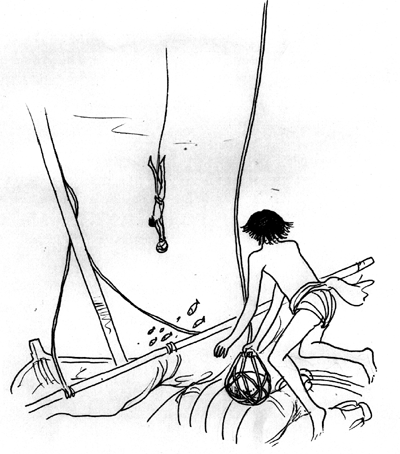
At that time, the ship's owner, when possible, tried to recover his valuable cargo when the sea was not so deep. At that time, human lives had little value.
In a dictionary, apnea is defined as an intentional interruption of breathing. But what happens when you hold your breath? Very quickly, after a few tens of seconds, you feel a strong sensation of suffocation, which quickly becomes unbearable and forces you to resume breathing. The cause of this feeling is the increase in the level of carbon dioxide in your blood (or, more precisely, the partial pressure of carbon dioxide; the difference will be explained below).
What can you do to extend the time of apnea? There are three ways to proceed:
- the first consists of controlling this feeling of suffocation. This is what some divers do, using techniques similar to Yoga (the same ones that can, for example, help control pain);
- the second consists of inhaling as much air as possible into your lungs before stopping breathing, for example, before diving;
- the third consists of hyperventilating before a dive.
To extend the time of free diving, the third method is by far the most effective; but it is also the most dangerous. Let's see why! To hyperventilate, the diver breathes in a jerky manner for a more or less long duration. By doing this, he does not necessarily take a deep breath, but he effectively ventilates his lungs: he expels the residual air and replaces it with fresh air. It is known that, when breathing normally, not all the air in the lungs is replaced at each expiration-inspiration. This mechanism is controlled by the muscles: the diaphragm, and to a lesser extent the muscles that lower and raise the ribs. But this technique has its limits. By doing this, you cannot completely empty your lungs. By panting, you replace almost all the air. Thus, the lungs contain a fluid identical to the ambient air, and not to the combination of the inhaled air and the residual air loaded with carbon dioxide, resulting from previous breaths.
To put it clearly: hyperventilation reduces the amount of CO2 in the pulmonary air. Hemoglobin is a molecule in the blood capable of capturing and transporting both oxygen (oxy-hemoglobin) and carbon dioxide. Hyperventilation therefore reduces not only the amount of CO2 in the lungs, but also its amount in the blood.
You cannot increase the percentage of oxygen in the atmospheric air (20%, the rest being nitrogen), but you can increase its amount in the blood. If you continue hyperventilating for a few tens of seconds, you will feel lightheaded; this phenomenon is the expression of the enrichment of the blood in oxygen. If you hold your breath, at the surface or at one meter depth, in a pool, remaining perfectly still, you will be surprised by the increase in your apnea time. Apnea times of one minute can thus be achieved quite quickly. With training, many men can reach one minute, without any effort. The maximum human is about four minutes, for the record holders in this specialty.
Why are you able to hold your breath for so long?
It is not so much because you have enriched your blood with oxygen, but because you have impoverished it in carbon dioxide before the apnea. Now, CO2 is precisely an alarm signal. The danger lies in the fainting that occurs when the level of oxygen in the blood falls below a critical threshold. This is extremely dangerous, because there is no precursor sign like discomfort. It is instant and causes the diver to lose consciousness, without resuming breathing. A person drowned in this way will keep their lungs dry. This is how apnea works after hyperventilation. A diver using this technique significantly improves his performance, but in return, he turns off his alarm system (the feeling of suffocation due to the rise in CO2 level in his blood). He can faint without feeling the slightest sensation of suffocation.
Apnea is mainly used for free diving. In these conditions, the diver asks himself the following question:
- Since I want to reach a certain depth, should I swim vigorously to reach this depth as quickly as possible during the given apnea time, or on the contrary, should I minimize my efforts, both during the descent and the ascent?
The second solution is the correct one. A free diver must swim, dive, and glide in a way that is economical in movements: no sudden movements, no intense muscular effort is allowed (they are correlated with an increase in oxygen consumption). The diver, carefully weighted, must descend and ascend slowly, without haste. The use of a diving suit is essential, unless you are diving in very warm water. Fighting the cold is indeed accompanied by a significant increase in oxygen consumption.
All unnecessary effort must be avoided, as well as any unnecessary consumption. In this sense, intellectual activity, the simple functioning of the brain, consumes a lot of oxygen. This is not negligible. If you perform apnea experiments, you will be surprised to notice a significant reduction in your results if you do complex calculations. Thus, unconsciously or consciously, the free diver gets used to not thinking during the dive. If he manages to think of nothing, his performance will be better. By doing this, he unconsciously uses the rudiments of meditation techniques (Buddhist, Hindu, yogi).
The masters who encourage their disciples to meditate tell them: " Eliminate the flow of your thoughts." What happens then? I cannot tell you. Either meditation brings human beings into contact with a transcendental mental activity, changes their state of consciousness, or the brains send oxygen to centers usually less supplied (the centers of conscious thought, which normally receive oxygen first). The result is a feeling of well-being, which every free diver experiences. An effective apnea is synonymous with well-being, otherwise it is not effective, simply because it can only be achieved in a state of non-thinking.
Before reaching spiritual awakening, or nirvana, through the absence of thought, the free diver enjoys behaving this way spontaneously, which can do you good when you are stressed or obsessed. Of course, free diving also allows you to discover the beauty of underwater landscapes. But the mystical dimensions that it has for many divers are based on an objective reality, of which few are aware.
From the point of view of the physical machine's capacity, divers can reach a depth of 30 meters, performing an apnea of one and a half or two minutes. Some "particularly gifted" ones can even go further. This activity is like Russian roulette. These "supermen" are only reducing the reckless gap that separates them from a fatal fainting.
So, what can you do? Decide once and for all that free diving is an extremely dangerous activity, or try to find a compromise?
Before venturing into numbers, you need to be informed. Fatigue, for example, greatly increases the risks: this can also be overwork, lack of sleep, any cause of fatigue.
When I was about 20 years old, I did free dives during the holidays. In winter, I sometimes went to a 50-meter-long pool (the Tourelles pool in Paris). I was quite fit, and I could thus cross the pool at one meter depth, with fins (which equaled diving to 20 meters depth and then returning to the surface). An apnea at such a shallow depth may seem safe. Big mistake! At the time, I was preparing seriously for the entrance exams to the Grandes Écoles. I slept very little and worked a lot. I thought swimming would do me good. I started diving in the empty pool. I had done this often, but only when I was fit; that day, I was a bit tired. Fortunately, I was swimming towards the shallow end. I never reached the edge of the pool. At about 40 meters, I fainted, instantly, without any warning. I have no memory of the event. I assume I was found, lifeless, floating on the water, and an alert was given. I woke up at the edge of the pool, having been revived by the pool attendant.
Imagine what would have happened if I had swum in the other direction. The Tourelles pool has a ten-meter-high diving board; it overlooks the deep end, which reaches five meters in depth. If I had dived towards the deep end, I could have gone further with my momentum and fainted at that moment. The buoyancy of the human body depends on the depth at which it is located. Even with full lungs, the pressure compresses them, which reduces the Archimedean thrust equally.
Since I fainted at one meter depth, I naturally returned to the surface, keeping air in my lungs, even if I lost some along the way. A few meters underwater, I would have gone straight down; I would not have been as easy to spot, and when someone saw me at the bottom of the pool, it would have been too late.
As soon as a fainting occurs, the brain cells are no longer supplied with oxygen. The problem is that their autonomy is not very great. If people who have drowned have sometimes been saved after a significant time underwater, in cold water, it is still exceptional. One can consider that a person who has received no oxygen for about 5 to 10 minutes is simply dead, for good.
You may have noticed that when rescuers perform mouth-to-mouth resuscitation on a drowning person, they ventilate their lungs not with atmospheric air, but with the air they expel. Thus, they hope that this will more quickly trigger the return of the respiratory reflex, which is controlled by the level of carbon dioxide.
Why do we have a "tendency" to breathe? Simply because, over time, the level of CO2 in the blood increases, and when it exceeds a threshold, the medulla oblongata, which receives the information, immediately triggers the inspiration movement. Otherwise, people would have to consciously decide to breathe, or else they would faint.
Any fatigue, as we have seen above, increases the dangers related to apnea, which are always present. The same goes for cold. In colder water, the heart rate increases, as does the metabolism of the cells. To fulfill its role as a pump, the heart also consumes precious oxygen. In cold water, even with a suit, the results must be revised downward. The extremely serious problem of apnea is that no one can know at any given moment and in a certain context where the limit is. The question " how long can I stay apneic today, with my physical condition, in this water? " can only be answered if... you have experienced it. It is very likely that many people have been a fraction of a second away from death without even realizing it.
During the dive, any sudden effort leads to an overconsumption of oxygen that can bring its level below the fatal threshold. This is how my friend Josso died, 40 years ago in Corsica. We had been students together at the École Supérieure de l'Aéronautique in Paris in 1960. Josso was used to diving with the Roubaix family. Madame de Roubaix had been a female spearfishing champion. Everyone had a passion for spearfishing and the sea near Corsica was rich, as it is no longer today. Josso dived reasonably. That is what he thought. But one day, while he was at a dozen meters depth, he speared a sea bream that was nestled on a rock. Josso slipped into a crevice and made efforts to pull the fish from its hiding place. The oxygen consumption necessary caused a fatal fainting.
A well-trained diver can reach a depth of 15 or 20 meters if someone else is nearby, who does not leave him out of sight and is ready to help immediately (without becoming a second drowning person). Spearfishing championships cannot be held at 10 meters depth. A well-fished water, especially in our regions, corresponds to greater depths. The competitors usually dive in pairs. Each member of the team takes turns diving, watched by the other. But free diving at great depth alone is nothing more than Russian roulette.
We mentioned above the partial pressure of oxygen. In reality, the rate of oxygen transfer in the blood depends on the relative density of the molecules near the blood cells. The higher the density, the more intense the transfer; this is quite logical. Thus, when professional divers descend very deep (more than 100 meters), what they use to breathe is a mixture where the oxygen percentage is significantly lower than the usual 20%, otherwise the oxygen would become too oxidizing. From the beginning of dives with breathing equipment, people who wanted to dive with pure oxygen in their tanks had convulsions. When its concentration is too high, oxygen acts as a toxin.
When a diver free dives to 20 meters depth, he is subjected to a pressure three times higher than atmospheric pressure. The blood can still be oxygenated, even if the oxygen is less abundant in the air contained in the lungs. The oxygen supply remains stable with a poorer air because the pressure is three times higher, and therefore the density of the oxygen molecules is also three times higher.
The situation is reversed during the ascent. The human body reacts not only to the drop in oxygen level in the blood, but also to the drop in oxygen supply. In fact, when a diver ascends, he goes from a pressure three or four times higher than atmospheric pressure to a pressure close to one atmosphere just under the surface. The blood flow then decreases. This is why a large part of the fatal faintings occur during the ascent. Some specialists even speak of a "fainting meeting at 9 meters."
Thus, when he is deep, and even if the oxygen contained in his lungs does not allow him to return alive to the surface, the diver feels very well. If he thinks he is a superman, he will not make the decision to ascend early enough, and will pay with his life for his negligence.
From a few meters depth, the compression of the air (contained in the lungs or in the alveoli of the suit) gives him negative buoyancy. The one who faints while ascending will not reach the surface, but will go straight down.
Be clear. If you have to remember something from this article: deep free diving is not a sport, but a foolish and bloody thing. Apnea has not progressed. The human machine is still the same. It is enough to not stay far enough from the disaster, for example, a minute away from it, for people to approach it recklessly and morbidly. The practitioners of long apneas or deep solo apneas are simply people flirting with death, resurfacing a few seconds before a fatal fainting, whether they know it or not.
At best, you will be warned and come out unharmed. At worst, it will be irreversible.
About fifteen years ago, a real frenzy for deep free diving emerged. Two men are directly responsible for this phenomenon. The first is the diver Jacques Mayol, the second is the director Luc Besson.
As soon as free diving developed, just after World War II, people wanted to know " how far can we go? "
A young diver performing apneas at 30 meters depth near them did not worry these three men, aged between fifty and sixty. They simply went deeper, without caring about him anymore. After the dive, they ascended performing their decompression stops. It was only once all their equipment was removed that Vogel asked Ebersoldt, for the first time, about "the diver."
- No, I haven't seen him for a while, answered the young man (the boat was several kilometers from the shore).
Panicked, the three men put their equipment back on, while trying to position the boat above the wreck using coastal markers (markers taken from the shore). Meanwhile, they had dropped the anchor and the boat had moved. When they retrieved the body of my son, it was too late, despite the efforts of Dr. Saint Jean.
Although I have been in contact with the four divers, I have never obtained a coherent version of the accident. Vogel, who seemed initially very sure of himself, began to hide the presence of the fourth diver (the Brazilian) from me (There were three of us: Saint Jean, Ebersoldt and me...). The German, with whom I spoke on the phone, hesitated when I asked him under what conditions he had taken a photo of my son dead on the deck of the wreck, a photo that Vogel had sent me by mail. I knew about the existence of this fourth diver thanks to Dr. Saint Jean. When I had another conversation with Vogel, he was confused (Ah yes, I remember now, there were four...). Of course, my son was not a victim of criminal intentions, but it was clear to me that these four were not very proud of what had happened that day.
You cannot rewrite the past or bring people to reason. But at that time, four experienced divers, far from being beginners, one of whom was a doctor, considered deep solo apneas as a routine event, causing no reaction.
This accident was followed by many others, all over the world. Mayol continued his crusade for free diving. No journalist took interest in this issue. On the contrary, television reports showed various apnea feats, such as Nicolas Hulot flying in a microlight without a safety helmet. I remember a man who demonstrated that he could stay four minutes underwater in a pool. This is enough to inspire vocations...
We must now draw a conclusion. Is apnea dangerous? Should we ban it?
We have seen that the danger is always present, that of a fainting that occurs without any warning.
This danger is multiplied by ten if the diver is tired or if the water is cold. Free diving as an "extreme sport" is a total absurdity, comparable to Russian roulette. The human machine has not evolved. Instead of practicing this activity at a safe distance from fainting, for example by drastically limiting apnea times to about 30 seconds, even for the most "gifted" or trained divers, the "champions" only flirt with death.
In good condition, after a gradual introduction, with good equipment (especially a neoprene suit protecting from the cold): 30 seconds, 10 meters, tandem dive, always keeping an eye on your partner, it is reasonable. Be sure to wait at least five minutes before diving again, to rest. In addition, limit the time you spend on this activity, because free diving is quite exhausting. If you are in good shape, an intense apnea can itself put you in serious danger by exhausting you.
The serious problem is that the media are absolutely not interested in this subject, especially before summer, when they should warn divers. It is just as serious as newspapers, men (Mayol), and filmmakers (Besson) participating in encouraging young people to recklessly play with their lives. It would be pointless to hope that a cult film like The Big Blue is preceded by a short warning message on the screen. But deaths do not attract the attention of the media. People rather talk about an "extreme sport." No one shows the pale bodies of the drowned or the disfigured bodies of free climbers. When a well-known personality dies practicing this kind of activity, people rush to say that she died "as she wanted" and throw a little sawdust on the bloodstained ring after the acrobat fell, blinded by the lights of the spotlights. Strange way to dream.
A few months after my son's death, in the south of France, I met a young baker used to spearfishing in deep water. He often dived to 30 meters and participated in competitions, so he trained regularly with his partner. A short time after our meeting, he was found, just in time, lifeless at the bottom of a 30-meter depth. There was no need to warn him again.
This man was lucky.
These deaths that happen
When my son died, performing apneas at 30 meters depth, he left a copy of the magazine Apnea containing an article presenting deep apneas. When you see the risks involved in wanting to practice such an activity, you have the right to wonder what pushes young people to continue. Of course, the huge impact of The Big Blue: when the film was released, there was a significant increase in apnea-related accidents, in all countries. In one of its last issues, the cover of the magazine Apnea said: "The Big Blue, 10 years later."
It is undeniable that apnea has something fascinating. The problem is that those who think, like Pierre Vogel ten years ago, that "apnea has made a lot of progress," generally ignore the risks they are taking. The federations of course advise to dive in pairs, a partner being always able to help a diver who faints. But he cannot save the diver in all circumstances. I read in Apnea that some divers actually hunt from an shelter, at a depth of 38 meters. What team partner would be able to save a spearfisher who faints at such a depth? Remember, fainting is instant, without any warning. The victim has no way to trigger a rescue device.
Let's look a bit at the problem of rescuing a person who faints at great depth. At 30 meters depth, the human body and the neoprene suit are subjected to a pressure of four atmospheres. The neoprene suit contains air. Anyone who has dived remembers their surprise at seeing their 6 mm suit reduced to the thickness of a cardboard at 60 meters depth, due to the pressure.
At 30 meters depth, the volume of each gas (the air contained in the lungs as well as in the suit) is reduced to a quarter. Even if the diver is weighted to have positive buoyancy at the surface, he will have negative buoyancy at depth and will have to make efforts to ascend. This negative buoyancy represents about a few kilograms.
If a rescuer tries to bring his unconscious partner up from a depth of 30 meters, not only will he be at the edge of his own abilities, but he will also have to pull a double weight while ascending. Of course, he can release both lead belts, but in such tragic situations, is everyone capable of keeping their composure? Have divers who go down with a friend ever asked themselves this question? How many have made the effort to check if rescuing an unconscious diver is possible?
After putting this document on apnea online, a journalist from Octopus contacted me. One of his best friends was used to spearfishing in pairs at depth. He suddenly fainted and his partner could not bring him back to the surface. He chose to alert a passing boat to ask for help, but it arrived too late. Remember that neurons cannot tolerate anoxia for more than 10 minutes: it's very short!
When you see the risks you take, why chase after results? If you read a magazine like Apnea, you will learn that the unchallenged static apnea record is now surpassed... for more than seven minutes. By the way, what does a static apnea competition look like?
There you go! You see the competitors lying on their stomachs in the shallow end of a pool, or more precisely in its swimming pool, which is 30 centimeters deep. During the operation, their backs emerge. The best result recorded in the above competition was 6 minutes and 22 seconds. When I see this photo, I wonder what the point is of using a pool. Would an ordinary changing room not do the job?
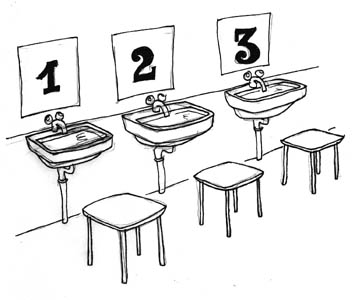
Just above, Olympic facilities where the competitors would only have to plunge their faces into the sinks.
To be honest, the world of diving must continue. Many things have changed in the last few decades. A few days ago, I did a dive far from the shore, in a very famous place (the islands of Marseille, precisely the Émaillades reef), where once you could admire beautiful sponges, sea roses (retepora cellulosa) and many wonders that the sea contains. I found only desolate bottoms, raked by generations of student divers, each wanting to bring back something from their dive. I don't even talk about the fauna, which today has nothing to do with what it was in the 1950s, or even the 1960s. I don't know if these bottoms will ever regain their former richness.
To not return empty-handed, spearfishers were the first to reach greater depths. Once, the free diver lived in a world full of fantastic fauna and flora. At ten or fifteen meters depth, there was a real jungle where you could meet large residents. Today, there are no large sponges, one of the specialties of the Mediterranean, nor nacre (some measured a meter in length). The typical inhabitants of the sea are now... sea urchins. Thus, a new sport has been promoted: apnea, considered as an activity in itself. Without the powerful sponsorship of brands (waterproof watches, underwater equipment...), these feats would not have had such an impact. Above, we mentioned the pioneer of this "discipline": Jacques Mayol, from Marseille. Attached to his pig, he reached a depth of 100 meters. We are no longer there. The feats, according to the April issue of Apnea, have first gradually developed. After the spectacular wall of 100 meters, the progress has been limited: 102 meters, then 104 meters, etc.
People and the media have grown tired of these small steps. As you can read in this issue of Apnea, page 66: * "Two more meters no longer bring in money."* Whoever says media says advertising. The sponsors demanded more spectacular progress. The leader of this discipline is Francisco Ferreiras, nicknamed "Pipin." Diving with a pig, ascending suspended on a balloon.
A simple remark: it's like compressing a man under seventeen atmospheres in one and a half minutes, then decompressing him in the same time. But the photo of a human diving towards the abyssal plains, attached to his weight, is more fascinating, and let's say, more morbid. People love circus games.
On January 15, 2000, Pipin made his first attempt to descend to 162 meters. He had adjusted a technique consisting of drowning his sinuses. However, the weather was very bad and a slight current carried him back to his starting point. The support divers were already down, but they couldn't stay long at such depths due to the duration of the decompression stops that our apnea daredevil didn't need to make: his dive was too short for the nitrogen to dissolve in his blood. "Pipin has only one minute to breathe!" (meaning: to deactivate his CO2 level controlled alert device, see above). He dived, but he fainted four meters from the surface ( "It was due to the effort he had made before his attempt").
It doesn't matter! The medical team estimated that he could try again the next day. And the next day, there it was. According to Pipin, "it's an open invitation to reach 200 meters," thanks to his sinus drowning technique, which he swore to reveal, making the compensation much faster. In these conditions, with a tank weighted for hydrodynamics, why not consider one day reaching 300 meters, or even more?
Thus, the future seems promising. The media will follow, as well as the sponsors. Many people will buy the fins or the neoprene suit with which Pipin set his record.
Static apnea has developed. Today, many cities see people gathering in clubs, putting their nose at the bottom of municipal swimming pools. Federation, official recognition, meetings, media coverage... Everyone can dream of becoming a record holder one day, of knowing the spotlight. No need to have big muscles, a good start: everything is in the head.
- Safety is not a profitable market...
Reactions:
A few days after I put this text on my website, I received reactions, all favorable. The first ones came from young people writing "Sir, my friends and I have practiced deep apnea dives. We didn't know all this, and we now realize that we must have been very close to death several times without even knowing it."
A diving school told me that they had put a link from their site to mine, for the education of their members. They emphasized the fact that diving clubs have benefited from the impact of "The Big Blue," as they had seen a significant increase in the number of members.
Certainly, but the increase in fatal apnea accidents can be estimated at more than five hundred during the year following the release of this film, with about fifty deaths in France.
Thanks to a reader, Laurent Latxague, this article was reproduced in the August issue of OCTOPUS. It is true that one of the journalists had lost his best friend in an apnea accident. He was spearfishing, monitored by his partner. After a too long dive, he fainted while ascending and fell to the bottom; his partner couldn't bring him back to the surface. He then looked for help, but in vain. I hope that the dissemination of this text saved lives last summer. I also hope that a diving equipment company will be interested in this project of a rescue system for an apneic diver who fainted. Today, each diver attaches his tanks to a inflatable vest. In the past, Mae Wests were a cumbersome luxury; they are now much more modest. Why shouldn't apneic divers deserve safety too?
May 18, 2000
A letter from Mr. Duhamel, living in Saint-Maur (France): *
Dear Sir,
I am very surprised to realize that I had the same experience as you when I was at a Grandes Écoles. I used to swim 50 meters underwater in a pool. One day, in the Saint-Ouen pool, I lay on the bottom (like you, in a shallow area), without realizing it. I remember that I had to make an effort to reach the end of the pool, then I woke up lying on the edge. Meanwhile, a friend who had followed my demonstration was surprised to see me stay underwater while I had reached the end. He first thought I still had some air, then, as I didn't move, he called the lifeguard who saved me. Like you, I am an apnea survivor. *
November 2000
I received a letter from a member of the French Harpoon Federation's council. He first reminded me of something very important. In the past, apneic divers practiced hyperventilation, that is, they breathed rapidly with a two-second pause, for one or two minutes. It is very effective for renewing all the air contained in the lungs, which has a higher level of carbon dioxide than ambient air. When you do such hyperventilation, you know when you feel dizziness. By doing this, you put the blood in contact with this air, which is poorer in CO2; therefore, the level of CO2 in the blood decreases, but it is precisely this level that makes you feel the "lack of air"
This accident has been followed by many others, all around the world. Mayol continued his crusade for breath-hold diving. No journalist showed interest in this issue. On the contrary, TV reports showed various breath-hold feats, as Nicolas Hulot was flying in a microlight without any safety helmet. I remember a man who showed he was able to stay four minutes underwater in a swimming pool. That's enough to give rise to vocations...
We now have to draw a conclusion. Is breath-hold diving dangerous? Shall we ban it?
We've seen that danger is always present, the danger of a fainting fit occurring without any warning sign.
This danger is increased tenfold if the diver is tired, if the water is cold. Breath-hold diving as an 'extreme sport' is a complete aberration resembling Russian roulette. The human body has not made any progress. Instead of doing this activity far from the risk of fainting, for example by drastically limiting breath-hold times to about 30 seconds, even for the most 'gifted' or trained divers, the 'champions' only flirt with death.
In good condition, after a progressive introduction, with good equipment (in particular a wetsuit protecting from the cold): 30 seconds, 10 meters, diving in tandem and always keeping an eye on your team mate, that is reasonable. Be careful to wait at least five minutes before diving again, to recover. Moreover, you should limit the time you do this activity, because breath-hold diving is quite tiring. If you're in good shape, intensive breath-hold diving may itself put you in serious danger by making you tired.
The serious problem is that no media show any interest in this subject at all, especially before the summer when they should warn divers. It's also serious that journals, men (Mayol), film-makers (Besson) are taking part in encouraging young people to recklessly play with their lives. It would be vain to hope a cult-film like The Big Blue to be preceded by a short warning message on the screen. But deaths don't attract media attention. People rather speak about an 'extreme sport'. There's no one to show the pale bodies of drowned persons or the dislocated bodies of the enthusiasts of free ascent. When a well-known figure dies doing this kind of activity, people hasten to say he died 'as he wanted to' and to throw some sawdust on the blood that spatters the ring after the trapeze artist has fallen down, blinded by the glare of the spotlights. Strange way to make people dream.
A few months after the death of my son, in the South of France I met a young baker who was used to do harpooning in deep water. He was often diving 30 meters deep and he was taking part in competitions, so he trained regularly with his team mate. Shortly after we had met, he was found only just, lifeless, on a 30-meter-deep bottom. There was no need to warn him once more.
This man was lucky.
Those deaths that bring in
When my son died, doing breath-holds 30 meters deep, he left an issue of the journal Apnea that contained an article introducing deep breath-hold diving. When you see the risks you run wanting to perform such an activity, you're entitled to wonder what encourages young people to go on. There has been of course the tremendous impact of The Big Blue: when it appeared on the screens, there has been a strong raise of breath-hold diving accidents, in every country. In one of its latest issues, the headlines of the journal Apnea read 'The Big Blue, 10 years afterwards'.
It's undeniable that breath-hold diving has something fascinating. The problem is that those who think, as Pierre Vogel did 10 years ago, that 'breath-hold diving has made a lot of progress' generally don't know the risks they're running. The federations advise of course to dive in tandem, a team mate being always likely to help a fainting diver. But he can't rescue the diver in all circumstances. I've read in Apnea that some divers actually hunt game from a hide, at a depth of 38 meters. Which team mate would be able to rescue a harpooning hunter having a fainting fit at such a depth? Remember, the fainting fit is instantaneous, without any warning sign. The victim has no means to set off any rescue device.
Let us analyze a little bit the problem of rescuing people having a fainting fit at great depth. At a depth of 30 meters, the human body and the wetsuit are under a pressure of four atmospheres. The Neoprene suit contains some air. He who has ever dived remembers his surprise when he saw his 6 millimeters wetsuit reduced to the thickness of a cardboard at a depth of 60 meters, because of the pressure.
At a depth of 30 meters, the volume of every gas (the air contained in the lungs as in the wetsuit) taken by the diver is reduced four times. Even if the diver is weighed down so as to have a positive buoyancy on the surface, he will have a negative buoyancy in depth and he'll have to do some efforts to climb up. This negative buoyancy is about a few kilograms.
If a rescuer tries to bring his lifeless team mate back up from a 30-meter depth, not only will he be at the limit of his own ability but he will also have to haul a double weight climbing up. Of course, he can drop both their lead belts but in such tragic situations, is everyone able to keep his composure? Have people diving with a friend ever thought about this problem? How many have made the effort to check if the rescue of a fainting diver was possible?
After I'd put this file on apnea on line, a journalist for the **Octopus journal contacted me. One of his best friends was used to harpooning at great depths in tandem. He suddenly had a fainting fit and his team mate was unable to bring him back to the surface. He chose to alert a boat cruising nearby to ask for help, but it arrived too late. Just remember that neurones can not stand an anoxia more than 10 minutes: that's very short!
When you see the risks you take, once more why race for the results? If you read a journal like Apnea, you will learn that the undisputed record of 'static apnea' is now over... seven minutes. By the way, what does a 'static' apnea competition look like?
This! You can see the competitors flat on their stomachs in the shallow end of a swimming pool, or more precisely in its paddling pool, that is 30 centimeters deep. During the operation, their backs emerge. The best result during the competition related above was 6 minutes 22 seconds. When I see such a photo, I ask myself what's the interest of using a swimming pool. Wouldn't an ordinary changing room be good enough?
Just above, olympic plants where competitors would just have to plunge their faces into the washbowls.
To tell the truth, the diving business must go on. Many things have changed in the last decades. A few days ago, I was having a dive far away from the coast in a very reputable place (islands off Marseilles, more precisely the Emaillades' reef) where in the past you could see splendid sponges, sea roses (retepora cellulosa) and many kinds of wonders the sea contains. I've only found deserted bottoms, raked over by generations of student divers, each having been intent on bringing back a little something from his dive. I don't even speak about the wildlife, that has today nothing more to do with what it was in the 50's, or even in the 60's. I don't know if those bottoms will ever get their former richness back.
In order not to come back empty-handed, harpooning divers were the first to reach more significant depths. Formerly, the apnea diver was in a world peopled with fantastic fauna and flora. Ten or fifteen meters deep, there was a real jungle where you could meet a great sized resident. Today, there are no giant sponges, one of the Mediterranean's specialities, nor mother-of-pearls (some were one-meter-long) anymore. The typical denizens of the sea are now... the urchins. So a new sport has been promoted: apnea, considered to be an activity in itself. Without the brands' powerful sponsorship (water resistant watches, underwater equipments...), thoses feats wouldn't have got such a response. Above, we've mentioned the pioneer in this 'discipline': Jacques Mayol, native of Marseilles. Hooked on to his pig, he was reaching a depth of 100 meters. We're no longer there. The feats, according to the April issue of Apnea, first progressed slowly. After the spectacular 100 meters wall, limited progress has been recorded: 102 meters, then 104 meters, etc.
People and the media have grown tired of those little steps. As you may read in this issue of Apnea, on page 66: 'two meters deeper don't bring in money anymore'. He who says media says advertisement. The sponsors required more spectacular progress. The leader in this discipline is Francisco Ferreiras known as 'Pipin'. Dive with a pig, climb up hanged to a balloon.
Just a remark: this is equivalent to compress a chap under seventeen atmospheres in one minute and a half and to decompress him in the same time. But the shot of a human diving towards the abyssal plains tied to his weight is more fascinating and, say it, more morbid. People love circus games.
On January, 15th 2000 Pipin attempted a first time to reach a depth of 162 meters. He has adjusted a technique consisting in drowning his sinuses. But the weather was quite bad and a slight current made him swim to reach his starting point. The assistance divers were already down but they can't stay for a while at such depths because of the length of the decompression stages our kamikaze-apneist has no need to make: his dive is much too short for the nitrogen to dissolve in his blood. 'Pipin has only one minute to ventilate!' (understand: to switch off his warning device controlled by the raise of the CO2 level in the blood, see above). He dives but he faints four meters to the surface ('This was caused by the effort he did before his attempt').
Never mind! The medical team considers he can try again the next day. And the next day, then comes the feat. According to Pipin, 'It's an open invitation to reach 200 meters', thanks to his sinuses' drowning technique Pipin has sworn to disclose and that makes the compensation much quicker. In such conditions, with a streamlined weighed tank, why not to envisage to reach one day 300 meters, or even more?
That way, the future looks great. The media are going to follow, and the sponsors too. Many people are going to buy the flippers or the wetsuit with which Pipin has made his record.
'Static apnea' has developped. There are today a lot of cities where people regrouped in clubs put their noses on the bottom of municipal paddling pools. Federation, official recognition, meetings, media coverage... Everyone can dream of becoming the record-holder one day, to know the footlights. No need to have big muscles, a good take-off: 'everything is in the head'.
- Safety is not a profitable market...
The reactions:
A few days after I'd put this text on my site, I received some reactions, all of them were favourable. The first were coming from young people writing 'Sir, my friends and me have been doing great depth apnea dives. We did not know all this and we now realize that we might have been several times very close to death without being aware of it'.
A diving school said to me they put a link from their web site to mine, for the education of their members. They pointed out the fact that diving clubs have made the most of the impact of The Big Blue, as they've seen a strong raise in the number of memberships.
Admittedly, but the increase of fatal accidents linked to apnea can be estimated at more than five hundred during the year following the release of this film, in which there were about fifty casualties for France.
Thanks to a reader, Laurent Latxague, this article was reproduced in the August issue of OCTOPUS. That's true that one of the journalists had just lost his best friend in an apnea accident. He was harpooning at a great depth, watched over by his team mate. After a too long dive, he fainted as he was climbing up and he fell down on the bottom; his team mate was not able to take him back to the surface. He then wondered for some help, but only in vain. I hope that the circulation of this text saved some lives during the last summer. I also hope that a diving gear company will get some interest in this project of rescue system for an apneist who has had a fainting fit. Today, every diver fixes his bottles on an inflatable jacket. In the past, Mae West were a cumbersome luxury; they're now much more sober. Why wouldn't apneists have a right to safety too?
May, 18th 2000
A mail from Mr Duhamel, living in Saint Maur (France): *
Dear Sir,
I am very surprised to see that I have had the same experience as you when I was in a Grande École of Engineering. I was used to swimming 50 meters underwater in a swimming pool. One day, in the Saint-Ouen swimming pool, I stayed lying on the bottom (as you, at the less deep end), without having noticed anything. I remember I've had to force myself a bit to reach the end of the pool, and then I revived lying on the edge of it. In the meantime, a friend who had followed my demonstration was surprised to see me staying underwater although I had reached the end. He first thought I still had some breath, and then as I wasn't moving he called the lifeguard who rescued me. Like you, I'm a survivor from apnea. *
November 2000
I've received a mail from a member of the board of the French Harpooning Federation. He first reminded me of something very important. In the past, apneists were doing hyper-ventilations, that is to say they were gasping with a period of two seconds, during one or two minutes. This is very efficient to refresh all the air contained in the lungs, that has a carbon dioxide level higher than it is in the surrounding air. When you do such a hyper-ventilation, you'll know it works when you feel dizzy. Doing this, you put the blood in contact with this air poorer in CO2; as a consequence the carbon dioxide level in the blood gets down, but that's precisely this level that make you feel the 'lack of air'. This way, the apneist only switches off his warning system and he so bases his decision to end the dive only on his own estimate of the time which has elapsed. Divers were advised to ban that forced ventilation and to replace it with 'consecutive long inhalations'. But it comes to the same thing: if you make several long inhalations and forced exhalations, the pulmonary air will be replaced with fresh one.
This man then joined to his mail a suggestion that seems to me very interesting. Divers harpooning are supposed to hunt in tandem (but, as we've seen it above with the story of the journalist from Octopus, a team mate may be unable to rescue his friend). My correspondent suggests equipping the two divers with lifejackets that would be inflated thanks to a CO2 refill, but as a fainting fit doesn't have any heralding sign, that's the team mate who would trigger it when his friend fainted. The rescue device could be triggered by radio. The drawback is that radio waves don't propagate very well in water, but ultrasounds yes and they're very easy to generate. Such a system could be worn on the wrist. Going further, parents or friends wishing to control the activity of an apnea diver could watch him out of the corner of their eyes being able at every time to bring him back to the surface at the least alert.
It doesn't seem a priori impossible to design an electricity-working Guardian Angel. The bathymeter-microprocessor coupling already works well (as dive computers exist). A microprocessor has got a clock with which it calculates the diving time. There remains to couple this system with a pyrotechnic triggering device. People who have the more abilities for developing such a system are those who are producing dive computers themselves. If you're interested or if you can help us, feel free to send me an e-mail.
An interesting variant would be a simple modification of the dive computer: all that is to be done is to adapt a jack on it to make it a safety device for apnea divers.
There's no lack of technical solutions but of the will to make these products. It's quite amazing to see that, for example, the BeuchatCompany does not get any interest in this, although it sponsors apnea competitors teams.
November, 14th 2000
I reproduce this story of Julie, apneist from La Réunion. No comment. *
Dear Sir, I'm not a big industrialist searching for a juicy project, but I've nevertheless taken the right to send you those few words. I'm twenty, I'm called Julie Gautier, I do top apnea dive and I took part in the last apnea world championship that took place in Nice in october. I have practised harpooning since I was ten, with my father who's taught me all. I've made a lot of progress in harpoon fishing since I have practised apnea dives. My 38 year-old uncle was very proud of my results and impressed by them. For quite a while, he even came with my father and me during our expeditions. On October, 29th my father and he dived both alone. 30 meters deep, they were doing glides to wait for tunas. When he was climbing up, my uncle stopped to shoot. My father then went down to help him, took the harpoon gun and followed him with his eyes. Everything was OK. When he arrived on the surface, my father did not see my uncle so he looked downwards and he saw him sinking straight down. He had had a fainting fit when his back was turned. At once, my father dived towards him but my uncle was at least 175 lbs and he was overweighed. He was on his back and was going down, looking my father in the eyes. He hung on the life's thread that was still holding out. Powerless in view of the fate asking him to chose between his own life and both their deaths, he climbed up to the surface. His tympanum was perforated, he had had to drop his belt. My uncle's body was found the following day by the divers. I do know you understand my sorrow. I wanted to share it with you because as you did, I thought a system should be invented to prevent those so numerous accidents. I've found with you the answers to my fears for the future. I hope your project will succeed to prevent other people from knowing the grief that wears us down.
Simply and sincerely,
Julie, e-mail : julie.c.gautier@voila.fr *
** From 2001, septembre the 15 th, number of connexions : ** * * ---