The combat robot Big Dog. The beginning of a future weapon
""
When chickens will have teeth
[http://www.lemonde.fr/sciences/article/2012/03/06/un-robot-a-quatre-pattes-bat-un-record-de vitesse_1652844_1650684.html](http://www.lemonde.fr/sciences/article/2012/03/06/un-robot-a-quatre-pattes-bat-un-record-de vitesse_1652844_1650684.html)
Update from March 7, 2012:
Things are evolving logically. The DARPA is a military organization. It would be pure naivety to imagine that the development of these robots corresponds to civilian goals. The artificial man created by Boston Dynamics is already very impressive. But the quadruped might be the most efficient, for fast progress in a crowded terrain. Even better: the Centaure. Four legs and two hands. A lot of weapons, including lasers. An infrared vision, and in all frequency ranges. The ability to swim, jump over obstacles, climb. Armor.
Terminator....
The slowness of the nerve impulse had hindered the progress of giant animals in the Mesozoic. There are no more problems now. Robots equipped with "intelligent armor," of large size, may be "the soldier of the future," fighting "against terrorism and for democracy." Recently, I saw on a video two kids aged 10-12 who had built an "electromagnetic cannon." But this is not new. Since when do we give weapons to our children, as toys?
Everything, rather than spending money on the best living conditions for the human species.
March 16, 2009: Progress in military exoskeletons
****November 4, 2011: Progress in humanoid robots (Japan)
Page initiated on April 7, 2006
****Link
Update from August 29, 2007: Big Dog starts to gallop and jump over obstacles!
March 18, 2008:
Big Dog on snow and ice, now able to carry a soldier and his equipment
See also swimming and climbing robots
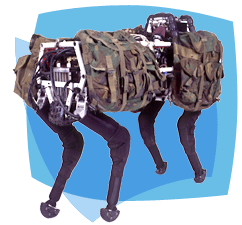
**The American robot Big Dog **
Watch this video which will show you where the Americans are in terms of robotics (at least what they allow us to see). The name of this quadruped robot is "Big Dog".
http://www.bdi.com/content/sec.php?section=BigDog
( then click on the video )
More recent :
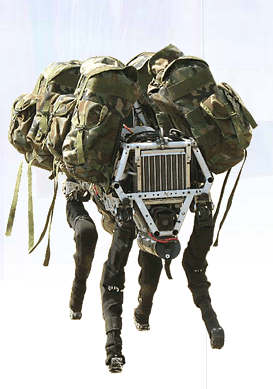 http://www.bostondynamics.com/content/sec.php?section=BigDog
**Big Dog carrying 150 kilograms of equipment **
http://www.bostondynamics.com/content/sec.php?section=BigDog
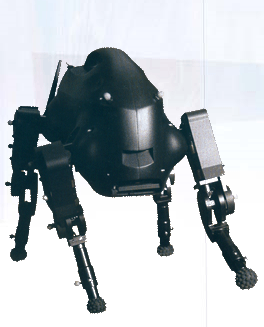 http://www.bostondynamics.com/content/sec.php?section=LittleDog
**Little Dog **
http://www.bostondynamics.com/content/sec.php?section=LittleDog
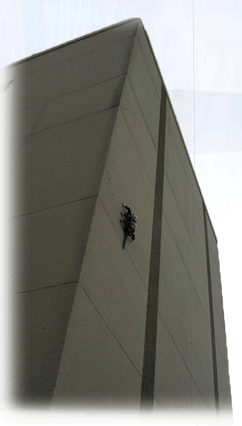 http://www.bostondynamics.com/content/sec.php?section=RiSE
http://www.bostondynamics.com/content/sec.php?section=RiSE
**Rise: the climber robot. Try to imagine a vehicle carrying soldiers, and climbing a steep cliff ..... ** ** **
The quadruped robot Big Dog
JPB 8/03/06
In the race to develop military or space robots capable of carrying loads in various terrains, it seems that the company General Dynamics has taken a lead, with the "mule" BigDog.
In fact, the company presents this new robot as the most advanced quadruped robot in the world. Sensors detect the different types of terrain and adapt to them. Others, proprioceptors, based on inertial units, detect the slightest "misstep." The robot can climb steep slopes, cross rock falls and maintain its balance even after receiving a violent lateral kick (which its designers do not hesitate to give, as shown in the video).
The four legs, which can be covered with pants to give them a more natural appearance, have three joints controlled by an onboard computer. The robot's hydraulic circuits are operated by a two-stroke gasoline engine. The total weight is about 100 kg. The robot can have some autonomy, but it can obviously also be remote-controlled or tethered.
The project is funded by the DARPA, which intends to have it carry loads of 40 kg, assisting soldiers operating on inaccessible terrain by wheeled vehicles. When you think about it, a quadruped robot is not the stupidest vehicle for transporting loads in various terrains. The performance of Bog Dog is quite astonishing. If we extrapolate such a machine, we find the robots of the Star Wars. Some see in Big Dog a kind of "mule" intended to relieve a soldier for carrying loads. But that is a serious lack of imagination. Big Dog can sneak into cover, carry cameras and machine guns, missile launchers, lay anti-personnel mines. After approaching its target by walking through rock falls, debris, undergrowth, it can spread its legs, steady itself and make a well-aimed shot. Going further, the resemblance to an animal can be refined. It is already quite astonishing, from the point of view of the gait. Big Dog, as a "mule," is a complex device, but it is also the prototype of machines performing penetrations
under animal camouflage
. This film shows that everything must now be considered. One day, guards will have to shoot at the slightest hedgehog, the slightest stray dog, the slightest rat that sneaks, the slightest seagull that flies over them, the slightest chicken that approaches them pecking, because it may not be a hedgehog, a dog, a rat, a seagull and that chicken may have ... teeth.
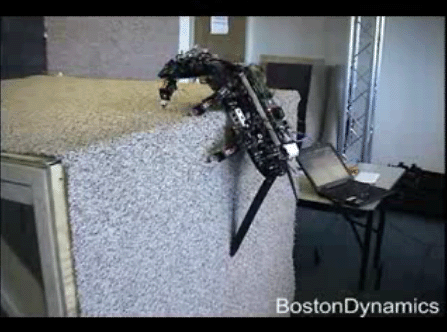
On the company's website, don't miss the robot equipped with claws that manages to climb up a vertical brick wall. A toy? No, if it is loaded with explosives or toxic gas, or anesthetic.
Big Dog, the quadruped, progresses at a quite acceptable speed. It reacts very quickly to destabilization attempts (a kick in its "flank"). Beyond that, it is by no means impossible to conceive of quadrupedal machines capable of running faster than any animal, jumping over obstacles. Remember the first motorized vehicle in history: Cugnot's fardier, equipped with a steam engine. It moved so slowly that a rider could precede it, moving away the curious. I think we've come a long way since. I imagine that those who saw it must have said, "Can you imagine that one day it will replace the horse?"
The habit of scientific journalists is often their inability to extrapolate. A car moves much faster than a horse. One day, quadrupedal robots will gallop, avoiding obstacles at a speed that surpasses us.
The Japanese have produced a robot capable of descending and ascending a staircase. One day it will be able to do it ... running. The clumsy and awkward robot ... is science fiction. When you give this Japanese robot a push to make it fall, it reacts quickly by stepping back one of its legs. That's just the beginning. You can imagine a robot boxer, dodging all the punches and not missing any of its own, delivered at a lightning speed. Or a tennis player, winning all the tournaments.
Twenty years ago, a friend developed a robot for the pastry shop. Due to insufficient entries in the large distribution, he could not place this amazing product. It was very simple. His robot was intended to write, with cream, faster and more accurately than any pastry chef "Happy birthday, Marcel" or "Happy Birthday, Grandma." Two motors moved bars that were joined by a Teflon cube, which they passed through. Everything was controlled by a simple PC.
What was astonishing was not that this mobile unit could write any text on these cakes, but its reaction capacity. My friend had placed on the cube, mounted on a simple nipple, a 15 mm diameter and one meter long PVC tube. When moving the tube, the fixing device transmitted this "position" information to the computer at the ... speed of light. At the top, a pétanque ball was placed. The experiment consisted of moving the ball and letting the machine put everything back upright.
You have all at least once played the tightrope walker by keeping a stick upright on your index finger. You can hold it almost upright, by "feeling." The machine, however, did not feel. It had such a capacity for anticipation, such a means of "proprioceptive" understanding, that it brought the rod upright in one go. There was
no oscillation
.
We are very primitive machines. Our nerve impulses travel at a low speed. You know the bill experiment. Someone places a banknote between your thumb and index finger, 5 cm apart. The game is as follows. Your assistant suddenly drops the bill and you have to close your fingers before it escapes. You never manage it. Because the time separating your visual perception of the bill's fall, added to the time of analysis by your brain and the time of the order "close the hand" is way too long.
Robots have bright days ahead, not because they will imitate humans and living beings, but because their performance will be infinitely superior.
The quadruped robot Big Dog
JPB 8/03/06
In the race to develop military or space robots capable of carrying loads in various terrains, it seems that the company General Dynamics has taken a lead, with the "mule" BigDog.
In fact, the company presents this new robot as the most advanced quadruped robot in the world. Sensors detect the different types of terrain and adapt to them. Others, proprioceptors, based on inertial units, detect the slightest "misstep." The robot can climb steep slopes, cross rock falls and maintain its balance even after receiving a violent lateral kick (which its designers do not hesitate to give, as shown in the video).
The four legs, which can be covered with pants to give them a more natural appearance, have three joints controlled by an onboard computer. The robot's hydraulic circuits are operated by a two-stroke gasoline engine. The total weight is about 100 kg. The robot can have some autonomy, but it can obviously also be remote-controlled or tethered.
The project is funded by the DARPA, which intends to have it carry loads of 40 kg, assisting soldiers operating on inaccessible terrain by wheeled vehicles. When you think about it, a quadruped robot is not the stupidest vehicle for transporting loads in various terrains. The performance of Bog Dog is quite astonishing. If we extrapolate such a machine, we find the robots of the Star Wars. Some see in Big Dog a kind of "mule" intended to relieve a soldier for carrying loads. But that is a serious lack of imagination. Big Dog can sneak into cover, carry cameras and machine guns, missile launchers, lay anti-personnel mines. After approaching its target by walking through rock falls, debris, undergrowth, it can spread its legs, steady itself and make a well-aimed shot. Going further, the resemblance to an animal can be refined. It is already quite astonishing, from the point of view of the gait. Big Dog, as a "mule," is a complex device, but it is also the prototype of machines performing penetrations
under animal camouflage
. This film shows that everything must now be considered. One day, guards will have to shoot at the slightest hedgehog, the slightest stray dog, the slightest rat that sneaks, the slightest seagull that flies over them, the slightest chicken that approaches them pecking, because it may not be a hedgehog, a dog, a rat, a seagull and that chicken may have ... teeth.
On the company's website, don't miss the robot equipped with claws that manages to climb up a vertical brick wall. A toy? No, if it is loaded with explosives or toxic gas, or anesthetic.
Big Dog, the quadruped, progresses at a quite acceptable speed. It reacts very quickly to destabilization attempts (a kick in its "flank"). Beyond that, it is by no means impossible to conceive of quadrupedal machines capable of running faster than any animal, jumping over obstacles. Remember the first motorized vehicle in history: Cugnot's fardier, equipped with a steam engine. It moved so slowly that a rider could precede it, moving away the curious. I think we've come a long way since. I imagine that those who saw it must have said, "Can you imagine that one day it will replace the horse?"
The habit of scientific journalists is often their inability to extrapolate. A car moves much faster than a horse. One day, quadrupedal robots will gallop, avoiding obstacles at a speed that surpasses us.
The Japanese have produced a robot capable of descending and ascending a staircase. One day it will be able to do it ... running. The clumsy and awkward robot ... is science fiction. When you give this Japanese robot a push to make it fall, it reacts quickly by stepping back one of its legs. That's just the beginning. You can imagine a robot boxer, dodging all the punches and not missing any of its own, delivered at a lightning speed. Or a tennis player, winning all the tournaments.
Twenty years ago, a friend developed a robot for the pastry shop. Due to insufficient entries in the large distribution, he could not place this amazing product. It was very simple. His robot was intended to write, with cream, faster and more accurately than any pastry chef "Happy birthday, Marcel" or "Happy Birthday, Grandma." Two motors moved bars that were joined by a Teflon cube, which they passed through. Everything was controlled by a simple PC.
What was astonishing was not that this mobile unit could write any text on these cakes, but its reaction capacity. My friend had placed on the cube, mounted on a simple nipple, a 15 mm diameter and one meter long PVC tube. When moving the tube, the fixing device transmitted this "position" information to the computer at the ... speed of light. At the top, a pétanque ball was placed. The experiment consisted of moving the ball and letting the machine put everything back upright.
You have all at least once played the tightrope walker by keeping a stick upright on your index finger. You can hold it almost upright, by "feeling." The machine, however, did not feel. It had such a capacity for anticipation, such a means of "proprioceptive" understanding, that it brought the rod upright in one go. There was
no oscillation
.
We are very primitive machines. Our nerve impulses travel at a low speed. You know the bill experiment. Someone places a banknote between your thumb and index finger, 5 cm apart. The game is as follows. Your assistant suddenly drops the bill and you have to close your fingers before it escapes. You never manage it. Because the time separating your visual perception of the bill's fall, added to the time of analysis by your brain and the time of the order "close the hand" is way too long.
Robots have bright days ahead, not because they will imitate humans and living beings, but because their performance will be infinitely superior.
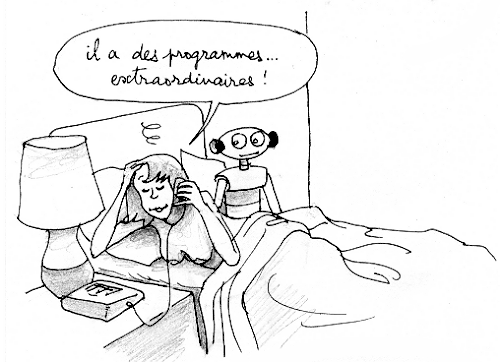
For more information on robotics, refer to my comic strip "What do Robots Dream of", published by Belin in 1982, twenty-four years ago! You will not find a better introduction to this discipline. A book that completely went unnoticed. Anyway, all these comics were sold at an excessive price, with a profit margin reaching 94% at the end of the exploitation, with mail order sales where the shipping cost was borne by the buyer. One can say that before Belin handed over the reins, it sold 20 copies per year and per title. A logical outcome of a commercial policy of maintaining a constant number of copies sold per profit made on each album sold. A strategy with a violent "non-linear response."
Fortunately, this time is over and this publishing house finally agreed to return my rights, to avoid having to reissue the out-of-print titles (which my contract allowed me to demand).
These albums have now become free and are beginning a new career on an international scale, with translations into 25 languages, currently, and 15 languages at the moment. See the site http://www.savoir-sans-frontieres.com
An employee of Belin Editions told me a few weeks ago:
*- In the house, they are wondering. Some are scratching their heads and saying "we may have missed something." *
*Do you know what? They really believed, after 28 years of existence, that the collection was dead. * ---
**August 29, 2007: The latest developments of the Big Dog robot. **
First link : http://www.bostondynamics.com/content/sec.php?section=BigDog
Big Dog is a quadruped robot that is one meter long, 72 cm high and weighs 75 kilograms.
The Most Advanced Quadruped Robot on Earth
It can move on all terrains, such as, for example, a terrain cluttered with rocky blocks. It maintains its balance thanks to a very elaborate system of proprioceptive sensors. You can see how it maintains its balance despite a strong kick given by one of the experimenters, in its flank.
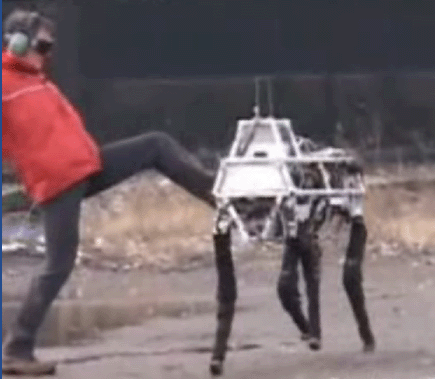
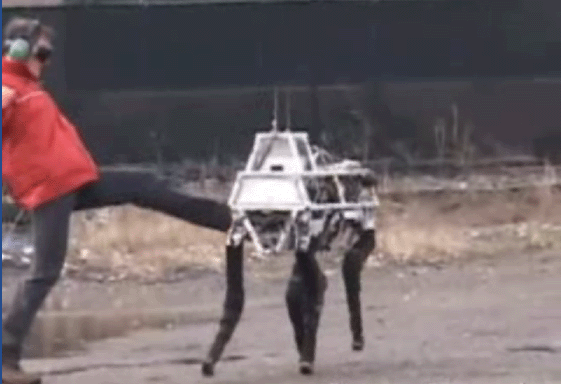
The experimenter sends a kick to the flank of Big Dog, with all his strength
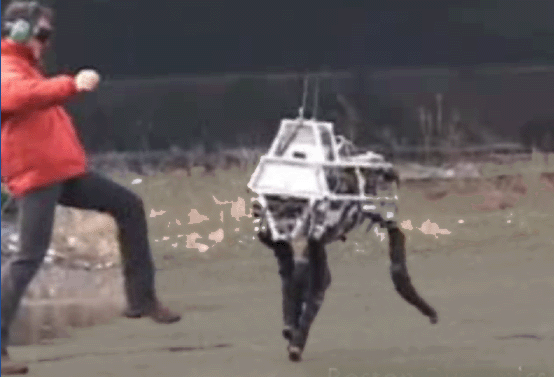
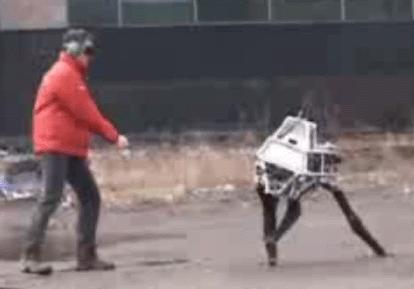
**Unbalanced, Big Dog immediately recovers its polygon of support by projecting one of its legs in the opposite direction of the kick **
It has a stereoscopic vision system. Its power source is a thermal engine powering oil cylinders. At this date, it could trot at 6 km per hour, climb slopes of 35° and carry a load of 60 kilograms. It is developed jointly by the Jet Propulsion Laboratory and the Concord Field Unit of Harvard, USA, with funding from the DARPA (Army).
This document is important. Big Dog is simply "the beginning of something." It would be naive to see in Big Dog a "mule" intended to carry loads accompanying a soldier in combat.
Big Dog is a formidable fighter in potential.
March 18, 2008 Big Dog in the snow and on ice. Its payload has been increased to 175 kilograms (a soldier plus his equipment)
It's anything but fun. If it were for the service of man, why not? But it's weapons, always weapons. You have to think about the money and the amount of technology, imagination, that we constantly pour into such projects.
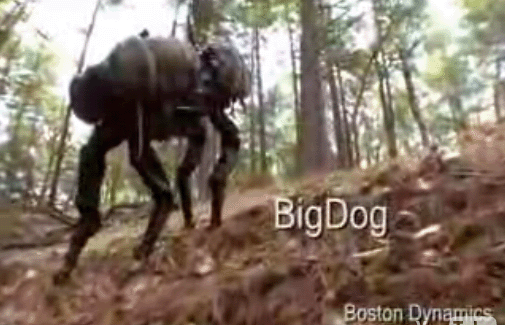
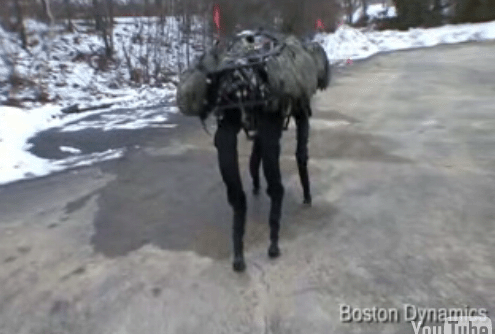
**Trudging up a slope cluttered with trees, which it avoids or moves through on a frozen lake **** **** **
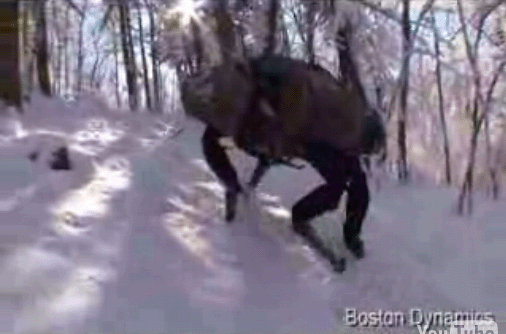
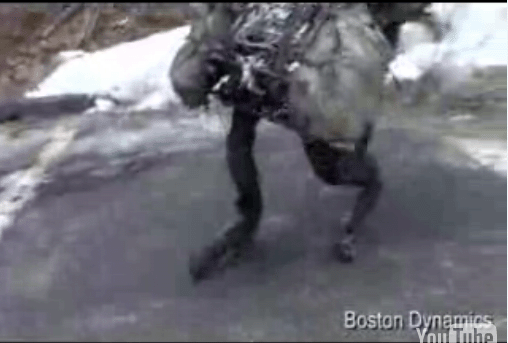
**Climbing snowy slopes When it slips on the ice, it catches itself on ... its elbows! **
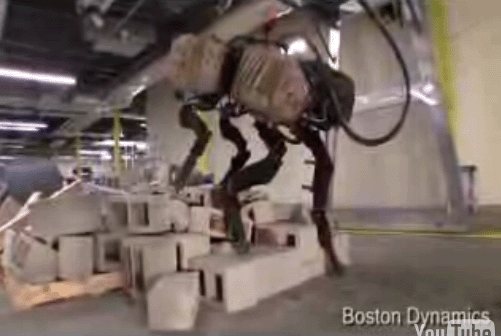
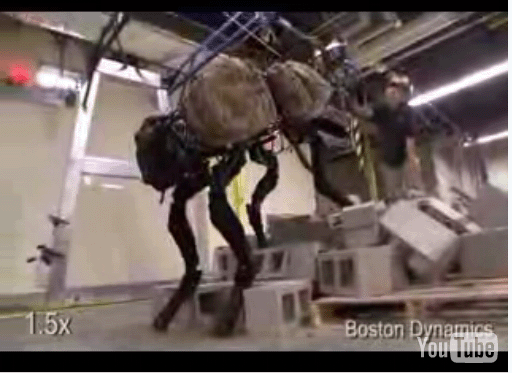
**It climbs a pile of bricks and descends without a single mistake. **
http://gizmodo.com/368651/new-video-of-bigdog-quadruped-robot-is-so-stunning-its-spooky
See also :
 http://www.youtube.com/watch?v=VXJZVZFRFJc
http://www.youtube.com/watch?v=VXJZVZFRFJc
The technology produces extensions of "biological objects" much more powerful than those that nature provides us with. When Cugnot's fardier appeared, it moved at the speed of a man walking at a pace and was propelled by a steam engine. A century later, locomotives were moving faster than the wind. Today, airplanes fly faster than birds. Bulldozers move loads much heavier than those that can be carried by domesticated elephants.
I think that today, robotics could allow the launch of a super tennis player capable of winning all competitions. A radar system would allow it to evaluate the speed of the balls much more accurately and quickly than a human could. It could thus make better anticipations, position itself well and return the balls at a speed that the opponent would not even see pass. Its passing shots would have centimeter precision. It would no longer even be interesting to watch such matches.
*Ah, for robotics, read my comic strip "What do Robots Dream of," published in ... 1982, which is downloadable for free on the site of Savoir sans frontières at this address. *
This Big Dog robot is only the prototype of extremely powerful weapons. In a "theater of operations," there are several ways to move.
- On the ground - Navigating on the surface - Underwater - Flying
*- Or even moving ... underground. *
We can imagine robots capable of performing these movements being much more efficient than any "bio-structure." We have imagined the wheel, movement on roads, rails. But a quadruped robot can run faster than a cheetah, the fastest land animal, capable of sprints at 100 km/h. There is, in principle, no limit to the speed of such robots, nor even to their scale. You are shown a robot the size of a large dog. But its extrapolation could give machines as big as houses, much more efficient than current tanks. Robots capable of galloping at hundreds of kilometers per hour, jumping over astonishing obstacles will appear.
Tank tracks are very fragile and allow only relatively slow speeds. When a tank battle takes place, the tanks must be brought to the battlefield by "tank transporters, or by rail," to avoid the fatigue of the journey. It would be unthinkable to see these tanks reach the battlefield by their own means: their tracks would not withstand it. In contrast, the combat robot can be completely versatile. It is the military transport of the future in the sense that it can continue to move regardless of the terrain's condition, even if roads and railroads are completely destroyed.
A robot can cross a waterway, by inflating bags ensuring its buoyancy. It can progress by moving along the bottom of a river, hiding there as needed for an indefinite time. It can climb very steep slopes, simply ... by extending retractable claws. There are already climbing robots, with eight legs, similar to spiders, capable of climbing vertical slopes. Inspired by the techniques of artificial climbing, a heavy climber robot can plant, using explosives, expansion pitons and progress on a smooth wall. In the film you can see a striking image: Big Dog jumping over an obstacle (invisible). But it doesn't matter. Big Dog knows how to walk, run and jump. The speed of information processing, the short reaction times make these robots, on all terrains, surpass living beings, in which the nerve impulse circulates at a ridiculous speed.
You doubt it? Take a 200 euro bill. Place it in the indicated position. Challenge a normally constituted person to catch the bill when you drop it, and even go as far as telling them that if they succeed in catching the bill, they can keep it. They will find it impossible to succeed. Simply because the time that represents:
*- The analysis of the bill's departure by the eye-brain system - The decision to initiate the gesture - Its realization in the form of a muscle contraction *
exceeds the time of the bill's transit between their fingers.
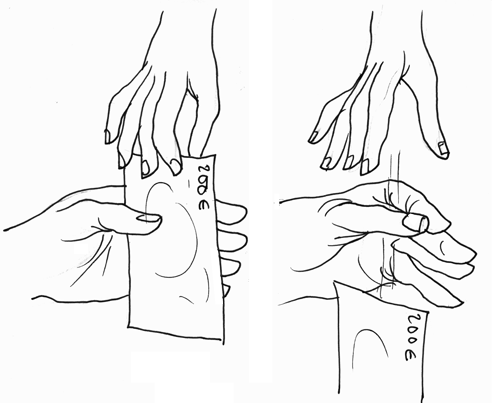
***With a technological system, the bill would be caught before it has even descended a tenth of a millimeter. ***
Look at the beetles. They are built like flying tanks, but are capable of deploying foldable wings, protected under armored elytra. They can burrow, progress ... under the ground. A robot can progress in very hostile environments, where the air is unbreathable, or dangerously polluted, where there is intense radioactivity, where the temperature is high, or very low.
*A versatile robot? Not impossible in principle. * ********
http://fr.youtube.com/watch?v=wIuRVr8z_WE&mode=related&search=
http://fr.youtube.com/watch?v=2hIhZ-QCWIg&mode=related&search=
http://fr.youtube.com/watch?v=fvYb2rUcMTg&mode=related&search=
http://fr.youtube.com/watch?v=IFVSuUIt8KY&mode=related&search=
http://ccsl.mae.cornell.edu/press/news/Science5802/SciencesEtAvenir.html
http://www.mae.cornell.edu/lipson
http://fr.youtube.com/watch?v=Q3C5sc8b3xM&mode=related&search=
http://fr.youtube.com/watch?v=PoBPkgjFIo4&mode=related&search=
**
http://fr.youtube.com/watch?v=TsZ2NMcMG4g
Added on August 30, 2007:
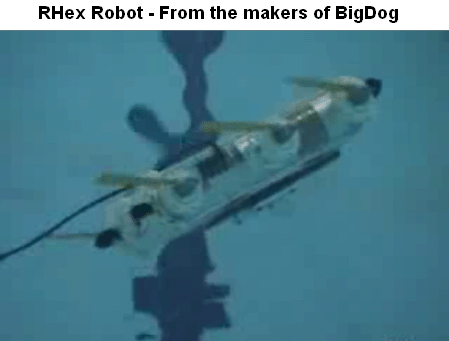
Message from Steve Higler, Mr. Petit, Regarding robots, here is one all-terrain, code name RHex Robot, it goes through mud, crosses a railway track, it swims... even underwater!!
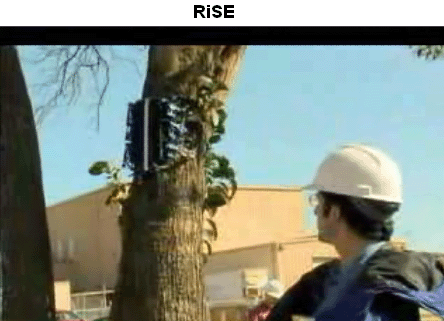
A robot with six underwater flippers, which it alternately moves. This one, code name RISE, climbs trees and walls:
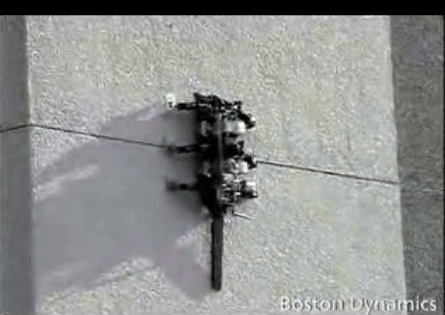
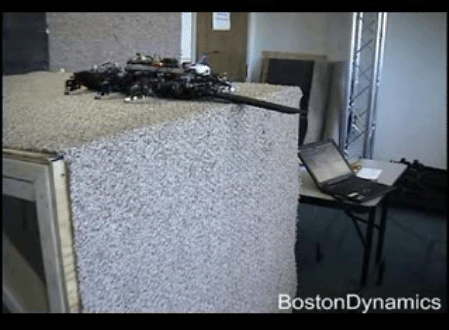
This one climbs trees with its claws. Here is another one that climbs walls by clinging to tiny irregularities. Now look at this one, equipped with a tail. It will use it to recover balance to "grab" a platform.
And there you go! There may be planets where climbers use their tails for climbing.
As a former instructor for this sport, I appreciate the idea.
The art of camouflage:
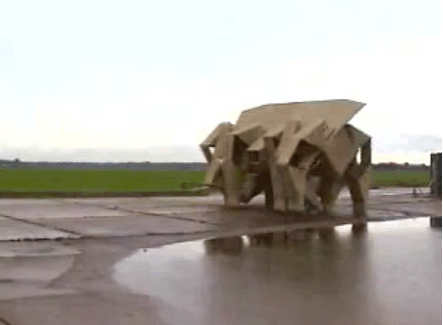
Here is a robot that, once damaged, tries to find a way to move by modifying its programming:
The video is here by clicking on the robot's image:
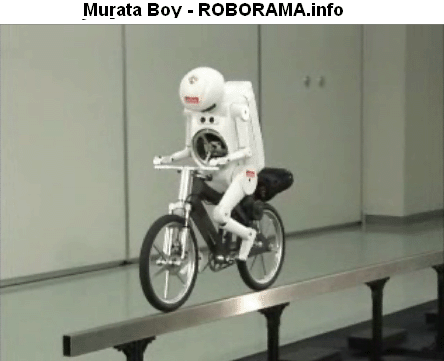
The Japanese are able to evolve a robot-bicyclist on a rail:
This Japanese robot-bicyclist travels on a 5 cm wide rail. As it passes, you will notice on the robot's belly its balancing system, which immediately compensates any tilting movement, "any angular momentum".
There is a fantastic idea for civil applications.
I don't know if anyone has thought of it. With a global market. The motorcycle is a very convenient vehicle for moving around. It is a single or tandem two-seater. It is narrow, allowing it to maneuver. Disadvantage for the city and when it rains: you cannot put a fully enclosed body on it, because the rider must put his legs out at low speed. As soon as the motorcycle is moving, no problem. But you have to move your legs when stopped, at very very low speed or when climbing a sidewalk. If the Japanese system were adapted to a motorcycle, it would ensure its verticality when stopped and when crossing obstacles like a sidewalk. But on a motorcycle, verticality is not what you want when turning, on the contrary. When it comes to it: the system only needs to activate below a certain speed, when balance is difficult to maintain, when it drops below the speed of a person walking at a normal pace, for example. As soon as the machine goes faster, it becomes a "normal" motorcycle, this balancing system is disconnected.
It is then possible to fully cover the motorcycle. At rest, it rests on its stands. When the engine starts, the balancing system activates and the stands automatically retract. The body offers different advantages:
-
No longer suffer from the weather - Reduction of drag. Higher speed at the same power. Economy.
-
Protection in case of an accident!
-
More, in the city, an extra comfort: the possibility to listen to music freely.
-
Easy heating for cold seasons.
-
Avoid getting dirty when crossing a puddle.
-
No need for "motorcycle gear" and even ... a helmet, since you are "inside a vehicle".
The multiplication of these vehicles, possibly with electric propulsion (I think of the multitude of electric bikes in China) would solve the problems of urban traffic and parking for a long time. Since this vehicle is relatively unobtrusive, one could imagine buildings with elevators allowing you to protect your vehicle from theft and damage, to bring it directly to your home, in the entrance, and to recharge it (but Chinese batteries are light enough for users to handle and charge them at their workplace or at home).
I spoke of motorcycle. But such vehicles could be covered bikes, with comfortable enough luggage racks to accommodate adults.
Always reported by Steve Higler, the state of the art of Japanese robotics: the robot Asimov. He knows... to run. He can take turns, "slalom".
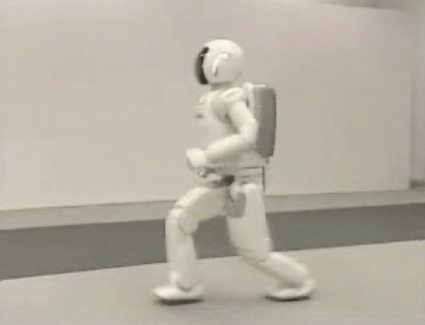
Asimov in full run (with flat feet) Asimov is a bipedal robot, which makes his run and balance more complex. Moreover, you will notice... that he has flat feet. This will greatly limit his speed. He has no arch that could give his run elasticity and length, flexibility. He runs heavily, with his legs always bent. He runs like a bear that starts to run on its two hind legs. I don't know if his designers understood this from the beginning. Bipedal running is a dynamic movement. The designers stabilize the torso very well with the movement of the arms. But it's not a real run. Asimov has knees, but he is weak in the calves. We have muscles in our calves that allow us to push with our legs. Asimov never uses his toes. He pushes heavily on his flat feet. On the Honda website you will find an attempt where Asimov tries to climb a staircase and... falls flat on his face. To climb a staircase, you actively use the muscles of the calves to push on your toes. But you can indeed climb and descend by placing your feet flat.
All of this is just the beginning. Everything will be improved. To get a good bipedal running robot, it would be enough to take inspiration from dinosaurs, give it a tail...
It is important to note the speed with which the robot perceives its environment. It can "have eyes in the back of its head", capture a multitude of information, evaluate speeds by Doppler effect. Its "speed of calculation and reaction" and the speed "of its nerve impulse" are infinitely superior to that of a living being. It can be equipped with a proprioceptive system that allows it to locate itself in space, very precisely. It can be equipped with "muscular capabilities" exceeding those of living beings.
From the point of view of running, Big Dog is currently potentially more performant than Asimov, who would not withstand a simple trip. It is not said that bipedalism is the panacea for robots. But know that, in principle, anything is possible. And when robots exist, which are able to run, climb stairs, carry objects, they can become serious competitors for humans, in a variety of jobs.
With robotics, nothing is impossible. One can theoretically make a robot dance like Fred Astaire or Gene Kelly. One can make it win all the Olympic games of the planet, including the 400 meters hurdles, the pole vault. One can make a robot-skier, unbeatable on all snow, descending at full speed on its... steel calves.
When will the robot be bought in a sex shop, which... does everything, heterosexual or bisexual, hermaphrodite? Moebius had a funny comic strip about an astronaut who tries to use a robot-girl who is apparently poorly programmed and kicks him in the balls, while he had set it to "great tenderness".
I have this ability to see far. I remember, when I was a student at Lycée Condorcet, the Russians put their first Sputnik in orbit. Immediately I told my math and physics teachers that soon there would be men in space, on the Moon. Reaction:
- No... in my opinion, it's another problem. Putting a satellite... yes, but a human being.....
no....
They were skeptical. And yet, things did not delay. When you see Asimov waddling and you have a little ability to project yourself into a relatively near future, you know what all this will become.
I will tell you a funny anecdote. I was a teacher at the School of Fine Arts in Aix-en-Provence, in sculpture. In 1977 the first Apple IIs arrived. Clock at 2 megahertz. 16 then 48 K of main memory. Floppy disks of 120 K. Screen display in 130 points by 180. Very quickly I wrote in BASIC a software: Pangraphe, which allowed to design all kinds of objects and give them images in perspective, with a small plotter. One day I wanted to show this to the School of Fine Arts in Aix in front of the professors. I sketched... the future.
Blindness, complete deafness.
-
You're not going to tell us that computers will one day be able to produce images with the fineness of pen drawings or paintings...
-
Yes... yes....
-
Finally! All this is ridiculous.
I packed everything up. Jacques Boullier, director and friend, was shocked. I told him:
- I will come back... in ten years.
In many areas it's like that. Sometimes there are idiots who talk about "technological delirium". The worst is yet to come: artificial intelligence. When it emerges, suddenly, as a consequence of the emergence of a (true) non-bivalent logic, it will develop explosively and invade all sectors. It could prove more efficient than humans for making decisions, fast ones or requiring the management of tens of thousands of parameters. It could prove uncontrollable. Not because it will command humans but because humans will tend, by delegating multiple tasks to it, to become cyber-dependent.
To finish, here is the expression of Albert Einstein:
Faced with these images, we are like the curious people who came at the beginning of the century to witness the graceful beginnings of aviation, without imagining for a second that the descendants of these aircraft would come to shoot columns of refugees, terrifying them with their siren (the Stuka dive bombers) or sowing death and destruction (the Spanish War: first aerial bombing of a city inhabited by civilians: Guernica, then Ethiopia, then bombings on London). I often think of the sentence that a friend, a "bomb expert", who had worked for 30 years on instrumentation, particularly at Mururoa, and who wrote to me a month ago:
- You who scream against the military, how do you explain your fascination for weapons?
I doubt that this idiot will ever say that to me in public again.
Sent by Flo, a video showing contemporary military applications:

http://www.youtube.com/watch?v=MY8-sJS0W1I
**
I
t is a thing that would be technically feasible without the slightest problem. I had this idea about fifteen years ago when I was asked to think about a project for a leisure park for a large city in the south of France, which was actually a screen project, intended to divert money. When I finally found out, I withdrew and the project fell apart. It was called "Lanturluland". The file, which is in a drawer, contains about a hundred original ideas.
D
uring this park, among other things, we would have put dinosaurs. One idea was to equip the head of a long-necked robot-dinosaur with three infrared sensors, hidden in its scales, which allowed the creature to locate an approaching source (a visitor, or the closest visitor). Then an actuation allowed the animal's head to turn towards the visitor and never let go of his gaze. For this Japanese robot, it would be enough to hide two sensors in ear rings and the third in a necklace. Activation of head movement and fixation (binocular) of the gaze on the source. Activation when the source is close enough. When the source becomes too far, the robot "looks elsewhere".
D
uring the dinosaur version, we had planned to make visitors come out of the shadows. The dinosaur would only show interest when the person appeared in the light. Conversely, when it, moving away, returned to the shadows, the dinosaur would have raised its head looking for it and making plaintive cries. Curious that the Japanese have not thought of this.
The day the robots have you in their sights, you'll be in trouble.
I
t is a thing that would be technically feasible without the slightest problem. I had this idea about fifteen years ago when I was asked to think about a project for a leisure park for a large city in the south of France, which was actually a screen project, intended to divert money. When I finally found out, I withdrew and the project fell apart. It was called "Lanturluland". The file, which is in a drawer, contains about a hundred original ideas.
D
uring this park, among other things, we would have put dinosaurs. One idea was to equip the head of a long-necked robot-dinosaur with three infrared sensors, hidden in its scales, which allowed the creature to locate an approaching source (a visitor, or the closest visitor). Then an actuation allowed the animal's head to turn towards the visitor and never let go of his gaze. For this Japanese robot, it would be enough to hide two sensors in ear rings and the third in a necklace. Activation of head movement and fixation (binocular) of the gaze on the source. Activation when the source is close enough. When the source becomes too far, the robot "looks elsewhere".
D
uring the dinosaur version, we had planned to make visitors come out of the shadows. The dinosaur would only show interest when the person appeared in the light. Conversely, when it, moving away, returned to the shadows, the dinosaur would have raised its head looking for it and making plaintive cries. Curious that the Japanese have not thought of this.
The day the robots have you in their sights, you'll be in trouble.
http://noxmail.us/Syl20Jonathan/?p=12270
November 4, 2011: the last Japanese humanoid robot.
As is usually the case in anything related to computing, nothing can stop these developments. Already, it is becoming difficult to distinguish between computer-generated images and synthesized voices, or synthesized musical instruments. Mimicking a human being: it is in progress. We are already creating doubles of existing living beings.
For this sequence to become more credible, it would be enough for the android to show some semblance of autonomy, have some random movements. It could also follow a person passing in front of it, detecting its presence using an infrared sensor. The eyes would turn first, then the head.
A mini-camera could be hidden behind a... mole, or even be completely invisible, or simply be located behind the crystalline of one of the two eyes. A shape recognition would allow the android to locate the eyes, and look you "straight in the eyes". Moreover, by using an ultrasonic sensor to determine the distance between you and it, it could converge its optical axes accordingly. There, we will start to feel very uncomfortable.
The same android could have a corresponding gestural language, pointing its finger at you, or signaling you to come.
All of this can be done, in terms of mimicry, and everything will be done.
Everything you think is already in progress.
One can create a thermal illusion, by setting the android's temperature to human temperature, giving the tissues the necessary flexibility, giving it a smooth gait, introducing a whole programming of reflex gestures like... shaking your hand.
For the moment, the human retains a last bastion, for which (for military or domination purposes, the most developed nations spend fortunes): artificial intelligence or AI.
There, we open the Pandora's box, straight.
It doesn't matter. All these advances have been made within the scale of a human life. It is very likely, if we manage to take hold of a minimum of artificial intelligence, that we could create androids hardly distinguishable from real human beings, in only a few decades. Thus, when witnesses say they have seen beings very close to humans coming out of UFOs, are they living beings or androids? This idea had already been suggested to me by the late Pierre Guérin, many years ago. It seems that his gaze saw further than mine.
These advances could be within our reach in the span of just a few decades. What to say of civilizations that could have centuries or millennia of technological advancement over us!
But technological advancement remains little. Where our terrestrial race maintains a constant, unchanging delay, it is on the social level, simply "human". The works of "social engineering", driven by idiotic oligarchies, mainly focus on the mental manipulation of societies, through their media and "false flag operations", deploying, through complicit media, a whole network of lies.
It remains for men two elements that they must discover within themselves and preserve like the primitive man preserves fire in a shelter, before these salvific elements go out: their skepticism and their conscience, the possibility of forming their own judgment. More than ever:
Learn to think for yourself, otherwise others will do it for you, and not in your interest, be sure of it
Return to the theme of combat robots:
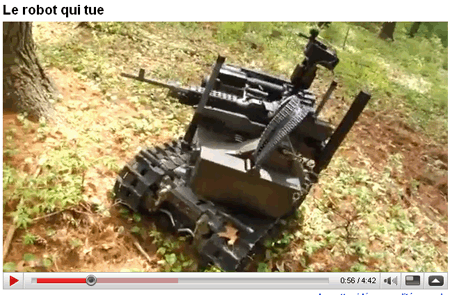
Such robots will be guided by GPS, equipped with sensory organs operating in all frequencies. They will be able to see in the visible, infrared, ultraviolet. Thanks to infrasound they will be able to detect the movement of humans trying to hide under thick foliage. They will be able to conduct reconnaissance and surveys using radar waves. Their hearing will be formidable. They will perceive ultrasound and infrasound. They will be able to analyze odors. The speed of information processing will be such that this war machine will have a panoramic perception of its environment.
Armament? Guided or wire-guided missiles no longer require the transport of heavy cannons. Combat robots will also kill with lasers or microwaves. They can carry a flamethrower, emit toxic gases. The absence of human beings allows to be free of heavy armor. Why protect what can be lost? Manufactured in great numbers by robots, armies consisting of tens of thousands of robots, programmed to detect and destroy, will invade battlefields like ants, small or large. They will be able to self-repair, heal from "injuries". They will know neither fear nor pity. There will be robots of all sizes. Nanotechnology will allow the deployment of troops where the combatants will be the size of insects. In contrast, other multi-legged robots can jump over houses.
Do not be mistaken: the future is already here
The Americans are not at all happy to lose human lives every day in battles and attacks in Iraq, Afghanistan and other places. Everything is being done to quickly replace the human soldier with mechanized soldiers, all-terrain.
The Web is full of videos showing how future wars will be played, how brave American soldiers will successfully carry out their battles wherever they have to "do the job". These films show American soldiers comfortably sitting in front of screens, showing the environment of the robot from different angles. The soldiers are enthusiastic:
- With this I can accurately hit the target, taking my time to adjust my shot
But none seem to think about the devices that kill them every day, the artisanal mines buried everywhere the armored vehicles pass, triggered by a simple call on a modified mobile phone.
I can no longer install folders on the different weapons that come out. Plus, it's tedious.
Go watch "Virus and Men" at http://leweb2zero.tv/video/alcandre_3646cd53e6a7b76
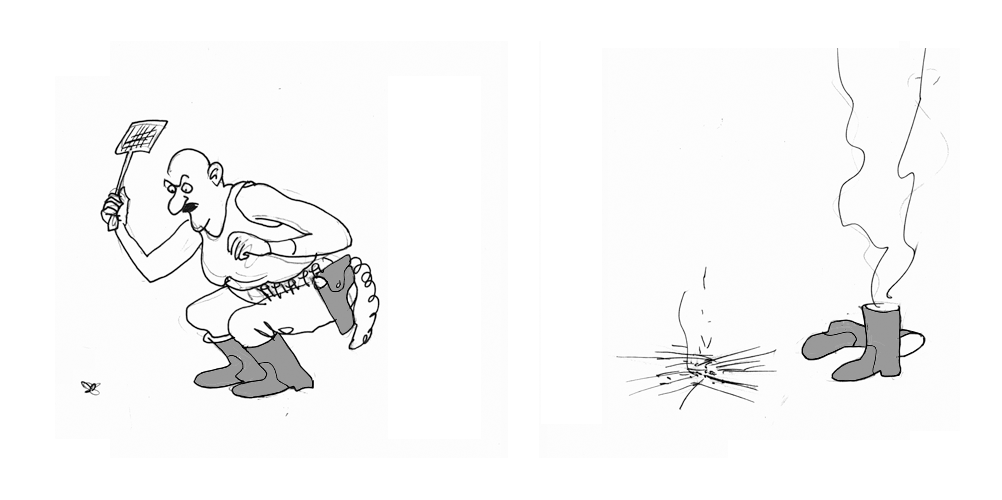
February 17, 2008: The beginning of the insect robot at Harvard :
February 1, 2009: The latest advances in military robotics :
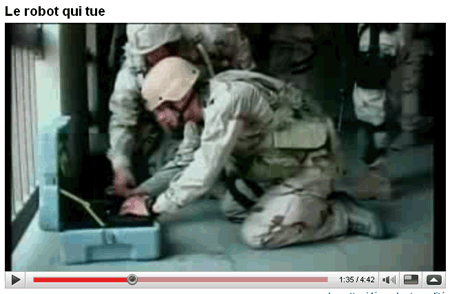
Anti-missile "Trophy"
Let's mention an enormous progress made to protect tanks and half-tracks when they are in the city and risk being hit by a "LRAC" (anti-tank rocket).
http://www.dailymotion.com/relevance/search/trophy/video/xzcjt_trophy-vs-raytheon-contractor_news
In the video you will see how a tank is supposed to be surrounded by an effective short-range "shield":
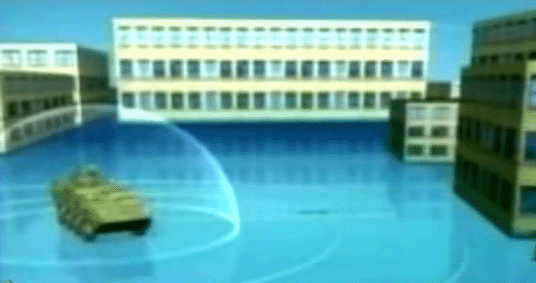
Shield to protect tanks: "Trophy"
In the video you can see missiles approaching a tank at high speed.
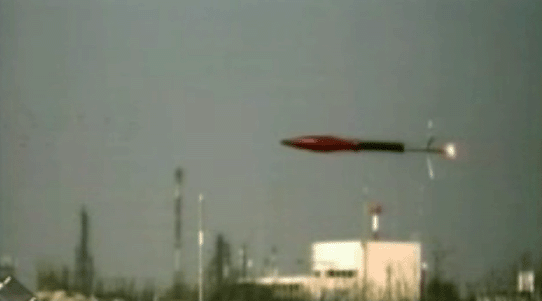
**First, the approaching anti-tank rocket, with its tail fin deployed. **
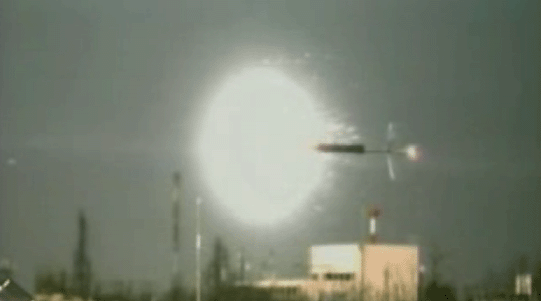
The missile is neutralized by the "Trophy" system
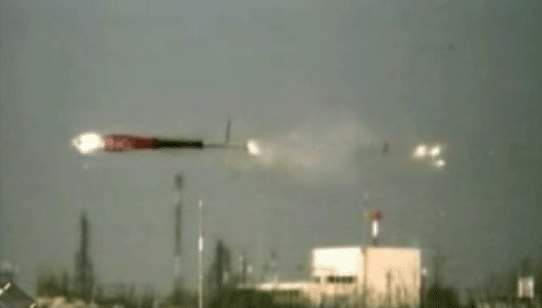
**As you can see, the rocket did not explode, but it was still neutralized. Why? **
A tank is a heavy structure that protects the crew with armor. During the war of 1939-45, "hollow charge" projectiles appeared. Working principle. At the front of the projectile, behind a "nose" with purely aerodynamic functions, an explosive charge is attached, which is glued to a metal cone, usually copper. When this explosive is ignited, the detonation is very rapid. Behind this cone, there is therefore a considerable pressure. This cone is propelled at 10 km/s. It is a layer of molten metal that converges towards the axis of the system in a fantastic shock wave. The fluid mechanics of these "blast waves" show that this cone turns into an extremely fast and dense "spike," which can then penetrate a thick armor. It is commonly considered that an anti-tank rocket of diameter D can penetrate an armor of thickness D. That is huge! So with a simple 10 cm diameter device, you can penetrate a 10 cm thick armor.
Remember, by the way, the strange shapes of these "Panzerfaust" rockets that were fired by children against Russian tanks in besieged Berlin. Remember that their heads may seem unusually large. It was to increase their penetration power.
So these tanks, these fantastic war machines, are in danger in the streets of Baghdad because barefoot people walk around with a vague tube on their shoulder. Unacceptable. Superman therefore designed the electromagnetic shield that allows to protect the tanks and half-tracks.
It works at short range, a few meters. The key element is a 360° Doppler radar that detects any object approaching at a speed above a threshold.
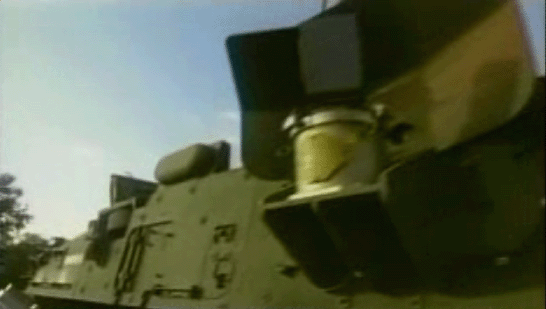
A Doppler radar on the side of a tank, to detect the approaching missile .
This system costs 300,000 dollars. The file shows that there is controversy within the army. And it shows how much wars are profitable for shareholders of companies like Raytheon. At one point, one of the images says: "What is the priority? Money or men?" Americans are beginning to ask questions. It reminds me of the book written by Lartéguy about the involvement of Americans in Vietnam:
One hundred thousand dollars for a Viet
How does it work? Tonton-JPP, "the man who screams against the military but is fascinated by weapons," as the other idiot says, will explain to you. The vulnerable element in the rocket is its metal cone turning into a high-velocity penetrator. When the missile is at a good distance, the tank emits a high-intensity electromagnetic pulse. As the Israelis also plan to use it, it makes one think of the episode in the Bible where the Ark of the Covenant struck down Ouza, a simple Jew who had touched it, while it was being transported by oxen. These oxen had slipped into a rut, and the Ark risked falling to the ground. Only the Levites were authorized to handle it. Ouza paid for this act with his life.
The electromagnetic wave vaporizes the metal cone, which is the key element of the rocket. As seen in the photo taken from the film, it does not explode and continues its course. It can hit the tank. Its charge can explode, either by an internal inertial detonator or upon impact. *But without this hollow charge effect, the damage will remain minimal. *And without this precious metal cone, no hollow charge effect.
*Smart, isn't it? *
The hollow charge effect has multiple uses. It is used, for example, in American attack torpedoes during "contact shots." The enemy submarine is then approached. The explosive is placed behind a "V" shaped groove. A shock wave is formed that resembles a cylinder cutting. It cuts the relatively thin sheet metal of the submarine, which allows, in the following, to insert a timed charge the size of a simple barrel. This is how the Kursk was sunk.
With this technique of the hollow charge, you can cut off huge I or H-shaped iron beams present in the structures of buildings you want to demolish, during a controlled demolition. We have found sheets cut this way in the (burning) debris of the twin towers of the World Trade Center. It is easy to extract the image from a video.
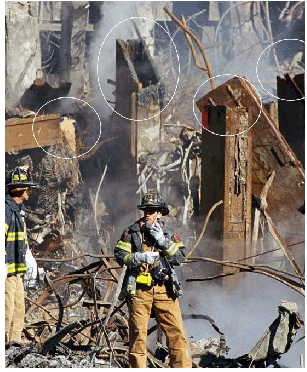
**Beams cut off in the debris of the twin towers. Clear evidence of a controlled demolition
Result impossible to achieve by bending the beams or impact. **How can the press continue to ignore these facts? **
See articles on agoravox :
http://www.agoravox.fr/article.php3?id_article=28653 and http://www.agoravox.fr/article.php3?id_article=28444
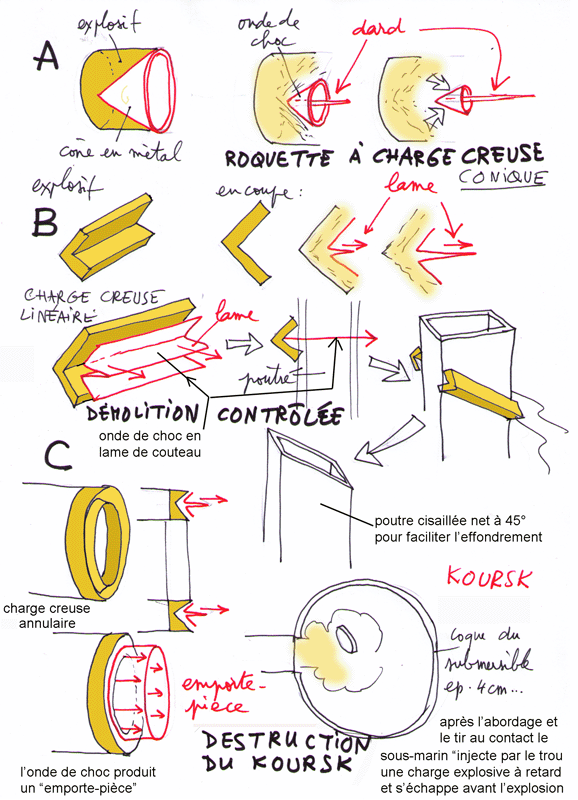
Hollow charge technique It is necessary for me to explain this essential phenomenon, which has been the subject of many applications, first military and then civilian (controlled demolition). Figure A: The explosive mass has the shape of a cylinder with a conical recess in contact with a metal cone, usually copper. The explosive has a high detonation velocity. Thus, after ignition, the metal cone, subjected to high, almost uniform pressure, is projected towards the axis at a speed of 10 km/s. This cone (metal vaporized) thus compresses itself, but at the same time secretes a "spike" of dense plasma projected at very high speed. It is this spike that is able to penetrate the armor of the tanks. It is considered that one can penetrate an armor whose thickness is equal to the diameter of the rocket. This spike injects a high-temperature plasma into the tank, killing its occupants, leaving only a hole of one cm in diameter.
Figure B: One can use a similar technique by arranging two explosive plates forming a dihedral (90° angle). After ignition, the overpressure related to the explosion projects two metal lamellae towards each other, according to the symmetry plane of the system. A "knife" made of vaporized metal projected at 10 km/s is formed, capable of shearing centimeters of steel. This system is used to cut beams cleanly during controlled demolitions. The 45% arrangement allows the beam to be freed to the side after shearing. The presence of beams cut cleanly in the debris of the twin towers (above photo) is irrefutable proof that these collapses were controlled demolitions. I am shocked that my colleagues researchers and engineers continue to brandish a "cautious skepticism." The explanation is fear.
Becoming aware of such an action would be "too horrible," not only for American citizens but also for French engineers or researchers from the CNRS.
Figure C: The dihedral is wound around itself and an annular hollow charge is obtained, which allows to realize a punch, capable of cleanly cutting a 4 cm thick sheet of a submarine. This is how the Kursk was destroyed, by this boarding and contact shooting technique; which allows to avoid the recording of the sound trace of a torpedo's course. It can then pass for an "accident." You will not find mention of this in any technical or scientific journal, in any military journal. Others will search for the explanation of this blindness or incompetence.
Hollow charge technique It is necessary for me to explain this essential phenomenon, which has been the subject of many applications, first military and then civilian (controlled demolition). Figure A: The explosive mass has the shape of a cylinder with a conical recess in contact with a metal cone, usually copper. The explosive has a high detonation velocity. Thus, after ignition, the metal cone, subjected to high, almost uniform pressure, is projected towards the axis at a speed of 10 km/s. This cone (metal vaporized) thus compresses itself, but at the same time secretes a "spike" of dense plasma projected at very high speed. It is this spike that is able to penetrate the armor of the tanks. It is considered that one can penetrate an armor whose thickness is equal to the diameter of the rocket. This spike injects a high-temperature plasma into the tank, killing its occupants, leaving only a hole of one cm in diameter.
Figure B: One can use a similar technique by arranging two explosive plates forming a dihedral (90° angle). After ignition, the overpressure related to the explosion projects two metal lamellae towards each other, according to the symmetry plane of the system. A "knife" made of vaporized metal projected at 10 km/s is formed, capable of shearing centimeters of steel. This system is used to cut beams cleanly during controlled demolitions. The 45% arrangement allows the beam to be freed to the side after shearing. The presence of beams cut cleanly in the debris of the twin towers (above photo) is irrefutable proof that these collapses were controlled demolitions. I am shocked that my colleagues researchers and engineers continue to brandish a "cautious skepticism." The explanation is fear.
Becoming aware of such an action would be "too horrible," not only for American citizens but also for French engineers or researchers from the CNRS.
Figure C: The dihedral is wound around itself and an annular hollow charge is obtained, which allows to realize a punch, capable of cleanly cutting a 4 cm thick sheet of a submarine. This is how the Kursk was destroyed, by this boarding and contact shooting technique; which allows to avoid the recording of the sound trace of a torpedo's course. It can then pass for an "accident." You will not find mention of this in any technical or scientific journal, in any military journal. Others will search for the explanation of this blindness or incompetence.
But how could a tank emit a powerful electromagnetic wave, without itself being a receiver of the same wave?
By turning its armor into an antenna. These new electromagnetic shielded tanks will have to be redesigned accordingly. It will also be necessary that this wave does not have a harmful effect inside the tank, does not explode the ammunition, does not damage the "human equipment." There must be an "anti-shield" shield.
All of this will be expensive, extremely expensive. The people in power in the USA, in the service of the money powers, will prefer, as in all previous wars, to make the American taxpayer spend ridiculous sums rather than undertake to bring a little more justice to the Earth. Think back to the Vietnam War, its cost, not only human but also in materials, bombers, helicopters.
*It's the ... party of the madmen, and how long will it continue? *
Let's go back to this robotics, which will one day be equipped with an authentic artificial intelligence (we will create robots capable of "creating code", of reprogramming themselves, of creating their own programs, not of implementing already written programs, using a logic different from that of classical binary logic) could render invaluable services to humans, in civilian applications. But who would care? This artificial intelligence will be used first of all to manage conflicts, or to create them, to analyze, manipulate, starve.
****http://leweb2zero.tv/multipod2/thefens_3146e943c23c8b0
****http://www.news.com.au/adelaidenow/story/0,22606,22405929-5006301,00.html
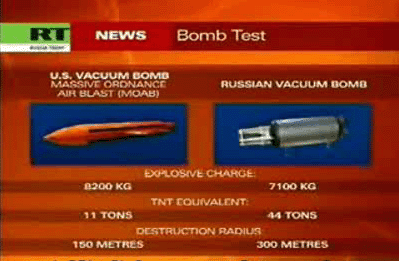
µ The thermobaric weapon (VACUUM BOMB) Kill me cleanely I have existed for years in low-altitude drop versions by bombers. These bombs are dropped attached to parachutes to allow the bomb-throwing pilot to get out of the blast effects.
On the left, the American bomb. Weight: eight tons. TNT equivalent: 11 tons. Destruction radius: 150 meters.
On the right, the Russian bomb. Weight 7 tons, power 44 tons (a third of Hiroshima), destruction radius: 300 meters. See the video from "Russia Today":
Reuters video:
44 tons of TNT equivalent, that's 1/272 of the power of the Hiroshima bomb, which devastated everything within a five-kilometer radius. There are anti-personnel mines, capable of killing a man or several, dangerous within a few tens of meters. There are anti-tank mines. The Hiroshima bomb was the first "anti-city" weapon, capable of erasing a city and its inhabitants from the map. I believe that people do not fully realize the monstrosity of the nuclear weapon. Megaton weapons represent 100 times Hiroshima. They are then "anti-city" weapons, on the scale of large cities. Let's not talk about the effects of fallout.
The news is currently focusing a lot on four 150-kiloton nuclear heads, ten times Hiroshima, which have been wandering on the wings of B-52s above American territory. It is the typical weapon of nuclear strike, which equips the multiple heads of nuclear submarines. Rumors circulate. Why this transport of arms, in such an "operational" way? It is known that nuclear arms are occasionally transported from one place to another, whose charge is made of plutonium. But this transport is then carried out "under the best security conditions," that is to say in such a way that if the carrier plane crashes, this plutonium would be protected in the equivalent of "black boxes" to prevent its dangerous dispersion (a microgram is enough to kill a man). However, this was not the case for the nuclear heads transported by the B-52. So, what were these heads for, did they have a target? Which one? Why not a city in the United States and three other European cities, to create an anti-terrorist hysteria.
We live in the time of all dangers. Only the fools do not realize it. What progress with these new bombs?
During the war of 1939-45, bombs weighing four tons were dropped. So, where is the progress? It seems to be of a qualitative nature. Until now, it was necessary to distinguish between incendiary bombs, releasing intense heat, and explosive bombs. Moreover, in an explosive, a chemical reaction occurs in a ten-thousandth of a second, where all the energy must be contained in the charge. The surrounding air does not play a role. It only allows the shock wave, born within the explosive, instantly gaseous, to propagate.
With napalm, first "progress": you no longer drop the "fuel". The oxidant is the air. Hence a weight saving. Moreover, a can of napalm can "water" an entire area. With a single can, during the Algerian war, you could kill all the inhabitants of a village, in one go. Napalm was gelled gasoline. But napalm burned, it did not explode. In the large thermobaric bombs, progress has been made in the preparation of the explosive mixture, in the dispersion of the fuel, in the form of an aerosol. It is only ignited in a second phase. In the first phase of the operation, it can spread over a large surface, occupy a large volume and even penetrate through openings. Specialists compare the effects to "silos explosions," which contain a mixture of air and fine particles. When ignited, the droplets of the aerosol created by the bomb are so fine that a real explosion occurs. By explosion, we mean that an exo-energetic chemical reaction rapidly spreads to a large volume of aerosol. Therefore, there is an essential difference with a classic explosive, which detonates when it is in a very concentrated state.
You have heard of "vacuum bomb," "empty bomb." Yet, usually when you think of a bomb, you think "blast effect." In the case of these new bombs, both phenomena are present. An analogy will allow to explain the phenomenon. Imagine a pool of water. Suddenly, in a certain limited area, you raise the water level. Then you remove the sluice very quickly. A crashing wave will occur, equivalent to a tsunami. But, in the opposite direction, a "rarefaction wave" will propagate, towards the center of the system. If a shock wave reflects according to a shock wave (where two shock waves meet, or converge towards the same geometric center), the rarefaction waves are reinforced. I don't know how much these new bombs can lower the pressure at the center, but it would not be impossible that their name "vacuum bombs" deserves its name.
Vacuum bomb schema C This rarefaction wave can then reduce the pressure significantly at the geometric center of this combustion mass. The device is formidable. First, the brevity of the aerosol combustion gives rise to an intense shock wave, capable of destroying vehicles, buildings by the effect of the blast. This being a simple shelter but sufficiently solid can allow soldiers to survive. A bunker, for example. At the same time the composition of the reactant makes that this ball of fire emits an intense thermal radiation. Such weapons have been tested during the first war against Iraq, the first "Gulf War." We saw photos of Iraqi soldiers burned, black. Now the second effect comes into play:
the rarefaction wave. This bomb ... creates a vacuum in the center of the explosion, by reverse effect. But if you can protect yourself from a shock wave, it is impossible to escape the effects of a large pressure drop. The overpressure is carried by a shock wave. It is brutal, of an infinitesimal duration. The shock waves reflect according to shock waves. If the bunker, the shelter is not destroyed, it will effectively fulfill its protective role. Soldiers can survive by crouching in trenches, while a destructive shock wave destroys everything on the surface.
But the rarefaction wave is not concentrated in space and time. See the diagram. In an area corresponding to the numbers advanced, imagine that a huge pump lowers the air pressure, not for a thousandth of a second, but for a time of the order of a second, less than a hundredth of the speed of sound. Then the trench no longer offers the slightest protection. This suction effect will spread everywhere.
It will be very effective for killing people hiding in shelters or tunnels.
A simple change of direction in a tunnel prevents a shock wave from propagating. It will reflect on the first solid obstacle encountered. The suction effect seeps everywhere, "slips." The chest cavities, the visceral masses burst.
It is really a new weapon, formidable against human beings, as well as against buildings, which burst like ripe nuts under the effect of this depression.
What is positively terrifying with these new bombs, is that they are ... non-polluting.
They escape the rules prohibiting nuclear devices.
They have already been used successfully and their use will become widespread. The "portable" version. We can't stop progress. Afghanistan: The British Army deploys a new weapon based on a mass killing technology.
According to a minister, the parliament was not informed.
A new "super weapon" has been given to British soldiers deployed in Afghanistan that uses a technology based on the "thermobaric" principle which uses heat and pressure to kill targeted people in a specific air field, sucking the air from the lungs and causing the rupture of internal organs.
The so-called "enhanced explosion" weapon uses a technology identical to that of the US "bunker buster" bombs and the devastating bombs used by the Russians to destroy the Chechen capital of Grozny.
Such weapons are brutally effective because they first disperse a gas or chemical product that is ignited in the second stage, allowing the explosion to fill the spaces of a building or the crevices of a basement. When the US Army deployed a version of these weapons in 2005, Defense Tech wrote an article titled "Marines remain silent on a new brutal weapon." (article) According to the US defense intelligence agency, which published a study on thermobaric weapons in 1993, "the mechanism for killing using the explosion against living targets is unique - and unpleasant... What kills is the pressure wave, and more importantly, the air rarefaction that follows, which causes the lungs to burst... If the fuel causes a deflagration without an explosion, the victims are severely burned and will probably inhale the burning fuel. As the most commonly used FAE (Fuel Air Explosives), ethylene oxide and propylene oxide, are highly toxic, FAEs that have not exploded will be just as deadly for people caught inside the cloud as in the case of most chemical agents." A second DIA study said: "Shock waves and pressure cause minimal damage to brain tissue... It is possible that FAE victims do not lose consciousness due to the explosion, but instead suffer for several seconds or minutes while suffocating." "The effect of an FAE explosion inside confined spaces is immense," said the CIA study on weapons. "Those ready at the point of contact are disintegrated. Those on the periphery will probably suffer many internal injuries and therefore invisible, including ruptured eardrums and internal ear organs, severe brain concussions, ruptured lungs and internal organs, and it is also possible to go blind." British military officers told the British newspaper The Guardian that the British bombs were "different."
"They are optimized to create an explosion rather than emit heat," one of them said, speaking according to the current anonymity standards in the UK. The officer added that it would be wrong to call them "thermobaric."
The officers told the Guardian that the new weapon was classified as a "lightweight launch" "light structure munition," and that the bombs would be more effective because "even when they hit the target, the damage is limited to a confined area."
"The ongoing problem of civilian casualties in Afghanistan has a huge importance in the battle to win hearts and minds," said Liberal Democrat leader Sir Menzies Campbell in an article. "If these weapons contribute to the death of civilians, then the primary goal of the deployment of British troops will be even more difficult."
According to Campbell, the deployment of these weapons was not announced to the parliament.
John Burne 23/08/07 – The Raw Story Translation Mireille Delamarre for
The thermobaric weapon (VACUUM BOMB) Kill me cleanly I have been around for years, low altitude drop versions by bombers. These bombs are dropped attached to parachutes to allow the bomber to get out of the blast effects range.
-
On the left, the American bomb. Weight: eight tons. TNT equivalent: 11 tons. Destruction radius: 150 meters.
-
On the right, the Russian bomb. Weight 7 tons, power 44 tons (a third of Hiroshima), destruction radius: 300 meters See the video from "Russia Today":
Reuters video:
44 tons of TNT equivalent, is 1/272 of the power of the Hiroshima bomb, which devastated everything within a five-kilometer radius. There are anti-personnel mines, capable of killing one man or several, dangerous within a few tens of meters. There are anti-tank mines. The Hiroshima bomb was the first "anti-city" weapon, capable of erasing a city and its inhabitants from the map. I believe that people do not fully realize the monstrosity of the nuclear weapon. Megaton weapons represent 100 times Hiroshima. They are then "anti-city" weapons, on the scale of large cities. Let's not talk about the effects of fallout.
Current news focuses quite a bit on four 150-kiloton nuclear heads, ten times Hiroshima, which have been wandering on the front of cruise missiles attached under the wings of a B-52, above the American territory. This is the typical weapon of nuclear strike, it equips the multiple heads of nuclear submarines. Rumors are circulating. Why this transport of weapons, in such an "operational" way? We know that nuclear armies are occasionally transported from one place to another, whose charge is made of plutonium. But this transport is then carried out "in the best security conditions", that is to say in such a way that if the carrier plane crashed, this plutonium would be protected in the equivalent of "black boxes", to avoid its dangerous dispersion (a microgram is enough to kill a man). However, this was not the case for the nuclear heads transported by the B-52. So, what were these heads for, did they have a target? Which one? Why not a city in the United States and three other European cities, to create an anti-terrorist hysteria.
We live in times of all dangers. Only the fools do not realize it. What progress with these new bombs?
During the war of 1939-45, bombs weighing four tons were dropped. So, where is the progress? It seems to be of a qualitative nature. Until now, it was necessary to make a distinction between incendiary bombs, releasing intense heat, and breaking explosives. Moreover, in an explosive, a chemical reaction occurs in a ten-thousandth of a second, where all the energy must be contained in the charge. The surrounding air mass does not play a role. It only allows the shock wave, born within the explosive, instantly gasified, to propagate.
With napalm, first "progress": only the "fuel" is dropped. The oxidizer is the air. Hence a weight saving. Moreover, a napalm can "water" an entire area. With a single can, during the Algerian war, you could kill all the inhabitants of a village in one go by burning them. Napalm was gelled gasoline. But napalm burned, it did not explode. In the thermobaric bombs, great progress has been made in the preparation of the explosive mixture, in the dispersion of the fuel, in the form of an aerosol. This is only ignited in a second phase. In the first phase of the operation, it can spread over a large surface, occupy a large volume and even penetrate through openings. Specialists compare the effects to "silos explosions", which contain a mixture of air and fine particles. When ignited, the droplets of the aerosol created by the bomb are so fine that a real explosion occurs. By explosion, we mean that an exo-energetic chemical reaction rapidly expands to a large volume of aerosol. There is therefore an essential difference with a classic explosive, which detonates when it is in a very concentrated state.
You have heard of "vacuum bomb", "empty bomb". Yet, usually when we think of a bomb, we think of "blast effect". In the case of these new bombs, both phenomena are present. An analogy will allow to explain the phenomenon. Imagine a body of water. Suddenly, in a certain area, limited by a lock, you raise the water level. Then you remove the lock very quickly. A crashing wave will occur, equivalent to a tsunami. But, in the opposite direction, a "rarefaction wave" will propagate towards the center of the system. If a shock wave reflects according to a shock wave (where two shock waves meet, or converge towards the same geometric center), the rarefaction waves are reinforced. I don't know how much these new bombs can lower the pressure at the center, but it would not be impossible that their name "vacuum bombs" is well deserved.
Vacuum bomb schema This rarefaction wave can then significantly reduce the pressure at the geometric center of this combustion mass. The device is formidable. First, the brevity of the aerosol combustion gives rise to an intense shock wave, capable of destroying machines, buildings by the effect of the blast. This being a simple shelter but sufficiently solid can allow soldiers to survive. A casemate, for example. At the same time, the composition of the reactant makes that this ball of fire emits an intense thermal radiation. Such weapons have been tested during the first war against Iraq, the first "Gulf War". Photos of burned, blackened Iraqi soldiers have been seen. Now the second effect comes into play:
the rarefaction wave. This bomb ... creates a vacuum at the center of the explosion, by reverse effect. But if one can protect oneself from a shock wave, it is impossible to escape the effects of a large pressure drop. The overpressure is carried by a shock wave. It is brutal, of an infinitesimal duration. Shock waves reflect according to shock waves. If the bunker, the shelter is not destroyed, it will effectively fulfill its protective role. Soldiers can survive by hiding in trenches, while a destructive shock wave destroys everything on the surface.
But the rarefaction wave is not concentrated in space and time. See the diagram. In an area corresponding to the numbers advanced, imagine a huge pump that lowers the air pressure, not for a thousandth of a second, but for a time of the order of a second, less than a hundredth of the speed of sound. Then the trench no longer offers any protection. This suction effect will spread everywhere.
It will be very effective in killing people hiding in shelters or tunnels.
A simple change of direction in a tunnel prevents a shock wave from propagating. It will reflect on the first solid obstacle encountered. The suction effect seeps everywhere, "slips". The chest cavities, the visceral masses burst.
It is really a new weapon, formidable against humans, as well as against buildings, which, under the effect of this depression, burst like ripe walnuts.
What is positively terrifying with these new bombs is that they are ... non-polluting.
They escape the rules prohibiting nuclear weapons.
They have already been successfully used and their use will become widespread. The "portable" version. We cannot stop progress. Afghanistan: The British Army deploys a new weapon based on mass killing technology.
According to a minister, the parliament was not informed.
A new "super weapon" has been provided to British soldiers deployed in Afghanistan, which uses technology based on the "thermobaric" principle, which uses heat and pressure to kill people targeted in a specific air field, sucking the air from the lungs and causing the rupture of internal organs.
The so-called "improved explosion" weapon uses the same technology as the US "bunker buster" bombs and the devastating bombs used by the Russians to destroy the Chechen capital of Grozny.
Such weapons are brutally effective because they first disperse a gas or chemical product that is ignited in the second stage, allowing the explosion to fill the spaces of a building or the cavities of a basement. When the US army deployed a version of these weapons in 2005, Defense Tech wrote an article titled "Marines remain silent on a new brutal weapon." According to the US defense intelligence agency, which published a study on thermobaric weapons in 1993, "the mechanism for killing using an explosion against living targets is unique - and unpleasant ... What kills is the pressure wave, and more importantly, the air rarefaction that follows, which causes the lungs to rupture ... If the fuel causes a deflagration without an explosion, the victims are severely burned and will probably inhale the burning fuel. As the most used FAE (Fuel Air Explosives) fuels, ethylene oxide and propylene oxide, are highly toxic, FAEs that have not exploded will be just as deadly for people caught inside the cloud as in the case of most chemical agents." A second DIA study said: "Shock waves and pressure cause minimal damage to brain tissue ... It is possible that FAE victims do not lose consciousness due to the explosion, but instead suffer for several seconds or minutes while suffocating." "The effect of an FAE explosion inside confined spaces is immense," said the CIA study on weapons. "Those ready at the point of contact are disintegrated. Those on the periphery will probably suffer many internal injuries and therefore invisible, including ruptured eardrums and internal ear organs, severe brain concussions, ruptured lungs and internal organs, and it is also possible to be blinded." British military officers told the English newspaper The Guardian that the British bombs were "different."
"They are optimized to create an explosion rather than emit heat," one of them said, speaking according to the current anonymity standards in the UK. The officer added that it would be wrong to call them "thermobaric."
The officers told the Guardian that the new weapon was classified as a "light launch weapon of light anti-structure ammunition," and that the bombs would be more effective because "even when they hit the target, the damage is limited to a confined area."
"The ongoing problem of civilian casualties in Afghanistan has a huge importance in the battle to win hearts and minds," said the liberal democrat leader Sir Menzies Campbell in an article. "If these weapons contribute to the death of civilians, then the primary goal of the deployment of British troops will be even more difficult."
According to Campbell, the deployment of these weapons was not announced to the parliament.
John Burne 23/08/07 - The Raw Story Translation Mireille Delamarre for
In all areas, man is digging his grave with feverish enthusiasm, with his hands, his teeth, his head. I never stop installing "disaster files" on my site. On the environmental level, we are heading towards "Green Sun". Climate change is accelerating. On the biology front, we are complete apprentice sorcerers.
The bees hide to die
September 6, 2007
Recently, the newspapers headlined "bees are dying in large numbers". If the bees die, there will be no pollination. It is the human species that would then be in danger. Einstein predicted it. Thirty years ago, Professor Michel Bounias, research director at the National Institute of Agronomy in Avignon, specialist in bee toxicology, sounded the alarm.
The article from Les Echos:
Bees are dying by the billions in recent months.
Their disappearance could sound the death knell for the human species.
It is an incredible epidemic, of violent and staggering scale, which is spreading from hive to hive around the world. Starting from a Florida breeding ground last autumn, it has first spread to most US states, then to Canada and Europe, until it contaminated Taiwan in April. Everywhere, the same scenario repeats itself: by the billions, the bees leave the hives and never return. No corpses nearby. No visible predator, nor any squatter ready to occupy the abandoned habitats.
In a few months, between 60% and 90% of the bees have thus vanished in the United States, where the latest estimates count 1.5 million (out of 2.4 million hives in total) colonies that have disappeared in 27 states. In Quebec, 40% of the hives are missing.
In Germany, according to the national association of beekeepers, a quarter of the colonies have been decimated with losses up to 80% in some breeding grounds. The same thing in Switzerland, Italy, Portugal, Greece, Austria, Poland, and England, where the syndrome has been named "Marie Celeste phenomenon", after the ship whose crew vanished in 1872. In France, where beekeepers have suffered heavy losses since 1995 (between 300,000 and 400,000 bees each year) until the ban on the incriminated pesticide, Gaucho, on corn and sunflower fields, the epidemic has also resumed with losses ranging from 15% to 95% depending on the herds.
"Colony Collapse Disorder" Legitimately worried, scientists have found a name to match these massive desertions: "colony collapse disorder". They have reason to be concerned: 80% of plant species need bees for pollination. Without them, no pollination, and practically no fruits, no vegetables.
"Three quarters of the crops that feed humanity depend on them," summarizes Bernard Vaissière, pollinator specialist at INRA (Institut national de recherche agronomique). Arriving on Earth 60 million years before humans, Apis mellifera (the honeybee) is as essential to its economy as to its survival. In the United States, where 90 food plants are pollinated by the foragers, the harvests that depend on them are valued at 14 billion dollars.
Should we blame the pesticides? A new microbe? The multiplication of electromagnetic emissions disrupting the magnetite nanoparticles present in the abdomen of bees?
"Rather a combination of all these agents," says Professor Joe Cummins from the University of Ontario. In a statement published this summer by the Isis Institute (Institute of Science in Society), an NGO based in London, known for its critical stance on the scientific progress race, he states that "evidence suggests that parasitic fungi used for biological control, and certain neonicotinoid pesticides, interact with each other and synergistically cause the destruction of bees."
To avoid uncontrolled spraying, the new generations of insecticides coat the seeds to penetrate systematically into the entire plant, including the pollen that the bees bring back to the hive, which they poison. Even at low concentrations, the use of this type of pesticide destroys the bees' immune defenses. Due to a cascade effect, intoxicated by the main active ingredient used - imidaclopride (approved by Europe, but widely contested in the US and France, it is distributed by Bayer under different brands: Gaucho, Merit, Admire, Confidore, Hachikusan, Premise, Advantage...), the foragers become vulnerable to the insecticidal activity of pathogenic fungi sprayed in addition on the crops.
Foragers apathetic For proof, the researcher estimates that fungi of the Nosema family are present in many collapsing swarms where the foragers, apathetic, have been found infected with a half dozen viruses and microbes.
Most of the time, these fungi are incorporated into chemical pesticides, to combat locusts (Nosema locustae), certain moths (Nosema bombycis) or the corn borer (Nosema pyrausta). But they also travel along the trade routes, like Nosema ceranae, a parasite carried by Asian bees that has contaminated its Western counterparts, killing them in a few days.
This is what was demonstrated in a study conducted on the DNA of several bees by the research team of Mariano Higes, based in Guadalajara, a province in eastern Madrid, known for being the cradle of the Spanish honey industry. "This parasite is the most dangerous in the family," he explains. "It can resist both heat and cold and infects a swarm in two months. We think that 50% of our hives are infected." However, Spain, which has 2.3 million hives, is the center of a quarter of the domesticated bees in the European Union.
The cascade effect does not stop there: it also plays between these parasitic fungi and the biopesticides produced by genetically modified plants, says Professor Joe Cummins. He has just demonstrated that larvae infected by Nosema pyrausta are 45 times more sensitive to certain toxins than healthy larvae.
"The regulatory authorities have dealt with the decline of bees with a narrow and limited approach, ignoring the evidence that pesticides act synergistically with other destructive elements," he accuses to conclude. He is not alone in sounding the alarm. Without a massive ban on systemic pesticides, the planet risks witnessing another collapse syndrome, scientists fear: that of the human species. Fifty years ago, Einstein had already emphasized the relationship of dependence between the foragers and humans:
"If the bee disappeared from the globe," he predicted, "humanity would have only four years left to live."
The article from Les Echos:
Bees are dying by the billions in recent months.
Their disappearance could sound the death knell for the human species.
It is an incredible epidemic, of violent and staggering scale, which is spreading from hive to hive around the world. Starting from a Florida breeding ground last autumn, it has first spread to most US states, then to Canada and Europe, until it contaminated Taiwan in April. Everywhere, the same scenario repeats itself: by the billions, the bees leave the hives and never return. No corpses nearby. No visible predator, nor any squatter ready to occupy the abandoned habitats.
In a few months, between 60% and 90% of the bees have thus vanished in the United States, where the latest estimates count 1.5 million (out of 2.4 million hives in total) colonies that have disappeared in 27 states. In Quebec, 40% of the hives are missing.
In Germany, according to the national association of beekeepers, a quarter of the colonies have been decimated with losses up to 80% in some breeding grounds. The same thing in Switzerland, Italy, Portugal, Greece, Austria, Poland, and England, where the syndrome has been named "Marie Celeste phenomenon", after the ship whose crew vanished in 1872. In France, where beekeepers have suffered heavy losses since 1995 (between 300,000 and 400,000 bees each year) until the ban on the incriminated pesticide, Gaucho, on corn and sunflower fields, the epidemic has also resumed with losses ranging from 15% to 95% depending on the herds.
"Colony Collapse Disorder" Legitimately worried, scientists have found a name to match these massive desertions: "colony collapse disorder". They have reason to be concerned: 80% of plant species need bees for pollination. Without them, no pollination, and practically no fruits, no vegetables.
"Three quarters of the crops that feed humanity depend on them," summarizes Bernard Vaissière, pollinator specialist at INRA (Institut national de recherche agronomique). Arriving on Earth 60 million years before humans, Apis mellifera (the honeybee) is as essential to its economy as to its survival. In the United States, where 90 food plants are pollinated by the foragers, the harvests that depend on them are valued at 14 billion dollars.
Should we blame the pesticides? A new microbe? The multiplication of electromagnetic emissions disrupting the magnetite nanoparticles present in the abdomen of bees?
"Rather a combination of all these agents," says Professor Joe Cummins from the University of Ontario. In a statement published this summer by the Isis Institute (Institute of Science in Society), an NGO based in London, known for its critical stance on the scientific progress race, he states that "evidence suggests that parasitic fungi used for biological control, and certain neonicotinoid pesticides, interact with each other and synergistically cause the destruction of bees."
To avoid uncontrolled spraying, the new generations of insecticides coat the seeds to penetrate systematically into the entire plant, including the pollen that the bees bring back to the hive, which they poison. Even at low concentrations, the use of this type of pesticide destroys the bees' immune defenses. Due to a cascade effect, intoxicated by the main active ingredient used - imidaclopride (approved by Europe, but widely contested in the US and France, it is distributed by Bayer under different brands: Gaucho, Merit, Admire, Confidore, Hachikusan, Premise, Advantage...), the foragers become vulnerable to the insecticidal activity of pathogenic fungi sprayed in addition on the crops.
Foragers apathetic For proof, the researcher estimates that fungi of the Nosema family are present in many collapsing swarms where the foragers, apathetic, have been found infected with a half dozen viruses and microbes.
Most of the time, these fungi are incorporated into chemical pesticides, to combat locusts (Nosema locustae), certain moths (Nosema bombycis) or the corn borer (Nosema pyrausta). But they also travel along the trade routes, like Nosema ceranae, a parasite carried by Asian bees that has contaminated its Western counterparts, killing them in a few days.
This is what was demonstrated in a study conducted on the DNA of several bees by the research team of Mariano Higes, based in Guadalajara, a province in eastern Madrid, known for being the cradle of the Spanish honey industry. "This parasite is the most dangerous in the family," he explains. "It can resist both heat and cold and infects a swarm in two months. We think that 50% of our hives are infected." However, Spain, which has 2.3 million hives, is the center of a quarter of the domesticated bees in the European Union.
The cascade effect does not stop there: it also plays between these parasitic fungi and the biopesticides produced by genetically modified plants, says Professor Joe Cummins. He has just demonstrated that larvae infected by Nosema pyrausta are 45 times more sensitive to certain toxins than healthy larvae.
"The regulatory authorities have dealt with the decline of bees with a narrow and limited approach, ignoring the evidence that pesticides act synergistically with other destructive elements," he accuses to conclude. He is not alone in sounding the alarm. Without a massive ban on systemic pesticides, the planet risks witnessing another collapse syndrome, scientists fear: that of the human species. Fifty years ago, Einstein had already emphasized the relationship of dependence between the foragers and humans:
"If the bee disappeared from the globe," he predicted, "humanity would have only four years left to live."
With GMOs, we have created more efficient insecticides, but they ... go up to the flowers, infect the pollen that the bees feed on. I don't have time to make a dossier on this topic. Let my readers forgive me. Go see, for example, at
I will just make a comment. With these GMOs we play the apprentice sorcerers. The death of the bees represents an "unforeseen collateral damage." Should we be alarmed? Who is right? The alarmists or those who want to calm everyone down?
The bee in numbers
A bee weighs 80 to 100 mg when empty; maximum load of a bee: 70 mg.
A queen lays up to 2,000 eggs per day, 130,000 per year and 500,000 in her life. The bee lives on average 20 to 35 days, the winter bee: 170 days and more.
A colony is 10 to 80,000 bees.
In a day, a colony of 40,000 bees, of which 30,000 foragers, visit 21 million flowers, that is 700 flowers per bee. So for 20,000 foragers in a hive: 14 million flowers visited daily.
A forager collects 40 mg of nectar, which will give 10 mg of honey and 20 mg of pollen. Number of trips needed to bring back a liter of nectar: 20 to 100,000. Number of trips needed to get 10 kg of honey: 800,000 to 4 million. The annual needs of the colony are 15 to 30 kg of pollen and 60 to 80 kg of honey. The larva is fed from the 4th to the 8th day and multiplies its weight by 1500.
Each year, since 1995, on average and depending on the regions, 30% of bee colonies disappear and must be reconstituted by beekeepers to maintain their herd.
In France, 40,000 tons of honey were produced in 1995, less than 25,000 today...
(Source: UNAF)
The bee in numbers
A bee weighs 80 to 100 mg when empty; maximum load of a bee: 70 mg.
A queen lays up to 2,000 eggs per day, 130,000 per year and 500,000 in her life. The bee lives on average 20 to 35 days, the winter bee: 170 days and more.
A colony is 10 to 80,000 bees.
In a day, a colony of 40,000 bees, of which 30,000 foragers, visit 21 million flowers, that is 700 flowers per bee. So for 20,000 foragers in a hive: 14 million flowers visited daily.
A forager collects 40 mg of nectar, which will give 10 mg of honey and 20 mg of pollen. Number of trips needed to bring back a liter of nectar: 20 to 100,000. Number of trips needed to get 10 kg of honey: 800,000 to 4 million. The annual needs of the colony are 15 to 30 kg of pollen and 60 to 80 kg of honey. The larva is fed from the 4th to the 8th day and multiplies its weight by 1500.
Each year, since 1995, on average and depending on the regions, 30% of bee colonies disappear and must be reconstituted by beekeepers to maintain their herd.
In France, 40,000 tons of honey were produced in 1995, less than 25,000 today...
(Source: UNAF)
It buzzes in our cities
To raise public awareness of the role of bees in the environment, the UNAF develops the program "The Bee, a Sentinel of the Environment," a project launched in 2005 which can now count on the support of new French and European collectivities and companies. The most visible action of the program is the installation of hives in the city. After Nantes and Paris, the City of Lille, the General Council of the Eastern Pyrenees, the City of Martigues, the Rhone-Alpes Regional Council, the City of Besançon and the Michel Bras Restaurant have officially signed the Charter. The partners therefore welcome on the roof of their building, or within their green spaces, from 6 to 8 hives on the basis of a 3-year renewable convention. The Federation takes care of managing the hive in the colors of the partner institution and, on the other hand, the partners commit to implementing the commitments of the Charter and developing awareness and communication actions towards the general public. Even if it seems paradoxical, bee colonies live better today in the city due to the absence of heavy phytosanitary treatments, a slightly higher temperature than that of the countryside and a sequence of flowering often more regular, which allows foraging to be longer and on a large diversity of flowers. "The bees produce well and show a reassuring vitality," says Jean Paucton, in charge of the hives of the Villette and the Paris Opera. The honey from the Paris Opera, harvested in the fall of 2006, thus gave a sweet honey with notes of blackcurrant!
The genome of the bee
Although some genes involved in the bee's immune defense have been known for a long time, complete genome sequencing has allowed access to the entire repertoire, mainly by comparing sequences with better-known insects such as fruit flies, mosquitoes, or parasitic butterflies. The same inducible defense systems against parasites and pathogens have been found. However, while other insects have many variants of these genes, forming important gene families, the bee's arsenal is less diverse (a total of 71 genes compared to 209 in the mosquito and 196 in the fruit fly). The bee has smaller detoxification gene families, making it much more sensitive to certain pesticides and diseases than other insects. The detoxification enzymes generated by certain genes allow insects to metabolize (destroy or modify) pesticide molecules, making them harmless. It is then said that the insect is resistant to the pesticide since it can make it harmless before it acts. Therefore, the bee has fewer resources against pesticides than mosquitoes or flies and is therefore more vulnerable in the current environment.
Bees in numbers
A bee weighs 80 to 100 mg when empty; maximum load of a bee: 70 mg.
A queen can lay up to 2,000 eggs per day, 130,000 per year and 500,000 in her lifetime. A bee lives on average 20 to 35 days, a winter bee: 170 days and more.
A colony consists of 10 to 80,000 bees.
In one day, a colony of 40,000 bees, including 30,000 foragers, visit 21 million flowers, that is 700 flowers per bee. For 20,000 foragers in a hive: 14 million flowers visited daily.
A forager collects 40 mg of nectar, which will result in 10 mg of honey and 20 mg of pollen. Number of trips needed to bring back one liter of nectar: 20 to 100,000. Number of trips needed to obtain 10 kg of honey: 800,000 to 4 million. The annual needs of the colony are 15 to 30 kg of pollen and 60 to 80 kg of honey. The larva is fed from the 4th to the 8th day and multiplies its weight by 1500.
Every year since 1995, on average and depending on the region, 30% of bee colonies disappear and must be reconstituted by beekeepers to maintain their herds.
In France, 40,000 tons of honey were produced in 1995, less than 25,000 today...
(Source: UNAF)
Bees in numbers
A bee weighs 80 to 100 mg when empty; maximum load of a bee: 70 mg.
A queen can lay up to 2,000 eggs per day, 130,000 per year and 500,000 in her lifetime. A bee lives on average 20 to 35 days, a winter bee: 170 days and more.
A colony consists of 10 to 80,000 bees.
In one day, a colony of 40,000 bees, including 30,000 foragers, visit 21 million flowers, that is 700 flowers per bee. For 20,000 foragers in a hive: 14 million flowers visited daily.
A forager collects 40 mg of nectar, which will result in 10 mg of honey and 20 mg of pollen. Number of trips needed to bring back one liter of nectar: 20 to 100,000. Number of trips needed to obtain 10 kg of honey: 800,000 to 4 million. The annual needs of the colony are 15 to 30 kg of pollen and 60 to 80 kg of honey. The larva is fed from the 4th to the 8th day and multiplies its weight by 1500.
Every year since 1995, on average and depending on the region, 30% of bee colonies disappear and must be reconstituted by beekeepers to maintain their herds.
In France, 40,000 tons of honey were produced in 1995, less than 25,000 today...
(Source: UNAF)
 http://fr.rd.yahoo.com/partners/ap/SIG=10vvp3lim/*http%3A//www.ap.org/francais/
7 September 2007 A virus could be responsible for the death of billions of bees in the United States WASHINGTON - Scientists investigating the death of billions of bees in the United States have a new suspect: an unknown virus on American soil, according to a study published this week in the online edition of the magazine "Science".
These researchers explain having used a new genetic technique and statistics to expose this Israeli virus, responsible for acute paralysis. It is the latest suspect in the large-scale death of worker bees, a phenomenon known as "colony collapse disorder".
They now need to try to inoculate this virus into bees to determine if it is lethal.
"At least we now have a lead. We can use it as a marker and check if it is really responsible for a disease," said Dr. Ian Lipkin, epidemiologist at Columbia University and co-author of the study.
But for experts, mites, pesticides and nutritional deficiencies remain potential suspects, as well as travel stress: beekeepers transport bees from one end of the country to the other to pollinate crops at flowering time.
According to experts who did not participate in the study, the newly identified virus could turn out to have been only a contributing factor to the already weakened state of the bees.
"It may be one or several pieces of the puzzle, but I certainly don't think it's the whole explanation," said Jerry Hayes, director of the beekeeping section of the Florida Department of Agriculture.
These unexplained deaths have affected between 50 and 90% of American beekeepers' hives, raising serious concerns about the effects it could have on the more than 90 crops that rely on bees for pollination.
The first signs of the colony collapse disorder date back to 2004, the same year the virus was first recorded by Israeli virologist Ilan Sela. It was also that year that American beekeepers began importing bees from Australia, a practice now banned by the "Honeybee Act" of 1922.
Australia is now pointed at as a potential source of the virus, a real turn of the situation since these imports were intended to counter another plague, the varroa mite. AP
7 September 2007 A virus could be responsible for the death of billions of bees in the United States WASHINGTON - Scientists investigating the death of billions of bees in the United States have a new suspect: an unknown virus on American soil, according to a study published this week in the online edition of the magazine "Science".
These researchers explain having used a new genetic technique and statistics to expose this Israeli virus, responsible for acute paralysis. It is the latest suspect in the large-scale death of worker bees, a phenomenon known as "colony collapse disorder".
They now need to try to inoculate this virus into bees to determine if it is lethal.
"At least we now have a lead. We can use it as a marker and check if it is really responsible for a disease," said Dr. Ian Lipkin, epidemiologist at Columbia University and co-author of the study.
But for experts, mites, pesticides and nutritional deficiencies remain potential suspects, as well as travel stress: beekeepers transport bees from one end of the country to the other to pollinate crops at flowering time.
According to experts who did not participate in the study, the newly identified virus could turn out to have been only a contributing factor to the already weakened state of the bees.
"It may be one or several pieces of the puzzle, but I certainly don't think it's the whole explanation," said Jerry Hayes, director of the beekeeping section of the Florida Department of Agriculture.
These unexplained deaths have affected between 50 and 90% of American beekeepers' hives, raising serious concerns about the effects it could have on the more than 90 crops that rely on bees for pollination.
The first signs of the colony collapse disorder date back to 2004, the same year the virus was first recorded by Israeli virologist Ilan Sela. It was also that year that American beekeepers began importing bees from Australia, a practice now banned by the "Honeybee Act" of 1922.
Australia is now pointed at as a potential source of the virus, a real turn of the situation since these imports were intended to counter another plague, the varroa mite. AP
 http://fr.rd.yahoo.com/partners/reuters/SIG=113fakdni/*http%3A//about.reuters.com/media/
 http://fr.ard.yahoo.com/SIG=12plrnt7g/M=200093858.201451850.202711931.200726115/D=frnews/S=2022420997:LREC/Y=FR/EXP=1189265677/A=200635041/R=0/*http://s0b.bluestreak.com/ix.e?hr&s=4701599&n=1189179277
http://fr.ard.yahoo.com/SIG=12plrnt7g/M=200093858.201451850.202711931.200726115/D=frnews/S=2022420997:LREC/Y=FR/EXP=1189265677/A=200635041/R=0/*http://s0b.bluestreak.com/ix.e?hr&s=4701599&n=1189179277
7 September 2007: REUTERS Bees may be victims of a virus, according to a study By Maggie Fox Reuters - Thursday, September 6, 10:37 PM WASHINGTON (Reuters) - A recently discovered virus could be deadly for bees, or at least contribute to their disappearance, according to American scientists.
(Advertisement) This virus is probably not the only cause of what specialists call "colony collapse disorder" (CCD), but could help understand what disease is affecting bees throughout the United States, the researchers reported.
Named "Israeli acute paralysis virus" (IAPV), the virus, previously unknown, was discovered in Israel in 2004.
According to estimates, 23% of American beekeepers have observed sudden bee losses in their hives during the winter of 2006-2007.
"These beekeepers have lost nearly 45% of their bees," can be read in the researchers' report, published by the journal Science.
Beekeepers do not find their dead bees. The hives are simply almost emptied of their workers, only the queens remaining.
This phenomenon also affects Europe and Brazil. Bees, in addition to honey production, are essential in the pollination of many cereal, fruit, and vegetable crops.
By examining bees from around the world and royal jelly samples, Dr. Ian Lipkin's team from Columbia University in New York discovered several bacteria, viruses, and molds that affect bees.
MULTIPLE LEADS CONSIDERED Only one of the viruses was consistently present in bees from hives whose populations had collapsed: IAPV.
Cause or effect? It remains to be determined whether IAPV is indeed the cause of the massive bee disappearances, or if, on the contrary, these disappearances favor its appearance in the insects.
To find out, the virus will need to be inoculated into healthy hives and the bee population's reaction observed.
Jeffrey Pettis, a beekeeping researcher for the U.S. Department of Agriculture, reminded that it was just one of the leads being considered to explain the phenomenon of disappearances.
"I continue to think that several factors are involved in (population collapses)," he said, mentioning parasites and bee nutrition.
IAPV is mainly transmitted by the Varroa destructor, a tiny red mite that affects bees in the United States but also in Europe and other parts of the world.
Many leads are being studied, but some with less urgency than others.
"We have very little indication that mobile phone radiation has an impact on bees," estimated Diana Cox-Foster, entomologist at Pennsylvania State University.
Tests have also shown that GMO crops do not make bees sick, but that pesticides increase their stress.
As for the disappearance of bees, it is possible that their navigation system, disrupted, prevents them from returning to the hive.
Another hypothesis, Cox-Foster thinks it is also possible that a sick bee deliberately avoids returning to the hive to avoid contaminating its companions.
7 September 2007: REUTERS Bees may be victims of a virus, according to a study By Maggie Fox Reuters - Thursday, September 6, 10:37 PM WASHINGTON (Reuters) - A recently discovered virus could be deadly for bees, or at least contribute to their disappearance, according to American scientists.
(Advertisement) This virus is probably not the only cause of what specialists call "colony collapse disorder" (CCD), but could help understand what disease is affecting bees throughout the United States, the researchers reported.
Named "Israeli acute paralysis virus" (IAPV), the virus, previously unknown, was discovered in Israel in 2004.
According to estimates, 23% of American beekeepers have observed sudden bee losses in their hives during the winter of 2006-2007.
"These beekeepers have lost nearly 45% of their bees," can be read in the researchers' report, published by the journal Science.
Beekeepers do not find their dead bees. The hives are simply almost emptied of their workers, only the queens remaining.
This phenomenon also affects Europe and Brazil. Bees, in addition to honey production, are essential in the pollination of many cereal, fruit, and vegetable crops.
By examining bees from around the world and royal jelly samples, Dr. Ian Lipkin's team from Columbia University in New York discovered several bacteria, viruses, and molds that affect bees.
MULTIPLE LEADS CONSIDERED Only one of the viruses was consistently present in bees from hives whose populations had collapsed: IAPV.
Cause or effect? It remains to be determined whether IAPV is indeed the cause of the massive bee disappearances, or if, on the contrary, these disappearances favor its appearance in the insects.
To find out, the virus will need to be inoculated into healthy hives and the bee population's reaction observed.
Jeffrey Pettis, a beekeeping researcher for the U.S. Department of Agriculture, reminded that it was just one of the leads being considered to explain the phenomenon of disappearances.
"I continue to think that several factors are involved in (population collapses)," he said, mentioning parasites and bee nutrition.
IAPV is mainly transmitted by the Varroa destructor, a tiny red mite that affects bees in the United States but also in Europe and other parts of the world.
Many leads are being studied, but some with less urgency than others.
"We have very little indication that mobile phone radiation has an impact on bees," estimated Diana Cox-Foster, entomologist at Pennsylvania State University.
Tests have also shown that GMO crops do not make bees sick, but that pesticides increase their stress.
As for the disappearance of bees, it is possible that their navigation system, disrupted, prevents them from returning to the hive.
Another hypothesis, Cox-Foster thinks it is also possible that a sick bee deliberately avoids returning to the hive to avoid contaminating its companions.
May 6, 2009:
Bees, hives: the catastrophe continues. Pesticides are blamed. Beekeepers: new cry of alarm and revolt. Beekeepers are increasingly worried and express their revolt more frequently. Below is the testimony of José Nadan ( ), president of the Syndicat des Apiculteurs Professionnels de Bretagne. Based in Kercadoret in Faouet (56320), José has been a professional beekeeper since 1984, that is, a good quarter of a century.
<<"The bee is disappearing because of pesticides, it is dishonest to deny it. And the situation continues to deteriorate.
The Grenelle de l'environnement has turned into the Grenelle de l'empoisonnement: the agrochemical industry replaces the old less profitable molecules with new ones that are much more profitable and with never-before-seen toxicity.
Toxicity is no longer measured in mg/l or ppm, but now in ppb (parts per billion).
An example of Cruiser recently authorized: the thin coating on a corn grain contains 0.63 mg of thiamethoxam (source Syngenta). Open one of these Cruiser seed bags, take a single corn grain, throw it into a tank of 5000 liters of water, you reach a contamination of 0.126 microgram per liter, which is above the European standard of 0.1 microgram per liter for drinking water. Thiamethoxam is highly soluble in water (up to 5 grams per liter of water).
Sown at 100,000 grains per hectare, the contamination potential of a hectare of Cruiser corn therefore corresponds to the potential contamination of half a billion liters of water at 0.126 micrograms per liter. Part of this thiamethoxam will inevitably reach your tap. Part of it, which is the goal, will spread into the plant's sap, and this time it is our small bees and all the pollinating insects that will remain in the field. And what impact does such a poison have on earthworms and the entire microbial flora of the soil?
Chemical companies know the extreme toxicity of the molecule and its persistence: "dangerous for bees and other pollinators", "use only every 3 years", "no attractive plants for bees in the crop rotation" (and what about corn?), "install deflectors on the seeders so that the dust does not fly away", "fill the seeder more than 10 meters from the edge of the field", "sow with light wind", "wear equipment that protects the eyes, mouth, and nose, including a mask, gloves, a hooded suit...". Could these be "seeds of death" to demand so many precautions from the farmer?
You can consult all the safety measures for farmers... which will give you chills... (1) Do they want to exterminate beekeepers, these inconvenient witnesses? Bees have been disappearing in large numbers for about ten years, which corresponds to the arrival of neonicotinoids, the famous Gaucho that everyone believes is banned, but the molecule, imidaclopride, is increasingly present in French soils. It is still used for cereals, for sugar beets, for fruit trees... under a dozen commercial brands, a list you can find on the website of the Ministry of Agriculture (2).
It is everywhere. A study in 2002-2003 found that 60 to 70% of the pollen of spontaneous vegetation contained imidaclopride in doses sufficient to constitute a chronic toxicity.
Most beekeepers are convinced of these facts, but it is not easy for them to prove it: the bees do not return to the hive, making it difficult to analyze them. There is an increasing depopulation of hives throughout the season, with many fertility problems (many buzzing hives...). And what do we know today about the synergistic effects of several molecules? Such a cocktail is found in nature, even in rainwater! See study 1999-2002(3).
A recent study in Italy proved the extreme toxicity of the exudates of corn treated with neonicotinoids, up to 1000 times the lethal dose for bees. (4) Most beekeepers are disgusted by the AFSSA's refrain: "bee deaths are due to multiple causes". Was the beekeeper more competent before? Less than 20 years ago, beekeepers produced honey by simply lifting the roof of the hive twice a year, once to place the super, once to remove it. Their main concern was to have empty hives to install natural swarms. Today, despite queen breeding and the numerous swarms we constantly make, we have always have pallets of empty hives. The evolution has been dramatic in recent years. Indeed, official figures show: a decrease of 15,000 amateur beekeepers at the national level between 1994 and 2004 (source audit GEM) and since then the decline has accelerated... Diseases, parasites or fungi existed before, they are not the primary cause of our problems but rather the consequence of the weakening caused by pesticides. Beware of the perpetual misinformation practiced by the agrochemical lobby in the media, on the Internet with its sponsored links. When you type "bees, environment...", you get www.jacheres-apicoles.fr funded by BASF and the major seed companies, where you find everything about the threats to the bee, but of course, a clearance of pesticides (5).
We are facing the power of the chemical industry. "Agricultural journalists" like Gil Rivière-Wekstein are totally devoted to them (6)... They even manage to establish a "collaboration" with colleagues beekeepers like Philippe Lecompte, beekeeper, and also organic. Should we still consider these people as "beekeepers" or first and foremost as "consultants" for these chemical companies?
The UIPP "Union des Industries de la Protection des Plantes" (7), a pesticide propaganda organization, is seated at the AFSSA, thus we understand why the AFSSA has so much difficulty in blaming pesticides... Is its presence compatible with independent functioning? (8) Yesterday, I was very perplexed when reading the latest "Avertissements agricoles" sheet on the use of Cruiser, issued by the SRPV (Service Régional de la Protection des Végétaux): just the minimum technical safety measures... absolutely nothing about the high toxicity of the product, not even for the farmer... no instructions to restrict this highly polluting treatment to known risk plots. Recently in Brittany (and elsewhere, no doubt) there was a big campaign to encourage farmers to order Cruiser-treated seeds, a campaign well relayed by some sellers. They manage to convince many farmers to play it safe, applying treated seeds even where there is very little risk of wireworms.
Yet an experienced, independent agricultural technician will tell you that many conventional farmers do not suffer serious damage from wireworms. He will tell you that the triggering risks are well known: degradation of organic matter under anaerobic conditions, insufficient pH, soil imbalance... It is also evident that these farmers impose incorporating organic matter into the soil long enough before sowing... Let us all be well aware that it is not the 1 to 2% of risk plots that are targeted by Syngenta, but all the corn areas. In their promotional materials, with biased and false arguments, with misleading graphs, they promise better yields in all situations. The fight against wireworms is only an excuse and an entry point to convince farmers to buy their poison. The systematic dissemination of "Wireworm Alert" bulletins to agricultural technicians and in agricultural newspapers has prepared the ground for years. They had announced a proliferation of wireworms following the ban of certain products considered too toxic. Since this did not happen, the chemical companies had to maintain pressure, communicate in all directions about the affected plots, otherwise the absence of treatments (and wireworms) could have accustomed the farmer to do without these products that the companies want to make indispensable.
Italian farmers also had to face these commercial strategies offering certain hybrids almost exclusively as insecticide-treated seeds. Farmers were thus forced to buy, whether willingly or not, treated seeds... But in Italy, following bee deaths, all insecticide-coated seeds are now banned (Gaucho, Cruiser, Poncho, Régent...). Previously, a multi-year experiment, 2003-2006, conducted on a representative sample of the conditions of corn in the Po Valley, had shown that the treatment with insecticides (Gaucho, Cruiser...) had no significant impact on corn yields and production (University of Padua).
The experiment highlighted that the corn yields obtained from fungicide-treated seeds tend to be higher than those obtained from insecticide-treated seeds, while there was no significant difference in production between corn from insecticide-treated seeds and non-treated ones. This study contradicts everything announced by Syngenta... Moreover, seeds without insecticides tend to germinate faster.
Despite the Italian experience, we will have to suffer these bee deaths, accept soil, water, and air pollution... All for the sole interests of Syngenta.
Our agricultural authorities cannot ignore these studies... So we can question the role played by the powerful FNSEA in this misinformation. Do its leaders exclusively serve the chemical companies and major seed companies? What are they doing to defend, even slightly, the real interests of farmers?
Why has the newspaper "Le Paysan Breton" become a propaganda tool for chemical companies, instead of being a tool for the dissemination of techniques that serve the interests of the farmer?
What are the chemical companies doing in some agricultural training schools?
This year, the miracle product is here with us, it is called "Cruiser", and the fight against wireworms - or more often its ghost - will be in full swing. After investigating farmers and cooperatives, I find that the percentages of Cruiser corn areas are not related to the wireworm risk, but rather more in line with the cooperative's commercial policy, and with its application on the field by salespeople who are more or less scrupulous. There is no agricultural logic... If some cooperatives have not offered it, or only very little, others such as Cooperl (pork producers from Lamballe) aim for 50% of the areas... We also notice the same differences among salespeople of the same cooperative: one of the Coopagri salespeople says he limits its use to plots he considers risky, while others are at over 50%... Enough to suggest the upcoming marketing of a "Bretagne Country Butter with Cruiser".
In our four departments, corn will cover more than 400,000 hectares. 100,000 hectares with Cruiser? Or more? Who cares? Imagine, however, the amount of this thiamethoxam poison being dumped into nature and inevitably coming back to us... through the air, through the water, through our food... What will be the damage for our bees, already too badly affected?
Who can say what portion of this thiamethoxam will end up in our rivers?
What is the opinion of the consumer and taxpayer?
What does the Regional Council think when it has to find millions of euros for the "Bretagne eau pure" program... or when it votes for significant funds for more environmentally friendly agriculture?
All this is done by using unfair and dishonest formulas: "Sustainable and reasoned agriculture" says a Cruiser advertisement sent to farmers (1). While it is the opposite, since the grain is coated with insecticide and fungicide without knowing if there will be an insect or fungal attack. It is the peak of systematic and unreasonable treatment.
I am the son, grandson, and great-grandson of farmers... and I cry today that the wisdom of the peasants has so completely deserted our fields... The bee is the unfortunate witness of these unconscious practices. What breeder, whatever the production, would economically and psychologically survive regular losses of their herd of 30, 40, and sometimes over 50%? Some colleagues are desperate, will it take human tragedies, family tragedies, for the French administration to stop treating us with contempt. In any official report on beekeeping, the so-called incompetence of beekeepers takes more space than the consequences of pesticide use. When I started, 25 years ago, almost without training and experience, the size of my herd increased without difficulty. Today, despite the techniques I have acquired, the larger means I have, I feel as helpless as a beginner. At the end of March, during my first visits this spring, the situation is still as worrying... Any new installation is impossible... See the appendix, the evolution of the herd of a young beekeeper who settled in Brittany in 2005 with 400 colonies (12).
The recent report by Martial Saddier "for a sustainable beekeeping sector" gives us no hope. The limits of the investigation are set in the letter of mission from the Prime Minister, Mr Fillon, in one sentence: "without prejudice to the necessary consideration of the health protection of crops", in other words: "reassure the beekeepers! Keep them busy! But the deputy is not allowed to question the pesticides". These instructions were respected, you can see it in the report (10).
Faced with the challenges we must face, the means of action of our union are negligible. The opponent is powerful, but we have on our side our good faith and our conscience, and especially an asset: public opinion! Because more and more people are victims of these poisons even in their flesh and they have to pay for the decontamination as well. We need support, we lack the human and financial means to communicate, to fight against the hypocrisy of the agrochemical lobbyists.
The urgency and stakes are significant, they concern each of us: we must alert our elected officials to make agrochemistry face its responsibilities.
The culture of corn in our Breton countryside is a real catastrophe for the planet: water-intensive, fertilizer-intensive, pesticide-intensive, unbalanced for the feeding of our herds, a serious threat to the water of our rivers and for our bees. Additional threat for our bees.">> José Nadan.
May 6, 2009:
Bees, hives: the catastrophe continues. Pesticides are blamed. Beekeepers: new cry of alarm and revolt. Beekeepers are increasingly worried and express their revolt more frequently. Below is the testimony of José Nadan ( ) president of the Syndicat des Apiculteurs Professionnels de Bretagne. Based in Kercadoret in Faouet (56320), José has been a professional beekeeper since 1984, that is a good quarter of a century.
"Bees are disappearing because of pesticides, it's dishonest to deny it. And the situation continues to deteriorate.
The Grenelle de l'environnement has turned into the Grenelle de l'empoisonnement: the agrochemical industry replaces the old less profitable molecules with new ones that are much more profitable and with a toxicity never seen before.
Toxicity is no longer measured in mg/l or ppm, but now in ppb (parts per billion).
Example of Cruiser recently authorized: the thin coating on a grain of corn contains 0.63 mg of thiamethoxam (source Syngenta). Open one of these seed bags of Cruiser, take a grain of corn, just one, throw it into a tank of 5000 liters of water, you reach a contamination of 0.126 microgram per liter, which is above the European standard of 0.1 microgram per liter for drinking water. Thiamethoxam is highly soluble in water (up to 5 grams per liter of water).
Sown at 100,000 grains per hectare, the contamination potential of a hectare of Cruiser corn therefore corresponds to the potential contamination of half a billion liters of water at 0.126 micrograms per liter. Part of this thiamethoxam will inevitably reach your tap. Part of it, which is the objective, will spread into the plant's sap, and this time it is our little bees and all the pollinating insects that will remain in the field. And what impact will such a poison have on earthworms and the entire microbial flora of the soil?
Chemical companies know the extreme toxicity of the molecule and its persistence: "dangerous for bees and other pollinators", "use only every three years", "no attractive plants for bees in crop rotation" (and what about corn?), "install deflectors on the seeders so that dust does not fly away", "fill the seeder more than 10 meters from the edge of the field", "sow with light wind", "wear equipment that protects your eyes, mouth and nose, including a mask, gloves, a hooded suit...". Could these be "seeds of death" to require such precautions from the farmer?
You can consult all the safety measures for the farmer... which will give you chills... (1) Do they want to exterminate beekeepers, these inconvenient witnesses? Bees have been disappearing in large numbers for about ten years, which corresponds to the arrival of neonicotinoids, the famous Gaucho that everyone believes is banned but whose molecule, imidaclopride, is increasingly present in French soils. It is still used for cereals, sugar beets, fruit trees... under a dozen commercial brands, a list you can find on the website of the Ministry of Agriculture (2).
It is everywhere. A study in 2002-2003 found that 60 to 70% of the pollen of spontaneous vegetation contained imidaclopride in doses sufficient to constitute a chronic toxicity.
Most beekeepers are convinced of these facts, but it is not easy for them to prove it: the bees do not return to the hive, making it difficult to analyze them. There is increasingly more depopulation of hives throughout the season, with many fertility problems (many buzzing hives...). And what do we know today about the synergistic effects of several molecules? You find such a cocktail in nature, even in rainwater! See study 1999-2002(3).
A recent study in Italy proved the extreme toxicity of the exudates of corn treated with neonicotinoids, up to 1000 times the lethal dose for bees. (4) Most beekeepers are disgusted by the AFSSA's refrain: "bee mortality is due to multiple factors". Was the beekeeper more competent before? Less than 20 years ago, beekeepers produced honey by simply lifting the roof of the hive twice a year, once to place the super and once to remove it. Their main concern was to have empty hives to install natural swarms that arrived. Today, despite queen rearing and the numerous swarms we constantly make, we have permanent pallets of empty hives. The evolution has been dramatic in recent years. Indeed, official figures announce: a decrease of 15,000 amateur beekeepers nationally between 1994 and 2004 (source audit GEM) and since then the decline has accelerated... Diseases, parasites or fungi existed before, they are not the primary cause of our problems but rather the consequence of the weakening caused by pesticides. Beware of the perpetual misinformation practiced by the agrochemical lobby in the media, on the Internet with its sponsored links. When you type "bees, environment...", you get www.jacheres-apicoles.fr funded by BASF and the major seed companies, where you find everything about the threats facing the bee, but of course, a clearance of pesticides (5).
We are facing the power of the chemical industry. "Agricultural journalists" such as Gil Rivière-Wekstein are completely devoted to them (6)... They even manage to establish a "collaboration" with colleagues beekeepers such as Philippe Lecompte, a beekeeper, and also a bio one. Should we still consider them as "beekeepers" or first and foremost as "consultants" for these chemical companies?
The UIPP "Union des Industries de la Protection des Plantes" (7), the propaganda organization for pesticides, is seated at the AFSSA, thus we understand why the AFSSA has so much difficulty in blaming pesticides... Is its presence compatible with independent functioning? (8) Yesterday, I was very perplexed when reading the latest "Avertissements agricoles" sheet on the use of Cruiser, issued by the SRPV (Service Régional de la Protection des Végétaux): just the minimum safety measures regarding the technical aspect... absolutely nothing about the strong toxicity of the product, not even for the farmer... no instructions to restrict this very polluting treatment to areas with an established risk of moles. Recently in Brittany (and probably elsewhere) a big propaganda campaign has taken place to encourage farmers to order Cruiser-treated seeds, a campaign very well relayed by some dealers. They manage to convince many farmers to play it safe, putting treated seeds even where there is very little risk of moles.
Yet an experienced, free and independent agricultural technician will tell you that many conventional farmers do not suffer serious damage from moles. He will tell you that the triggering risks are well known: degradation of organic matter under anaerobic conditions, insufficient pH, soil imbalance... It is also evident that these farmers impose incorporating organic matter into the soil long enough before sowing... Let us all be well aware that it is not the 1 to 2% of risky plots that Syngenta targets, but all the corn areas. In their advertising materials, with biased and false arguments, with misleading graphs, they promise better yields in all situations. The fight against moles is only an excuse and an entry point to convince farmers to buy their poison. The systematic bombardment by the distribution of "Mole Alert" bulletins to agricultural technicians and in agricultural newspapers has prepared the ground for several years. They had announced a proliferation of moles following the ban of certain products deemed too toxic. Since this was not the case, the chemical companies had to maintain pressure, communicate in all directions on the affected plots, otherwise the absence of treatments (and moles) could have accustomed the farmer to do without these products that the companies want to make indispensable.
Italian farmers, too, have had to face these commercial strategies offering certain hybrids almost exclusively as insecticide-treated seeds. Farmers were thus forced to buy, whether willingly or not, treated seeds... But in Italy, following bee deaths, all insecticide-coated seeds are now banned (Gaucho, Cruiser, Poncho, Régent...). Previously, a multi-year experiment, 2003-2006, conducted on a representative sample of the conditions of corn in the Po Valley, showed that the treatment with insecticides (Gaucho, Cruiser...) had no significant impact on corn yields and production (University of Padua).
The experiment highlighted that the yields of corn obtained from fungicide-treated seeds tend to be higher than those obtained from insecticide-treated seeds, while there was no significant difference in production between corn from insecticide-treated seeds and untreated ones. This study contradicts everything Syngenta has announced... Moreover, seeds without insecticides tend to germinate faster.
Despite the Italian experience, we will have to suffer these bee deaths, accept soil, water, and air pollution... All for the sole interests of Syngenta.
Our agricultural officials cannot ignore these studies... So we can question the role played by the powerful FNSEA in this misinformation. Do its leaders exclusively serve the chemical companies and the major seed companies? What are they doing to defend, even slightly, the true interests of farmers?
Why has the newspaper "Le Paysan Breton" become a propaganda tool for chemical companies, instead of being a tool for disseminating techniques that serve the interests of the farmer?
What are the chemical companies doing in some agricultural training high schools?
This year, the miracle product is here, it's called "Cruiser", and the fight against moles - or more often its ghost - will be in full swing. After investigating farmers and cooperatives, I find that the percentages of Cruiser corn areas are not related to the mole risk but much more in line with the cooperative's commercial policy, and with its application on the field by more or less scrupulous salespeople. There is no agricultural logic... If some cooperatives have not offered it, or only very little, others such as Cooperl (pig producers from Lamballe) aim for 50% of the areas... We also notice the same disparities among salespeople of the same cooperative: one of the salespeople from Coopagri says he limits its use to plots he considers risky, while others are over 50%... Enough to suggest the imminent commercialization of a "Bretagne Country Butter with Cruiser".
In our four departments, corn will cover more than 400,000 hectares. 100,000 hectares with Cruiser? Or more? Who cares? Imagine, however, the amount of this thiamethoxam poison being dumped into nature and inevitably coming back to us... through the air, through the water, through our food... What will be the damage for our bees, already too badly treated?
Who can say what portion of this thiamethoxam will end up in our rivers?
What is the opinion of the consumer and the taxpayer?
What does the Regional Council think when it has to find millions of euros for the "Bretagne eau pure" program... or when it votes for significant funds for more environmentally friendly agriculture?
All of this is done by using unfair and dishonest formulas: "Sustainable and reasoned agriculture" says a Cruiser advertisement sent to farmers (1). While it is the opposite, since they coat the grain with insecticide and fungicide without knowing if there will be an insect or fungal attack. It is the peak of systematic and unreasonable treatment.
I am the son, grandson, and great-grandson of farmers... and I cry today that the wisdom of the farmers has so completely deserted our fields... The bee is the unfortunate witness of these unconscious practices. What breeder, regardless of production, would economically and psychologically survive regular losses of their herd of 30, 40, and sometimes over 50%? Colleagues are desperate, will it take human and family tragedies for the French administration to stop treating us with contempt. In every official report on beekeeping, a so-called incompetence of beekeepers takes more space than the consequences of pesticide use. When I started, 25 years ago, almost without training and experience, my herd size increased without difficulty. Today, despite the techniques I have acquired, the larger means I have, I feel as helpless as a beginner. At the end of March, during my first visits this spring, the situation is still as worrying... Any new installation is impossible... See the appendix, the evolution of the herd of a young beekeeper who settled in Brittany in 2005 with 400 colonies (12).
The recent report by Martial Saddier "for a sustainable beekeeping sector" gives us no hope. The limits of the investigation are set in the mission letter from the Prime Minister, Mr. Fillon, in a sentence: "without prejudice to the necessary consideration of the sanitary protection of crops", in other words: "reassure the beekeepers! Keep them busy! But the deputy is prohibited from questioning the pesticides". These instructions have been respected, you can see it in the report (10).
Faced with the challenges we must face, the means of action of our union are negligible. The opponent is powerful, but we have on our side our good faith and our conscience, and especially an asset: public opinion! Because more and more people are victims of these poisons, even in their flesh, and they have to pay for the decontamination as well. We need support, we lack the human and financial means to communicate, to fight against the hypocrisy of the agrochemical lobbyists.
The urgency and stakes are huge, they concern each of us: we must alert our elected officials to make agrochemicals face their responsibilities.
The culture of corn in our Breton countryside is a real catastrophe for the planet: water-intensive, fertilizer-intensive, pesticide-intensive, unbalanced for the feeding of our livestock, a serious threat to our river water and our bees. Additional for our bees.">> José Nadan.
Last week I set up a file on Chernobyl. I simply watched the movie "The Battle of Chernobyl". As a plasma physicist, I looked at this column of light, orange and bluish, rising to the clouds, visible day and night. A "column of hot gas"? Come on. Not so straight, not such a color. No, the trace of an ionization due to a radiation of an incredible power, never measured, never evaluated.
Why this rush by the Russians, these 2000 miners sacrificed to dig in a hurry a huge tunnel under the reactor, first to house a cooling system (which quickly proved impossible) then to pour concrete, trying to stop the Chinese syndrome. It was indeed that. It is not science fiction. The reactor exploded. Then the graphite caught fire. The heat melted the reactor elements. Uranium and plutonium, very heavy (heavier than lead) gathered at the bottom of the vessel. There was criticality. The heat released melted the 30 cm thick steel cube, then the concrete slab on which it rested. A natural crucible was formed, containing what the reporters call "magma". What is the diameter of this hellfire? We don't know. Maybe a ball of ten or twenty centimeters in diameter. It is indeed a very fluid magma, but where does the heat come from? The film's commentary is silent on this subject. No one dared to say it. This hellish heat came from fission, working in this alchemist's crucible.
*There was then auto-refining. The heavy metals naturally gathered at the bottom of the crucible. *
As new reactor elements melted, the mass of uranium and plutonium undergoing fission increased. There was really a risk that the critical mass would be reached and that this crucible would turn into a fission bomb, sending into the air enough to pollute ... all of Europe. As it sank, this mass of nuclear fission magma, if it reached the groundwater, could contaminate the waters of a large part of the territory for ... millions of years.
Yes, the Russians seriously considered, at one point, sending a hydrogen bomb into the crater, to take everything away at altitude. A hydrogen bomb, not a little A-bomb. It would have been "less bad".
Yes, any reactor can evolve this way in case of loss of control. It depends on the temperature reached. It depends "on the severity of the incident". If the temperature is too high, the melting of the elements makes any technical solution obsolete. No more way to lower the control rods. At Chernobyl the Russians tried everything, like sending lead into the crater. The heat ... vaporized it, polluting the region seriously.
I am ... a catastrophist? Maybe. I am tired of being one and I envy those who sleep soundly on their two ears.
I am surprised by the slow awareness of many colleagues in science. I went to a mathematics physics conference where there were great people. But I quickly realized that it was useless to venture into the "September 11" file: one of them told me:
*- I know there are many disturbing clues. But I refuse to consider the theory of a self-attack, because it would be too horrible. *
I didn't insist to not make him uncomfortable.
One of my colleagues, a scientist, a friend for thirty years, told me this morning:
*- If we had to consider such things, it would be the end of everything. I refuse, no, I refuse! *
And he is a fundamentally honest, upright person.
On the energy side, in France, in Europe, we have: ITER, "social plan", but also fantastic techno-foolishness, while facing the advances of the Z-machine, the only reaction is (in the USA) to busy themselves to create "pure fusion bombs". On the scientific level: the party of the superstrings. Among astrophysicists and cosmic troops: long live dark matter and dark energy!
I am one of these few incorrigible utopists who still believe that the apocalypse can be avoided.
March 15, 2009:
An animation engine with artificial intelligence
http://www.dailymotion.com/video/x57h9j_natural-motion-euphoria-demo_videogames
Video sent by Jean-Stéphane Beetschen, young Parisian graphic designer, from the Méliès school of animation and digital special effects

You will start by clicking on this link. It will show you the animation of a small "synthetic" character, very schematic, made up of a skeleton:

The animators then gave it virtual muscles:

Then a schematic outfit:

The texture of this outfit evokes an envelope made of a kind of elastic foam. It is important to keep in mind that in 2009 everything is simulable: forces, inertia, elasticity, dissipative processes (the damping of movements). The growth of computer performance means that the limits will be constantly pushed back. The progress has been extremely rapid. In one generation (a few decades), we have gone from very schematic to sophisticated. Soon, no one will be able to tell the difference between reality and fiction.
In the mid-1970s, the washing machine manufacturer Arthur Martin presented one of his machines on television in "wireframe" image, which fluttered on the small screen.
The production of computer-generated images has gone through several successive resolutions. In the schematic "Arthur Martin" image, the database contained a certain number of "connected points", referenced:
( x i , y i , z i )
Taking into account each of these points, the program then calculated their "image on the screen", in the form of two Cartesian coordinates 2d:
( x e, y e )
An instruction
PLOT ( X,Y)
then displayed these points on the screen, possibly with a color, specified by the "register" C.
PLOT ( X,Y), C
The machine could therefore display points and segments connecting a pair of two points, using an instruction of the type:
LINE ( XA, YA ) - ( XB , YB ) , C
This is how the wireframe image of the Arthur Martin washing machine was made.
Then it was necessary to eliminate the hidden parts, to add a simple shading. This is how this antiquity, the film TRON, the first computer-generated image film showing a virtual motorcycle race inside a computer, was made. There is one thing that an observant viewer will notice: when the motorcycle passes quickly in front of him, the straight lines remain "straight lines". I think of roads, for example. Simply because these lines are drawn with the instruction above. The program does not handle "barrel distortion". Indeed, look up and see the line between the wall in front of you and the ceiling. If you are close enough, this line is not "straight" for you, it curves. A well-made program should try to represent as faithfully as possible what you see.
Therefore, the film TRON was "out of the game".
At that time, there were already more sophisticated means of producing images, directly inspired by human vision. This consists of considering that the human pupil (or the "virtual camera" lens) is a point (a "point of view"). From this point, a large number of light rays emanate. Let's say that to create a pleasant computer-generated image, a dozen million is a good number. These rays then hit elements of a set, made up of small facets. These can be considered as emitting their own light, or as reflective facets that reflect the light from a source, point or extended. In which case the ray will be reflected and hit a source.
The facet can also be the surface of a refractive material, in which case the ray will enter the medium, with possible absorption, color change, etc. The image is created by the principle of reverse ray tracing. All these ray trajectories are memorized, which end with an impact on a source. Then they are "read" backwards and you then get the image, on the retina, of that light point. This technique completely discarded the technique of connected points and shaded facets mentioned above. It is very likely that the young people working at Pixar do not even know that it existed, three decades ago; when they themselves were still in the project stage. But thirty years ago, an image where you simply, using this technique, represented the image of a billiard ball, seen through the wall of a glass, required hours of calculation on a powerful computer, and cost an advertiser easily three thousand euros.
Let's continue. Textures appear. We decide that certain surfaces will no longer reflect light so simply. We invent algorithms, we add a pinch of randomness. It turns out that I wrote, in the 1970s, the software Pangraphe and Screen, true dinosaurs of computer-generated imagery, which managed objects with ... 300 facets and projected images in three colors, without gradients, on a 130 by 180 matrix screen. All of this calculated on an Apple IIE with 48 K of memory and running at 2 megahertz. But we still had fun with it. The segments presented unpleasant stair steps, which fortunately smoothed out when the object moved.
Moving, in real time? Impossible, with such a clunker! But a duplicated memory on a 512 K card allowed to present 64 screen images of 8 K. At the end of the 1970s I was able to present on TF1 a sequence of images showing a village, made up of a few houses and a church, that were connected. Hidden parts eliminated. You could even see through windows.
With a mouse? No, since the mouse did not exist yet. We turned knobs, called "paddles".
- Devil, many people said, including the director general of the CNRS at the time (I think it was Papon)* how does he manage to make an Apple so fast? *
He had asked one of his collaborators, recently in charge of microcomputing, to contact me. At the time I was directing the microcomputing center of the faculty of letters in Aix-en-Provence, which I had founded. I went to see this person, who welcomed me in an empty office. I sent him my floppy disk, a 5-inch (12 cm by 12) with the program, the images. I remember his welcome:
- I didn't answer you, because my secretary was on vacation...
In his office stood an IBM ballpoint machine. No printer, no microcomputer and obviously... no word processing. The CNRS in all its splendor. The exchange resembled a dialogue between deaf-mutes. How to describe verbally a work in computer-generated imagery. On leaving, I wanted to say to him:
- Don't worry. Go back to sleep and pretend I never came...
But let's leave all that. The years pass and computer-generated imagery progresses by leaps and bounds. You can compare the images of TOY STORY 1 and 2 (both excellent) with the excellent Ratatouille, which I loved. In this second animated film, the problem of movement is raised. How is the complicated gestural of the apprentice cook, Lenguini, entering his cramped home with his bicycle? Everything is schematically tested with real characters (which is shown in the bonus). But does that mean that the animators will copy this scene frame by frame, like the animators of Walt Disney did when they represented Cinderella descending the palace stairs, with her gauzy dress, based on a sequence filmed with a stand-in descending a staircase of plywood? .
Not at all. The character, the bicycle, everything is modeled dynamically and this is what this Euphoria software presented here evokes. You immediately see the link between robotics (the reflexes of Big Dog regaining its balance after being kicked in the flank by an experimenter) and computer-generated imagery. There, no need for an experimenter; everything would now be played in the virtual, including the kick. The character reacts with the inertia of its components, then with its proprioceptive system (which allows it to have "consciousness" of the position in space of its different components, as you do) and its reflex subprograms. It falls, bounces, then uses its muscles, gets up. Today an animator is a ... director.
- No... don't get up right away. Pretend you're dazed, rub your head. Look where the kick came from... and now, get up...
Once the animator has finished his work, he passes the baton to an outfitter, or to outfitters. One will modify the character's head, at this stage a simple doll similar to that shown in the Euphoria sequence, with the head's skeleton, jaw articulation, facial muscles. Another will slide an irregular coating over this "skin", with red on the cheeks, at the tip of the nose, freckles, all kinds of irregularities. Under the direction of the chief animator, he will adapt the character's expression to the scene it is experiencing. Another will take care of the shoes, a third of the hairstyle, etc.
All of this will be animated in increasing levels of resolution. The set will also be schematic at first. Then, when the scene is deemed satisfactory, a powerful machine with a larger number of processors will work all night to finalize these few seconds of the film.
The sound can even be entrusted to the machine. The clatter of the bike against the door, the creaking of the hinges. No more "sound effects artist".....
Now go rent the DVD of the film by Robert De Niro and Dustin Hoffman, directed by Barry Levinson: "A Few Good Men," from 1998. An excellent film, by the way. You see De Niro creating an entirely fake news report from scratch, to divert the attention of American voters, at the moment when his team is trying to manage the re-election of the incumbent president, who had the clumsiness of grabbing a young camp counselor at the White House. Allusion to the Clinton-Lewinsky affair, where the president was giving oral sex between 1995 and 1998 in the Oval Office. We are at a time of full maturation of the conflict in the Balkans, the Kosovo war.
De Niro has the idea of mentioning troubles in Albania.
-
Why Albania?
-
Why not?
A producer, Dustin Hoffman, is then asked to create images. A young girl is hired, who will play the role of an Albanian, fleeing, her village being attacked by "terrorists." The girl is given a bag of chips, which she must hold in her arms.
-
But, am I not supposed to be holding a ... cat?
-
Yes, but we film it like that. We will add the cat later....
Indeed, the sequence is shown where the white cat replaces the bag of chips. The girl asks De Niro:
-
Will I be able to mention this work in my CV?
-
No.
-
And why?
-
Because if you do, you will be killed, De Niro answers with a smile.
Everything will work perfectly. The president, momentarily in difficulty in the polls, will be re-elected in a wheelchair, and it is a way, for the director, to show us how much information can be manipulated (remember the girl from the Iraqi ambassador's embassy crying at the UN, saying that soldiers of Saddam Hussein had taken babies from incubators in a maternity ward and left them on the floor, a lying but moving testimony that justified the UN intervention in Kuwait). At the end of the film, the producer, Dustin Hoffman, claims a minimum of publicity for the role he may have played in this re-election. De Niro reminds him of their agreements.
- No, it's not possible. You must never speak about this....
But Dustin insists. A single glance from De Niro to one of his "assistants" immediately condemns Hoffman to death. He is seen being taken in a black limousine, and in a subsequent sequence, we learn that he died of a heart attack....
Would this team leave behind witnesses of these manipulations? What happened to the young extra playing the Albanian with the white cat, who could testify by saying "it was me." Would they let such a "troublemaker" live? Solutions? Car accident, overdose, heart attack?
When you rewatch this film and think about the years that followed, you really wonder if the word "fiction" still has any meaning. After watching this sequence from Euphoria, you will probably notice one thing. Of course, the pretext is that of a "video game." Therefore, the character is shot (the red line). This is emphasized in the demo. Let's note, by the way, that we will continue, more than ever, to feed our children, from the cradle, with these morbid images. In future video games, the "bad guys" (in American, the "bad guys") will collapse, while a flow of blood will emerge from their wounds. How can one be surprised that teenagers end up acting, simply unable to tell the difference between fiction and reality??
Which government, which public power will take the decision to ban the democratization of violence, suddenly understanding that it acts like a drug. By absorbing daily images of violence, your children simply learn to become indifferent to human suffering. Seeing these images, they feel nothing. With other internet users, we have the opposite approach: we feel more and more all this violence. I watched the film Butch Cassidy and the Kid with Paul Newman and Robert Redford a few days ago. We follow the exploits of two outlaws who rob banks. Newman, on the other hand, never killed anyone. Eventually, they anger the owner of a railroad company who decides to employ people, specialists, including an Indian to track them down, in order to find them and ... kill them, simply. The escape begins, which will make them leave the country to flee to Colombia. Newman:
- But, what did we do to this guy?
There, they try to make the reader laugh by showing Newman struggling with vocabulary to manage his bank robberies. He is forced to take a paper out of his pocket and read his texts. A romantic outfit of two outlaws, accompanied by a pretty girl who follows them, out of boredom. Between two attacks, they live the good life, drink champagne, wear tuxedos and beautiful dresses. But the Colombian police chase them. The girl, understanding that it will end badly, abandons them.
Last scene: Newman and Redford, recognized, are surrounded by a multitude of police officers. Redford is an excellent shooter, who hits every time, and it will take the intervention of the army to take these two out of action. Before this last image, where the scene freezes, where the two try one last escape, and where we understand that they will be turned into sieves, Redford kills a good twenty police officers, all at once. These are only Colombian police officers. But maybe ... fathers of families? Redford will kill them or make them disabled. Who cares?
It's ... for fun, for show.....
Bang, you're dead!
Today, such scenes, I can no longer stand them. Not more than I had tolerated these photos where we saw, during a military equipment presentation by the army, two sergeants (with nail polish) teaching 8-year-old boys how to handle a machine gun. I had dared, in 2005, to compare it with a photo showing a Pakistani child, on his father's back, holding a 9 mm. A reader wrote me "how can you compare these two images? It's not the same thing." You will read his complete email.
Message from September 2005:
Mr. Petit Your aversion for the army is becoming hysterical... I would say it's even in the domain of pathology.
I don't see what you have against these images where two children are seen with weapons. In their eyes, I see, for sure, a difference. One shows hatred, and the other shows curiosity or amusement.
Who hasn't played cowboy, soldier or outlaw when they were a child! I remember holidays spent in the Var where with my children, we attended an open day at an army center in Fréjus. All the children rushed to the AM, AMX tanks, and other armored vehicles, bombarding the soldiers with questions. So, you don't have to make a big deal out of it!
Moreover, stop constantly boring us with the Algerian War, which I lived as a civilian, and where I lost many friends who were massacred by the FNL killers.
I owe my life to Massu's paratroopers...
In any case, one thing is sure, if France ever went to war, it wouldn't be people like you who would save it.
It's more comfortable to make war behind a desk armed with a pen.
Too bad, in other areas I really like you.
Greetings. G. P. (I removed the name)
Message from September 2005:
Mr. Petit Your aversion for the army is becoming hysterical... I would say it's even in the domain of pathology.
I don't see what you have against these images where two children are seen with weapons. In their eyes, I see, for sure, a difference. One shows hatred, and the other shows curiosity or amusement.
Who hasn't played cowboy, soldier or outlaw when they were a child! I remember holidays spent in the Var where with my children, we attended an open day at an army center in Fréjus. All the children rushed to the AM, AMX tanks, and other armored vehicles, bombarding the soldiers with questions. So, you don't have to make a big deal out of it!
Moreover, stop constantly boring us with the Algerian War, which I lived as a civilian, and where I lost many friends who were massacred by the FNL killers.
I owe my life to Massu's paratroopers...
In any case, one thing is sure, if France ever went to war, it wouldn't be people like you who would save it.
It's more comfortable to make war behind a desk armed with a pen.
Too bad, in other areas I really like you.
Greetings. G. P. (I removed the name)
**Computer-generated image or reality ??? **
With more sophisticated software, it is already possible to show you a fake demonstration, stone-throwing, explosions, a fake shooting, a fake anything.
Go see this dossier, compiled a year earlier
*Matrix is already here * ---
16 March 2009: Amazing progress in military robotics
Sometimes I wonder what I'm for and why so many internet users come to my site. I think the answer is simple. I have a "document service" made up of emails from readers who inform me of files, videos, and I just sort and spread them in different areas. I also add a bit of my personal scientific reflection. The following images were brought to my attention by Frédéric Noyer. We already knew that exoskeletons had been the subject of intensive research in the military field. In what follows, you will discover, if you haven't already, a form of exoskeleton that is much less bulky, which a soldier can use on the battlefield. It was developed at the University of California, Berkeley, and was only made public in November 2007 (try to imagine ... what is not made public! ).
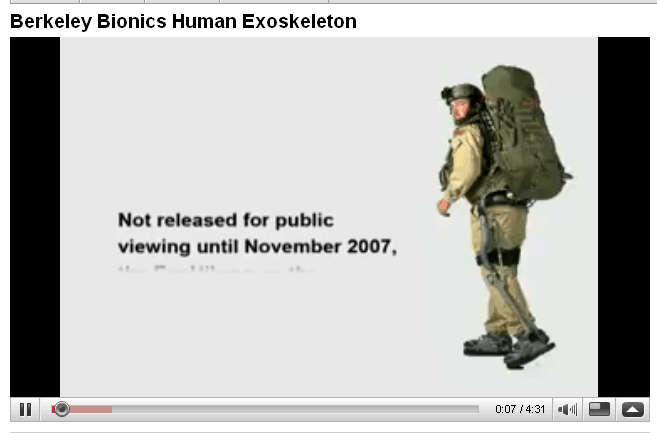 http://www.youtube.com/watch?v=EdK2y3lphmE&feature=related
http://www.youtube.com/watch?v=EdK2y3lphmE&feature=related
Here, you have the brave American soldier equipped with his exoskeleton and "exomuscles," in the form of jacks, all controlled by a microprocessor. It weighs only a few tens of kilograms.
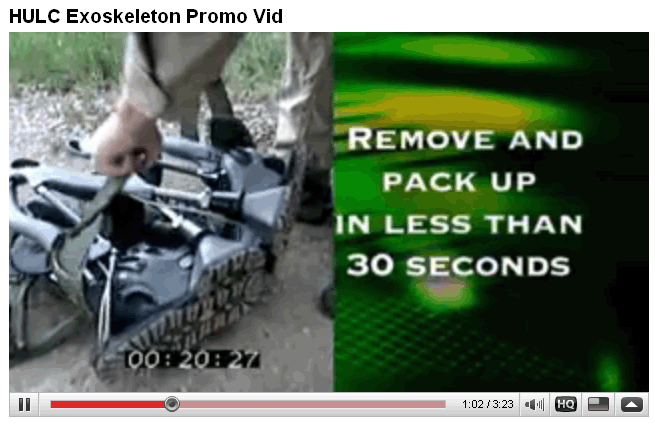 http://www.youtube.com/watch?v=EdK2y3lphmE&feature=related
**HULC: You can fold it and unfold it in thirty seconds! **
You can walk, carry loads, run. It turns any skinny guy into a superman. And, in case of a failure, if you have to run away and flee on your own legs, you can get rid of it in a flash. But who would have imagined such a mess a few decades ago!?!?
Immediate reaction from a reader, Christophe: The concept of an exoskeleton, very well defined, already existed in the comic strip of Roger Leloup, in 1974, in the fourth issue of his series on Yoko Tsuno. Very nice....
This and many other things. When asked where Cousteau found the concept of his diving saucer, "Denise," he answered "in Spirou." Indeed, look at the drawing of the exoskeleton imagined by Leloup, with its jack driving the leg: it's really well thought out! Hats off, Mr. Leloup!
Is the American army studying a "exobrain," a multiplier of intellectual abilities for a somewhat simple Marine? We are in full human-machine symbiosis. I bet there are people studying a telescopic penis connected to the center of pleasure. As long as there is a market....
There is, however, an extremely positive outcome: the ability to equip the disabled, who can leave their wheelchairs and ... walk:
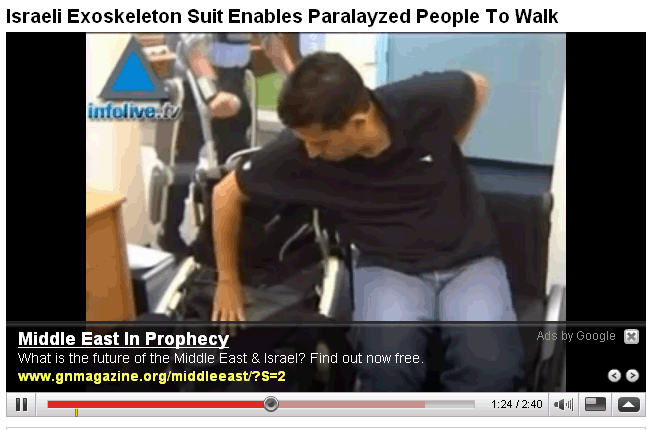 http://www.youtube.com/watch?v=424UCSN3Fjg&feature=related
Here, in Haifa, a paraplegic who leaves his wheelchair with the help of his arms to install himself in his exoskeleton
( The system is developed by a small Israeli company )
**http://www.youtube.com/watch?v=424UCSN3Fjg&feature=related **
 http://www.youtube.com/watch?v=424UCSN3Fjg&feature=related
Stand up, and walk!
We always find the two same faces of the ... technology, antinomical.
Above, you have seen the impressive progress made, on one hand in the field of computer-generated images and on the other in the field of robotics with reflexes. In a recent article, the press is questioning the ethical concepts that future robots will have when they have to analyze a situation and make a quick decision. Some announce that within a few years, 40% of the American bombing fleet will consist of drones. But will that change much? Soldiers are already human drones. They perceive their targets with the eyes of their guided bombs, images that resemble video games. They mechanically press the joystick button.
In principle, I have some ability to anticipate. But I admit I'm a bit lost here, although I have some knowledge of cybernetics and computer science. All this comes from the spectacular increase in the capacity to store energy in the form of electricity. And it will only grow, with side effects, such as the emergence of electric, autonomous vehicles. A few years ago, a man very much aware of the progress made by major car companies told me, "Everything is already in place, operational. We just wait for the right moment to put it on the market." You can believe that without difficulty.
Back to robotics. The worst is yet to come. We see that military robots are developing at a high speed. We have seen "the all-purpose mule": Big Dog, from Boston Dynamics, which will soon gallop through crowded terrain at 100 km/h, firing left and right, if it's not already the case.
http://gizmodo.com/368651/new-video-of-bigdog-quadruped-robot-is-so-stunning-its-spooky
http://www.youtube.com/watch?v=VXJZVZFRFJc
We also have the drone bomber from the US Navy, which will punish the "bad guys":
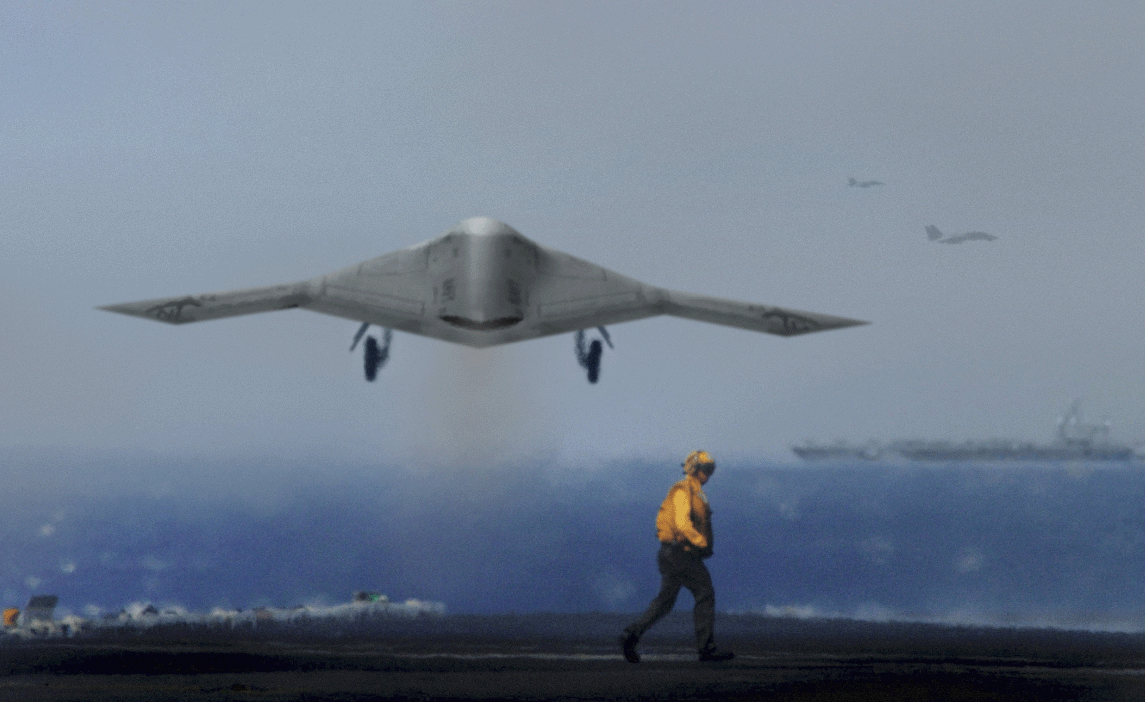
**The US Navy drone bomber, in qualification ** ****
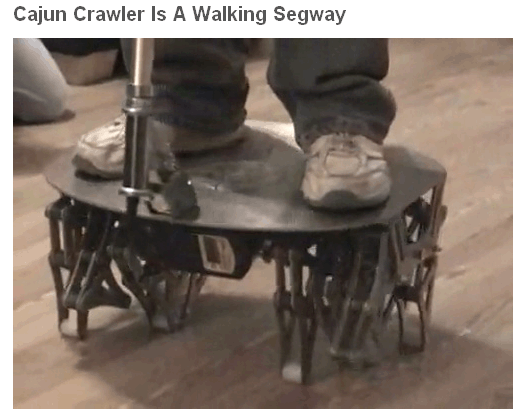
http://www.ohgizmo.com/2009/03/16/cajun-crawler-is-like-a-walking-segway
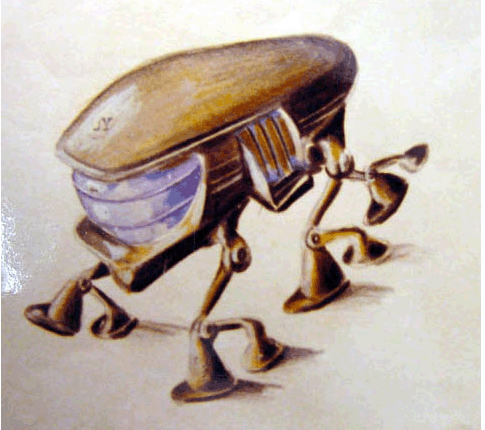
18 March 2009: Reported by an anonymous reader, a video on a gadget that should not be taken as a toy, the crawler:
As the object appears in the video, it looks like any other toy. However, one should note the agility and maneuverability of this platform, at the scale of an individual. Now, make a small effort of imagination. In Ummite texts from the sixties, the movement on this hypothetical planet was described as taking place on strange "vehicles with legs," which made everyone laugh.
The GOONIIOADOO UEWA from the Ummo D 41-6 document, dating from ... 1966. In this text, these vehicles are described as being adapted to "roads" completely different from terrestrial roads. Suppose that the planetary meteorology has frequent and violent winds, which can cause roads to be chronically covered in sand. The wheel would then no longer be practical. It should be noted that there are civilizations that have neglected this mode of transportation, for purely geographical reasons. The Egyptians, because these roads would have been too frequently covered in silt by the Nile floods and the South Americans because of the too rugged nature of the inhabited regions (Inca countries with rope bridges).
On Earth, we install our roads in the valley bottom. On a planet subject to pulvérulent transport, it would be necessary to travel on the ridgelines, after laying a non-slip surface. Even more, the dwellings would be better off being either buried or positioned on stalks, like ... mushrooms, or, in a more sophisticated way, retractable. Their circular, lens-shaped form would allow them to eliminate sanding by using centrifugal force. The legged bus, visible in the image above, is therefore not so silly after all.
Think. If we want to install communication routes other than "the air route" and we are determined to use wheeled vehicles, we must plan for heavy and costly road infrastructure. But if the technology including robotics allows the use of legged vehicles, then we can consider things differently. A panther has non-slip pads on its legs that allow it to take hold of the ground, especially to accelerate quickly. But when it comes to climbing a tree, it ... extends its claws, which prove to be extremely effective. The cheetah is without them. The panther is also a very good swimmer. It doesn't fly, that's all, and is incapable of clinging to the ceiling with suction cups, like the gecko lizard.
We have seen on this page robots with legs and claws. The technology allows us to imagine a versatile vehicle, equipped with non-slip pads, claws and .. suction cups. It can even be equipped with a deployable rotor, blowers or even nozzles.
&&& By the way, could a reader find me the video on this mini crab (shrimp) capable of producing ultrasound with one of its legs, in order to knock out its prey?
Believe me, legged vehicles, agile, fast, capable of going anywhere, even jumping like grasshoppers, are at our doorstep. Above, you have seen exoskeletons allowing the carrying of heavy loads. Why not, one day, "seven-league boots" for tourism?
18 March 2009: Reported by an anonymous reader, a video on a gadget that should not be taken as a toy, the crawler:
As the object appears in the video, it looks like any other toy. However, one should note the agility and maneuverability of this platform, at the scale of an individual. Now, make a small effort of imagination. In Ummite texts from the sixties, the movement on this hypothetical planet was described as taking place on strange "vehicles with legs," which made everyone laugh.
The GOONIIOADOO UEWA from the Ummo D 41-6 document, dating from ... 1966. In this text, these vehicles are described as being adapted to "roads" completely different from terrestrial roads. Suppose that the planetary meteorology has frequent and violent winds, which can cause roads to be chronically covered in sand. The wheel would then no longer be practical. It should be noted that there are civilizations that have neglected this mode of transportation, for purely geographical reasons. The Egyptians, because these roads would have been too frequently covered in silt by the Nile floods and the South Americans because of the too rugged nature of the inhabited regions (Inca countries with rope bridges).
On Earth, we install our roads in the valley bottom. On a planet subject to pulvérulent transport, it would be necessary to travel on the ridgelines, after laying a non-slip surface. Even more, the dwellings would be better off being either buried or positioned on stalks, like ... mushrooms, or, in a more sophisticated way, retractable. Their circular, lens-shaped form would allow them to eliminate sanding by using centrifugal force. The legged bus, visible in the image above, is therefore not so silly after all.
Think. If we want to install communication routes other than "the air route" and we are determined to use wheeled vehicles, we must plan for heavy and costly road infrastructure. But if the technology including robotics allows the use of legged vehicles, then we can consider things differently. A panther has non-slip pads on its legs that allow it to take hold of the ground, especially to accelerate quickly. But when it comes to climbing a tree, it ... extends its claws, which prove to be extremely effective. The cheetah is without them. The panther is also a very good swimmer. It doesn't fly, that's all, and is incapable of clinging to the ceiling with suction cups, like the gecko lizard.
We have seen on this page robots with legs and claws. The technology allows us to imagine a versatile vehicle, equipped with non-slip pads, claws and .. suction cups. It can even be equipped with a deployable rotor, blowers or even nozzles.
&&& By the way, could a reader find me the video on this mini crab (shrimp) capable of producing ultrasound with one of its legs, in order to knock out its prey?
Believe me, legged vehicles, agile, fast, capable of going anywhere, even jumping like grasshoppers, are at our doorstep. Above, you have seen exoskeletons allowing the carrying of heavy loads. Why not, one day, "seven-league boots" for tourism?
We model the legs, the wings. There remains ... the head. And there lies the major challenge. You are probably far from imagining the huge sums invested in different military laboratories around the world to succeed in creating a true artificial intelligence. It is not just about allowing a machine to make choices between different options (called subroutines in computer science). These are choices of behaviors already programmed in the machines. Already in operation are programs including self-learning, the ability to modify a reaction to a situation where the standard reaction has not proven "effective." Chess programs already include this (some can predict ... 18 moves ahead).
A reader brought to my attention an article on artificial intelligence in Wikipedia. Unfortunately, this text is poor (the English version is already better, less filled with preconceptions. Elsewhere, for example in biology, the articles are often only translations, often incomplete and unfinished, of articles written in English).
This encyclopedia can be of fantastic service in certain areas, provided you cross-check it with other sources. Thanks to Wikipedia, it only took me four days to compose the article " The Country of Suffering and Hatred ". I simply put together the pieces of the puzzle. It was enough to surf on Zionism, its history, on the biography of Israeli prime ministers, discovering that they were often genuine terrorists. This, plus a glance at the Byzantine Empire, the maps, the Ottoman Empire, activate a few neurons, and it's in the box.
It is in the field of certain sciences that Wikipedia is the stronghold of encyclopedists. As you may know, I was quickly "banned for life" from this encyclopedia, following the vote of a half-dozen "administrators covered by a prudent anonymity." What a pity that such an extraordinary tool, so useful, has been infested by such mediocre people! The problem is, however, insoluble. I did not ask for anything and I would not dare to cross swords with all these brilliant thinkers. I am not the only one in this case. I know many scientists who could provide quality contributions, but who would not waste their time with cohorts of mediocre people protected by their sacred pseudonyms.
Excerpts from this Wikipedia page :
Definition:
The concept of
strong artificial intelligence
refers to a machine capable not only of producing intelligent behavior, but of experiencing a feeling of real self-awareness, of "real feelings" (whatever one may mean by these words), and "an understanding of its own reasoning."
Definition:
The concept of
strong artificial intelligence
refers to a machine capable not only of producing intelligent behavior, but of experiencing a feeling of real self-awareness, of "real feelings" (whatever one may mean by these words), and "an understanding of its own reasoning."
On this page, devoted to artificial intelligence, the authors use many expressions that they do not define :
-
Intelligent behavior
-
Feeling of real consciousness
-
Understanding of its own reasoning (...)
The word consciousness is used, but no one cares to define it, as if things were obvious, while it is the most slippery terrain in the world. One will remember the sentence of Edelman, Nobel Prize in neuroscience, saying "I am convinced that one day we will be able to create thinking and conscious robots," while we are not even able to define what is alive and what is not.
At a time when metaphysics is in crisis, it is reassuring to see that the philosophy of the bar is doing well
Yes, when scientists get involved in subjects that philosophy has tried to approach over centuries or millennia, one quickly falls into barroom talk. You remember the sentence of Hawking, in "A Brief History of Time":
- If the universe has no beginning, no end, and contains itself, then what is the use of God?
The truth is that we know very little about the world around us, and a little modesty would not do us any harm. It would avoid saying things like:
- Do you believe that from a certain number of calculations per second, consciousness would appear?
One then thinks of Galvani's experiments on frogs, with the beginning of electricity, noticing that one could make muscles contract by subjecting them to electric shocks (one will note, by the way, that in all hospitals in the world, hearts are restarted by ... electric shocks of "defibrillation"). In Galvani's time, people thought that living beings might be "driven by electricity." In a way, to revive a dead person (theme of the novel Frankenstein), it is enough to restore their internal electrical generator. A few milliamps in the muscular system, as many in the neural wiring, and it starts again....
Don't look for it: consciousness is electricity......
**- expert systems
Currently, the achievements of artificial intelligence can be grouped into different fields, such as:
The
,
The
,
The
,
The
, faces and general vision, etc.
Currently, the achievements of artificial intelligence can be grouped into different fields, such as:
The
,
The
,
The
,
The
, faces and general vision, etc.
None of this corresponds to a true artificial intelligence. It is the domain of what a ganglion or a piece of cerebellum can do. The authors have not understood the subject at all. It is not because the computer Deep Blue beat chess champions that we have made any progress in this sense. It has long been possible to beat a champion runner with a simple bicycle. At the beginning of computing, we still saw duels between computers and "prodigy calculators," a theme that would now make everyone smile.
Twenty years ago, a friend had developed a small robot, using a simple computer of that time. The device controlled a 2D mobile, using a frame. The idea, which was not successful, was to create a machine for bakers capable of writing "Happy birthday, Marcel" automatically and quickly on top of a cake, with cream. The speed was impressive and even more so the absence of inertia. As a demonstration, the engineer had his mobile team pilot a simple 2 cm diameter, one meter long PVC tube, on top of which was placed a pétanque ball. You can try this yourself. With a little skill, you can place the tube on your inverted finger and keep the ball in a fairly approximate vertical position. For this, the eye must detect the movement, transmit this information to the brain, which then activates muscles, taking into account the slow propagation of the nerve impulse. To keep the tube vertical, with the pétanque ball on top: hello...
On the other hand, with a machine, the anticipation was total and immediate. If you tilted the tube by a moderate angle, say ten to fifteen degrees, the machine would trigger the optimal movement, without the slightest oscillation. The slowness of our nerve impulse is mentioned above (the bill that you can't catch). Indeed, with a nerve impulse traveling at the speed of light, it helps. But should we be amazed?
When the wise man points to the star, the fool looks at the finger.
On this Wikipedia page you will read that other "thinkers" suggest that "consciousness could arise from some quantum process." All that remains is to add a bit of randomness and deterministic chaos, and the trick is done. We find the theme of several covers of Science et Vie, a high point of contemporary thought:
Einstein in dismay.......
This reminds me of a phrase from a friend, a philosophy professor, who had attended a session of a theoretical physics conference:
*- I now know the depths of thought..... *
Today, quantum mechanics has taken the place that electricity represented for people in the nineteenth century.
No, artificial intelligence has nothing to do with computing power, the megaflops involved. A huge memory, associated with a multitude of processors working in parallel, does not constitute an "electronic brain."
Intelligence, what nonsense is said in your name!
I mentioned this problem in my book [The Year of Contact, Albin Michel] published in 2005. It is about creating code from nothing. It is much more than pattern recognition, learning ability, expert systems. Intelligence (at its most basic level): it is the ability to invent behaviors, to react, to improvise, to create behavior from nothing, after analyzing structures of all kinds. A smart machine will simply be able to reprogram itself in an original and autonomous way. Animals are intelligent. A dog, an octopus is intelligent. This ability to create code is being worked on by thousands of researchers. It implies the implementation of another logic, not bivalent. The computers that will perform these tasks will be completely different from those we know today, which are just high-speed brains, ganglia. A "tetra-valent" information flow is not made up of "two bivalent flows." This is the essence of what is called quantum computers, which are still in their infancy. Machines will emerge that will transmit two forms of information through a single channel when, at very low temperatures, the Heisenberg principle is fully in effect, the particles become waves, and it is no longer possible to choose between these two natures.
In the military algorithm circles, which would be worthy of Field medals for their authors, are marked with the seal of defense secrecy. The stakes are considerable. The nation that will be the first to master true artificial intelligence will dominate the world (or, incidentally, be dominated by it, just a passing remark). Unfortunately, this entire research, like so many others, is entirely oriented towards power, the need to dominate, to enslave.
We are really living in a strange time. One would have to be blind and deaf not to notice. Technological advances are made, but alas, they are immediately seized by the military. On March 9th, I gave a lecture at the École Polytechnique (you will not find any mention of it on the school's website). Topic: the Z-machine. As you will see in an article I will publish in the press, the Americans are disinforming, trying to hide the results obtained as early as 2008 on their ZR machine (the increase of the Z-machine from 18 million to 26 million amperes). Objective: "pure fusion bombs." I had already announced this three years ago, in 2006. See science summary. The people from Sandia are biting their fingers for having published in Physical Review Letter in 2006 their results, written by the Englishman Malcolm Haines. In the context of disinformation, the matter is spreading. The British press (I can't find the article that a reader showed me yesterday) is beginning to say that... finally, there's more than tokamaks to achieve fusion. The tokamak path (the JET of Culham and now ITER, in France) is expensive, complicated, and above all... too long. Fifty years to provide solutions to human energy needs, is that really reasonable? The Americans, who withdrew from the ITER program in 2008, must have thought not.
ITER: after the success of the English JET, we launched headlong into a pharaonic project before essential questions had been resolved, or even addressed. If the English JET worked for a second, then ITER will work for three minutes, right? Yes, but then what? Will the superconducting magnet withstand intense neutron bombardment? The Nobel Prize winner Gennes, an expert on these questions, strongly doubted it, but he is no longer here to say so. And what wall to put, in the immediate vicinity of the plasma (the "first wall"). You will find here references of quality. They come from the JET site.
http://www.jet.efda.org/pages/jet-iter/wall/index.html
The principle of the divertor. The polluting, heavy elements are supposed to be located in the purple layer, near the wall. The arrows indicate the "leakage flow"
The wall problem in the ITER reactor. Source: the JET English site, 2006
I translate. It's worth it. It's your money, after all....
**
One of the main problems related to fusion reactors is the durability of the wall directly facing the plasma, the "first wall." Existing tokamaks have so far used a carbon-based component (CFC), similar to the tiles on the wings of the space shuttle, to withstand high temperatures and intense heat fluxes. However, it is evident from the experiments conducted with the English JET tokamak that these carbon compounds are not suitable, due to the presence of tritium (tritium, an isotope of hydrogen, represents 50% of the deuterium-tritium fusion mixture in the reactor). This is because carbon tends to migrate, causing tritium to deposit on the wall.
Therefore, the designers of ITER have been led to consider replacing these carbon tiles with beryllium, limiting the use of carbon in another part of the chamber, where the plasma is deflected by divertors (deflectors) and eventually comes into contact. (In the image above, the beryllium wall is green, and the carbon is black.
The divertor is a system designed to clean the plasma. It is the equivalent of the ashtray in a steam engine, since ITER is, strictly speaking, the steam engine of the third millennium).
Beryllium is indicated by the letters Be, carbon by the letter C, and tungsten by the letter W. The latter (the filament of incandescent lamps) is what resists the highest temperatures. It melts at 3695 ° Celsius). It is a heavy element (its atomic mass is 184). Its nucleus has 74 protons. It can greatly pollute the plasma. Very strongly ionized at these high temperatures, it becomes the source of a huge energy loss through radiation and can dilute in the deuterium-tritium fusion mixture. (The idea that these tungsten atoms will have the good taste of not migrating to the core of the nuclear boiler, contenting themselves with staying on the wall, is a pious wish. If they migrate, the project is over).
(The energy loss comes from "braking radiation," or Bremstrahlung, related to the interaction between electrons and ions. This increases as the square of the electric charge. And with tungsten, hello! This is, among other things, what I would have liked to discuss with the X specialists during my lecture on March 9, 2009, which they preferred to skip.
) Hide this radiative loss, I can't see it. Beryllium is a light element (its atomic mass is only 9). It has only 4 electrons (so fewer radiative losses in perspective). But it melts at 1284 ° Celsius. This combination of using beryllium and tungsten has never been tested so far in a tokamak. It will be tested in ITER, based on plasma data from experiments conducted on the JET.
During the installation period, which will last a year, a technology will be used to remotely replace the elements (no question of sending people to do it in the chamber. We are not in Chernobyl anymore).
Remote maintenance system project on JET (simulation) On JET: work done by hand. All this to test this combination of beryllium for the first wall and tungsten for the divertor (it is necessary to create a "leak" in the plasma to allow the chamber's contents to be drained. This "leak," or "divertor," is an area where the magnetic barrier is canceled. But in correlation, the plasma approaches the wall dangerously. If the wall does not withstand the thermal shock, hello!
). The experiments conducted on the JET will aim to optimize the different scenarios in accordance with the wall geometry chosen for ITER. The amount of tritium captured and the effect this phenomenon could have on the plasma parameters will be determined. The performance will be tested to determine whether the amount of tungsten removed from the wall and migrating towards the reactor core, where the fusion reactions occur, will be sufficiently low (otherwise the energy loss due to the radiative losses caused by the presence of this tungsten will cause the nuclear boiler to suffocate, which I have been repeating for years).
The lifetime of the wall will be studied under conditions similar to those of ITER by increasing the heating due to the injection of neutral particles. Thus, there is a synergy of pan-European fusion, while the tokamak (Euratom-IPP Garching, Germany) explores the viability of a formula where the first wall is made of tungsten (tungsten is considered the most resistant material for fusion reactors). While the Germans will explore the "all-tungsten" approach, the JET will strive to meet the most immediate needs of ITER.
Let's explore... let's explore....
One of the main problems related to fusion reactors is the durability of the wall directly facing the plasma, the "first wall." Existing tokamaks have so far used a carbon-based component (CFC), similar to the tiles on the wings of the space shuttle, to withstand high temperatures and intense heat fluxes. However, it is evident from the experiments conducted with the English JET tokamak that these carbon compounds are not suitable, due to the presence of tritium (tritium, an isotope of hydrogen, represents 50% of the deuterium-tritium fusion mixture in the reactor). This is because carbon tends to migrate, causing tritium to deposit on the wall.
Therefore, the designers of ITER have been led to consider replacing these carbon tiles with beryllium, limiting the use of carbon in another part of the chamber, where the plasma is deflected by divertors (deflectors) and eventually comes into contact. (In the image above, the beryllium wall is green, and the carbon is black.
The divertor is a system designed to clean the plasma. It is the equivalent of the ashtray in a steam engine, since ITER is, strictly speaking, the steam engine of the third millennium).
Beryllium is indicated by the letters Be, carbon by the letter C, and tungsten by the letter W. The latter (the filament of incandescent lamps) is what resists the highest temperatures. It melts at 3695 ° Celsius). It is a heavy element (its atomic mass is 184). Its nucleus has 74 protons. It can greatly pollute the plasma. Very strongly ionized at these high temperatures, it becomes the source of a huge energy loss through radiation and can dilute in the deuterium-tritium fusion mixture. (The idea that these tungsten atoms will have the good taste of not migrating to the core of the nuclear boiler, contenting themselves with staying on the wall, is a pious wish. If they migrate, the project is over).
(The energy loss comes from "braking radiation," or Bremstrahlung, related to the interaction between electrons and ions. This increases as the square of the electric charge. And with tungsten, hello! This is, among other things, what I would have liked to discuss with the X specialists during my lecture on March 9, 2009, which they preferred to skip.
) Hide this radiative loss, I can't see it. Beryllium is a light element (its atomic mass is only 9). It has only 4 electrons (so fewer radiative losses in perspective). But it melts at 1284 ° Celsius. This combination of using beryllium and tungsten has never been tested so far in a tokamak. It will be tested in ITER, based on plasma data from experiments conducted on the JET.
During the installation period, which will last a year, a technology will be used to remotely replace the elements (no question of sending people to do it in the chamber. We are not in Chernobyl anymore).
Remote maintenance system project on JET (simulation) On JET: work done by hand. All this to test this combination of beryllium for the first wall and tungsten for the divertor (it is necessary to create a "leak" in the plasma to allow the chamber's contents to be drained. This "leak," or "divertor," is an area where the magnetic barrier is canceled. But in correlation, the plasma approaches the wall dangerously. If the wall does not withstand the thermal shock, hello!
). The experiments conducted on the JET will aim to optimize the different scenarios in accordance with the wall geometry chosen for ITER. The amount of tritium captured and the effect this phenomenon could have on the plasma parameters will be determined. The performance will be tested to determine whether the amount of tungsten removed from the wall and migrating towards the reactor core, where the fusion reactions occur, will be sufficiently low (otherwise the energy loss due to the radiative losses caused by the presence of this tungsten will cause the nuclear boiler to suffocate, which I have been repeating for years).
The lifetime of the wall will be studied under conditions similar to those of ITER by increasing the heating due to the injection of neutral particles. Thus, there is a synergy of pan-European fusion, while the tokamak (Euratom-IPP Garching, Germany) explores the viability of a formula where the first wall is made of tungsten (tungsten is considered the most resistant material for fusion reactors). While the Germans will explore the "all-tungsten" approach, the JET will strive to meet the most immediate needs of ITER.
Let's explore... let's explore....