combat robots
The Warriors of the Future
February 16, 2005
May 12, 2005: Replicants
A new company is about to make a name for itself. Its name: SWORD.
Special Weapons Observation Reconnaissance Detection Systems
This time it is a ground drone, the first of a long line. Evolution is inevitable. A soldier costs a lot. He must be fed, cared for, paid a pension, a retirement. He has moods, scruples. Ground robots had already been tested in Bosnia and Afghanistan where they carried out more than 20,000 missions. They were, as will also be the robots of the Sword company, guided by soldiers comfortably seated in front of their screens. Or rather equipped with helmets with all-around vision. When the man turns his head, the robot, kilometers away, does the same. To the right, to the left, up, down. Cost of a Sword: 230,000 dollars.
By the way, to learn more about robotics, read "What Do Robots Dream Of," out of print in bookstores, available on CD Lanturlu 1.
The handicap of ground robots is the difficulty they have moving over varied terrain. Let's take a look at the robot of the Sword company:
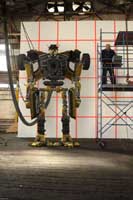
The combat robot of the Sword company.
This robot is inspired by studies by demining companies. Not bad in open terrain, but disconcerted by a staircase, a tree trunk. Oh yes, man is still quite a machine for moving over the most varied terrain. Vulnerable, unfortunately. What then will be the combat robot of the future? Hard to say. A kind of "terminator," a steel pedestrian? I would tend to think that the flying drone has an advantage over man. It can do what he cannot do. Advances in nanotechnology mean it can be undetectable, the size ... of an insect, whose flight it can imitate. There can also be carrier drones, of larger size. An insect-drone can enter through a window. It can even slip into a building by following a precise "flight plan." There are a thousand ways to kill. The machines seen above are heavy, crude. They can fire 60 mm missiles and .50 caliber shells. Mini-drones can explode on contact with their target. To kill a man, ten grams of explosive are enough. In any case, in Iraq or elsewhere the drones are going to attack.
The Americans blindly believe in their technology. It seems to them to be the answer to all their problems. It is a strange psychology, as if they took human beings for ... insects.
**May 7, 2005: ** A robot four meters tall, capable of stopping a car?
A reader, who had not given his name, had directed me to the site:
http://www.r50rd.co.uk/research/internal/v2i/engin/
where various videos were located. The inventor of this robot was supposed to be a retired English engineer, Colin Mayhew:
and here is his machine:
Among the videos presented, this one:
http://www.r50rd.co.uk/research/internal/v2i/engin/videos/stop_test.htm
The inventor speeds toward the back of the hangar at the wheel of a 4 x 4. The robot then takes position by kneeling on one knee and then stops the car with its left hand, while it presses its right hand on the roof to immobilize it. Mayhew confides "that he nevertheless had his foot above the brake pedal, not very sure that his robot would manage to stop his vehicle."
Fortunately, when I am the target of a hoax I have a whole network of readers who intervene immediately. Arnaud Riess conducted his investigation. An hour after it was posted online the matter was solved. It nevertheless remains instructive and shows that because of the computer-generated images that can be made today it often proves very difficult to tell the difference between fiction and reality. This hoax was in fact an advertisement for BMW since at the end the inventor said that among the various firms that had contacted him this one had seemed to him to be the best equipped for a collaboration.
Thank you, Arnaud
**May 12, 2005, from yahonews: ** **** ** **
Thursday, May 12, 2005, 9:35 am
"Replicant" robots, when science dreams of equaling fiction
LONDON (Reuters) - Self-replicating robots no longer belong to the realm of science fiction since American researchers created models capable of assembling structures similar to themselves.
Each robot is composed of an identical assembly of 10 cm cubes, electromagnets that attach and detach, and replication software devised by scientists at Cornell University, in Ithaca, New York State.
The robots can bend over to grab the cubes and stack them.
"Although the machines we have created are still simple compared to biological self-reproduction, this demonstrates that self-reproduction is possible in mechanics and does not belong solely to biology," declares Hod Lipson in an article in the scientific journal Nature on Wednesday.
His team and he himself believe that the principle could be applied to design long-lasting robots that could repair themselves or each other in perilous situations or during space flights.
Powered by contact with the table on which they move, the experimental robots, which do nothing other than replicate themselves, exchange data through the faces of their cubes. The machines bend over to deposit their top cube on the table. They then bend over again to grab another cube and place it on the first and repeat the process. While the new robot begins to take shape, it participates in its own construction.
"Robots with four modules are capable of building a replica in 2 minutes 30," adds Lipson.
Back to Guide Back to Home page
**Number of visits to this page since May 7, 2005 **: