Genetics of Genes and RNA Mutations
Comment by Jean-Christophe Rabouin
August 6, 2002
I have carefully read your article published on August 6, 2002, regarding the bacteriological weapons used by the Japanese in China. In your presentation, you describe a disease where having a disease-causing gene on just one chromosome results in a sick individual, whereas having the same gene on both chromosomes leads to a healthy individual. Recently, I came across an article (attached) explaining why such results can occur. I would particularly like to draw your attention to the paragraph discussing the color of ranunculuses and those dealing with RNA fragments that inhibit gene expression, effectively silencing them.
Sincerely, Jean-Christophe Rabouin
Mr. J.C. Rabouin’s email was accompanied by an attachment containing a PDF copy of an article published in the European Wall Street Journal titled:
The Silent Treatment
Some Genes May Exist
Simply to Stop Others
(Article by Antonio Regalado)
At the bottom of the page: www.pressplus.com
To contact directly: J.C. Rabouin and obtain the full PDF file, which I will attempt to summarize here.
In my previous article on bacteriological weapons, I mentioned the gaps in biologists’ understanding of genetics, citing the example of a genetic sequence linked to glaucoma, where the disease does not manifest when the sequence appears twice. The paper sent to me by J.C. Rabouin confirms this. In summary, biologist Richard Jorgensen, while conducting genetic manipulations on petunias, had the following idea: after identifying the genetic sequence responsible for red coloration in these plants, he wondered whether doubling the gene would intensify the color. This is what he obtained (which he immediately named "the Cossack dancer"):
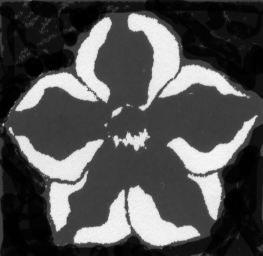
The flower did not turn completely white or completely red, but instead displayed this unusual pattern at blooming. The article naturally goes on to discuss "gene interactions." It seems as though biologists have just discovered that beyond the purely lexical function of these "words" of life—genes—there may also exist syntactic, grammatical, or even semantic rules. This discovery spread rapidly through laboratories, and it was clearly seen as a sign that certain conditions linked to genetic sequences might be treatable by identifying, activating, or transplanting the "inhibitory gene." The article states that when the complete human genome map was published last year, scientists realized they had no idea what 98% of the identified genes actually do. These uncharacterized genes were dubbed "silent genes." Recent findings suggest that many of these may actually serve an inhibitory role. Further on, the article's author writes: "It was an almost retro process" (it almost resembled a retroactive phenomenon).
There are two ways to interpret this striking discovery. Notably, if we were to apply the "Cossack dancer effect" to glaucoma, a child whose genome carried this sequence twice might not develop normal vision or total blindness, but rather "partial blindness," with the retina responding only in specific areas corresponding to the "Cossack dancer" pattern.
Geneticists indeed now possess new tools to attempt influencing living organisms. But along the way, it becomes evident that different segments of a genome interact with one another, much like words in a sentence or sentences in a text. No one seems to be paying attention to the potential negative consequences of these techniques. Up until now, the strategy was straightforward: if a living organism (including humans) lacks a certain biochemical product, this is considered a "genetic disease." So, simply graft the missing gene into its genome. In "The Transparent Egg," Testard notes that genetic engineering techniques for treating genetic diseases have so far produced nothing effective in humans—what we can do is only make fluorescent mice. Yet apparently, things are far from simple. What emerges from these recent studies—something many people suspected (including myself)—is that a genome is not merely a sequence of elementary commands that can be treated in isolation, just as a book is not merely a simple collection of words. Changing a single word in a sentence, procedure, or contract can completely alter the intended outcome. All of this calls for humility. Yet this is precisely not the impression conveyed by this article, where biologists once again seem to feel they are facing a new "wild west," where anything is possible and worth attempting. A dangerous game of the apprentice sorcerer, in every domain of life.