Drawing
An instrument as simple as a ballpoint pen can produce excellent results. I personally used it a lot in my travel notebooks during the trips I took around the world with my son Jean-Christophe, when he was between seven and fourteen years old. All these notebooks, once scanned, will appear on the CDs I distribute. The drawings below are taken from “The Penguin’s Walk,” which refers to a trip I made to Iceland in the late 1970s.
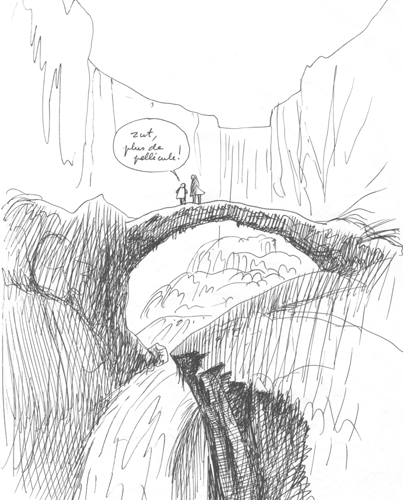
The strange landscapes of Iceland. On the left, Jean-Christophe, ten years old.

Detail showing how a simple ballpoint pen is used.
This is a sketch of the cargo ship that took us to Heimaey Island, southeast of Iceland. This island has quite a history. It lies right along the “fault line” that runs across Iceland from northeast to southwest—the very spot where the two tectonic plates diverge. On this island there’s a volcano: Elgafell. In the 1970s, Professor Sigurðsson held the chair of volcanology at the University of Reykjavík. The day before Elgafell erupted, he declared in class that this was a perfect example of an extinct volcano. The inhabitants of Heimaey had always had a reputation for being rather xenophobic. In the month prior to the eruption they even demanded independence from Iceland. One might wonder why people living on such a desolate rock would seek political and economic independence. The reason is simple: the island is essentially just the above-water portion of a vast underwater plateau where some of the richest fish stocks on Earth gather. European trawlers travel thousands of kilometers to fish in these waters, within their permitted zones. Meanwhile, the people of Heimaey simply have to cast their nets around the island and return with their holds full. Apart from a few houses, the island hosts a fishmeal factory. Back then, per capita income there ranked second in the world, only after Kuwait. Along its four-kilometer-long road, locals drove Ford Mustangs. The map below gives an idea of Iceland’s various locations, all of which have names hard to forget. At the bottom, you see Heimaey Island.
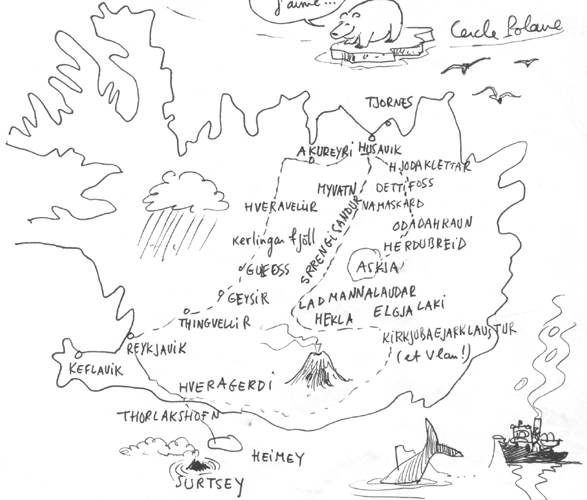
Map of Iceland
Along the dotted route (our itinerary) lies a place called Geysir, which gave its name to the word “geyser.” An amusing detail: geysers can stop functioning; this happens quite often when the heat source beneath them runs out. Essentially, a geyser is a column of water with a heat source at its base, where the water is under considerable pressure. When boiling occurs, a bubble forms, causing the entire column to turn into steam as it rises due to Archimedes’ principle. When this bubble reaches the surface—often marked by a small pool—the volume of steam can reach several cubic meters. It lifts the liquid surface, bursts at its highest point, and spews steam like a whale. One must be quick to photograph this phenomenon, since it unfolds in just a fraction of a second. I’ve always dreamed of installing an artificial geyser near the port of Marseille; technically, it shouldn’t be too difficult. All one needs is a well-insulated column and powerful heating at the base. There is, however, a very spectacular way to reactivate inactive geysers, as Maurice Kraft showed us during our trip to Iceland (he later died in an accident together with his wife Katia). All you have to do is pour the contents of a bottle of dishwashing liquid into it. It takes several minutes for the liquid to reach the bottom, but doing so lowers the boiling point there. Instantly, the geyser erupts, spewing millions of enormous soap bubbles. This is the kind of thing I proposed to Marseille’s municipality, though sadly without success. Should any French municipality feel tempted to give it a try, contact me.
Next to Heimaey lies an islet called Surtsey. It’s a volcanic island that appeared in the 1960s, if I recall correctly. Suddenly, Icelanders saw a huge column of ash rise from the sea; within weeks, a cone of ash marked the summit of a new volcano, still situated along that famous fault line—one of the most active on Earth. Scientists were extremely interested in observing how life could develop on such untouched land. It happened very quickly, as seabirds routinely carry countless seeds in their droppings. Surtsey is the name of a mythical character from Icelandic sagas, a sort of giant. It was volcanologists who came up with this name. Since the press quickly picked it up, there was no chance to assign another name; however, the Icelandic government was quite annoyed that a mere university professor got to name a new island. A few years later, the same phenomenon occurred: steam plumes, ash cones emerging, etc. This time, Iceland’s parliament made it clear: the name of any new islet should be chosen by politicians, not mere scientists. Thus, this new location was named after King Haakon of Norway’s daughter. Everything was prepared for a grand naming ceremony, complete with a royal visit, his daughter, and all the pomp. A substantial budget was allocated, magnificent speeches written, hotel rooms booked. Unfortunately, just days before the event, the island vanished into the depths without a trace. Icelanders and Norwegians found themselves back at square one. To this day, they still laugh about it.
The volcano Hekla, visible on the map, served as a model for Jules Verne’s novel “Journey to the Center of the Earth.” When Jean-Christophe and I went to Iceland, we intended to locate the passage discovered by Arne Saknussemm and attempt the expedition ourselves. Childhood dreams are tough to kill. Sadly, it proved impossible; the passage must have closed up since. The drawing of the white bear on its ice floe isn’t fictional; periodically, bears do make their way to northern Iceland during especially harsh winters.

All Icelanders then arm themselves with firearms, quickly turning the animal into a sieve. In theory, the first person to spot it gets to claim it as a rug, but given the somewhat prickly nature of Icelanders, this often leads to disputes. Near the end of our stay, we drove southeast along the coast, right beneath the massive Vatnajökull glacier. The sketch below was done in a shelter where we found the remains of two bear skulls, probably brought there by tourists.
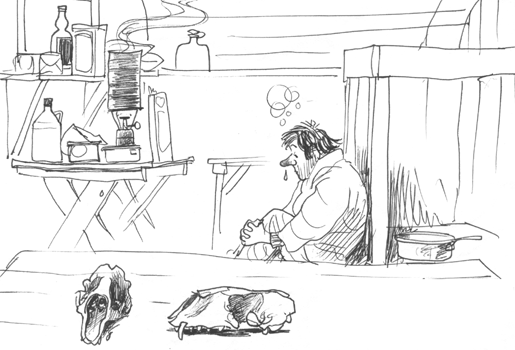
In the foreground, a white bear skull
I realize that if I’m not careful, under the pretense of providing examples of pen drawings, I’ll end up recounting all our travels—which might get a bit lengthy. I’ll wrap up this overview of Iceland with two images. First, this splendid trawler, sitting on its slipway on Heimaey:
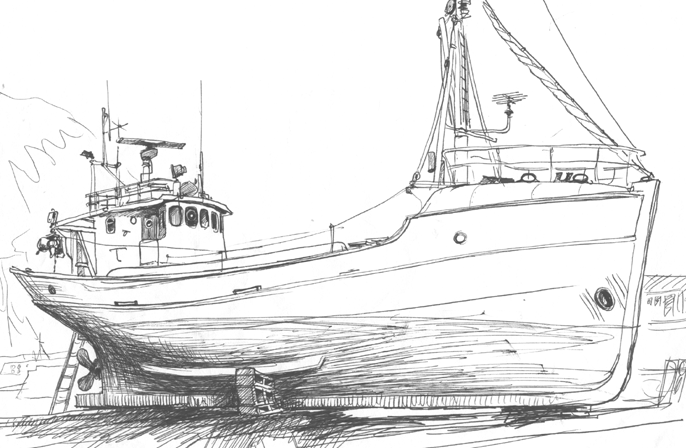
A trawler resting on Heimaey’s slipway
This drawing (done with a ballpoint pen...) has a story. I’ve sold thousands of drawings in dozens of countries I’ve visited. This one’s pretty good, admit it. Imagine the owner of this trawler arriving just as I’m putting the finishing touches on it.
“How much would you ask for this drawing?”
As I mentioned, the folks of Heimaey are very wealthy—and also quite xenophobic. I waited for him around a bend; this time, I caught one. I replied:
“Let’s make a deal: I’ll give you this drawing in exchange for a coffee you’d offer me at your home.”
The man choked, then offered $50, then $100.
“No, you don’t get it. It’s not about money. I just want you to treat me to a coffee at your place. It’ll take five minutes, and you keep the drawing.”
I didn’t succeed. That’s my only failure. With my talents—drawing, playing music, singing songs in every language, performing magic tricks—you could drop me anywhere: the Amazon, the middle of the Gobi Desert. An hour later I’d manage to get invited by nearby villagers by drawing portraits of their whole family. But here on Heimaey, total failure. The trawler owner was beside himself; he’d have paid any price for that piece of paper. But inviting me into his house? No. On this island, the only one to ever get invited to a snack was my son. He played with Icelandic kids his age; he had blond hair. Kids are less foolish than we are. I saw him chatting away with Maasai children. Kids understand each other everywhere.
By the way, a little-known anecdote: I mentioned that the volcano Eldgafel began spewing lava and ash on the island we visited shortly after those events. No one died, but some rather peculiar things happened. At one point, the volcano spewed ash so rapidly that pilots of a military plane on the runway couldn’t clear their wings fast enough; they snapped under the weight. At the same time, a cargo ship lay waiting in the harbor, loaded with all the goods accumulated by islanders: Ford Mustangs, TVs, furniture, etc. The influx of ash had a similar effect: it sank... straight into the harbor.
The lava flows lasted weeks. They emerged from a long fissure running down the volcano’s side, then headed toward the harbor. They swallowed a few houses, but the worst part was that they began blocking the channel leading out to open sea. If it continued at that rate, Heimaey Harbor, with all its fishing fleet, would become an inland lake, cut off from the ocean by a thick strip of solid basalt. The Icelanders then thought to reduce the lava’s fluidity by continuously pouring seawater onto it; for this they borrowed powerful bilge pumps from a U.S. aircraft carrier stationed nearby.
Haroun Tazieff, a renowned volcanologist based in France, happened to be in Iceland during the eruption. He openly mocked the Icelanders, who promptly grabbed him by the collar and stuffed him onto the first plane heading to France, forbidding him to return. Years later I attended a lecture by Tazieff in which he referred to this incident, saying, “Those poor Icelanders! Trying to fight a volcano! It’s like kids trying to pee on a river of lava...” In reality, the operation worked. On site I clearly saw the difference in lava thickness where water had been poured versus where it flowed freely to the sea—a factor of two difference, actually. Still, publicly ridiculing Tazieff seemed pointless to me. Moreover, given his reputation, I figured my word wouldn’t carry much weight against his. But it’s clear this affair upset locals at the time, and we ended up suffering some consequences.
The second drawing shows part of Heimaey’s coastline. In the foreground are puffins, strange seabirds the size of pigeons that nest in burrows. They have flat, tapered beaks; they fish by skimming just above the water, their lower beak slicing through it. Once they catch a fish the size of an anchovy, their beak shuts tight. Their tongue stores previously caught prey. You’ll see them gliding just above the sea surface, four or five tiny fish wedged between the top of their beak and their tongue, while they wait for the next catch.
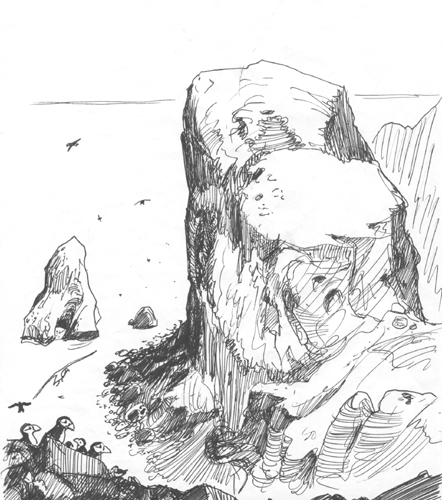
Coastal landscape. Heimaey Island
Iceland is very green. I have a photo of my son atop one of its peaks; it looks like a poster for a travel agency. I can’t remember where I put it now. One might say, “That doesn’t really matter anymore.” True. Yet my heart aches whenever I think of that child I loved more than anything. Look at him back then, with his sandwich and his Dutch friend Mirhils—how handsome he was.

Mirhils and Jean-Christophe
February 2007: The Great Wall, drawn with a pen during a trip to China

The Great Wall, 50 km from Beijing


May 2010: Inside a restaurant in Istanbul. On the left, the hot plate for making pancakes

The bartender at Saint-Tropez’s L’Esquinade, 1960s (flo master)

The “horned beast” (pen drawing); a lithographic press I used. In the foreground, lithographic stones

Ancestor of “markers”

Polyhedral version of the “clover knot”

Ramses II

Cap Croisette (Marseille, beyond Les Goudes) in 1958

Portrait of a mathematician
 **Emmanuel Macron **
 **Summary of a life **

Portrait of Étienne Klein**
