Drawing with a ... ballpoint pen
Drawing
An instrument as simple as a ballpoint pen can produce excellent results. I personally used it extensively in my travel notebooks during perilous journeys I undertook across the planet with my son Jean-Christophe, when he was between seven and fourteen years old. All these notebooks, scanned, will in fact be included on the CDs I distribute. The drawings below are excerpts from "The Penguin's Walk," referring to a stay we made in Iceland at the end of the 1970s.
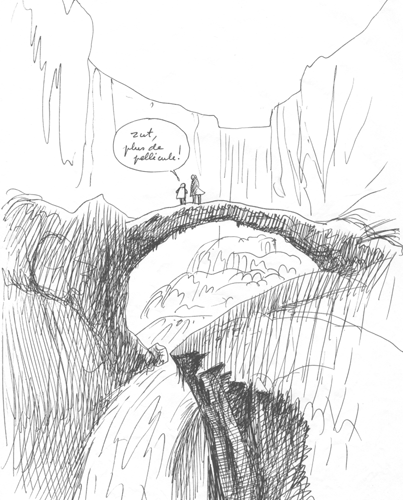
The strange landscapes of Iceland. On the left, Jean-Christophe, aged ten.
Detail showing work done with a simple ballpoint pen.
Here is a sketch of the cargo ship that took us to Heimaey Island, in southeast Iceland. This island has a history. It lies directly on the "rift zone" that cuts across Iceland from northeast to southwest—the place where the two tectonic plates are pulling apart. On this island stands a volcano: Elgafell. In the 1970s, Professor Siguaierson held the chair of volcanology at the University of Reykjavik. The day before Elgafell's eruption, he had declared in class that this was the prototype of a dormant volcano. The inhabitants of Heimaey had long been known for their extreme xenophobia. In the month preceding the eruption, they had even requested independence from Iceland. One might wonder why the people of such a desolate rock would suddenly demand political and economic independence. The reason is simple: the island is merely the visible tip of a vast underwater plateau where the richest fish banks on Earth permanently reside. European trawlers travel thousands of kilometers to fish in the portion of these waters permitted to them. As for the residents of Heimaey, all they had to do was step outside and trawl around the island to return with their holds full. The island, aside from a few houses, hosts a fishmeal factory. At the time, per capita income was second only to that of... Kuwait. Along the four kilometers of road, islanders drove Ford Mustangs. The map below gives an idea of the various locations in Iceland, all bearing names that sound like they belong in a dream. At the bottom, Heimaey Island.
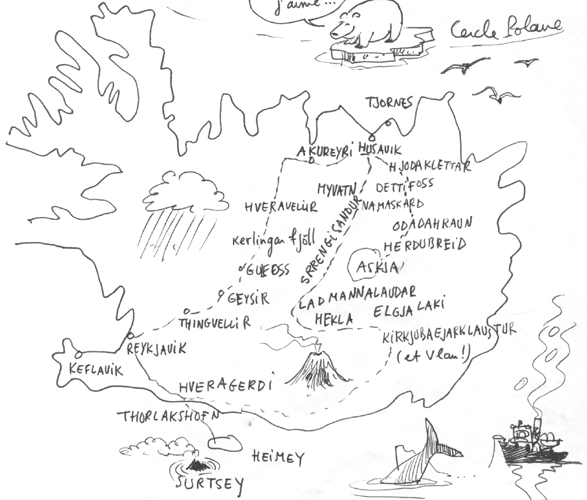
Map of Iceland
Along the dotted route (our itinerary), a place called Geysir, which gave its name to the word "geyser." An amusing detail: geysers can stop functioning, and this happens quite frequently, when the heat source beneath them runs out. Indeed, a geyser is essentially a column of water with a heat source at the base, where the water is under several bars of pressure. When boiling occurs, a bubble forms and triggers the transformation of the entire column into steam as it rises due to Archimedes' principle. When this bubble reaches the surface—often marked by a small basin—the volume of steam can reach several cubic meters. It then lifts the liquid surface, bursts at its highest point, and blows its steam like a cetacean. One must be quick to photograph this phenomenon, as it happens in a fraction of a second. I have always dreamed of installing an artificial geyser near the port of Marseille, and I believe this would pose no particular technical difficulty. All that would be needed is a well-insulated column and a strong heating element at the base. In any case, there exists a very spectacular way to revive inactive geysers, as Maurice Kraft showed us during our trip to Iceland (he died later in an accident, along with his wife Katia). Simply pouring the contents of a bottle of dish soap into the geyser will do the trick. It takes several minutes for the soap to reach the bottom of the chimney, but it lowers the boiling point at that spot, causing the geyser to restart instantly, ejecting millions of enormous soap bubbles. This is the kind of installation I once proposed to the city of Marseille, unfortunately without success. Should any French municipality ever feel tempted by such an adventure, contact me.
Next to Heimaey Island lies a small islet named Surtsey. It is a volcanic island that emerged in the 1960s, as far as I recall. The Icelanders suddenly saw a massive plume of steam rise from the sea, and within weeks a cone of ash marked the summit of a new volcano, still located on that famous rift—the most active on Earth's surface. Scientists were extremely interested in observing how life could develop on such a pristine land. It happened very quickly, as seabirds are accustomed to transporting seeds in their droppings. Surtsey is the name of a mythical figure from Icelandic sagas—a kind of giant. It was the volcanologists who chose this name. As the press quickly picked it up, it became impossible to assign another, but the Icelandic government became very irritated that a new island had been named by a mere university professor. A few years later, the phenomenon occurred again: the steam plume, the ash cone emerging from the sea, etc. This time, the Icelandic parliament was clear: the name of this new islet should be chosen by politicians, not by common scientists. It was decided that the new island would be named after the daughter of King Haakon of Norway. Everything was prepared for the island's naming ceremony, complete with royal visit, the princess, and all the fanfare. A substantial budget was approved, magnificent speeches were written, hotel rooms were reserved. Unfortunately, just days before the event, the island vanished into the abyss without warning. Icelanders and Norwegians were left with nothing but a laugh. They still chuckle about it there.
The volcano Hekla, visible on the map, served Jules Verne as a model for his novel "Journey to the Center of the Earth." When Jean-Christophe and I went to Iceland, we intended to locate the passage discovered by Aarne Saknudsen and attempt the expedition once more. Childhood dreams have tough skin. Unfortunately, this proved impossible. It must have been sealed off since. The drawing of the polar bear on its ice floe is no fiction. Indeed, polar bears occasionally arrive in the north of the island during exceptionally harsh winters.
All Icelanders then arm themselves and quickly turn the creature into a sieve. By principle, the first person to spot the animal has the right to claim it, but since Icelanders have somewhat difficult personalities, this often leads to problems. At the end of our trip, we drove southeast along the coast, just beneath the enormous Vatnajökull glacier. The sketch below was made in a mountain refuge where we found the remains of two bear skulls—no doubt brought there by tourists.
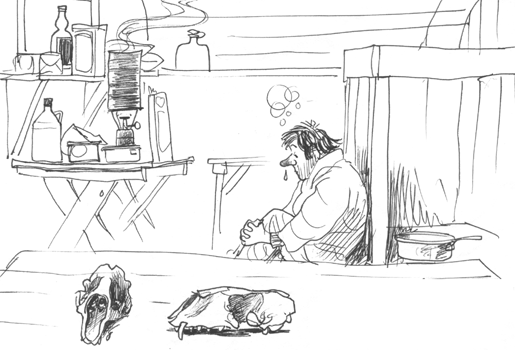
In the foreground, a polar bear skull
I see that if I don't take care, under the pretext of giving...