A new axiomatization of groups **

--- **
...Souriau lives in an apartment in old Aix. The door facing the street is magnificent. In the entryway stands a rather unusual vehicle: an antique sedan chair belonging to the building's owner, a young lady, an archaeologist, I believe. The chair is against the wall. All that remains is to find two bearers, slide the two long wooden poles into the rings, and sit down to take a ride. The openings are glass-paned: the side panes can be lowered, not by a crank, but by pulling leather straps, just like in the train compartments of my childhood.
...How dreamlike all this is. I realize I've never ridden in a sedan chair. In these times of unemployment, I'm convinced people could earn a living by launching the first regular line of sedan chairs in old Aix. All it would take is building a vehicle resembling the old ones. That shouldn't be too difficult. Then, acquire two embroidered costumes and two wigs, and off we go. Route: the Cours Mirabeau. That would be more than enough. After that, all you'd need is imagination, a little dreaming.
...Jean-Marie lives alone with his cat, Pioum, in his spacious apartment, full of gilding and paneling. Pioum is adorable. Yet I don't particularly care for cats. But this one is exceptionally welcoming and affectionate.
We usually work in the kitchen, one floor above. A small room under the roof, whose cramped size contrasts sharply with the imposing dimensions of the lower rooms. Every time, Jean-Marie tries to get me to drink his favorite beverage: Fernet-Branca, made from artichoke, which I find utterly dreadful, though he attributes to it all possible virtues.
...When he goes for a walk in town, he always carries his GPS, which never leaves his side. It's genuinely fascinating to be guided by satellites located forty thousand kilometers away from the street you're walking on. To get a better signal, Souriau tends to walk straight down the middle of the street, eyes fixed on the liquid crystal screen. It seems effective, but still relatively dangerous.
...I find we have a lot of fun together. One December evening, I dropped by to visit him, and this conversation ensued.
-
I'm going to talk to you about groups. Do you remember the axioms?
-
Yes, there are six. They are:
1 - There exist elements a, b, c, ... belonging to a set E
2 - There exists an internal operation, denoted o ("round"), allowing the combination of two elements from a set.
a belongs to set E
b belongs to set E
a o b belongs to set E
3 - This operation is associative:
a o b o c = (a o b) o c = a o (b o c)
4 - There exists a neutral element e such that:
a o e = e o a = a
5 - Every element a in the set has an inverse, denoted a⁻¹, such that:
a⁻¹ o a = a o a⁻¹ = e
That makes five?
-
Well, five, or four, or even one. There's no absolute rule regarding the numbering of axioms. We could just as easily combine axioms 1 and 2 into a single one:
-
There exist elements a, b, c, etc., belonging to a set E, equipped with an internal composition law satisfying:
a belongs to set E
b belongs to set E
a o b belongs to set E
This is equivalent.
-
Fine, five, four, doesn't matter. Where are you going with this?
-
I'm going to eliminate what you called axioms 4 and 5—defining the neutral element and the inverse—and replace them with the sandwich axiom. Altogether, the axioms are:
1 - There exist elements a, b, c, ... belonging to a set E
2 - There exists an internal operation, denoted o ("round"), allowing the combination of two elements from a set.
a belongs to set E
b belongs to set E
a o b belongs to set E
3 - This operation is associative:
a o b o c = (a o b) o c = a o (b o c)
4 - Let a, b, c be three elements belonging to set E.
Consider the equation:
a o y o b = c
It has a unique solution.
This is what I call the sandwich axiom, where the "ham" y is sandwiched between elements a and b, and c is the whole sandwich. The axiom means:
You can always extract the ham from a sandwich.
*
And I claim these axioms define groups—they are equivalent to the previous ones.
-
This unique solution y belongs to set E, since the operation is internal and associative.
-
Of course, that goes without saying.
-
But it's even better when you say it. I don't know how you'll go about recovering the two axioms referring to the neutral element and the existence of the inverse, but I at least understand what inspired this idea.
-
I asked myself, "What's the point?"
-
Exactly. What's the point of having a neutral element? In itself, it means "if I have a set E and a neutral element, I can compose all elements of this set with it and get the same result." That's of no practical use to me. Likewise, what's the point of an inverse in itself? When doing calculations on groups, or on any structure, we always manage, by multiplying on the right or left by elements or their inverses, to produce expressions like a o a⁻¹ or a⁻¹ o a, which we replace with e, then b o e or e o b, which we replace with b. Your sandwich axiom is "functional."
-
If you want. Let's move on to the theorems derived from the sandwich axiom. The first is:
I - There exists a neutral element which, when composed with itself, yields itself:
e = e o e
II - This neutral element is unique.
Proof:
Starting from the sandwich axiom, the equation
a o y o b = c
has a unique solution y.
This is also true when b = c = a, so
a o y o a = a
has a unique solution. Multiply on the right by y:
a o y o a o y = a o y
Let a o y = e
...This is an element of the set, since a and y belong to the set and the operation is internal. Therefore, there exists an element of the set such that:
e o e = e
...Theorem I is proven. Now to uniqueness, Theorem II. If uniqueness did not hold, another element of the set, call it f, would satisfy:
f o f = f
We have:
e o e = e
Multiply on the right by f:
e o e o f = e o f
Multiply again on the right by e:
e o e o f o e = e o f o e
Use associativity:
e o (e o f) o e = e o f o e
These are two sandwiches. Call them:
p = e o (e o f)
q = e o f o e
...According to the sandwich axiom, we can "extract the ham," meaning we can compute the expressions for (e o f) and f, which must be equal since p = q. Therefore:
(e o f) = f
...Now repeat the process starting from the proposition attributed to the second element f:
f o f = f
...Multiply on the right by e, twice on the left:
e o f o f = e o f
e o e o f o f = e o e o f
...Use associativity:
e o (e o f) o f = e o e o f
...Using the sandwich axiom a second time, we deduce:
e o f = e
Therefore:
e = f
Theorem III: If I take this element e "identical to its square," it follows that:
a o e = a
Proof:
We continue using the sandwich axiom. Starting from the definition of e:
e o e = e
Multiply on the right successively by a and by e:
e o e o a o e = e o a o e
Apply associativity:
e o (e o a) o e = e o a o e
Therefore:
e o a = a
Starting again from:
e o e = e
and multiplying on the left successively by a and e:
e o a o e o e = e o a o e
Apply associativity:
e o (a o e) o e = e o a o e
Hence:
a o e = a
Theorem III is proven.
Now to Theorem IV
(existence of an inverse, denoted a⁻¹).
Statement: Given an element of the set, there exists a unique element satisfying the equation:
a o y o a = a
We denote this element a⁻¹ and call it the inverse of a. This element satisfies the properties:
a o a⁻¹ = e
a⁻¹ o a = e
Proof.
The existence and uniqueness of this element follow directly from the sandwich axiom, when formulated as:
When the bread slices are identical to each other and identical to the sandwich, the ham is the inverse of the bread slice (or of the sandwich).
a o y o a = a
We can apply associativity in two ways:
(a o y) o a = a
a o (y o a) = a
But we know that:
e o a = a
a o e = a
Therefore, the solution y satisfies:
a o y = e
y o a = e
Let us show that this solution is unique. If it weren't, another solution z would exist such that:
a o z = e
z o a = e
Multiply the first equation on the left by y:
y o a o z = y o e
(y o a) o z = y
But y o a = e, so:
z = y
We call this solution a⁻¹, the unique solution of the equation:
a o a⁻¹ o a = a
Thus, the new set of axioms leads to the same properties that, classically, define groups.
Therefore, groups can be defined using this new set of axioms:
Definition of a group.
1 - There exist elements a, b, c, ... belonging to a set E
2 - There exists an internal operation, denoted o ("round"), allowing the combination of two elements from a set.
a belongs to set E
b belongs to set E
a o b belongs to set E
3 - This operation is associative:
a o b o c = (a o b) o c = a o (b o c)
4 - Let a, b, c be three elements belonging to set E.
Consider the equation:
a o y o b = c
It has a unique solution.
If the elements of set E, equipped with its internal composition operation, satisfy these four axioms, I say they form a group.
Theorem: The neutral element is its own inverse. This new definition of the neutral element, based on a single equation, leads to a different proof of this property.
e o e = e
This is the definition of the special element e. But the sandwich axiom makes this equation identify with the property (not the definition) of the inverse.
Another theorem: The inverse of the inverse equals the element itself:
(a⁻¹)⁻¹ = a
a⁻¹ o a = e
a o a⁻¹ = e
a is the inverse of a⁻¹. Hence the property.
Let us show that:
(a o b)⁻¹ = b⁻¹ o a⁻¹
We compute:
a o b o b⁻¹ o a⁻¹ and b⁻¹ o a⁻¹ o a o b
Let us show both quantities equal e.
a o (b o b⁻¹) o a⁻¹
= a o e o a⁻¹
= a o a⁻¹
= e
Same for the other expression.
-
This is a different approach to the concept of a group.
-
The ontology of groups.
-
If you like.
-
But something tells me this idea might prove fruitful.
-
Now, forget everything, even the sandwich axiom. Consider a set E equipped with an associative internal composition operation o. Suppose there exists in this set an element that, when composed with all others, acts as a neutral element:
a o e = e o a = a - Is it unique?
-
If it exists, it must necessarily be unique; this can be proven.
-
Ah yes, that's true.
-
I would say two elements a and b are related by a reciprocal relation if:
a o b = b o a = e
Given a, b is its inverse. I claim that if we restrict the set to the subset of elements that have inverses, this subset forms a group. This is a way to construct groups. In other words, we select from the set those elements satisfying this property and I say that this suffices to assert that this subset forms a group.
We must show this property is closed under the operation.
-
What do you mean?
-
Let two elements a and a' satisfy the property, i.e.:
a o b = b o a = e
a' o b' = b' o a' = e
a has an inverse b
a' has an inverse b'. They are therefore in the subset in question. We must show that a o a' also has an inverse.
Let's drop the "rounds," which are cumbersome.
a' o b' = e
Multiply on the left by a and on the right by b:
a o a' o b' o b = a o e o b = a o b = e
Therefore:
(a o a') o (b' o b) = e
Starting again from:
b o a = e
Multiply on the left by b' and on the right by a':
b' o b o a o a' = b' o e o a' = b' o a' = e
(b' o b) o (a o a') = e
Therefore, the element obtained by composing a and a', both of which have inverses, also has an inverse.
-
It remains to show that this subset indeed forms a group.
-
To do so, I will show that this subset satisfies the sandwich axiom, i.e. that:
a o y o b = c
has a unique solution y.
-
I understand. Axiomatically, you're doing the reverse of what you did earlier. Previously, you assumed the sandwich axiom and showed it implied the existence of inverses. Now, you assume all elements of the set have inverses and will use this property to reconstruct the sandwich axiom.
-
The best way to show the equation has a unique solution is to construct it. Multiply the equation above on the left by a⁻¹ and on the right by b⁻¹.
a⁻¹ o a o y o b o b⁻¹ = a⁻¹ o c o b⁻¹
(a⁻¹ o a) o y o (b o b⁻¹) = a⁻¹ o c o b⁻¹
y = a⁻¹ o c o b⁻¹
- Thus y is indeed a solution to the equation:
a o y o b = c
By inserting the constructed solution, we get:
a o (a⁻¹ o c o b⁻¹) o b = c
...In doing so, we assume we can manipulate parentheses, generalizing associativity. We assumed (as one of the axioms) that we can isolate two elements within a sequence of operations:
a o b o (c o d) = a o (b o c) o d = (a o b) o c o d = (a o b) o (c o d)
We need to show it's valid to include three elements between two parentheses. But we will accept this without proof.
Applications:
...Consider the set of real numbers equipped with multiplication × as the composition operation. It is internal, but it is not a group under this new set of axioms. Indeed, the equation defining the element e:
e o e = e
has two solutions:
e = +1 and e = -1
...Consider the previous construction. We are given a set (the real numbers), an associative composition operation (multiplication). This set has a neutral element 1, which is not defined as a solution of
e o e = e
but rather as an element that, when composed with any other element of the set (including itself), yields that element—i.e., the classical definition:
For all a belonging to set E, it is true that:
e o a = a o e = a
Starting from the classical definition of the inverse:
a o a⁻¹ = a⁻¹ o a = e
...We have shown that the subset of elements possessing an inverse forms a group. Thus, the real numbers excluding zero form a group.
Consider square matrices of size (n,n). They possess a neutral element:
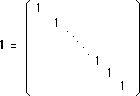
with zeros outside the main diagonal, filled with "1"s.
The invertible matrices form a group, called the General Linear Group GL(n).
-
I really like all this.
-
Hmm... it's just a variant of the classical axiomatization. I presented this at an epistemology conference in Grenoble last week.
TO BE CONTINUED
