The Mysteries of the B-2 Bomber
The Mysteries of the B-2
August 20, 2002
Page 1
The Problem of Long-Range Bombing
As soon as the United States possessed the atomic bomb, the challenge arose of developing intercontinental delivery vehicles capable of striking deep into the territory of the presumed potential enemy: the USSR. Initially, in 1945, the Americans had the B-29 Superfortress, which had carried out the bombings of Hiroshima and Nagasaki, forming the 509th Bomb Group, based in Roswell. However, these aircraft did not offer sufficient performance for bombing Soviet territory. Northrop then developed flying wings, aircraft expected to have a very long range and, moreover, stealthy—meaning barely or undetectable by the radar technology of the time. Jack Northrop had initiated this project even before the 1939–1945 war. The first aircraft, a contra-rotating propeller-driven model named the XB-35A, made its first flight at Edwards Air Force Base on June 26, 1946.
Subsequently, the aircraft were reequipped with a different propulsion system—eight turbojets—and were redesignated as the YB-49.
They were assembled in Hawthorne, California, in 1947. The wingspans of both aircraft were identical (52 meters). A pre-series of about a dozen aircraft was thus built. However, flight tests proved disastrous. At the time, very little was known about the aerodynamics of swept wings. In particular, it was not understood that at high angles of attack, flow separations occurring at the wingtips tended to migrate very rapidly toward the nose of the aircraft, causing an extremely abrupt dive. This phenomenon occurred repeatedly during YB-49 stall tests and even led to the loss of an aircraft and its pilot. It was impossible to put into service aircraft for which it would have been necessary to prohibit approaching stall conditions. Furthermore, commercial competition between Northrop and Boeing at the time favored Boeing. All YB-49s were destroyed. To be precise, this catastrophic stall behavior did not appear with the XB-35A, which had propellers, although the reason for this difference was never fully understood. These problems encountered with the YB-49 affected all swept wings, and the solution was to equip them with "fences" (barriers). Below (a) is this solution, as implemented on certain aircraft (identical solution for the "Caravelle" wing):
Subsequent swept-wing aircraft, including delta-wing aircraft, adopted two other solutions. The first involves creating a notch at the leading edge (b), which generates a particularly strong vortex at high angles of attack, acting as a natural barrier preventing the separation at the wingtips from migrating forward.
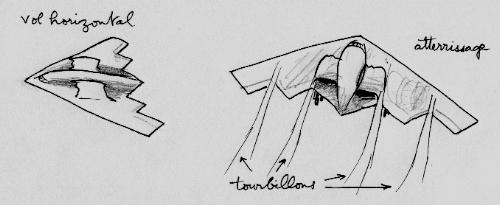
The current standard solution (as used on the Mirage III) consists of introducing a notch in the leading edge (c), which has been shown to perform the same function. It should be noted in passing that the zigzag trailing edge of the B-2 serves two purposes. The first is indeed to provide a weaker radar return (this is the general use of all "hairpin" or "hairpin-like" fillets or edges). But at high angles of attack, this serrated trailing edge generates vortices that act as barriers preventing the separation that might occur at the wingtips from migrating forward (d).
Had this solution (fences extending up to the leading edge) been known in 1947, Jack Northrop's aircraft might have been saved. The United States would thus have immediately possessed a highly stealthy aircraft. However, it appears that this stall-induced dive problem was not the only one encountered during testing, as there were also issues with engine overheating.
Let us recall that the Germans seem to have been the first to understand the importance of stealth (they suffered heavy losses due to the early detection of their aircraft waves by British radars, the most advanced at the time). In the final years of the war, they developed a craft designed by the Horten brothers.
This aircraft had no vertical tail surfaces and was systematically constructed using materials that weakly reflected radar echoes (as was later the case with the famous British Mosquito fighter-bomber, built entirely of wood). The reader may naturally wonder how such aircraft could be controlled in yaw. The answer is extremely simple. It is the same principle used on the B-2, which also lacks vertical tail surfaces. It consists of simultaneously opening two flaps located at the wingtips—upward and downward—thereby increasing drag locally.
Summary of the dossier Next page
Counter initialized on October 7, 2002. Number of page views: