The Mysteries of the B2
The Mysteries of the B2
August 20, 2002
Page 2
Below is a photo of the B2, and more precisely of the first machine built. The wingspan, 52 meters, is identical to that of the wing designed by Jack Northrop. The profile is not "self-stable" (with an "S" shape). The pitching moment induced by lift (see my comic strip "L'Aspirissouffle," available on the "CD Lanturlu," along with 17 others, which the reader can order by sending 16 euros to J.P.Petit, villa Jean-Christophe, chemin de la Montagnère, 84120, Pertuis) is counterbalanced by a rear centering, which implies continuous piloting. It is impossible to let this aircraft fly on its own, with fixed controls. It is fundamentally unstable. It must be continuously controlled in pitch using a flap, visible in this photo, at the back of the "pseudo-fuselage," which has the shape of a "beaver tail" with a triangular tip. This flap is constantly operated by a computer, except when the pilot decides to climb or dive. The turning on this aircraft, which lacks a vertical tail, is achieved by creating drag at the wingtip, by opening two flaps. In the photo below, the opening of these two flaps at the right wingtip indicates a right turn.
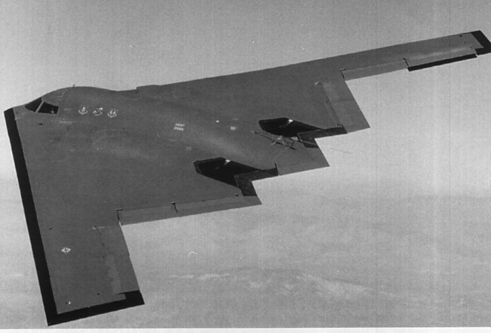
Plus widely deployed, these flaps can then serve as air brakes during approach and landing maneuvers.
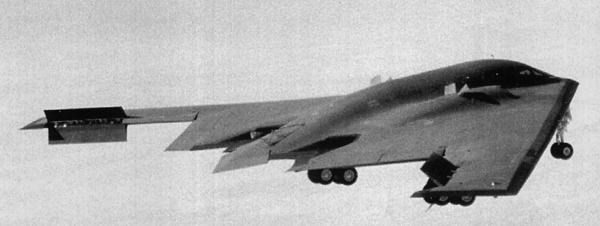
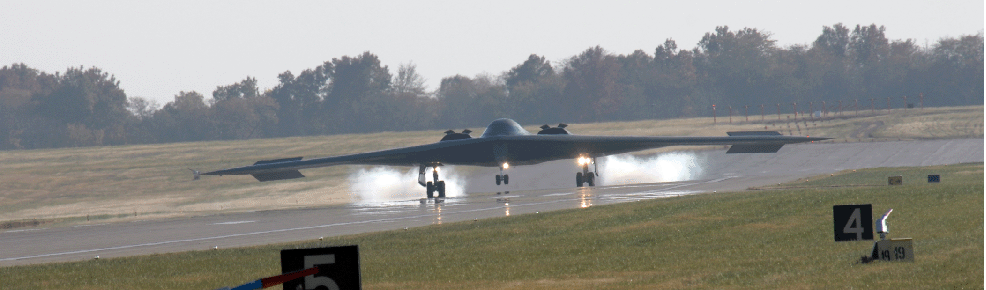
Sur this photo, the first prototype of the B2, taken in 1989 at Edwards, which still has its black leading edges. By opening the wingtip flaps wide, they become air brakes. The "beaver tail" is in the "dive" position. On the top of the engine cowlings, the open flaps provide additional air supply in the closed position, during takeoff and landing. In cruise, these flaps are then kept closed. You can clearly see these flaps open during takeoff and landing:
Les "Pacemaker," with six engine pods driving propellers, constituted the first backbone of the Strategic Air Command (SAC). Below is a photo found by J.P.Ballard:
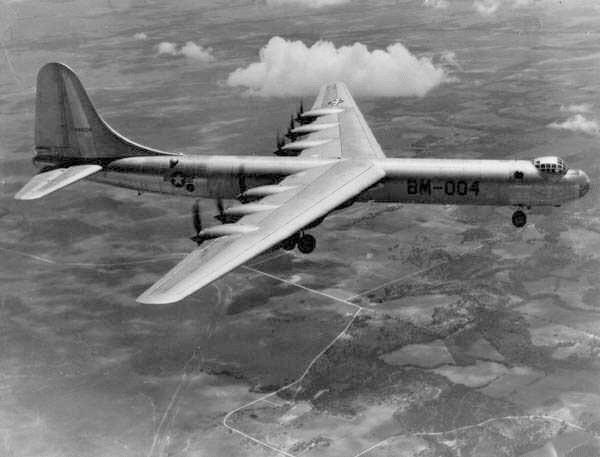
The B-36-1 Convair "Pacemaker"
. ****These aircraft were later equipped with additional jet engines mounted in "pods". At the same time, the Americans sought a completely jet-powered aircraft. The first attempt was the B-47, a six-jet:
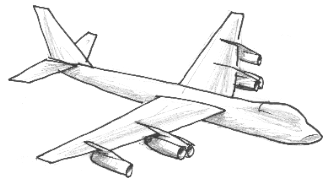
Too small, not fast enough, in fact the "draft" of the future B-52, an eight-jet:
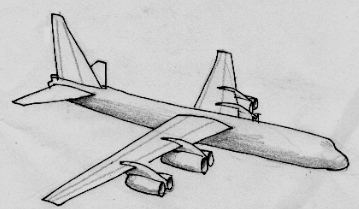
Equipped with 6 crew members (so two pilot-copilot-navigator sets in principle), this aircraft could reach the main cities and industrial installations of the USSR, according to transpolar flights.
NB : The characteristic duration of these missions, flown at 900 km/h, at altitudes of 12-15,000 meters, was a maximum of 12 to 15 hours for a round trip. These aircraft were equipped with rest chambers that could be used by the crew members.
En general, the problem was to increase the range, speed, altitude, and invulnerability of the carriers. Increasing speed necessarily required entering the supersonic world, but this immediately raised the question of wave drag, which roughly increases with the cube of the Mach number. A corresponding attempt was the B-58 Hustler. (A nice photo found by J.P.Ballard, which clearly shows this four-jet aircraft carrying its "mod" under its belly with its military load, shaped to be able to penetrate supersonically):
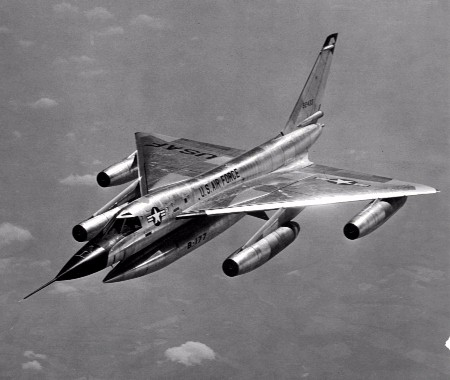
the American equivalent of the Mirage IV (much larger, obviously). But speed means increased fuel consumption. If "to hustle" means "to penetrate" in English, it would have been a "penetration bomber." This incursion into enemy territory would have involved in-flight refueling (as for the "one-way mission" of the Mirage IV).
Plater came the SR-71 "Blackbird," flying at Mach 3, in conditions representing the best that the technology of the time could offer. However, apart from carrying a single pilot and cameras, it was essentially, given its fuel consumption, a true flying fuel tank. It should be noted that the Hustler took off with a small fuel load. Then, its tanks were filled with in-flight refueling before it ventured into "enemy territory."
L'introduction of intercontinental missiles as carriers completely changed the game, and from then on, bombers took a back seat. Following a too timid and not very dynamic policy, the Americans, relying on a certain number of bases on the periphery of the USSR, were limited to intermediate-range (2500 km) vehicles, such as the Redstone powder rocket. The Atlas, a liquid-fueled rocket, intended for intercontinental use, was the next step, but it had a difficult beginning.
C'est then that the Soviets created the event by revealing to the world the existence of giant rockets "Semyorka," designed by the brilliant Korolev, with a range of 10,000 km and a payload capacity that could reach any point in the United States with Soviet hydrogen bombs. Both East and West used inertial guidance for rockets. The impact accuracy, around 2 km, forced the Soviets to use very powerful hydrogen bombs. The Americans reacted in two ways. On the media front, it was the Apollo project, aimed at restoring the image of American technological supremacy around the globe. It is known that the Soviets also attempted the same projects as the Americans (including, later, with the Buran space shuttle). However, the explosion on the launch pad of the giant rocket Energia ruined this "Russian moon project."
Sur the strategic level, the Americans pushed the development of carriers with shorter response times, which gave rise to the "Minuteman" powder rocket, which was immediately deployed and installed in silos in various locations in the United States. The progress in impact accuracy achieved by the Americans allowed them to reduce the size of this vehicle as well as the standard nuclear charges (300 kT). Later, MIRV (multiple independently targetable reentry vehicles) appeared. Each rocket bus could carry up to twelve warheads. Advances in radar imaging (allowing to see through a cloud layer) gave these warheads (first tests with the Pershing II) an impact accuracy of less than 80 meters, allowing "surgical strikes." At the same time, the Americans developed a subsonic cruise missile, Tomahawk, also with target recognition, offering an impact accuracy of a few meters at thousands of kilometers distance, and which could also be fired from ... submarines.
Les Soviétiques tried to follow them in all these directions, developed their own "minuteman," their rocket with pro...