The Mysteries of the B2 Bomber
The Mysteries of the B2
August 20, 2002
Page 3
The B2's Armament:
If one reads the brochure dedicated to the B2, it seems that it was designed, among other things, to carry extremely precise self-guided bombs, to carry out surgical strikes in enemy territory, while avoiding "collateral damage." Today, the problem is no longer being able to crush an adversary under a deluge of bombs, but rather to destroy his military potential in a targeted way, even "in peacetime," even if these targets are located in urban communities or areas with high population concentrations. The defensive weapon then becomes "international public opinion," reacting to the sight of "the bodies of innocent women and children lined up after the last American raid."
More than the bomber, the key item becomes the bomb itself and its guidance system. These are mentioned and described in the brochure dedicated to the B2. However, it should be noted that, aside from stealth, all of this can be implemented on simple B-52s (synthetic aperture radars, "smart" bombs, etc). Before considering the performance of the bomber, its specifications, it is the entire mission that needs to be analyzed.
The brochure reviews the different types of munitions that the B2 is capable of carrying and it is necessary to examine these weapons carefully.
AGM-129: Cruise Missile
Production ceased at the end of the Gulf War in 1991. 461 units built. Carries a nuclear warhead with a yield ranging from 5 to 200 kt. Six and a half meters long, three meters in wingspan, with deployed wings. Weight: one and a half tons. Range: 7,225 km.
B61
Non-guided nuclear bombs (ballistic trajectory). 340 kt. "When you're not into lace."
B83
These are the most powerful thermonuclear bombs used in the USA, with 1.2 MT (after the 9 MT that B-52s can carry, which can hold up to 9 in their bomb bays, which increases the firepower of each of these aircraft to 81 MT). Regarding the B2, these bombs are optimized for low supersonic cruise, against "hard targets" (hard targets: explosion after penetration into the target) or for air bursts, with or without a delayed parachute. The B2 can carry sixteen 2,000-pound (907 kg) thermonuclear bombs with a unitary yield of 16 megatons. This amounts to 15 tons of thermonuclear bombs. The number sixteen is not a coincidence. See, further down, the B2's rotating bomb rack (but it is also used on other aircraft and the Russians have had it for a long time). Since there are two bomb bays, one behind the other, this makes 2 x 8 = 16.
A priori, the B2 is designed to drop conventional, non-nuclear bombs. Although it has only two bomb bays (compared to three for the B-1B), it can carry approximately the same load as that aircraft or the "Big Belly" ("Bibedum"), a modified B-52 used during the Vietnam War.
Mk 82 (80)
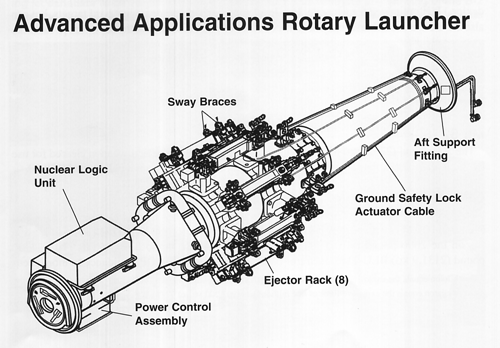
A 500-pound (226 kg) ballistic trajectory bomb designed for the B2. In 2003, the B2 will have a version of this bomb called the GBU-30, called JDAM (Joint Direct Attack Munition). Eight of these bombs can be arranged on a rotating axis called the Advanced Applications Rotary Launcher (AARL).
GPS-Aided Munitions (GAMs) (16)
The USAF has developed bombs coupled with GPS, whether they are general-purpose bombs or penetration systems. Approximately 100 of these bombs were dropped by the 509th Group, most of which were dropped during operations against Yugoslavia (Operation ALLIED FORCES).
Joint Direct Attack Munitions (JDAMs) (16)
The conventional bomb initially intended for the B2 was the 2,000-pound GBU-32. It is estimated that 700 GBU-32s were dropped during this operation with a destruction rate estimated at 87% (and a failure rate of 13% ...).
CBU-87 (36)
This is a 2.3-meter-long, 0.4-meter-wide bomb that disperses 20-centimeter-long, 6-centimeter-diameter mini-bombs, effective against personnel and equipment, with or without light armor.
CBU-89 (36)
Another bomb (2.3 meters by 38 cm in diameter) that delivers components in the form of anti-personnel or anti-tank mines. The scattering depends on the deployment altitude of the dispersion system but typically corresponds to a rectangle of 150 m by 400 m.
CBU-97 (36)
Another 400 kg composite bomb, with a ground dispersion area of 140 m by 400 m. The submunitions dispersed are programmed to automatically orient themselves toward sources of infrared radiation.
AGM-154 Joint Standoff Weapon (JSOW) (16)
This is a 4-meter-long glide bomb, weighing 680 kg, and of moderate cost, capable of traveling 30 to 80 km. This depends on the release altitude. A multi-purpose weapon capable of fulfilling multiple functions.
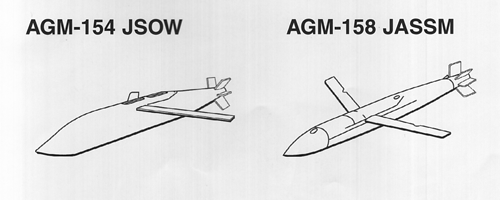
AGM-158 Joint Air-to-Surface Standoff Missile (JASSM) (16)
A precision cruise missile. Target recognition by infrared imaging. 4.3 meters long, one ton. Range 370 km.
BBU-37/B
Tested since March 1997, the "Bunker Buster" (fortress buster) weighing 4,700 pounds (2,131 kg). It is a JDAM (Joint Direct Attack Munition). The Bunker Buster can penetrate three or four layers of 3.7 meters of reinforced concrete when dropped from 13,000 meters. A sensor located in the tail detects the number of successive layers of concrete penetrated, and the level at which the charge is to explode can be pre-set.
Previous Page Table of Contents Next Page
Counter initialized on October 7, 2002. Number of visits to this page: