The Mysteries of the Stealth Bomber B2
The Mysteries of the B2
August 20, 2002
Page 4
The B2 Missions
Information about the B2 can be found in interviews, the continuation of the brochure, or in the photos. In a March 1998 interview, Major Scott Vander Hamm, when asked about the B2's lifespan, estimated that these aircraft should remain operational until 2030. He added, "since it is mainly non-metal" (as it is composed of 80% non-metallic, composite materials), they would be less susceptible than other aircraft to corrosion. He noted that the B2's stealth capabilities and those of the F-117A are "comparable." He added that both aircraft types address the same concerns: penetrating heavily defended and protected airspace and delivering precise ordnance. He also pointed out the difference is that:
- The B2 is capable of carrying out such missions starting from deep within the United States and returning to its original base after completing the mission.*
(In a 1998 Washington Post article discussing controversy over the B2's validity. At the time, the aircraft had not yet been used in combat. Some critics objected to the claim—see below—that the radar-absorbing coating is sensitive to rain! Proponents of the program argue it would be impractical to establish B2 bases in various global locations, as hangars would require expensive air conditioning systems. Thus, here is a "all-weather" bomber apparently extremely sensitive to temperature or humidity fluctuations.)
This is precisely what makes this aircraft so strange. The Americans have bases in numerous locations around the globe, which can serve as launch points for a wide variety of missions targeting many countries. The insistence on having these aircraft depart from and return to the U.S. seems extremely peculiar. For example, at the end of the brochure, an operation named ENDURING FREEDOM is mentioned, taking place on November 5, 2001, following the September 11 attacks on Manhattan's twin towers. On that mission, six B2s from the 509th Bomb Wing, departing from Whiteman Air Force Base in Missouri, flew a route from Missouri to Kabul to Diego Garcia (Indian Ocean), and dropped 900-kilogram satellite-guided bombs from an altitude of 15,000 meters. (Side note: Did you notice that the B2 is part of the 509th Bomb Wing, which dropped atomic bombs on Japan in 1945, and that Roswell in 1947 became a focal point of early UFO interest?) According to the brochure, the outbound flight took forty hours. The B2s made a brief stop at Diego Garcia, where crews were swapped, toilets emptied, refueled, and the aircraft immediately resumed their direct return flight, engines running continuously. The return journey lasted 30 hours. Thus, the engines ran for a total of 70 consecutive hours.
Note: On a Northrop-Air Force website, different figures are given for this mission: "The B2 has repeatedly demonstrated to penetrate hostile air without being detected and its all-weather capability during Operation Allied Force and Operation Enduring Freedom with missions up to 44 hours duration." Translation: "The B2 has repeatedly demonstrated its ability to operate in hostile territory and conduct all-weather missions during 'Operation Allied Force,' a bombing campaign in Serbia, and 'Enduring Freedom,' another in Afghanistan, with mission durations reaching up to 44 hours." This second piece of information appears more reliable than the data provided in James Goodall's brochure. Indeed, if we calculate speed based on a 70-hour mission duration, accounting for the 40-hour outbound leg, we arrive at speeds far too slow. This may therefore be an error in James Goodall's brochure (or, more simply, a document produced in clear disregard for common sense).
Regardless, it is quite interesting to plot these round-trip flights on a world map.
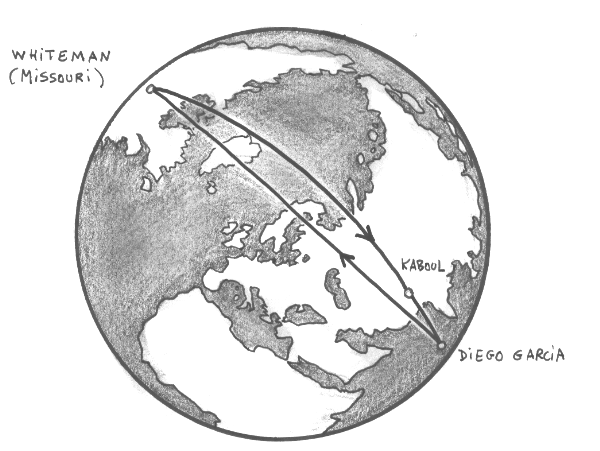
The outbound flight covers over 16,000 kilometers. Three in-flight refuelings were required, which cannot be conducted above 7,500 meters at speeds of 250–350 knots. The map shows that one of these refuelings necessarily had to occur over Russia. Although Russia is now considered a "friendly" country, one must remember that during in-flight refueling, an aircraft is particularly vulnerable: it flies low and slowly, making it susceptible to surface-to-air missiles. Moreover, the refueling tanker, unarmed, is itself vulnerable. If the entire mission depends on the success of this rendezvous, and the tanker is shot down, the mission fails completely. According to André-Jacques Holbecq, an in-flight refueling operation is relatively quick—15 to 20 minutes. Let's allow a full hour, at most. Subtracting three hours for refueling, 37 hours of flight remain. For 16,000 km, this translates to a speed of 432 km/h. No matter how one looks at it, the figures in the brochure lead to absurdities. An aircraft cannot fly this slowly at 15,000 meters altitude without stalling immediately. Furthermore, regarding the raid on Yugoslavia (30 hours total), the outbound flight duration of 16 hours leaves only 14 hours for the return flight—this is illogical, since on the outbound leg, aircraft benefit from jet streams (routes correspond to high-latitude transatlantic flights). Additionally, we know that an aircraft flies at the same speed regardless of whether it carries a bomb load (internally). More inconsistencies to clarify...
Note: The Air Force website document states:
"This tremendous capability gives the aircraft the ability to fly anywhere in the world and deliver a variety of weapons in less than 24 hours." This extraordinary capability allows the aircraft to reach any point on Earth (including the antipodes) and deploy a wide range of weapons in under 24 hours. These figures are more plausible than those in James Goodall's brochure, given the distance (20,000 km) and the time required for in-flight refueling. Let's return to the brochure.
Interviewed, Major Przybyslawski said:
- The B2 combines stealth, long range, high payload capacity, and precision munitions, making it the most capable long-range bomber in the world.*
One wonders which aircraft he might be referring to. Below is the three-view drawing and specifications of the B2.
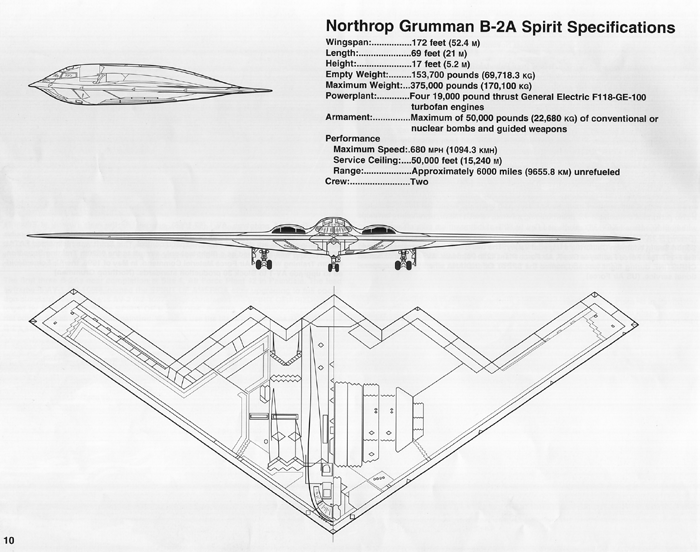
B2: Three-View Drawing
The 9,000 km figure corresponds to the maximum range.
On page 49 of the brochure, it states:
The flight from Whiteman AFB to Afghanistan required six aerial refuelings.
It seems we must interpret this sentence as:
The raid on Kabul, departing from Whiteman, required a total of six in-flight refuelings.
But that is already considerable. The major's text appears to suggest that this type of B2 mission is a "typical..."