The mysteries of the B2 stealth bomber: air intakes
The Mysteries of the B2
August 23, 2002
Page 6
Air intakes of the B2. Final reflections.
Let's examine them in more detail. On page 7 it says that the aircraft is powered by four non-afterburning General Electric F118-GE-100 engines (noting in passing that these engines, which had already equipped, among others, the B1, did not require a new study and could not explain the exorbitant cost of the B2). Speed of the Spirit: 1094 km/h (given as corresponding to "high subsonic") with a ceiling of 15,000 meters. Still on page 7, we learn that in order for the turbine blades not to reflect radar echoes, the engines are housed in the wings, recessed. This corresponds with the images of the air intakes given on pages 14 and 15.
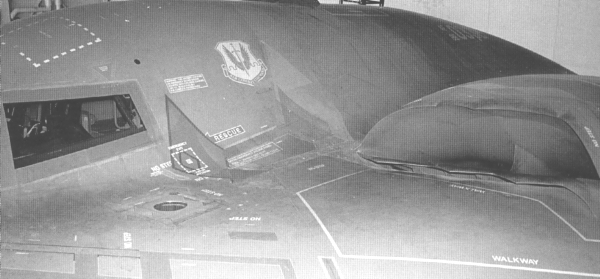
**Left engine air intake. Sawtooth leading edge.
Same for the boundary layer trap visible near the surface of the wing.
**
At the center, apparently a partition separating the flows destined for the two turbofans (without afterburners). It is specified that this incident air flow, captured by these "boundary layer traps," is then used to be mixed with the exhaust gases and thus reduce the infrared signature. The following image shows this air intake from another angle.
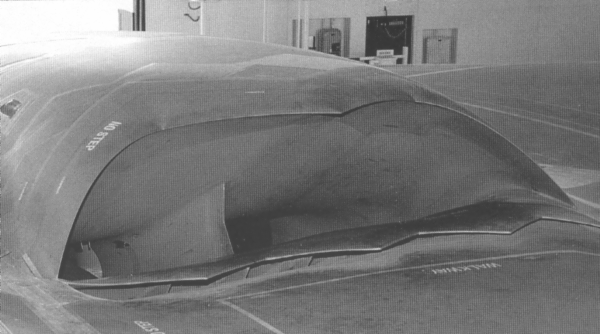
Still on the photo at the top left of page 15, although the image is somewhat flattened by this "almost front view," a "zig-zag" (hairpin junction in the text, meaning a hairpin shape) can be seen on the upper part of the engine cover. It is known that this zig-zag structure helps to reduce the electromagnetic signal re-emitted by any leading edge or leakage, which behave like antennas. The zig-zag shape is a classic in stealth technology, ensuring that the parts facing each other reduce each other's echo signals. A zig-zag cut can be found not only on all parts of the aircraft that serve as leading edges or trailing edges but also on any area that serves as a junction between two different materials (or even the same material, as for all the aircraft's hatches, such as the landing gear hatches). On the photo of the sheet, this zig-zag cut can be seen on the upper part of the engine cover. This suggests a system designed to ensure the stealth of the air intakes. The wall that deflects the airflows from the upper surface to the engine compressor would be transparent to radar waves. Immediately behind it would be a 45° reflector that would redirect these waves upwards through a radar-transparent window, the zig-zag cut indicating the boundary, the junction with a more resistant material forming the engine cover, subject to stresses (perhaps metallic).
One has a side view showing how the engine covers protrude on the upper part of the wing:
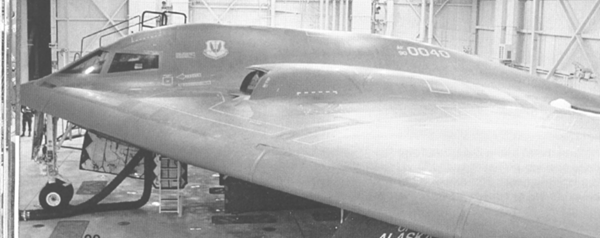
View of the engine placement (in the rear position: they are short because they are without afterburners, as indicated in the sheet).
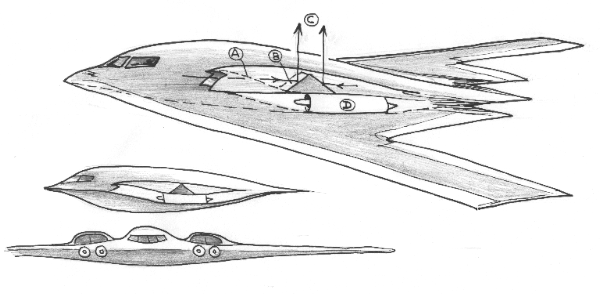
Commonly indicated in the sheet, the four standard General Electric F118-GE-100 engines are housed in the wing in such a way that radar waves cannot reach the turbine blades, whether at the entrance or the exit. This suggests a stealth device. For this, it is sufficient that the partitions ensuring the deflection of the gases are transparent to radar waves and that, as indicated, metallic partitions reflect them back to the stars (a system similar to that of the F-117A air intakes, described in my book). However, there is still a stealth problem. The sheet indicates, on page 38, that the B2 wing does not have leading edge flaps. Its sweep of 33° implies a rather nose-up attitude during landing.
Lhe B2 wing has a sharp edge in the part that is in front of the fuselage (which does not contribute to the lift of the aircraft). On the other hand, the following photos show that the leading edges of the "wings themselves" are very rounded. This is logical for a subsonic wing, but it represents a large frontal surface that reflects radar waves. We are told that the aircraft's surface is covered with a special coating, both very thick (7 to 10 cm) and very fragile (necessitating that the B2s be quickly stored in their hangars) and even sensitive to weather. All of this is difficult to understand, as an aircraft flying at 15,000 meters or said to be "all-weather" missions is subject to a lot of "meteorological stress," whether it be rain, hail, or radiation.
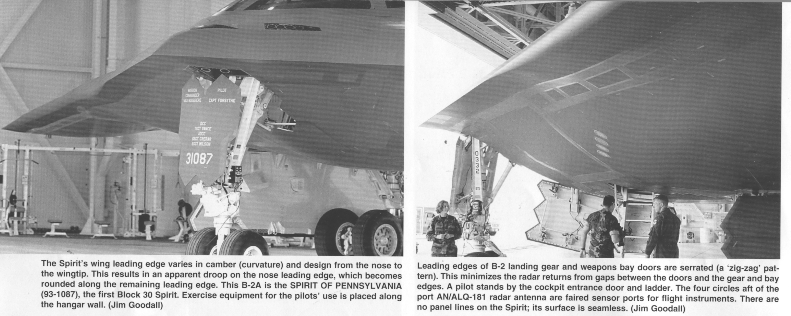
One will also notice that this famous protective coating, so thick, does not seem to be present on the landing gear hatches or on other pictures showing the bomb bay hatches. If someone has an explanation......
Lhe sheet gives some brief information on the absorption technique, which would consist of embedding fine metal particles within the thickness of the coating. This would also be the case for the cockpit windshield, which is also said to have a thickness of 7 to 10 cm.
It is specified on page 14 that the B2, combining its satellite positioning system (GPS), its "ring-laser gyro platform" and an astronomical tracker (astro-tracker), knows its position at any time within a few meters. On the same page, it is specified that the 7 to 10 cm thick windshield has two gold wire networks that constitute radar wave reflectors/diffusers, both incident and emitted from inside the cockpit. The pilots can eject through the cockpit ceiling. The locations are indicated by dashed lines. The leading edges of the two wings (in the most recently built models, from the "block 30") are in one piece, which avoids "hairpin" (hairpin) joints.
The B2 wing's sweep (33°) implies a nose-up attitude during landing. If the leading edge were "knife-edged," it would have to be able to pivot downward to adjust the "camber of the profile" accordingly and avoid stalling. The other solution, chosen for the B2, was to adopt a very rounded leading edge, clearly visible on the photos extracted from page 20. The disadvantage of this design concerns the low stealth of this type of profile, with respect to radar waves arriving from the front. On page 20, it is also specified that the aircraft are stored in their hangars as soon as possible to protect the radar-absorbing coating from any damage related to the environment (which one? It cannot be solar coating, as these aircraft are designed to fly at 15,000 meters altitude. It is difficult to imagine that this coating could be sensitive to weather (as specified in the sheet!). In our opinion, there would be a completely different reason, which remains to be determined.
Page 22 indicates that the B2 cannot be photographed from the rear, the exhaust system visible from this angle being "classified".
**Conclusion. **
Le great my...