A film showing the B2's MHD system in action.
The Mysteries of the B2
January 17, 2003 - Updated December 8, 2005
Page 7
A video shows the B2's MHD system in operation.
When you want to keep a secret, you must be extremely vigilant. Sometimes, certain clues leak out. By entering:
http://www.is.northropgrumman.com/videos/b2_tx.wmv
into your browser, you can view a one-minute sixteen-second video (1.9 megabytes), downloadable. It shows a series of aerial shots of the B2—this one, not the hypersonic bomber.
Here is the key short excerpt:
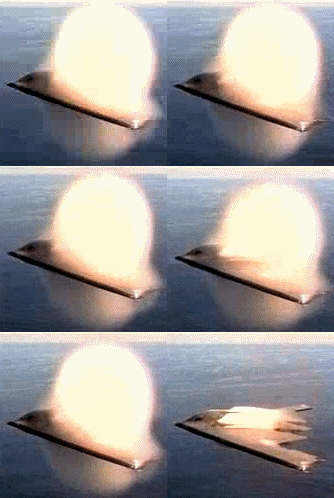
B2 passing through transonic flight above the sea. Migration of the electric discharge (MHD) into the water vapor environment. Isolated sequence converted into animated GIF by Christophe Tardy.
Note that the glow of the discharge affects only the upper part of the aircraft.
The B2 is equipped with a plasma generation system using the surrounding airflow as an MHD generator, allowing it, even in subsonic configuration, to be enveloped in plasma. This plasma is invisible during daylight. It is this plasma that makes the aircraft stealthy by absorbing and scattering radar waves. If this "demonstration B2" weren't so clearly labeled, people might wonder, since it's supposedly undetectable. In the video, this minimal MHD system is activated. Normally, the electric discharge should not be visible. But when the aircraft flies over the sea—where humidity is high—it passes through transonic flight. Below is a transonic wing profile. As the aircraft approaches the speed of sound, "compressibility effects" appear near the thickest part of the wing (indicated by the dashed line).
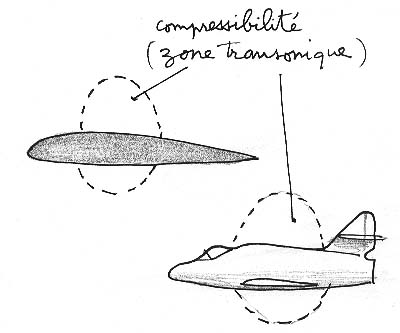
Airplane wing and fuselage in transonic regime.
It is in this region that water vapor condenses, generally briefly, since aircraft are not designed for long-duration transonic flight, where they are inherently unstable. When an aircraft breaks the sound barrier, it is a speed range it does not tend to linger in. The same applies when slowing down. Below is a photo of an F-18 flying over the sea in transonic flight. A variable-sized cloud-like haze appears—obviously white, since it is... water vapor.
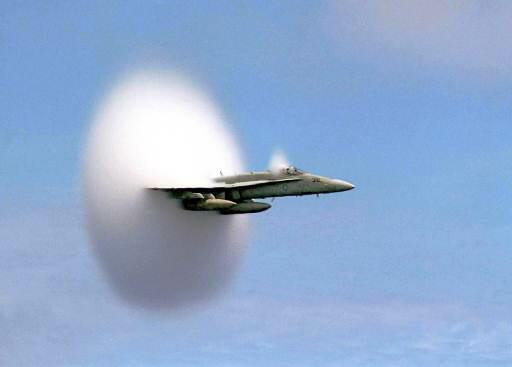
F-18 passing through transonic flight in humid air.
(Photo provided and transmitted by J. Costagliola)
Other photos of the same phenomenon, reported by Gérard Chenu:
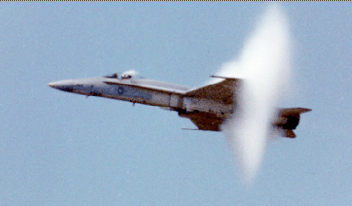
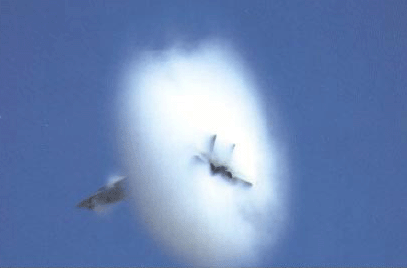
This link points to a video showing an aircraft passing through transonic flight. It's not a "crazy plane," but a classic example in fluid mechanics:
http://www.incroyablement.com/images/videos/asf/avionfou.wmv
In the video showing the B2, however, we see something entirely different. See the two images below:
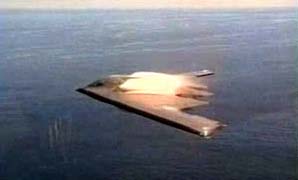
The electric discharge spreads into the transonic region where water vapor condenses.
Note the reflection of the glow on the upper surface of the wing.
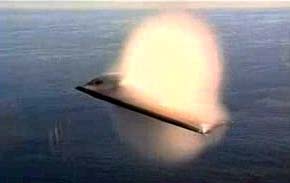
Second image extracted from the video: The vapor bubble reaches maximum extension.
Same for the electric discharge.
What do we observe? On the upper part of the aircraft—where the MHD system is located, primarily at the engine inlets and nozzle exits—the vapor bubble is strongly luminous. This is normal. Air filled with micro-droplets of water vapor is more electrically conductive. The electric discharge therefore tends to spread throughout this region. Clearly, this vapor bubble emits light, due to radiative de-excitation of gas molecules excited by collisions with free electrons forming the discharge. This luminosity is greatly attenuated, or even absent, on the underside of the aircraft.
How did the Air Force allow such images to be released? In our view, because no one paid attention. Under normal conditions (matching all other footage in the video), the electric discharge is invisible. It became visible only for a brief moment because the condensation of water vapor during transonic flight suddenly increased the electrical conductivity of the air. These images were handed over to a company tasked with assembling this one-minute video. No one noticed the abnormal coloring and luminosity of the vapor bubble during this very brief sequence. Only a specialist’s eye would have detected this anomaly.
Moral: Even when you take great care to hide things, clues always remain.
On the image below, the same halo phenomenon around the B2, but with the MHD system deactivated.
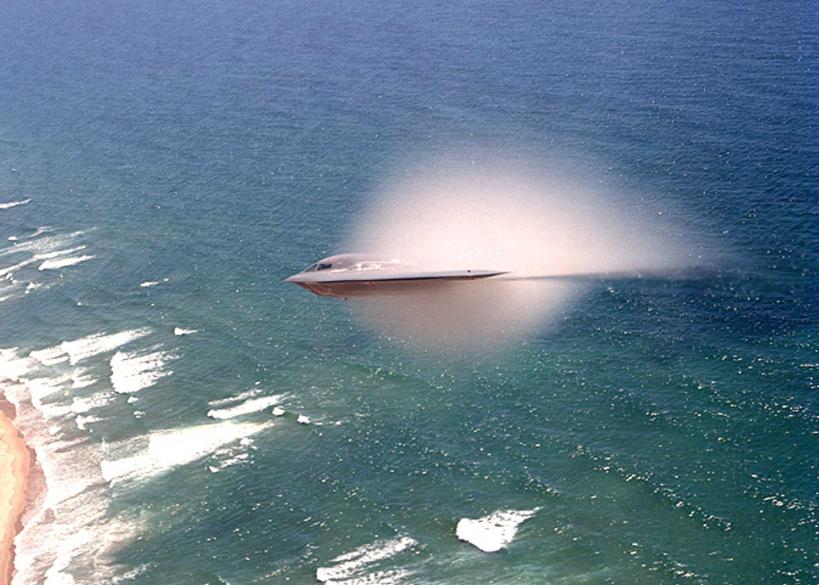
Halo of micro water droplets from condensation around a B2 passing through transonic flight.
MHD system deactivated. (Photo provided and transmitted by J. Costagliola)
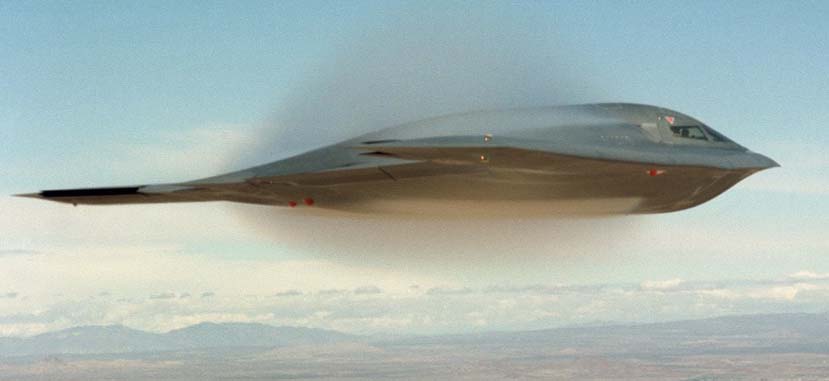
Another image, transmitted by Eric Dezoête
The background clouds indicate high air humidity
Submitted by reader Laurent Molieras, found on an Air Force website:
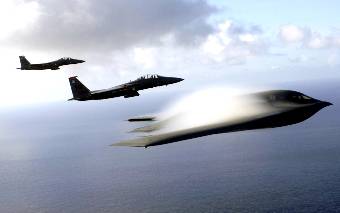
An unusual image
We see again the theme of a vapor cloud forming near the main wing section of an aircraft in transonic flight. The reader then poses two questions, which I cannot answer immediately.
- Why doesn't this phenomenon occur on the two escort fighters as well?
- Why does it affect only the upper surface of the aircraft?
Some observations: the aircraft are flying in humid air (over the sea). We also know that this transonic phenomenon is quite sharp and fleeting, corresponding to a relatively narrow speed range. It reflects a localized "compressibility" effect, just before shockwave systems form around an object. To be complete, one must consider a regime where air density can vary, not just pressure (hence "compressibility" and "decompressibility"). One might also consider that the three aircraft may not be flying at exactly the same speed. The B2 could be "catching up" to the two fighters. But this seems unlikely. Finally, the B2, being bulkier than the escort fighters, might experience this phenomenon earlier than the others. Thus, the condensation could occur on the B2 before appearing near the two more slender aircraft. Finally, fluid mechanics experts familiar with the phenomenon of condensation due to compressibility might offer insight into why it occurs only on the upper surface. Yet something still feels strange. Let’s examine the attitudes of the different aircraft:
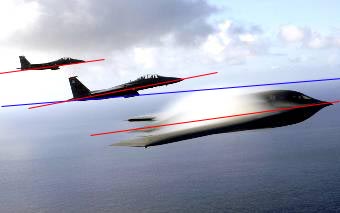
The B2 is described as an aircraft expected to operate at the lower limit of the...