A surface embedding in R³ is a representation where the tangent plane is continuous and there is no self-intersection set.
APPENDICES
An embedding of a surface in R³ is a representation where the tangent plane is continuous and there is no self-intersection set. The sphere and the torus can be embedded in R³.
An immersion of a surface in R³ also has a continuous tangent plane, but there is a self-intersection set present. Examples: Boy's surface, Klein bottle.
One can always transform an embedding into an immersion. Take a sphere and bring two points—say, antipodal ones (the "poles")—into contact from inside. In this "immaterial" world of immersions, surfaces may pass through themselves. This creates a self-intersection curve (here, a circle).
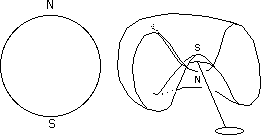
However, the reverse is not automatically possible. The projective plane cannot be embedded in R³; it can only be immersed. The classical form of this immersion is Boy's surface, which has a self-intersection set shaped like a triple helix, with a triple point (where three sheets intersect). See figures 29a and 29b. The same applies to the Klein bottle, whose minimal self-intersection is a closed curve. See Topologicon, page 46. Embeddings can be considered special cases of immersions where the self-intersection set is empty. Representations featuring cusp points are not immersions, since these points are singular with respect to the continuity of the tangent plane. Let us call such representations shearings of objects in R³. A shearing of a surface in R³ might appear as an immersion "almost everywhere," meaning the tangent plane is continuous except at a finite number of points. But this is not a precise enough definition, since there are multiple ways to introduce discontinuity in the tangent plane. We will revisit the issue of discontinuities later.
Surfaces, and more generally geometric objects—point, line, closed curve, "bordered curve" (segment or "b1-ball"), disk, etc.—are like the elements of a language. We have extensively used all these components in the Topologicon (see cd-Lanturlu), as "words" or "letters" from which we can form words and sentences according to a syntax. We call such objects constructions.
There are transformations that are genuine geometric operators. In this article, we described the operation of creating and destroying cusp points. Let us elaborate on it.
A fundamental object could be called the "gamma-cylinder."
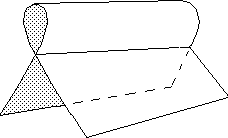
It has a self-intersection line, from which, by constricting the upper tubular passage, we will create two cusp points.
We begin the constriction operation:
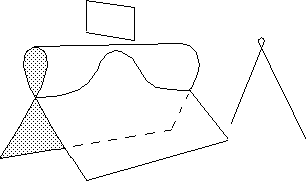
The surface's cross-section remains a "gamma," but corresponds to a narrowing passage. Analyzing the neighborhood of a singular point is always delicate. There are several possible drawings, corresponding to different types of singularities.
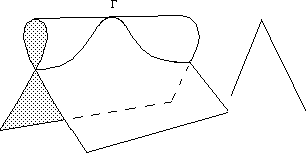
Point G corresponds to the merging of two cusp points. Anglo-Saxons refer to all singularities as "cusps." Dictionary translation: horn, peak. But the peak of a horn is a conical point. Larousse: cusp: sharp, elongated tip, from Latin cuspida: point. The singularity arising from merging can take other forms, for example:
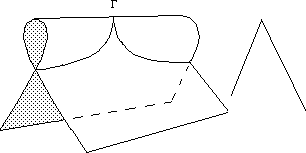
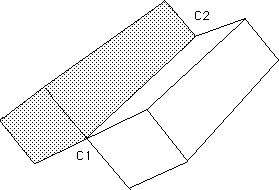
The transverse section is the same: an inverted "V," but it is neither the same object nor the same singularity. Nevertheless, one can pass from one of these figures to:
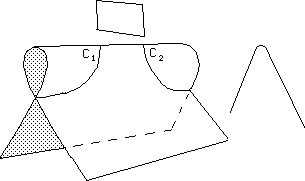
where we have two cusp points, C1 and C2. The cross-section has changed (shown on the right, with the cutting plane indicated above the figure).
This is modification "C."
Detail: 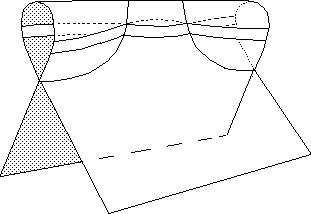
I once explained to a friend on the phone what a cusp point is.
-
Imagine you're riding a horse. Suddenly, with your legs, you crush the horse so that your two leg-segments come into contact. The horse-surface changes. Its right buttock joins its left shoulder, and its left buttock joins its right shoulder.
-
But where is the cusp point?
-
You're sitting on it.
The phenomenon of changing sheet connections is called surgery. The operation described below is the creation of a cusp point from a parabolic cylinder (the "horse" from earlier):
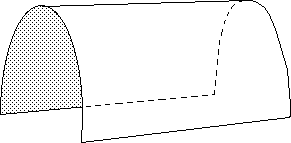
After "crushing the horse":
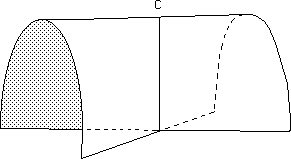
At the top, the cusp point.
The cusp point obtained by crushing a surface along a segment and changing sheet connections (a surgery) allows us to understand how a sphere can be transformed into a Cross-Cap (also called in French "crossed cap sphere") by pinching a sphere with a curling iron.
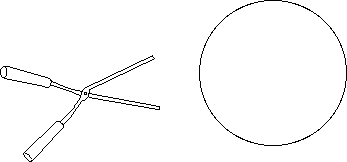
Thus, the curling iron becomes the simplest tool to transform a sphere into a one-sided surface.
Below is the Cross-Cap:
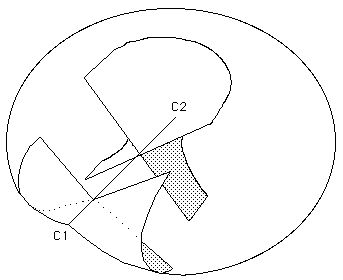
Brief digression: how to "mesh" a Cross-Cap? We can start from one of its polyhedral representations:
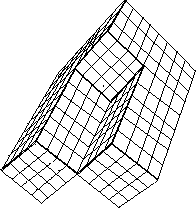
From this, we can deduce the mesh near a cusp point:
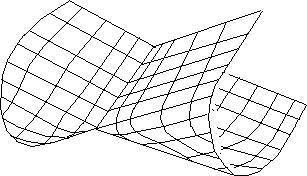
Does this mean that a single curling iron stroke automatically transforms a two-sided surface into a one-sided one? No—see the following drawing:
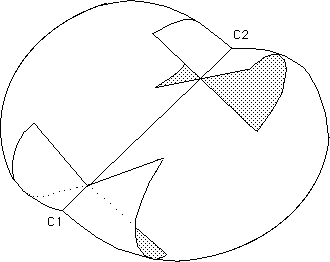
Here, we pinched a sphere between two rulers. It remains a two-sided surface. Paint it—you’ll see. You can use two colors (for the Cross-Cap, you couldn’t, since it’s one-sided):
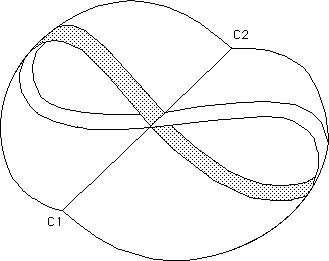
Another view:
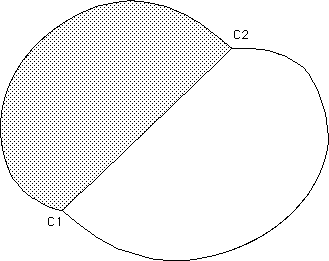
In this configuration, the sphere shows half of its exterior and half of its interior. If you have trouble visualizing this object, here is a polyhedral representation:
When encountering such polyhedral representations, one might be tempted to apply the decomposition into "contractible cells" (see Topologicon, cd-Lanturlu) to attempt calculating the Euler-Poincaré characteristic. Polyhedral representations of the sphere (a simple cube) or the torus allow us to compute their characteristic: two for the first, zero for the second. In the album, page 47, there was a construction plan for a "Boy-Cube" with edges represented. In passing, one could assemble this using "Reynolds square-section profiles," lightweight alloy rods used for building shelves. Cut the square tubes with a saw, as close as possible...