Four days on the Belem sailing ship
The Belem
Four days elsewhere, or a brainwashing with sea water.
September 11, 2012
I learned to sail on what are now called old ships. On an old Breton fishing boat, to be precise, and in Brittany. It would seem today that it was quite "physical". There was no "whinch". This is how we tightened the sheets.
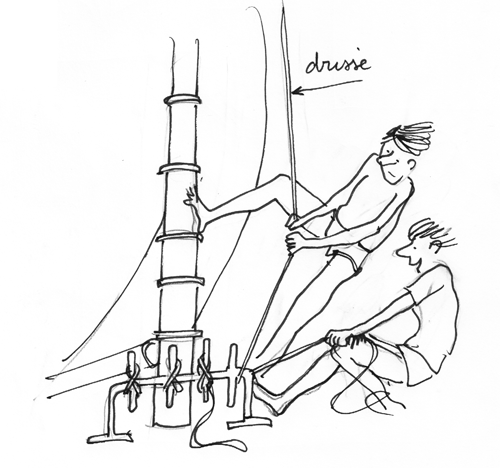
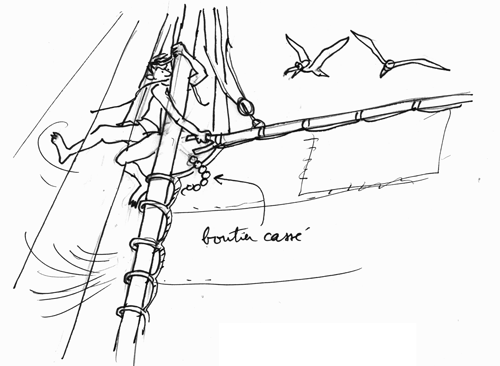
I liked the rough weather. One day the "boulier" broke and the fork (is that the exact term, I don't remember?) came out of the mast. I had to go and put it back in place, sitting on a monkey ladder (same question).
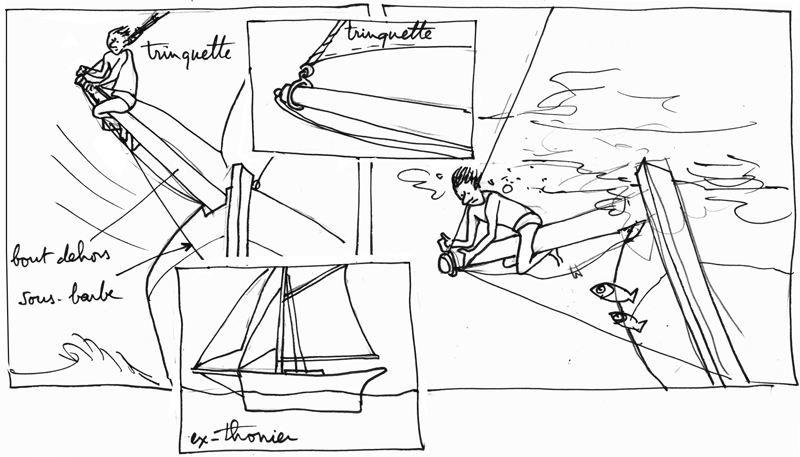
Another time, the ring on which the trinquette was fastened was stuck, at the end of the outer yard. I had to unscrew it by squeezing the outer yard between my legs. It was so unstable that when the boat pitched forward, I ended up underwater.
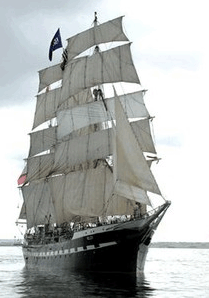
This summer, my wife and I wanted to treat ourselves to a four-day "training" session on the Belem. I recommend it. It's great. Save some money and treat yourself to it once in your life. You will never forget these moments. And it's also the most powerful way, when you can afford it financially and physically, to forget everything for a few days, and to undergo a brainwashing with salt water. Sometimes, it's not bad.
On the Belem website, you can order a set of two DVDs. One recounts the history of this sailing ship, built in Nantes in one and a half years, and launched in 1896, at a time when these ships could still compete with steamships, which were burdened by unreliable machines, and carried their black wind in their holds. For the owner of the Meunier chocolates, it went to Belem, Brazil, to fetch cocoa.
 .
.
The Belem, yesterday and today
Length: 58 meters. Width: 8.8 meters, 540 tons.
It has seen all kinds of things. On its first voyage, it loaded a hundred mules in Montevideo, to take them to another port in Brazil, where they were supposed to pull the trams. But a fire broke out on board and the mules died. Seriously damaged, the Belem returned, empty, to its home port, Nantes. The one that the seafarers had nicknamed the "Yacht of Nantes" because of its elegant lines, returned in a poor condition.
I leave you to discover the rest. It narrowly escaped in 1902, at the time of the eruption of the Montagne Pelée in Martinique, to the pyroclastic flow. Due to lack of space, it had to anchor at the other end of the island. The next day, it killed everyone in seconds, exhaling its 400-degree fumes at hundreds of kilometers per hour, a "two-phase" mixture of burning gases and rocks. Thirty thousand people died in seconds. The anchored ships caught fire immediately, capsized and all sank. The rain of blocks, mixed with gases, rushing at 150 meters per second, collapsed the buildings of the city. An unimaginable tragedy, by its brutality and speed.
| September 26, 2012 | . | I | found a video, corresponding to an INA archive, which provides details on the effect of the pyroclastic flow. | C | this document is very interesting. One has a rather wrong idea of the phenomenon. There was indeed an | explosion | of the top part of this volcano. There was a plug, and under it there was probably a very high pressure. Under this plug there was a more or less liquid lava, with a mass of dissolved gas. When this solidified lava plug gave way, this "two-phase" (a mixture of gas, liquid and solid) mass expanded. This expansion was so abrupt that it generated a | shock wave | . | I | t should be known, in fluid mechanics, that the shock wave propagates faster than "the interface" between the air and the explosion products". This wave, propagating in the air, preceded the front of the pyroclastic flow. What collapsed the buildings were two things. First, instantly, the overpressure corresponding to the propagation of this shock wave in the air, so strong that it was enough to knock down all the buildings facing it. The lighthouse was ... swept away. But the walls that were "in the wind's path" remained standing. | I | don't know what the initial pressure was, just before the explosion. This value could allow us to calculate "the Mach number of the shock". With a very high value, this wave represented not only the propagation of a pressure wave, but also possibly a "thermal wave". | O | ne can say that, in this aspect, the eruption of the Montagne Pelée is comparable in intensity and power to a nuclear explosion. We see in the video that we found bodies whose side facing the explosion had been burned. | A | fter the propagation of this "wave front" followed the "interface", the front of the pyroclastic flow, and behind this interface the content of the volcano, released, that is to say a mixture of gas and blocks of all sizes. The propagation of these blocks was | at supersonic speed | . Thus the city was subjected to: | - A strong shock wave | - Followed by a flow moving at supersonic speed. | C | it is a situation that is difficult to imagine, but it explains the extent of the destruction. These blocks caused additional mechanical destruction. The city was bathed in a flow of burning gas, which set everything on fire. | C | ommonly, when there is an explosion of this kind, the inertia of the ejected masses created a | depression | at the epicenter, which triggered the start of a | rarefaction | wave. This explains why we found the bodies with their entrails removed, burst open. | T | he power of the shock wave was still sufficient, on the shore, to vaporize the lighthouse. Therefore, the anchored ships were immediately stripped of their masts. Their superstructures were scattered in all directions. The roofs were pulverized, like the wooden houses that can be seen when they are hit by the shock wave of a nuclear explosion (those who have seen these films will remember the "reflux movement" observed then). | T | he most fragile hulls were torn open (but the entire fleet, anchored, still had its bow facing the shock). After the passage of this shock wave, the arrival of the pyroclastic flow completed the work, setting all the buildings on fire. | T | hese phenomena should make us think of the effects of the new weapons developed by the great powers. This brings to mind these mega bombs, where first an aerosol is dispersed in a large volume, which mixes with the air. Then this large volume is set on fire. One obtains a "blast wave", which kills in two ways. | - By the overpressure it creates, which humans can protect themselves from by taking cover behind an obstacle, in a trench or in a bunker. | - Then by the rarefaction wave, which it is impossible to ...