Neural Implants: Toward Absolute Social Control?
April 3, 2005,
Alain Goumy
Computer scientist, 57 years old, Orléans. Contact:
alain.goumy tiscali.fr
Thanks to tiny electrodes implanted on the surface of the brain, it is already possible to directly control certain devices with one's thoughts. Such "neural implants" are currently being studied in several universities and private companies, thanks to civil and military funding. Should we fear that these researches open the way to absolute control by society over our thoughts and actions?
BrainGate
The preliminary results of a pilot study on the use of a neural implant were recently presented [1]. This study concerns a system called BrainGate ("Brain Gate"), developed by Cyberkinetics [2], which allows people with motor disabilities to easily use various devices, such as computers, household equipment or medical devices, by directly controlling them with their thoughts.
This system, based on an implant consisting of a 10 by 10 electrode matrix, each thinner than a hair, is intended to be implanted by a surgeon on the surface of the brain, to receive electrical signals from a region controlling movement (motor cortex). It thus allows the simultaneous capture of the electrical activity of 100 neurons. These signals are transmitted via a cable, through the skull, to an external device placed in the wheelchair. After analysis by electronic and computer processes, the necessary commands are sent to the devices to be controlled.
Since its implantation in June 2004, the first patient, a young man paralyzed from the neck down, has learned to turn the lights on and off, to control his television or to read his email, solely by thought. He can even do this without any particular effort of concentration, as he can do it while talking.
The final results of the pilot study, which should include four other tetraplegic patients, will be published in early 2005.
(Readers wishing to deepen their knowledge of the functioning of the nervous system can consult the website (in French) which I provide the reference in [3]).
Brown University
The studies that led to the BrainGate system were conducted at Brown University. This university, located in Providence (Rhode Island), has set up a multidisciplinary research program on brain sciences (Brown University's Brain Science Program - BSP) [4].
It is particularly the neuroscience laboratory [5] of Professor John Donoghue that has developed this project. Funding has been provided both by a civilian organization (National Institute of Neurological Disease and Stroke), and by a military organization (DARPA), whose objectives I will examine in more detail in the following article.
John Donoghue is also one of the founders of the company Cyberkinetics. This "start-up", created in 2001, is responsible for the commercialization and continued development of products resulting from university research in neural information processing, and particularly the BrainGate system. Such an approach, still rare in France, is not exceptional in the United States.
John Donoghue gave an interview to the magazine Discover in November 2004 [6]. I have extracted this paragraph which is chilling:
If the brain code can be cracked, does that mean that my thoughts could eventually be read? D: Yes, if you believe that spiking activity and populations of cells are the essence of brain activitywhich they might not be. There might be more to it than that. But if that's it, and you could pick up all those by millions of electrodes, then in theory you should be able to reconstruct everything that's going on in your head and see your dreams and know your thoughts.
[ If the brain code can be cracked, does that mean that my thoughts could eventually be read? D: Yes, if you believe that spiking activity and populations of cells are the essence of brain activity which they might not be. There might be more to it than that. But if that's it, and you could pick up all those by millions of electrodes, then in theory you should be able to reconstruct everything that's going on in your head and see your dreams and know your thoughts. ]
We are not there yet, but the path is open ...
Readers interested in the technical details of the BrainGate system will find useful the document (69 pages in English) which I provide the reference in [7].
Upon reading this document, one can see that neural implants will, in the future, not only allow the control of devices, but also the reception of sensory information, which will be sent back to the brain to allow better interaction with the controlled devices (see 6.6, p. 29 and 30).
DARPA
DARPA (Defense Advanced Research Projects Agency) [8] is an agency of the United States Department of Defense. Practically unknown to the general public, it still plays an important role as it is the central organization for research and development of this ministry.
Among the areas it funds, in the section "Bio: Info: Micro Projects" [9], there are projects concerning the development of neural interfaces.
The objectives are described as follows:
The common focus in these efforts is the interaction between a biological information processorthe brainand the synthetic networks of nano- and micro- devices. By concentrating on those interactions, DARPA seeks to develop a deeper understanding of the neural and synaptic organization of the brain and to eventually use that understanding as a guide to designing new DoD capabilities in signal processing, computation, and the human-machine interface.
[ The interaction between a biological information processor - the brain - and the synthetic networks of nano- and micro-devices constitutes the common focus of these efforts. By focusing on these interactions, DARPA seeks to develop a deeper understanding of the neural and synaptic organization of the brain, and to eventually use this understanding as a guide for designing new DoD capabilities in signal processing, computation, and the human-machine interface. ]
Here, I open a "science-fiction" parenthesis:
- One can imagine, as military applications, in the near future, the control of fighter planes or weapon systems, for which the reduction of reaction times, by eliminating the delays of nerve signal transmission, would be a decisive advantage on the battlefield.
- One could also, in the long term, witness the integration of human beings into computer decision-making systems. Their brain would then be used as a "bio-informatic" processor, and would fulfill the functions for which traditional computer systems are poorly adapted, notably the resolution of unforeseen problems (no need to lock them in a cabinet among electronic circuits; it would be sufficient to have a simple connection to the computer network, probably wireless, from their regular workstation).
Closing this parenthesis, I return to the current situation.
The neuroscience laboratory of John Donoghue has received funding from DARPA for a study called "Coupling of Brain with Microstructured Electronic/Optoelectronic Arrays: Interactive Computation at the Bio:Info:Micro Interface", concerning the coupling of the brain with nanotechnology-based electronic and optoelectronic circuit networks. This study does not directly cover the "BrainGate" project, but I have found little information about it. If one refers to a difficult to read presentation page [10], the study would currently be focusing on the use of nanosensors near neurons, in order to create images of brain activity. The use of nanotechnology for coupling with the brain does not seem to be on the agenda yet.

(If nanotechnology is still a mysterious subject for you, visit the pages of introduction to molecular nanotechnology (in French) which I provide the reference in [11]).
DARPA has also funded the Arizona State University for a study called "Advanced Neural Implants and Control". A general presentation can be found in the document (66 pages in English) which I provide the reference in [12].
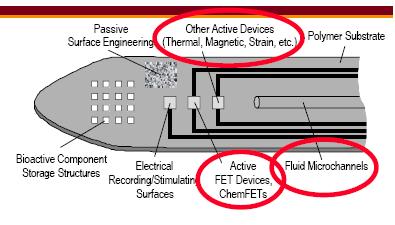
I have extracted (p. 17) a very interesting image, representing the end of an implant. It is no longer, as one can see, a simple passive electrode, but a set of active devices, with multiple functions.
One can notably observe
- structures for storing bioactive components (Bioactive Component Storage Structures)
- devices for recording electrical signals, and for electrically stimulating neurons (Electrical Recording/Stimulating Surfaces)
- active devices based on field-effect transistors, without further details (Active FET Devices, ChemFETs)
- other active devices for thermal, magnetic, or pressure stimulation (Other Active Devices)
- microchannels for fluid transport (Fluid Microchannels)
With these devices, all sorts of coupling modalities will be possible with neurons and synapses: electrical (bidirectional), thermal, magnetic, chemical, etc. Almost unlimited possibilities are thus offered for experimentation, both for the recovery of neuronal signals, and for the stimulation of neurons.
The door is now open to both the best and the worst. The best: considerable progress will be made in the treatment of disabilities - paralysis, deafness, blindness, debilitating nerve diseases. The worst: the means to place entire populations under absolute mental control will become available, and some may be tempted to put them into practice. Let us hope that the remaining human wisdom will prevent the worst.
To deepen the subject
I have gathered here the list of documents consulted during the preparation of this article. You will find many information to deepen the subject, if you wish. Unfortunately, practically all these documents are in English.
To view a document, simply click on its number.
If you do not yet have a document viewer program, install Adobe Reader.
[1] Article from Brown University reporting the results of the BrainGate pilot study (in English)
[2] Website of Cyberkinetics Neurotechnology Systems, Inc. (in English)
[3] Website of the Neurobranchés: all the mysteries of the nervous system (in French)
[4] Website of the Brown University brain research program (in English)
[5] Website of the Brown University neuroscience laboratory (in English)
[6] Interview of John Donoghue in the magazine Discover of November 2004 (in English)
[7] Detailed principles of the BrainGate neural prosthesis (pdf document in English, 69 pages)
[8] DARPA home page (in English)
[9] Presentation page of DARPA's research programs in bioinformatics (in English)
[10] Presentation page of the project "Development of nanosensors for optical imaging of neuronal activity" from Brown University (in English, does not work with all browsers)
[11] Introduction to molecular nanotechnology (in French)
[12] Description of the DARPA project on neural implants conducted at Arizona State University (pdf document in English, 66 pages)
[13] Description of wireless neural microimplants, by a research team from the University of Michigan (pdf document in English, 22 pages)
[14] Proposal from the University of Michigan for the application of biotechnology to soldiers (pdf document in English, 26 pages)
Number of visits to this page since April 4, 2005 :