Neural implants: Towards absolute social control?
Alain Goumy
Computer scientist, 57 years old, Orléans. Contact: alain.goumy tiscali.fr
Thanks to tiny electrodes implanted on the surface of the brain, it’s already possible to control certain devices directly through thought. Such “neural implants” are currently being studied at several universities and private companies, thanks to civilian and military funding. Should we fear that these research efforts could lead to society gaining absolute control over our thoughts and actions?
– In the near future, military applications could include controlling fighter jets or operating weapon systems. Reducing reaction times by eliminating delays in nerve signal transmission would be a decisive advantage on the battlefield.
– In the longer term, it might also be possible to integrate humans into computer-based decision-making systems. Their brains could then serve as “bio-computers,” performing tasks that conventional computers struggle with—such as solving unexpected problems. No need to enclose them in a cabinet filled with electronic circuits; all that’s needed is a simple wireless connection from their workstation to the network.
Now, back to the present situation.
John Donoghue’s neuroscience laboratory received funding from DARPA for a project called “Coupling of Brain with Microstructured Electronic/Optoelectronic Arrays: Interactive Computation at the Bio:Info:Micro Interface.” This project involves connecting the brain to networks of nanoscale electronic and optoelectronic circuits. It doesn’t directly relate to the “BrainGate” project, but I found very little information about it. According to a poorly written description [10], this research currently focuses on using nanosensors near neurons to create images of brain activity. The use of nanotechnology for interfacing with the brain doesn’t seem to be imminent yet.
(If nanotechnology still seems like a mysterious topic to you, check out my introductory pages on molecular nanotechnology [11].)
DARPA also funded Arizona State University for a project titled “Advanced Neural Implants and Control.” A general overview can be found in a 66-page document in English; I’ve provided a link to it [12].
On page 17 of this document, there’s an interesting illustration showing the end of an implant. It’s no longer just a passive electrode; it’s now a collection of active devices with multiple functions.
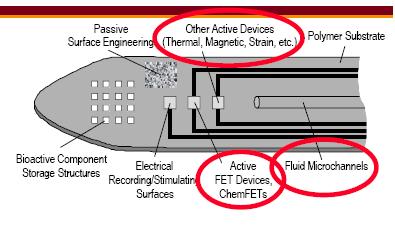
Notably, we see:
– Structures for storing bioactive components
– Devices for recording electrical signals and stimulating neurons
– Active devices based on field-effect transistors
– Other active devices for thermal, magnetic, or pressure-based stimulation
– Microchannels for transporting fluids
These devices enable various types of interactions with neurons and synapses: electrical, thermal, magnetic, chemical, etc. This opens up countless possibilities for experimentation, both for capturing neural signals and for stimulating neurons.
The door is now open to both good and bad outcomes. On the positive side, significant progress can be made in treating disabilities such as paralysis, deafness, blindness, and other neurological disorders. On the negative side, it becomes possible to exert absolute mental control over entire populations. Hopefully, human wisdom will prevent this from happening.
For further reading
I’ve compiled a list of documents I consulted while writing this article. You’ll find plenty of information here if you wish to learn more. Unfortunately, almost all of these documents are in English.
To view any document, simply click on its number.
If you don’t have a program to view PDF files, install Adobe Reader.
[1] Article from Brown University describing results of the BrainGate pilot study (English)
[2] Website of Cyberkinetics Neurotechnology Systems, Inc. (English)
[3] Website of Neurobranchés: all about the nervous system (French)
[4] Website of Brown University’s brain research program (English)
[5] Website of John Donoghue’s neuroscience lab at Brown University (English)
[6] Interview with John Donoghue in Discover magazine, November 2004 (English)
[7] Detailed principles behind the BrainGate neural prosthesis (PDF, 69 pages, English)
[8] DARPA homepage (English)
[9] Overview of DARPA’s bioinformatics research programs (English)
[10] Description of Brown University’s project on developing nanosensors for imaging neural activity (English; may not work on all browsers)
[11] Introduction to molecular nanotechnology (French)
[12] Description of DARPA’s project on neural implants at Arizona State University (PDF, 66 pages, English)
[13] Description of wireless neural implants developed by researchers at the University of Michigan (PDF, 22 pages, English)
[14] Proposal by the University of Michigan regarding applying biotechnology to soldiers (PDF, 26 pages, English)
Number of views of this page since April 4, 2005: