Untitled Document
Free Fall
October 15, 2012
I just saw the video showing Baumgartner's fall from an altitude of 39,000 meters.
According to his interview, he was very scared when he started spinning, not seeing anything at all, probably because of the fog that had formed on his visor. A heating system for his visor had been planned. However, during the two and a half hour ascent, around 20 km altitude, Baumgartner reported that his heating defogging system for his visor was not working properly. But at 39 km altitude, he still jumped. He plummeted from 36 km, reaching a speed of 1,341 km/h (Mach 1.24). He thus became the first skydiver to break ... the sound barrier.
****http://en.wikipedia.org/wiki/Red_Bull_Stratos
His suit is pressurized, otherwise, at an altitude of 20 km, his saliva would start to boil. This is the altitude where the pressure is 47 mm of mercury (Armstrong limit), and where water (and all human body fluids) starts to boil at 37 degrees. A man released in space at a higher altitude, without a pressurized suit, or with a torn suit, would see his blood filled with bubbles.
But as he descended, his visor fogged up. Without any ground reference, he was unable to control his fall. When he started spinning, I even wonder if he knew which way he was turning! Hello, anxiety. Finally, Baumgartner opened his parachute at 2,500 meters after a free fall that lasted a total of 4 minutes and 19 seconds.
It reminded me of a memory: my first free fall. I was 20 years old.
I had done my ten or fifteen jumps with automatic parachute, jumping from a Haviland Dragon, the plane that Léo describes very well in his comic book Kenya, in several volumes (I recommend this five-volume series, it's excellent).
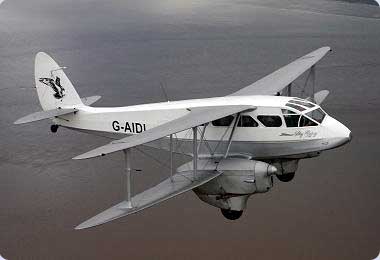
The de Haviland Dragon
The Dragon is also the plane in films by de Funès, as well as the glider C-25S, which is seen at the end of The Great Escape, the one on which I learned to paraglide.
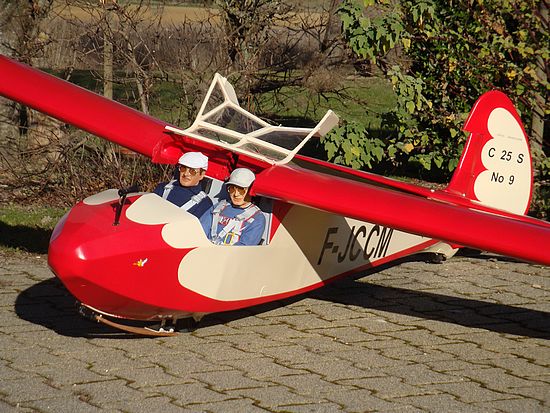
The C-25-S, a two-seater.
A detail about this machine: the C-25-S did not stall, it ... parachuted, descending slowly.
See this link for comments on the use of this glider in The Great Escape:
http://nimotozor99.free.fr/planeurs-grande--vadrouille.htm
Back to skydiving. It worked well. At that time, we jumped with "hemispherical" parachutes, surplus from the army, very worn. Sometimes there were holes in the canopies. Then our instructors marked them by drawing circles with a ballpoint pen, with the date. It sometimes happened that the hole suddenly got bigger. Then we ended up with ... a split parachute. We landed a bit faster, but not much more than the 6 m/s of a normal descent.
We did "indicator pulls." That is, we jumped with a SOA, an automatic opening strap. But we had a "commanded" opening handle, engaged in its housing, with the cable running in its sheath. After three seconds, we pulled it. This showed that in these jumps, we were not completely lost, that we kept awareness of what was happening.
In short, after fifteen jumps, my instructor said, "Okay, you're going to jump commanded." We then equipped the parachute accordingly. The Dragon took off, climbed to an altitude of 600 meters. He went over the left wing, holding on to the struts, facing the tail. And there I went, I jumped. I counted:
- One, two, three ....
and I brought my right hand to the left shoulder strap, to grab the handle.
No handle.....
I was acting like someone looking for their keys. Then I thought, before deciding to pull the ventral handle.
- Oh, this handle must be somewhere!
I put my hands behind my head and felt the metal sheath, which emerged from the parachute, and which was spinning.
Of course, it was sewn on the left shoulder strap. The parachute was old, the seam had simply come loose. I grabbed the mess with both hands and pulled. But during these three seconds of "reflection," I had flipped over and ended up on my back. I saw the parachute passing between my legs.
Fortunately, at that time, we had switched to "sheathed parachutes," called "suspension first" rather than "canopy first." What you see emerging between my legs is not the canopy of the parachute, but a long nylon sock, inside which the canopy was inserted. The six meters of suspension lines were then attached in a zigzag on a flap, using elastic. At the top, it's an extractor, a sort of frilly device containing a spring, designed for maximum wind capture. This thing comes out first, catches the wind and pulls the parachute. Then the elastic securing the suspension lines breaks. All these efforts slow down the deployment time of the parachute, and these efforts have the effect of putting the clumsy person back in the right position, head up and feet down.
In the "canister" parachutes, the "modern" parachutes (compared to these antiquities), the opening delay is achieved by a rectangle of thick nylon, which holds the suspension lines together, passing through large eyelets, and only releasing them gradually, as it descends, to position itself above the skydiver's head.
The "glider" above the skydiver.
Still on anecdotes, these ancient hemispherical parachutes had a peculiar behavior when opened in free fall, at 50 m/s (a normal speed, reached after 8 seconds of fall). When they opened, they captured a large mass of air, which they accelerated downward. All the surrounding air around the canopy was "over-accelerated," causing the canopy to almost completely close, leaving only a 50 cm diameter opening, before finally opening completely. Back to my first free fall.
On the ground, my instructor ran over.
-
What is this? Three seconds, that's not six! And you opened while on your back. That's not good at all!
-
Did you see the parachute you gave me?
-
Oh ... my god!
And there, everyone said, "This guy has a steel nerve." They overestimate me, they overvalue me. All the instructors wanted this type of person who went to get the handle above his head. And that's where it started to go wrong. I am no more skilled than anyone else. But on the next jump, they gave me 10 seconds of free fall, then 20 seconds on my third jump. A progression too fast for a beginner like me.
Imagine you just did your first flight in a light single-engine plane and then the next flight you're put in a World War II fighter, a Spitfire, then on the third jump in a jet.
At that time, we jumped "in T," and not like now, with arms and legs spread and bent. We had to keep our legs together, straight, and stretch our arms, arching as much as possible. Well, I did my best. And suddenly I started spinning, like the Austrian. Why? Probably because my two legs together were not at the same height, and that acted like a flap.
To turn, I turned. And it accelerated. I thought, but I hadn't been taught how to "pilot" this strange flying machine that was my own body. I was...