f5101 An Analytical Representation of the Boy Surface J.P. Petit and J. Souriau .
**...**Below is a reproduction of a note published in the Comptes Rendus de l'Académie des Sciences de Paris, signed by J.P. Petit and J. Souriau, from 1981.
**...**This work has a history. Until my album Topologicon, published by Belin in the series Les Aventures d'Anselme Lanturlu, appeared in 1985, representations of the Boy surface in specialized literature were rare. One could occasionally find photographs of models made either in plaster or chicken wire. Charles Pugh, from the mathematics department at the University of Berkeley, is the undisputed world expert on chicken wire. Indeed, it was with this material that he won a substantial financial prize for constructing scale models depicting Bernard Morin’s sphere eversion, which were later digitized by Nelson Max to produce a film now circulating in mathematics departments worldwide.
**...**But I find chicken wire a rather undignified material, especially for such high-level scientific subjects. Having met a sculptor named Max Sauze, I learned the technique of working with copper wire—flexible yet rigid—which Max skillfully soldered, carefully avoiding overheating it to prevent unwanted stresses in the material.
**...**My friend Jacques Boulier, alias Vasselin, was then a professor at the Beaux Arts in Aix-en-Provence. One year he offered me the chance to replace one of his professors who had gone abroad; I accepted, working part-time alongside Sauze. While I designed the objects, Max soldered them. Our students, intrigued, gathered around us and tried their best to imitate us. That year, this wing of the Aix-en-Provence Beaux Arts school had become a kind of factory producing mathematical surfaces in series.
**...**If you want to try it yourself, it’s not complicated. You need a spool of copper wire—say, 1.5 mm in diameter, at most—and a pair of wire cutters. With these tools, you can represent the two families of curves that make up any surface.
**...**The challenge lies in properly shaping these objects. To do this, it’s helpful to be able to slide the connection points where the "meridians" and "parallels" intersect. A good solution is simply to tie the two metal wires together with sewing thread. It’s tight enough to give the object stability, yet slippery enough to allow deformation and adjustment.
**...**Only when you feel the object is mathematically accurate to your satisfaction should you entrust it to someone skilled in silver soldering who knows how to join the pieces without overheating the rods—something Max did with consummate artistry.
**...**One day I brought a prototype of the Boy surface, having discovered how meridians and parallels should be arranged. Apparently, one could make the meridians resemble ellipses almost perfectly.
**...**Max carefully copied the object. Then I went to see Souriau. His son (who never had the patience to finish his physics degree) was playing with his father’s Apple II. I said to him:
-
Jérôme, would you like to have a pure mathematics publication under your name?
-
Well, why not? Who do I need to kill for that?
-
Nobody. Look at this object. Take a protractor, measure these ellipses, and try to build a semi-empirical representation of the surface.
-
We can always try. Give me...
**...**Two days later, it was done. The paper was quickly accepted by the Comptes Rendus de l'Académie des Sciences de Paris and published under our two names: J.P. Petit and J. Souriau.
**...**But since the father is Jean-Marie and the son Jérôme, all mathematicians are convinced that this was a joint work by Souriau senior and myself.
**...**The computer drawing of the surface using a small BASIC program of just a few lines greatly surprised many mathematicians, who expected something far more complex. The affair had an unpleasant aftermath. The mathematician Bernard Morin had a doctoral student, Apéry, son of Apéry senior, author of the infamous theorem stating that the sum of the cubes of integers is an irrational number. Among other things...
**...**I was unaware of this. Our progress deeply troubled Morin, especially since I naïvely assured him at the time that this method should also allow describing the four-ear surface that had made him famous—the one previously built by Pugh using chicken wire and later digitized by Max, etc.
Morin frowned:
- No, that’s impossible!
**...**We’ll see about that later. I remain convinced otherwise. But this remark was the counterpart of Archimedes’ famous retort to the Roman soldier who interrupted his thoughts—“Noli tangere circuleos meos!”
In French: “Don’t touch my circles!”
Here, it was more like: “Don’t touch my ellipses!”
**...**Later, Apéry exploited my discovery—that one could endow the Boy surface with a system of elliptical meridians—to construct the first implicit equation for the object:
f(x, y, z) = 0
**...**Morin, furious to see me appear as a disruptive figure in his own mathematical work, forced Apéry to clarify in his thesis that it was Sauze who had come up with the idea of the ellipses. Max did not contradict this, but it’s false. The proof is in my cellar: the model I brought to Max to have it properly finished.
**...**In the end, all this is rather ridiculous. This anecdote serves only to show that mathematicians are no brighter than physicists.
**...**The Polytechnician Colonna, a pioneer in computer-generated imagery, used our equations extensively without mentioning their origin. But there’s an amusing detail: if you ever see images of the Boy surface on screen, and it’s “ours,” you’ll inevitably notice three slight “folds” near its pole—a minor adjustment flaw in the equations. Jérôme, son of Souriau, had hastily made this approximation, and a final small touch with the iron near the pole would have helped. This is still easily fixable for anyone who wants to.
**...**This saga of the Boy surface is not closed. To complete the story, let’s mention one more character: Carlo Bonomi, an Italian billionaire. I met him during an expedition to the Bermuda Triangle (but that’s another story entirely). We were speeding across his breathtakingly luxurious yacht in search of a sunken pyramid mentioned by Charles Berlitz in one of his books. We didn’t find the pyramid, and nearly got eaten by the numerous sharks haunting those waters. If you have an atlas, the supposed location of this cursed “Atlantean Pyramid” is southwest of a reef called Cay Sal Balk, fifty miles south of Cuba.
**...**Between dives and caviar dinners, I proposed to Bonomi that he sponsor mass production of Boy surfaces. He liked the idea, and it led to something. Let’s say the Boy surface adorning the mathematics hall at the Palais de la Découverte in Paris was paid for by Bonomi and crafted by Sauze. The financier had envisioned an exhibition featuring objects made of solid gold wire. But the project never came to fruition. Surprised by his prolonged silence, I called his Milan office. Alas, involved in the P2 lodge scandal, he had been imprisoned, and his interest in topology suffered irreversible damage.
**...**The two-sheeted covering of a Boy surface, which represents the projective plane P² (see Topologicon), is a sphere S². Pugh constructed this covering using two layers of chicken wire—an object remarkable in every way, though I personally prefer copper wire and the meridian-parallels representation. But even in pure mathematics:
- De gustibus et coloribus non disputandum.
**...**Before presenting the note, one last anecdote. Charles Pugh had built seven models in chicken wire, earning him a significant prize, depicting the successive stages of the sphere eversion—something I’ll explain when I find five minutes to upload it to the website—and these models had been hung from the ceiling of the mathematics department cafeteria at the University of Berkeley.
**...**Mathematicians from around the world came on pilgrimage to admire this sequence in every respect admirable. But one night, the models were stolen, and no one knows what became of them—objects that were strictly unsellable. Who would accept such a transaction? Unless a wealthy amateur, part aesthete, part mathematician, had funded the theft to store them in a vaulted cellar, solely for the joy of being the only person able to behold this eighth wonder of the world, even if it was made of chicken wire.
**...**Despite his mastery of the material, Pugh lacked the courage to rebuild a new series.
**...**As we’ve already said at the beginning of this site, Werner Boy’s life remains a mystery. After inventing the surface that bears his name, he literally vanished after leaving university. Despite Hilbert’s efforts, his trace could not be found, and even his burial place remains unknown.
**...**Back to mathematics. The note below is relatively easy to read. From formulas 1 to 8, any alert high school student can generate beautiful images and verify that the cross-sections match Figure 5.
C.R. Acad. Sci. Paris, t. 293 (5 October 1981) Série I - 269
GEOMETRY. - An Analytical Representation of the Boy Surface. Note by Jean-Pierre Petit and Jérôme Souriau, presented by André Lichnérowicz.
An analytical representation of the Boy surface is presented, allowing its drawing.
1. INTRODUCTION.
**...**The surface invented in 1901 by mathematician Werner Boy, a student of Hilbert, is well known among mathematicians. It can serve as a central stage in the eversion of the sphere ([1] and [2]).
**...**In 1979 (J.P.P.), I built a metal wire model highlighting the positions that the meridians of the surface should occupy. A second project, carried out in 1980 with sculptor Max Sauze, allowed reconstructing a second model where the curves lay in planes and appeared quite close to ellipses. From such a model, it seemed possible to construct an analytical representation of a surface with the topology of the Boy surface, whose meridians were ellipses passing through a single pole.
2. HOW TO GENERATE THE BOY SURFACE USING ELLIPSES.
**...**Let us place the pole at the origin of coordinates. At this point, the surface will be tangent to the (XOY) plane. It will therefore have the OZ axis as a threefold symmetry axis (see Figure 1). The meridional curves are thus ellipses lying in planes Pm. Let OX₁ be the trace in the XOY plane of a plane Pm. Let m be the angle (OX, OX₁). In this plane Pm, let us define a second axis OZ₁ perpendicular to OX₁. Let a be the angle (OZ, OZ₁).
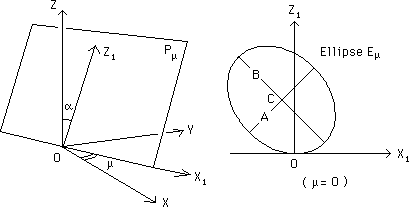
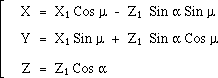
Fig. 1 and Fig. 2
**...**The first parameter of this analytical representation will be the angle m. We will consider angle a as a function of m (defined later). In the plane Pm, we now draw an ellipse tangent at O to OX₁ (see Figure 2). We take the axes of this ellipse parallel to the bisectors of X₁OZ₁. Let A(m) and B(m) be the values of the axes of this ellipse. This ellipse Em is generated by a second free parameter q.
**...**In summary, we obtain the coordinates X(m,q), Y(m,q), Z(m,q) of a point on the surface.
**...**In this semi-empirical approach, measurements taken by (J.S.) on the model enabled approximations of the functions a(m), A(m), and B(m). The surface was then plotted using an "Apple-II" computer, and constant-Z cross-sections were obtained. Examining these sections allowed confirming the topological identity with the Boy surface. This could only be achieved through numerical experimentation (J.S.), which eliminated spurious singularities (the appearance of cusp point pairs).
**...**We retained:
(1) A(m) = 10 + 1.41 sin(6m - π/3) + 1.98 sin(3m - π/6)
(2) B(m) = 10 + 1.41 sin(6m - π/3) - 1.98 sin(3m - π/6)
(3)
**...**In the X₁OZ₁ coordinate system, the coordinates of the center of ellipse Em are:
(4)

(5)
**...**In the same coordinate system, the coordinates of a point on the ellipse are:
(6)

(7)
and the coordinates x, y, z are given by:
(8)


