f5102
3. ANALYSIS OF THE RESULTS.
... In Figure 3, the periodic functions A(m) and B(m) are shown. B is simply phase-shifted relative to A.
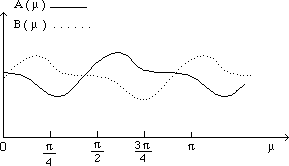
Figure 3.
.
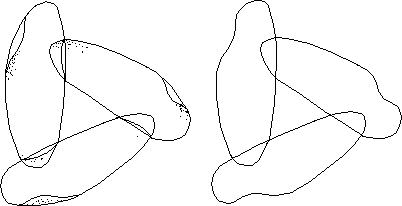
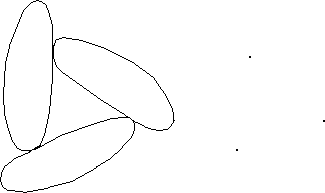
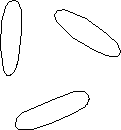
...Using an "Apple-II" microcomputer, we plotted a view of Boy's surface showing the elliptic meridians intersecting the single pole.
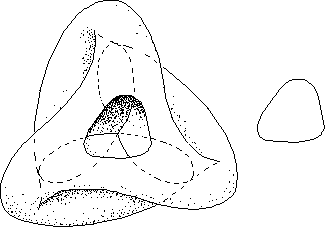
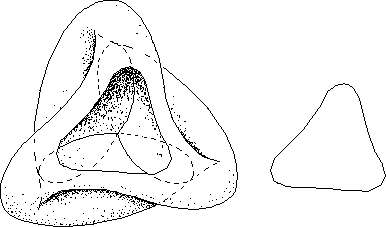
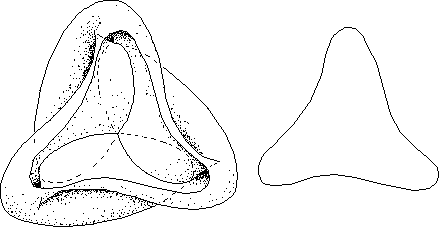
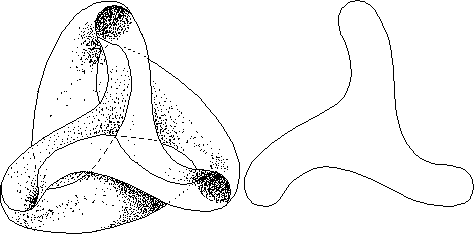
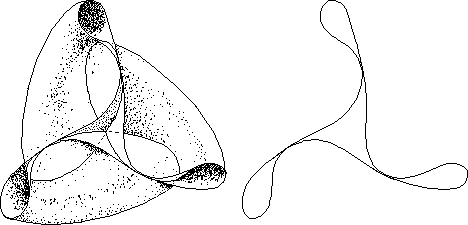
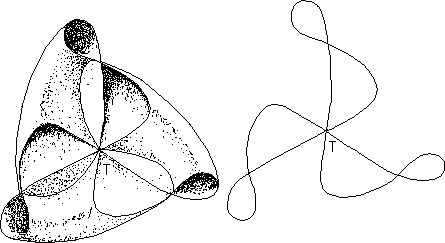
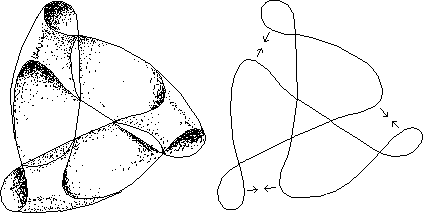
...Now consider the cross-sections Z = constant. Their equations follow from that of the surface. They are drawn in Figures (5a) to (c). All figures exhibit ternary symmetry, as can be seen. The first three cross-sections display points of inflection. These slight irregularities are the traces of cusp singularities appearing in this region before coefficient adjustment. In Figure (5j), three sealed points are found. The two circles embedded in this figure (5j) have neighborhoods that are Möbius bands, twisted three times half a turn relative to the horizontal plane z = constant.
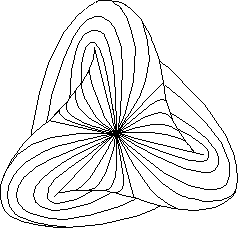
Figure 4. Meridional lines (Em) of Boy's surface plotted using an "Apple II".
...Below, we present improved illustrations compared to those accompanying the original note in the Comptes Rendus de l'Académie des Sciences de Paris:
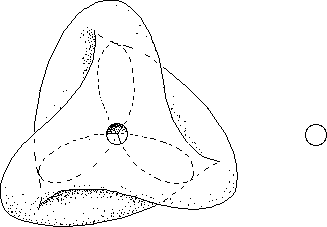
Fig.5a -------------------------------------
Fig.5b ------------------------
Fig. 5c -------------------------
Fig.5d ----------------------- .
Fig.5e
. Fig.5f -------------------------
. Fig.5g -------------------------
. Fig.5h ---------------------- . Fig.5i -------------------
. Fig.5j -------------------------
. Fig.5k ------------------------
Fig.5 l
Figures 5a to 5l
...Cross-section (5g) passes through the triple point of the surface. Cross-sections (5f), (5j), and (5m) correspond to limiting cases where changes occur in the way the curve arcs are joined.
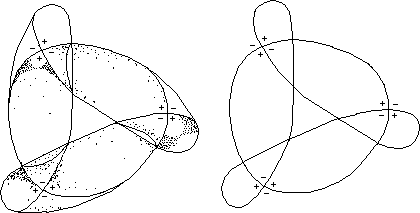
...In Figure (5i), we have indicated the sealed points by:

References.
[1] A. Phillips, Turning a Sphere Inside Out, Scientific American 1966.
[2] B. Morin, Comptes Rendus, series B.
[3] B. Morin & J.P. Petit: The eversion of the sphere. Pour la Science (French edition of Scientific American), January 1979.