Let us return to this class of homotopies of immersions of the torus in R³. We can easily connect the two objects shown here using a "C" transformation. Take a torus and "self-penetrate" it somewhere, creating a double point line that forms a circle: 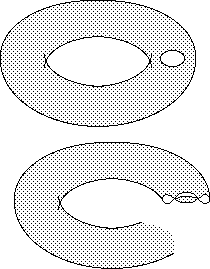
I've used "two colors": gray for the outside of the torus, white for the inside. This self-penetration (which leads to one of the infinite possible immersions of the "standard torus") thus reveals a white portion of the surface.
Let us now observe this object from a point located on the axis of the torus:
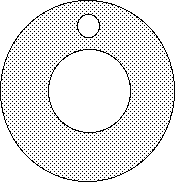
At the top, the inner (white) portion of the torus revealed by the self-penetration. We can then apply a "C transformation" and create two cusp points: 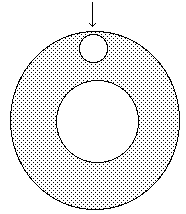
At the point indicated by the arrow, we "pinch" a passage. This operation creates two cusp points, C1 and C2:
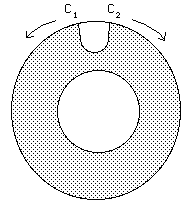
which we can then migrate as follows:
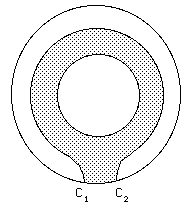
All that remains is to perform a C⁻¹ transformation (coalescence of two cusp points):
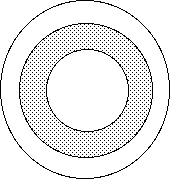
We obtain the object: 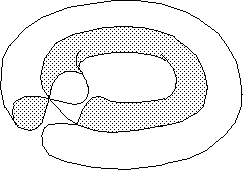
This immersion of the torus is homotopic to the standard torus.
We see that this operation "C" and its inverse "C⁻¹"—which extend the universe of immersions to that of surface foldings in R³—allow us to achieve interesting results. We can construct all the foldings of classical surfaces (sphere, projective plane, torus, and Klein bottle). How many such classes exist?
We have seen that the sphere and the projective plane belong to the same class (as do the right and left Boy surfaces). How many classes of torus foldings exist? I believe, unless I am mistaken, that this problem is currently unresolved. Can one pass from one immersion class of the torus to another using C operations? Intuitively, I would tend to answer no, but this is merely a conjecture.
A construction cannot prove impossibility, only illustrate possibility. If someone finds constructions allowing transitions between classes, the theorem will be effectively proven. But the fact that no such constructions have been found does not in itself constitute a proof. The absence of proof is not proof of absence. Saying there are four classes of torus foldings in R³, or that there is only one, are both conjectures, mere beliefs, at this stage.
It so happens that Smale proved the sphere eversion was possible before Phillips provided the first explicit construction. It could just as well have been the other way around. But who would have had the idea to undertake such a project, going completely against our geometric intuition?
The C transformation allows transforming a sphere into a cross-cap, then into a Boy surface, via Steiner's Roman surface. See the article. Can it transform a torus into a Klein bottle? Logically, yes—but I do not have a ready answer to this question.
Incidentally, why speak of the "projective plane"? The shown objects (one-sided surfaces) are finite. Souriau's answer is:
- On a plane, there is "the line at infinity." We simply glue the plane along this line.
Which, as expected, is a closed curve.
In the Topologicon, there is a small animated drawing, a "foliation," showing how a Möbius strip with three half-twists can transform into a Boy surface. The final image shows this surface minus a disk. It suffices to add this disk to complete the surface. A Boy surface is therefore a Möbius strip plus a disk. Exercise: using the tools of the Topologicon, recalculate its Euler-Poincaré characteristic (which equals 1).
Conversely, one could start with the disk and let it grow, self-penetrating, until it glues back onto the three-half-twist Möbius strip—a different construction.
I have recovered these drawings from my 55-page communication presented at the Lacanian psychoanalysis colloquium in Aix-en-Provence (April 4–5, 1987), dedicated to "Perversion," which appears in the proceedings edited by the organizers. I will use this text in a future document titled "JPP chez Lacan."
First image: the disk in the process of contorting.
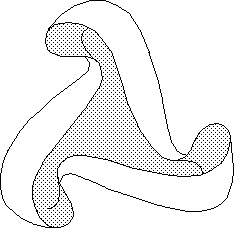
Next, the initial stage of creating the self-intersection set:
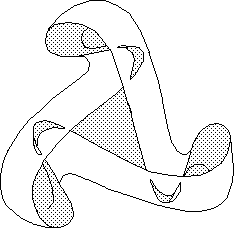
Next figure: appearance of the triple point:
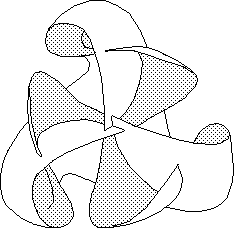
I stop adding shading, since the surface is about to become one-sided.
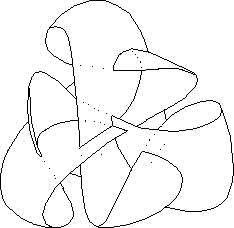
Next, the surface is ready to glue back onto itself along its boundary.
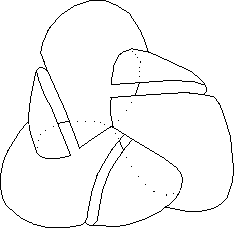
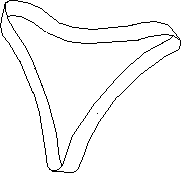
Here, we have depicted the three-half-twist Möbius strip, completing the surface:
Next figure: the same Möbius strip.
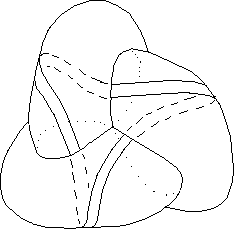
Then, the complete Boy surface. Compared to the images shown in the Topologicon, one cannot say "we see it from below"—a Boy surface has neither a head nor a tail. Let us say that as it appears here, we see its triple point.
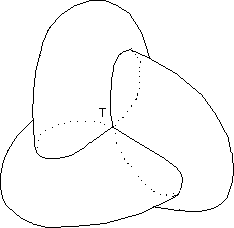
Next, its self-intersection set: 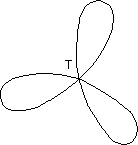
Thus, you have just witnessed the plane folding back onto its "line at infinity." Hence its name: "projective plane," rather strange at first glance. Perhaps this is the first time people have seen infinity so closely.
These images were composed over twenty years ago, and this website or CD finally offers a chance to display them. The reader may wonder why they did not appear in "Pour la Science" or "La Recherche." I did send articles to these journals, but the editors did not find the topic interesting.
I hope that with this "geometric toolkit," you will eagerly set out to invent countless new surfaces. Here is one imagined by Madame Ivars. Take a sphere and push in two segments of equal length in diametrically opposite directions until they touch, imagining them welded onto two rods, like this:
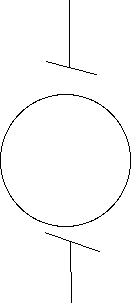
When the segments meet, a "surgery" occurs. There is a sheet crossing along the segment, and two conical points at each end. Below is this surface in cross-section.
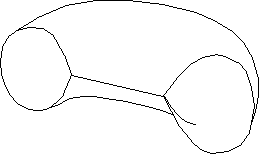
The same, in perspective:
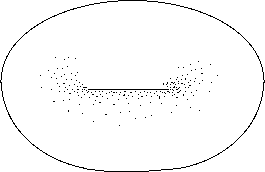
At the radius tool...