Oh Michel, my brother
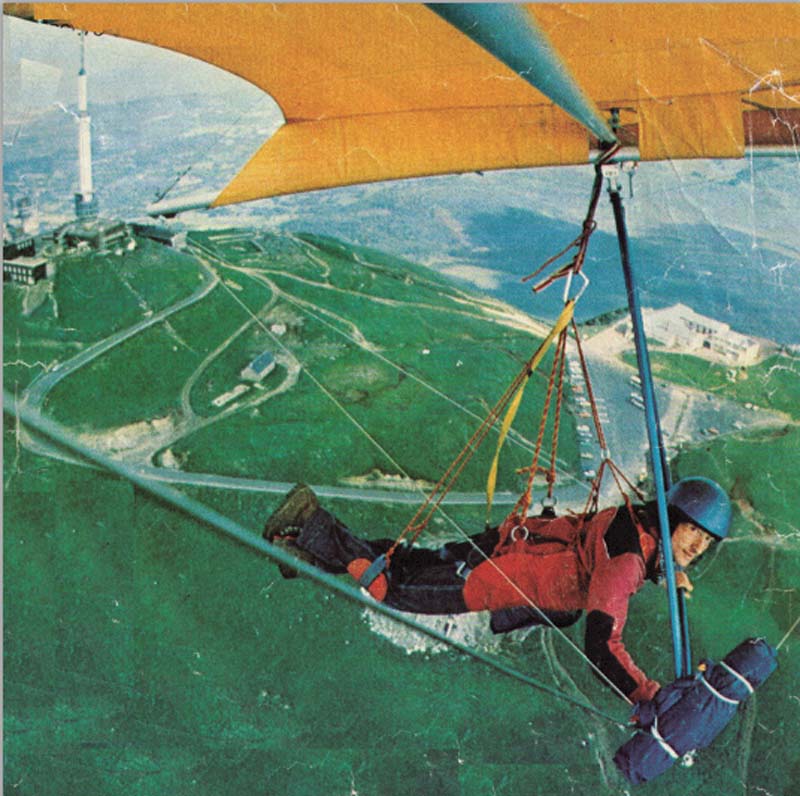
**In memory of my friend Michel Katzman, who died while flying a hang glider in 1989.
In 1974, Michel introduced me to hang gliding in Chamonix. After seeing a guy take off from the Champs-Élysées, I went to Chamonix to make my first solo flight on a Danis glider, where Lachenal’s son trained clients by putting them on the glider and having them take off and land on skis. Excited, I bought a “Danis” glider—a Rogallo wing with a fixed crossbar, a 90-degree sweepback, and a sink rate of 2.5 m/s. It looked almost like an ironing board. All winter long I took off on snow at various ski resorts. Then, when the snow melted, I didn’t know what to do. So I fitted old skis with wheels from strollers. Then I went to Chamonix, where I met Katzman; he burst out laughing upon seeing my setup. And I asked:
– But how do you take off?
– By running! I’ll show you.
I quickly got used to this practice and made my first “big flight” in Cluses, then in Annecy. For years I lived this “flying bohemian” life with Michel and Odile.
As a geology student, Michel earned money in winter by taking clients to Méribel on the first two-seater hang gliders. Later, together with his partner Odile Monrozier, they traveled all over France and Switzerland. I followed them with my 2CV and my glider. One year, I even joined them in California. Unfortunately, Michel didn’t believe in the effectiveness of parachutes. He died in Méribel after a “strut breakage” caused by fatigue. It was a cheap little part that joins the lateral cables to the leading edge tubes. Too thin a piece. It’s the only case of such a failure in hang gliding history. If it had been half a millimeter thicker, it would never have happened. He and his client crashed onto the roof of a hotel. A witness heard Michel shout to his client, “Close your eyes, we’re done for!” Afterwards, I tried to improve safety in hang gliding. One of my Supaéro classmates, Laroze, became head of the structures department at the school, which moved to Toulouse. Having suffered a hang gliding accident himself, he was motivated by safety issues. So we held a meeting in Toulouse with a representative from the hang gliding federation. The goal wasn’t to restrict the sport but to help manufacturers avoid mistakes due to ignorance, especially regarding material fatigue (the cause of Michel’s death).
Since the DGAC (General Directorate of Civil Aviation) refused to regulate this aerial sport, it issued endless “exemptions.” Consequently, fatal accidents kept occurring. Some said, “When there are enough deaths, they’ll stop doing this stupid sport.” Incompetent air police officers wrote sloppy accident reports, always ending with “accident, cause undetermined.” I personally witnessed such behavior during a fatal accident in Laragne, where both pilot and passenger died, leaving behind an orphaned girl waiting for her mother at the “Otto Lilienthal Center” (run by a man named Manucci; the center no longer exists). The accident could have been avoided if the motorized hang glider had been better designed. The sail, worn out and damaged by UV rays, tore in mid-air. Its trailing edge had no reinforcement—just a simple hem. Had there been a nylon strip underneath, the poor-quality sail would still have torn but the craft would have remained controllable. The pilot activated his pyrotechnic emergency parachute, but the shock absorber, based on rubber (which ages and breaks), snapped. The rocket continued its path without deploying the parachute. After the air police, who merely photographed the bodies, I found the rocket and reconstructed the tragedy. Then the DGAC representative arrived, annoyed by my presence.
In Toulouse, the federation rep realized that Laroze and I wanted only to combat this wave of fatal accidents. Thus, manufacturers agreed to provide us with equipment. At the school, Laroze would use all its top-of-the-line, expensive facilities to test assembly strength, including fatigue resistance—a concept manufacturers barely understood (actually, not at all!). As practical exercises, students would test the gear. At the heart of this effort, we needed a PhD candidate, preferably from Supaéro or ENICA, who practiced hang gliding. His thesis would cover all aspects of hang gliding. Two supervisors: Laroze for structural issues, providing the “KATIA” software; me for aerodynamics and flight mechanics. After two years, the candidate would get a job and visit manufacturers and centers to offer advice, detecting flaws before they led to fatal accidents (which had been how hang gliding “advanced” until then: on corpses). We even planned to develop manufacturing and testing standards, plus calculation programs for free PCs manufacturers could use. The federation even offered to fund this “thesis grant.”
Before going to Toulouse, I contacted someone I’d met at Supaéro, Daniel Tennebaum, a military engineer who’d become DGAC director. Upon returning from Toulouse, I wrote to him: “We’ve got a solution to stop the carnage. Now we just need funds for the grant.”
He... ignored me. Eventually I wrote, “Daniel, how many young people must die before you act?” The reason: my solution was too simple, too cheap, and above all “outside the system”—which meant giving good salaries to buddies, creating an administration and hierarchy, preferably staffed by polytechnicians like him. As for the rest, I recalled what the DGAC investigator told me in Laragne: “When these people get tired of dying, they’ll quit.” My former classmate had become a “politician” in industry and aviation.
I have no idea how this sport has evolved today. I know fatal accidents keep happening in hang gliding, paragliding, and motorized wings. Has it gotten better now? I hope so...
Arpeggio chords
Chorus:
Oh Michel, my brother
lam rém
Talk to me, talk to me, say
mi7 lam
Oh Michel, my brother
lam rém
Michel, my friend
si7° mi7
He walks beneath the clouds
lam
When the sun is at noon
rém
And thus he travels
mi7
With his funny umbrella
lam
He greets the hawks as he passes
lam
And birds are his friends
rém
Down below, wheat fields and meadows
mi7
Will soon serve as his bed
lam
And when suddenly the wind carries him away
He flies off like a straw
He rises so high into the sky
That many times he got lost
But like a brave captain
He steers his silk vessel
He climbs mountains,
Lakes, fields and woods
The sun beats down on the plain
And I’m alone on my rock
With my memories and my sorrow
Without you, I’ll fly away
I’ll search for you among the clouds
My brother I loved so much
Farewell, our lovely adventures
Beyond mountains and meadows
Are you in the stars now
Since you left us
May your ship unfurl its sails
Across the Milky Way
At night I gaze at the dark sky
Days pass, years go by
Hoping to see you
Like a beautiful shining eagle