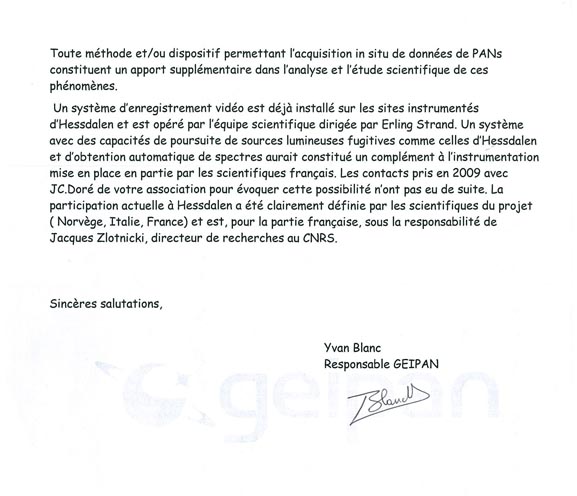
Mr. Yvan Blanc's response, head of Geipan,
to the invitation to the Strasbourg conference
Michel Padrines, organizer of the conference, had sent Mr. Yvan Blanc three messages inviting him to participate in this event, without receiving a reply. In desperation, I eventually wrote to him myself, as president of the UFO-science association. Here is my letter dated September 30, just days before the event began.
Jean-Pierre Petit
Former Research Director at CNRS
President of the UFO-science Association
17300 Rochefort 31401
Mr. Yvan Blanc
DCT/DA/GEIPAN
Centre National d'Études Spatiales
8 Blvd. F. Buisson 18 av. Edouard Belin,
TOULOUSE Cedex 9
Rochefort, September 30, 2010
Sir,
Mr. Michel Padrines is organizing an international congress in Strasbourg on October 16 and 17. He told me he had tried contacting you three times without success.
Given that the conference theme is "Astronomy-Space-OVNI Case," we thought it logical that you would participate, and thus I was somewhat surprised by your lack of response to his invitations.
Mr. Nicollier, having received assurances that this conference would "remain on scientific tracks" and that any sectarian or delusional deviation would be avoided, has confirmed his attendance. As you can see in the attached text (Annex), the presentations will focus on methodology, trace analysis, thermal and biological data, spectral acquisition, and vehicle modeling (MHD).
This last approach has been the subject of numerous publications in peer-reviewed journals and international specialized conferences, not in "ufological journals," and also of a doctoral thesis.
Most recent example: The UFO-science team will present recent experimental results on the magnetic field gradient inversion-induced wall confinement in a disc-shaped MHD aircraft at the international conference in Korea on October 10 and 13, 2010, which will gather over a thousand participants.
At this conference, the experimental research program of UFO-science, funded by members, will be discussed. This includes the construction in 2011 of a hypersonic wind tunnel where we will attempt to eliminate shock waves and turbulence using MHD—closely linking this research theme to the OVNI subject.
Given your position, it is hard to imagine how you could be absent from such an event, and it is at Mr. Padrines’ request that I reiterate his invitation.
Following an idea already old—implemented by Americans in the 1950s—we have initiated, over the past two years, a "hunt for an OVNI spectrum." To this end, we distributed three thousand diffraction gratings (500 lines per millimeter) in the form of simple slides. Since the cost of such an accessory was very low (0.1 euro), we sent them to anyone who requested them. The map below shows the national scale of this first operation.
(Planetary extension:
http://www.ufo-science.com/wpf/?page_id=111
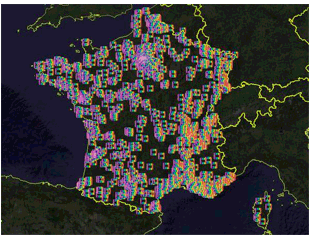 )
)
We then studied a more convenient device: an adhesive grating suitable for attachment to a smartphone camera. We currently have a batch of one thousand units being manufactured in China.
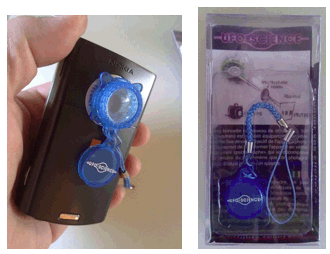
Adhesive grating, manufactured in China (UFOscience)
Including manufacturing, packaging, and shipping, the cost of this device should not exceed a few euros. The grating remains at 500 lines per millimeter. We will make these devices available to participants of the Strasbourg conference at a price that allows us to recover our costs.
But the purpose of this operation is not commercial. This device has not been patented or registered as a model. The goal is to place these devices in the hands of as many people as possible, so that we may have a chance in the near future to capture an actual OVNI spectrum.
You therefore have full latitude to collaborate in this effort, if you wish, by ordering these devices directly from China at manufacturing cost and distributing them through your preferred channel.
We have enclosed one of these Chinese-made diffraction gratings with this letter.
We have remained in indirect contact, through Mr. Christian Nazet, with the team of Professor Erling P. Strand working at the Hessdalen site. As you know, a phenomenon manifests there, usually appearing as fleeting, mobile glows. We have developed a tracking system for such sources, which we call UFOcatch, and which is nearing operational status thanks to the work of Mr. Jean-Christophe Doré.
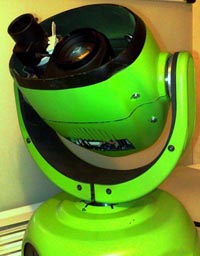
This system, based on a surveillance camera with a fish-eye lens, automatically and rapidly directs a mobile unit ("lyre") toward any moving source, after filtering (e.g., to prevent UFOcatch from automatically tracking ordinary meteors). The device then performs an automatic zoom, framing the object completely to eliminate nearby light sources that would degrade the signal-to-noise ratio—a factor we consider essential.
A spectrum is then automatically captured and analyzed.
Two UFOcatch units pointing at the same source allow recording of the 3D trajectory and speed.
This device will be presented at the Strasbourg conference, along with the test bench that enabled the experimental results to be presented in Korea.
Following Mr. Nazet’s suggestion—whom Mr. Padrines, the organizer, has authorized to provide contact details—we contacted Erling P. Strand, head of the Hessdalen research team, hoping he might attend the conference, despite the late invitation.
Otherwise, again following Mr. Nazet’s suggestion, we plan to visit him after the conference to discuss the possibilities offered by the UFOcatch acquisition system. It is expected that he will accompany us, with UFO-science covering his travel and accommodation expenses.
We hope this letter will receive a favorable response.
Sincerely yours,
Jean-Pierre Petit
Former Research Director at CNRS
President of the UFO-science Association
The spirit of this conference
-
For over fifty years, the study of the OVNI phenomenon has remained confined within the boundaries of an ill-defined activity called "ufology." Meanwhile, the phenomenon has never lost its scope and continues to display its many bewildering facets worldwide. This confinement in such a kind of ghetto can be explained in various ways.
-
Some aspects of the phenomenon remain extremely puzzling and may, for example, be classified among so-called "paranormal" phenomena, toward which my scientific community exhibits legendary allergy.
-
The vast majority of materials available to scientists, with very rare exceptions, consist of witness accounts—always questionable—and sketches, photographs, and videos.
-
Supposedly scientific approaches are often tainted with highly speculative elements, leading many scientists to declare that the OVNI phenomenon does not constitute a viable subject of study, and that no concrete object—something one could "place on a slide and cover slip"—is available upon which laboratories could base concrete research programs.
-
The methodology employed by certain groups, even when they enjoy an aura of official status, remains questionable, very rudimentary, or even marred by fatal methodological flaws.
-
Finally, within a broad community of people, the OVNI dossier and the questions it raises trigger psycho-socio-immunological reactions, referred to by others as "cognitive dissonance," which manifest as a total, irrational rejection—comparable in every way to an allergic reaction.
In conclusion, for over fifty years:
-
The entire scientific community has turned away from the OVNI dossier, considering its study a waste of time and money. As a result, this approach has effectively been taken over by non-scientists who call themselves "ufologists"—a term referring to no well-defined discipline, and which essentially amounts to collecting testimonies and photographic or video documents. That said, these people have always been the first, the only ones, and continue to be the only ones who, with their meager means (a notebook, a tape measure, a camera, a compass), attempt to gather information, however poor in content, essentially testimonial in nature—while far more sophisticated, relatively inexpensive tools could have been made available to them for a long time.
-
Moreover, within their political and military spheres, certain technologically advanced countries appear to have held information for decades that they avoid releasing, under the pretext of not wanting to cause disorder or panic among populations, especially since such information might support the idea that our planet has been visited or intruded upon by extraterrestrials for more than half a century, and probably much earlier. It is also argued that releasing such information, documents, or evidence could completely destabilize terrestrial structures—political, economic, religious, and scientific.
-
Conventional science, confronted with this idea, immediately erects the barrier of the physical impossibility of traveling faster than light. Yet, if we look back at the history of science, it is evident that science has always undergone profound transformations—the impossible of yesterday suddenly becoming the possible of today. The examples are countless. Every scientist worthy of the name must consider that today’s impossibility might, through a new paradigm shift, become tomorrow’s possibility.
-
Finally, the OVNI subject is the target of powerful disinformation campaigns, whose result is to discredit the dossier. With very rare exceptions, cinematic productions or literary works serve to relegate the phenomenon to the realm of a new folklore. The term "science fiction" was created precisely for this purpose (while today’s science is... yesterday’s science fiction). Certain small groups form around mentors who adopt guru-like attitudes. Sects have emerged, such as the Raëlians. We must not exclude the possibility that intelligence services either facilitated the emergence of such movements or created them outright, in order to mislead the public, easily exploiting either millennial fears or messianic expectations—or both simultaneously. The most commonly used technique is amplifying disinformation: blending real facts with fantastical elements designed to discredit specific aspects of the dossier.
It is also not ruled out that the OVNI phenomenon itself may be conducting its own disinformation operations, in order to maintain a protective skepticism among populations and prevent a sudden, overwhelming awareness of extraterrestrial presence on Earth—potentially triggering upheavals of unimaginable, unpredictable, paradigm-shifting scale across religious, political, social, and economic domains.
Throughout history, Earth has witnessed numerous cases of "ethnocide" following a sudden contact between two civilizations too far apart in technological-scientific and, more generally, cultural terms. Subtle ethnocides are currently underway in many regions of the world, destroying forever cultural and artistic traces, entire cultural and linguistic systems, fragments of history, and even valuable medical and pharmacological knowledge among populations previously untouched by "the modern world."
In the recent years, France and England have made public archives, admittedly devoid of scientifically or technically exploitable information. As always, these are merely testimonial materials. Recently, the public was informed that a prominent statesman, Winston Churchill, had formally prohibited the dissemination of the crew’s testimony from a bomber that, during World War II, had made a close encounter with an OVNI—an object of metallic appearance, whose performance was incompatible with the technology of the time. The stated reason from the Prime Minister was to avoid alarming the British population, already anxious due to threats of German invasion.
The way French media reported this news is significant of the complete discredit afflicting the OVNI dossier in French press circles. On TF1, the journalist began his report by saying:
- We knew the statesman, the war leader. But we didn’t know that Winston Churchill was also interested in science fiction.
What we must consider is that such a presentation reflects no deliberate, coordinated policy, but rather the journalist’s own ingrained formatting, shaped over years, which would prevent any other form of presenting such news.
By organizing, on October 16 and 17, 2010, an international conference in Strasbourg on the theme
Astronomy - Space - OVNI Phenomenon
I wished to attempt a review of the activities carried out by certain scientists related to the OVNI phenomenon.
-
The recent discovery of exoplanets—now numbering five hundred and growing exponentially—will be discussed.
-
Professor Chandra Wicramasinghe, Director of the Cardiff Centre for Astrobiology and exobiologist, will report on the possibility of organized, intelligent life in the universe, where we estimate the number of planets capable of harboring life at 100 billion billion (a million in our own galaxy, the Milky Way).
-
Nick Pope, former Director of the UK Ministry of Defence’s UFO Office, will speak on "The UK Government’s UFO Files."
-
Jean-Charles Duboc, Jack Krine, Daniel Michau, experienced civilian and military professional pilots, will testify about their own encounters with the OVNI phenomenon.
-
Stanton Friedman, from Canada, Nuclear Physicist, will deliver a lecture titled "Flying Saucers and Sciences."
-
Claude Nicollier, astronaut, will speak about space flights under NASA’s leadership, particularly the Hubble Space Telescope rescue mission, in which he actively participated as part of the Atlantis, Discovery, Columbia, and Endeavour mission teams.
-
Jesse Marcel Jr., U.S. Army Colonel, Chief Medical Officer of Montana, son of Major Marcel, one of the key figures in the Roswell incident, will present his book: "The Legacy of Roswell."
-
Jean-Jacques Vélasco, former Director of SEPRA ("Service d'Expertise des Phénomènes de Rentrées Atmosphériques"), will present his conclusions after thirty years of research and reflection on the OVNI subject.
-
Jean-Pierre Petit, former Research Director at CNRS, will demonstrate, based on his publications since 1975, that observing objects capable of supersonic or even hypersonic flight in dense air is not incompatible with their material nature, thanks to what is known as MHD. He will report on three presentations delivered at the 2008 MHD International Conference in Vilnius, at the Imperial College cosmology conference the same year, at the AIAA conference in Bremen in 2009, and will be able to report on the most recent presentation, made just days earlier, at the international MHD conference in Jeju (Korea), on experimental MHD work conducted in collaboration with Jean-Christophe Doré, within a program studying disc-shaped MHD aircraft—otherwise known as MHD flying saucers. He will also, during a six-hour session dedicated to presenting the work of the group he leads, UFO-science, discuss the current crisis in physics, astrophysics, and contemporary cosmology, as well as the emergence of new perspectives suggesting an imminent paradigm shift.
-
Jean-Christophe Doré will present the automatic OVNI tracking station UFOcatch, which he designed, built, and will demonstrate live in the hall. He will explain how a network of such stations monitoring the sky could detect the presence of any unusual object, record its trajectory parameters, and precisely locate its potential ground contact point. (This system could also be used for detecting meteorites or satellite debris.) UFOcatch, using its fish-eye lens to scan the entire sky, is designed to automatically focus on any detected object, perform an automatic zoom, and record its spectrum. Indeed, any detection of a characteristic spectral line in an OVNI spectrum—indicating a substance not present in Earth’s atmosphere—would allow ruling out a meteorological phenomenon. The Strasbourg conference will be an opportunity to present and sell, at a unit price of ten euros, one thousand adhesive diffraction gratings, suitable for immediate attachment to smartphone lenses, a device also designed by J.C. Doré and currently being manufactured in China through Ms. Qin Jie.
-
Mathieu Ader, also a member of the UFO-science team, will discuss various systems for collecting physical and biological data at an OVNI landing site: laser fluorescence, analysis of plant pigments. The large-scale distribution program of diffraction grating slides will also be addressed. To date, UFO-Science has already circulated 3,000 of these units among the general public across more than 17 countries.
-
Xavier Lafont, from UFO-science, will demonstrate live the persistence of thermal traces—this technique being usable to locate a potential ground contact point of an OVNI, whose trajectory was previously detected and recorded by a network of UFOcatch stations.
-
Christel Seval (UFO-science) will discuss the psycho-sociological aspects related to the OVNI phenomenon, previously presented in her book Contact and Impact.
-
Malcolm Robinson ("The Best OVNI Observations in Scotland"), Vicence Puletto ("Is Human Historical Heritage the Launchpad for a Leap into the Future?"), Antonio de Comite ("OVNI Disclosure of the Third Millennium"), who have contributed to the study of the OVNI dossier, will complete these presentations.
-
Hervé Laurent will close the conference by discussing the impact of the phenomenon on religious beliefs.
The goal of this congress is not to turn it into a forum where everyone expresses nothing more than opinions. It is also impossible, within just two days, to address all facets of the OVNI phenomenon, none of which can be denied.
We will simply aim to confine presentations to specific domains where scientists have carried out concrete actions, producing tangible results, leading to publications in peer-reviewed journals (not in simple ufological journals) and communications at high-level conferences (not in ufology conferences). In short, we will attempt to build a bridge between the OVNI phenomenon and contemporary, proven science.
The analytical methods presented will also remain firmly rooted in current scientific knowledge, purely for pragmatic reasons. However, this should not prevent participants, outside sessions, from establishing contacts and engaging in exchanges on their chosen terrain.
We hope this conference will also be an opportunity to establish partnerships, particularly for the international development of systems currently limited to prototype stages.
Michel Padrines
As of October 11, 2011, Mr. Yvan Blanc responded as follows:
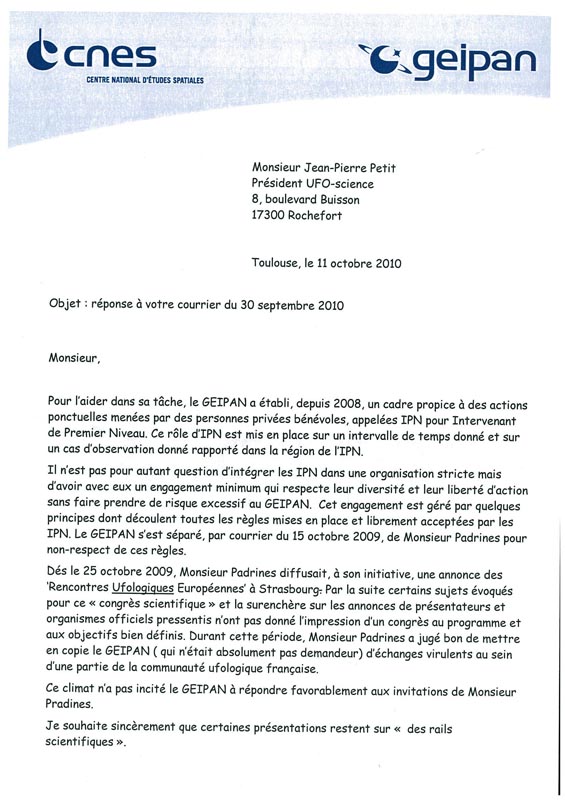
Zlozinski is a member of the Geipan steering committee. The composition can be accessed on the website:
http://rr0.org/org/eu/fr/cnes/geipan/COPEIPAN.html
LIST OF MEMBERS OF THE GEIPAN STEERING COMMITTEE AS OF DECEMBER 31, 2007
Y. SILLARD
Chair
L. BARRUE
DGGN (National Gendarmerie)
B. RIVIERE
DGPN
(National Police)
F. SCHROTTENLOHER
(Air Force General Staff)
T. ORTEGA
CNOA (National Council of Architects)
F. ERYES
DGA
(Military Research)
J. BEQUIGNON
(Civil Security)
R. ROSSO
DGAC (Civil Aviation)
G. LE BARS
(Meteo-France)
I. de LAMBERTERIE
CNRS (Specialty: Law)
J. ZLOTNICKI
CNRS (Specialty: "MHD-Tectonics")
P. BERNAUD
(Central School)
D. ASSEMAT
(CNES)
P. TREFOURET
(CNES)
J. ARNOULD
(CNES)
Zlotnicki’s specialty, mentioned in the letter, is accessible on his page:
http://wwwobs.univ-bpclermont.fr/lmv/pperm/zlotnicki_j/index.php
Where it reads:
"Electromagnetic phenomena associated with volcanic and seismic risks. Study of natural hazards. Study of geological structures using electromagnetic methods."
We asked Mr. Padrines to invite a representative of the Norwegian Hessdalen team. Mr. Padrines and I had agreed that travel and accommodation costs would be shared between the conference organizing committee and UFO-science. I personally wrote to Professor Erling Strand, who replied he could not attend at that date, but his collaborator Bjorn Hauge, author of an article presenting his analysis of a spectrum taken at the site, replied he could come and that a presentation of UFOcatch interested him.
Unfortunately, the day before the conference, Mr. B. Hauge informed Mr. Padrines that he had fallen ill and could not travel to Strasbourg.
Return