Untitled Document
December 30, 2009
I sold the Boy surface I had created
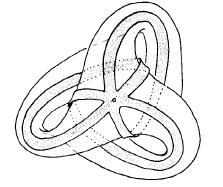
There it is: this one and a half meter wide object left this morning for Belgium, bought by a doctor, Pierre, who is also a loyal reader of Lanturlu's comics and already knew the object from reading the album Topologicon, freely downloadable on the Savoir sans Frontières website at:
****http://www.savoir-sans-frontieres.com/JPP/telechargeables/Francais/topologicon.htm
Topologicon is mentioned on the Wikipedia page, but the link does not lead to the download page of the Savoir sans Frontières site, which is quite unfortunate. Someone could perhaps add this link, but I personally would not be able to do it, having been "banned for life" from Wikipedia in October 2006 (for having revealed the identity of a contributor, an ex-student of the École Normale Supérieure, who, thanks to his doctorate in theoretical physics on superstrings, was able to get a position in a bank).
This object was exhibited for twenty-five years in the "salle pi" of the Palais de la Découverte in Paris. I recovered it a few years ago when the Palais administration wanted to install a small wooden amphitheater in that room. I preferred to recover it before it was crushed, stored in some warehouse, as "consumable science".
When an exhibition on the different theories about the construction of the pyramids was held at the Palais, the workshops made a quite nice 50 cm by 50 cm model showing the corner pieces of my stone ramp. I wanted to recover the object, but to date it has been lost. Unless, as a "consumable scientific" object, it ended up in a trash can. Perhaps a reader could inform me?
When visiting the Cité des Sciences, one is struck by the invasion of the virtual, plasma screens showing this or that. So much so that one is tempted to think: "Why go to these places, when I can access all this at home via the Internet?"
Virtual worlds, consumable sciences, do you have a soul?
It's in the air.
What is the importance of the Boy surface in mathematics? Among the closed surfaces of two dimensions, free of singular points, there are only four:
| - The sphere | - The torus | - The Klein bottle | - The Boy surface |
|---|
The first three were well known for a long time. The fourth was more mysterious. It was only in the late 1970s, when I was a sculpture teacher at the École des Beaux Arts in Aix-en-Provence, that I built the first representation of this surface, with two families of curves, equivalent to the meridian-parallel sets of the sphere S2. As seen in the comic strip, the surface invented by the German mathematician Werner Boy, a student of Hilbert, is the result of applying the points of a sphere onto each other, each point being made to coincide with its antipodal point. Thus the north pole is brought into coincidence with the south pole. The meridians of the sphere "wrap around" the meridians of the Boy.
Immediately, I had the idea of identifying one of the families of curves with ellipses.
At the time, the young Jérôme Souriau could use the Apple II of his mathematician father. One day I said to him:
*- Would you like to do a job for me that would earn us a publication in the field of mathematics? *
And Jérôme replied:
*- Who do I have to kill for that? *
It was simply a matter of taking measurements on the ellipses, using a protractor and a ruler, to construct curves, then their representation using a Fourier series. He completed the work in an afternoon. The note to the Comptes Rendus de l'Académie des Sciences of Paris passed without difficulty. See this reproduction of the note
These equations allowed Colonna, head of the first image synthesis workshop at the École Polytechnique de Paris, to produce the first images of the object, but without mentioning the equations he had used for this work (a behavior quite common in the "scientific community").
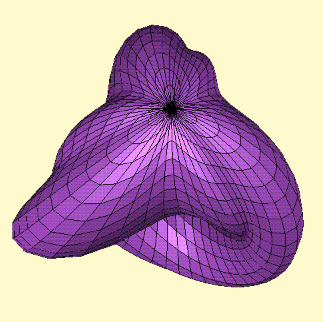
**Image created from the JP PETIT - Jérôme Souriau representation, with its three ugly folds, resulting from an incomplete Fourier representation. **
Later, parametric representations multiplied. Below is that of R. Bryant:
This second discovery, that of a parametrization using elliptic meridians, allowed the mathematician Apéry, a student of the mathematician Bernard Morin from Strasbourg, to construct the first representation of the surface in an implicit form, of the sixth degree. (in his doctoral thesis, he attributes this invention to the sculptor Max Sauze, doctor of welding in silver):
f(x,y,z) = 64 (1 - z)3 z3 - 48 (1 - z)2 z2 (3x2 + 3y2 + 2z2) + 12 (1 - z) z (27 (x2 + y2)2 - 24 z2 (x2 + y2) + 36 Sqrt(2) y z (y2 - 3 x2) + 4z4) + (9x2 + 9y2 - 2z2) (-81 (x2 + y2)2 - 72 z2 (x2 + y2) + 108 Sqrt(2) x z (x2 - 3y2) + 4z4) = 0
Terribly complicated.
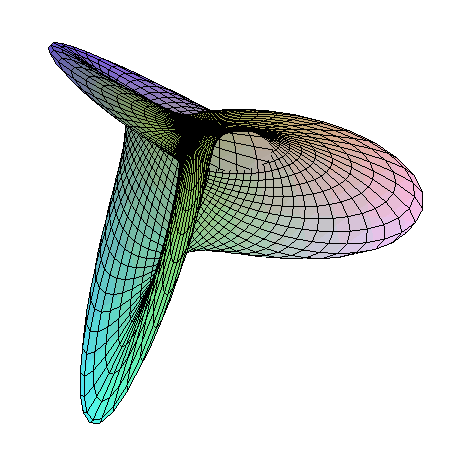
**Image of the Boy surface, constructed using Apéry's implicit representation, with the "elliptic meridians" of J.P.Petit **
On the Wikipedia site, at this page, you will find an animation, inspired by the flip book found in Topologicon (1988). The same goes for the polyhedral representation of the surface (another invention of mine, also present in the album), with rounded edges.
In 1988, the mathematician Brehm gave another polyhedral representation, with ten faces, and a theorem indicates that the object cannot have fewer than 9 faces....
De gustibus et coloribus non disputandum
Back to Apéry's representation, the only known implicit representation. Why is this surface so disharmonious (and therefore its equation so complicated)?
Guided by Morin, Apéry did not exploit the ternary symmetry of the object. The equation places the OZ axis as the axis of symmetry; this is an error. A better result would have been obtained by choosing the vector (1, 1, 1) as the axis of symmetry. The ternary symmetry would then have given an equation invariant under permutation of the coordinates x, y, z. Moreover, by placing the origin of the coordinates at the triple point and deciding that the three tangent planes to the surface are the principal planes, we would eliminate the second, first, and zero order terms, and reduce the third order term to
x y z
Such symmetry is exploited in the surface discovered in 1844 by Steiner, in the city of Rome, later called the Roman surface of Steiner, whose equation is:

A look at the surface:
The Roman surface of Steiner
Also composed of ellipses, it is, like the latter, a one-sided surface, therefore not edible. :
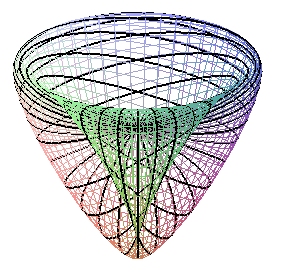
The families of ellipses of the Roman surface...