The Wurmstein-Paparazzi Test
An extraordinary discovery:
There are just as many idiots at the CNRS
and in the academic world
as in any other professional category
1st November 2002
Since the work of Wilfried Wurmstein and Laetitia Paparazzi from the 1950s, it has been possible to classify individuals from any given socio-professional category into a certain number of groups (called "Wurmstein-Paparazzi categories"). These are:
-
5% genuinely honest individuals, whose moral standards are relatively independent of their environment or circumstances.
-
20% outright jerks, solely concerned with their own interests and capable of almost anything to achieve their goals.
-
75% undecided individuals, susceptible to sliding toward either extreme depending on circumstances and their environment.
All subsequent studies have ultimately only reinforced these results with remarkable consistency. In fact, the entire history of contemporary humanity revolves around the gradual awareness of this Wurmstein-Paparazzi statistic.
We know that many discoveries are often the purest fruit of chance. More precisely, important discoveries can remain dormant indefinitely while more perceptive or daring researchers could have brought them to light long ago. A famous example concerns the relatively recent discovery of biomolecules in the most remote regions of the cosmos. A chemical entity—molecule or atom—can be identified by its "spectroscopic signature." Every substance possesses a characteristic spectrum, either emitted or received, composed of a set of spectral lines. To detect its presence remotely using a telescope, one merely needs to place a filter that allows passage only of the light emission corresponding to the characteristic lines of a given substance. Of course, in the universe, the most ubiquitous atom is hydrogen, in all its forms (neutral, ionized). Next comes helium, named after the way it was discovered—as an unusual emission originating from the Sun (hélios in Greek). Researchers, using this spectroscopic filtering method, first searched for various atoms, then, outright, molecules such as carbon dioxide. But it took decades before someone had the idea to look for organic matter, whose presence between stars would have seemed incongruous. It turns out the first biomolecule identified was urea. I don’t know who first had the idea to search for this component of urine by pointing a telescope toward a cloud of organic matter. But it was historic, regardless.
Since its discovery in the 1950s, the Wurmstein-Paparazzi test, used to assess individuals within a human population, has obviously become more refined. From five initial parameters, it has evolved to twenty-nine, yet this has scarcely altered the original results. Among these is the famous CF (crowd factor). Indeed, idiots display a remarkable gregarious instinct and identify with certainty. One can compare idiots to the cells making up sponges, whose performance stems from this remarkable spirit of mutual recruitment. An idiot rarely remains alone for long. Very quickly, he finds his kind and joins their group, feeding it. Like any biological entity, these synergistic groups develop socio-immune reactions. They then effectively resist anything that might disrupt this structure, this common point that allows them to assert their identity, creates their strength, and ensures their cohesion: stupidity.
Wurmstein and Paparazzi were both sociologists. Only after many years applying their method to highly varied groups—religious figures, social security employees, plumbers, politicians, etc.—did they suddenly consider studying a population of 187 sociologists, a perfectly representative sample from a statistical standpoint. Their surprise was immense when they found, identical to the earlier results, the same distribution.
Such a finding should have prompted a generalization of the study. For reasons still poorly understood, it wasn’t until 2002 that one of Paparazzi’s students, Florent Marie, undertook to extend the investigation to members of the CNRS. Some have claimed that Wurmstein, being a researcher at the CNRS, had obstructed the study out of fear of jeopardizing his promotion to the rank of senior research director. But these are mere speculations: other human groups have also long escaped this "microscopic examination" purely by chance.
The result will surprise no one. Florent Marie found, within a margin of 0.2%, the same percentage of idiots among CNRS researchers and administrative leaders. This result raises the persistent question: why these percentages (5–20–75)? Are they encoded in our genes? Is stupidity, like death, an inescapable phenomenon? Going further, some now wonder: given that the idea of intelligent extraterrestrial life is gaining ground and that the search for extraterrestrial intelligence is expanding, wouldn’t it be more fruitful to search for signs of extraterrestrial stupidity rather than focus solely on intelligence? Already, specialists such as exo-ethnologists are asking:
- Do they have the same percentage?
The general public holds a completely idealized image of the scientific community, comparable to the image humble people once had of the religious world during the Middle Ages. This machine gathering thirty thousand souls that is the CNRS functions, like all other human groups, only thanks to 5% of its members—1,500 individuals—who must struggle against the actions of 6,000 idiots, under the watchful eyes of 22,500 "unlabeled" individuals who lend support to the various protagonists at random, depending on circumstances and environmental pressures.
Stupidity is measured using the Wurmstein-Paparazzi test. The reader may be familiar, for example, with the famous Rorschach test, where inkblots are presented to the subject, who is then asked what the shapes represent. A less well-known but more closely related test is Rosensweig’s, which measures the aggressiveness of subjects. In this test, subjects are shown drawings accompanied by speech balloons. One of them contains a text, and the subject is expected to provide the response text.
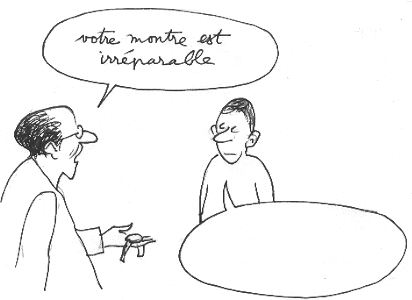
Rosensweig Test
In the drawing above, a customer receives his watch back from a watchmaker. He may then develop several possible responses, coded by Rosensweig. For example:
- It doesn’t matter. Sorry for the inconvenience (intro-punitive response)
or:
- It was you who made my watch irreparable (extra-punitive response)
Rosensweig designed his test to demonstrate the duality of frustration-aggression. It’s rather amusing to consider the circumstances and the population he used for his study. Being English, he chose students from a Cambridge-area high school as test subjects. The students in one class were told the Queen of England would be visiting them, and then—on the morning of the test...