MHD and Hypersonic Flight Faraday Generator
Lecture given at Supaéro
June 10, 2003
MHD and Hypersonic Flight
J.P. Petit
page 1
Recap of the history of MHD in France.
The inventor of MHD (magnetohydrodynamics) was the Englishman Michael Faraday. This discipline has two main aspects:
- MHD accelerators, or the art and technique of moving fluids using Laplace forces ("Lorentz forces" in English) J × B
- MHD generators, or the art and technique of converting the kinetic energy of a moving fluid into electricity.
Faraday experimented with both principles. In both cases, he implemented a linear converter, which bears his name. Schematically, a linear converter is a nozzle equipped with electrodes (segmented to achieve better current distribution within the flow channel), flanked by coils generating a transverse magnetic field. The device’s axis, the direction of the magnetic field, and the direction of the electric field created by the electrodes form a right-handed orthogonal triad.
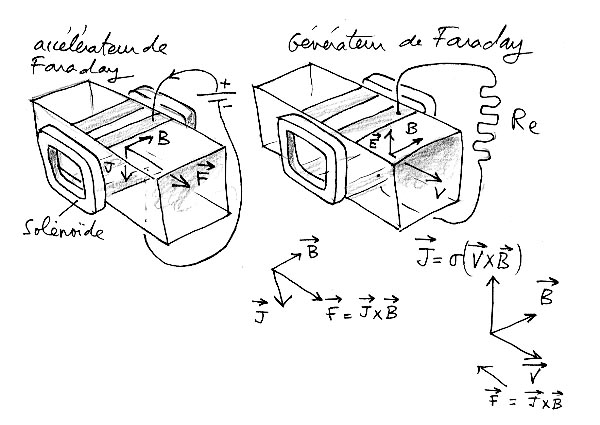
Faraday Converter
In the early 1960s, the British were the first to consider electricity production via MHD, without moving parts, through "direct conversion." On paper, this seemed very simple. A fluid flows at velocity V through a nozzle, cutting across the lines of a magnetic field B. This induces an electromotive field V × B, which generates a current J (current density, in amperes per square meter), collected by electrodes and flowing through load resistances. These MHD generators offered several advantages. They could be rapidly deployed. Furthermore, they bypassed the Carnot efficiency limit, which at the time restricted gas turbine efficiency to around 40%. Theoretical calculations suggested that, on paper, overall efficiencies of nearly 60% could be achieved. If these machines had worked, this would have meant producing 50% more electrical energy from the same amount of fossil fuel.
But gases are poor electrical conductors. Consider a gaseous mixture resulting from hydrocarbon combustion. Its components have ionization potentials. Yet even at the highest temperatures permitted by current technology, the electrical conductivity of the medium remains low. Only a small fraction of the gas’s enthalpy would be converted into electricity, the majority being dissipated within the flow via Joule heating.
Thus, researchers considered increasing the gas’s conductivity by adding a substance with a low ionization potential, primarily an alkali metal. This conductivity enhancement problem was so critical that the most easily ionizable substance was immediately considered: cesium. The first MHD conversion experiments therefore involved adding a Faraday linear generator downstream of a combustion chamber burning hydrocarbons. Results were disappointing. Temperatures approaching 3000°C—comparable to the filament of an incandescent lamp—were required. Efforts focused on the thermal durability of materials: walls and electrodes. In the early 1960s, it was not uncommon during experiments for electrodes to shatter, as well as the plates meant to ensure thermal integrity of the walls. These studies on what became known as "open cycles" continued in numerous laboratories worldwide throughout the 1960s. In France, participation included EDF at its research center in Les Renardières near Moret-sur-Loing, the French Institute of Petroleum, and CGE (Compagnie Générale d’Électricité). The international (civil) MHD effort mobilized up to 5,000 researchers across dozens of laboratories scattered around the globe. The lack of success eventually led to the gradual cessation of research. The Russians were the last to persist, until the mid-1970s, with an experimental generator named "U-25," located near Moscow.
The Russian MHD generator U-25. In the foreground, the electromagnet.
Impressive dimensions of the U-25 generator’s flow channel. Electrodes are on the left and right.
Another approach was quickly considered, based on what was termed "non-equilibrium (thermodynamic) electrical conduction." This situation, where the electron temperature Te exceeds the gas temperature Tg, will be detailed later. These conditions prevail in a neon tube. The basic idea is as follows: in a neon tube, an electric field E, created by electrodes, accelerates free electrons along their mean free path (between collisions with neutral atoms or ions). If the mean free path is long enough, the kinetic energy gained by electrons can reach the ionization energy Ei of an atom. During a collision, an "electron avalanche" occurs. The resulting electric current creates an ionized state within the tube. Conversely, ions attract relatively slow free electrons and tend to capture them (radiative recombination).
I have already published two MHD-related files on my website, presented at a popular science level. There will be links to these in the following sections.
In the mid-1960s (more precisely at the 1964 Newcastle conference in England), a young Russian researcher, Velikhov, predicted the emergence of an extremely abrupt ionization instability (occurring within a few microseconds). The theory behind this phenomenon is far from obvious. Its mechanism defies intuition. Here is an image from the 1960s, showing (at the time, numerical simulations required the most powerful computing systems, and these images come from the USSR). It illustrates how this instability develops, locally compressing the electric current lines. This localized increase in current density J triggers a response from the gas in the form of ionization. The medium thus stratifies, forming layers of high electrical conductivity alternating with regions of low conductivity.


Evolution of the electrothermal instability in a Faraday converter (1968)
It was precisely this instability, which no one could overcome, that caused the collapse of the entire global civil MHD effort (dozens of labs, 5,000 researchers). By the end of the 1960s, the situation was settled in Europe. All research teams were dismantled, despite one notable success at the Marseille Institute of Fluid Mechanics between 1966 and 1970. Two significant results emerged:
-
First stable operation of a non-equilibrium generator, immune to ionization instability (J.P. Petit, 1967, 7th International Congress in Warsaw). Gas temperature: 6000°C, electron temperature: 10,000°C, power extraction: 2 megawatts. Notable current flow up to 4000°C.
-
Acceleration of an argon plasma. Input parameters: pressure, 1 bar; velocity, 2700 m/s; temperature, 10,000°C; electrical conductivity: ...