Astrophysical gas interstellar artifact simulation
Artifacts
May 10, 2004
What is an artifact? According to Larousse, it is an accidental or artificial structure appearing during an experiment or observation. We can say that computer numerical simulations—“computational experiments”—involve a constant hunt for artifacts. When we seek to simulate, we strive to reproduce a phenomenon using “something else,” another system, analogously. An aerodynamicist faces such a problem. A dense or hot gas does not behave the same way as a rarefied or cold one. In fluid mechanics, these phenomena have been studied, if not perfectly, at least with the greatest possible precision according to similarity criteria (such as the Reynolds number). Yet, despite decades of experiments, aircraft designers have sometimes encountered shocking surprises. For example, when the large military transport aircraft, the Lockheed Galaxy, was built, it turned out to be sensitive to a phenomenon called aeroelasticity: it began to... flap its wings—something that neither wind tunnel tests nor numerical simulations had revealed. These oscillations could have been catastrophic. Indeed, aircraft structural aging is primarily linked to material fatigue. Rather than modify the wing structure, engineers instead equipped the aircraft with a feedback system, using control surfaces (ailerons) to counteract this "flutter" motion. A similar problem plagued the American Space Shuttle, which posed the most acute challenges. Designers had to ensure its flight qualities across all atmospheric layers it traversed, ranging from the most rarefied to the densest. Under these conditions, the "center of thrust" shifted. During its first flight, disaster nearly occurred. Having received what was believed to be a standard load, the shuttle suddenly became nose-heavy, so much so that the pilot had to push the control stick into his stomach. The vehicle nearly flipped upside down, causing damage to the tiles on its upper surface, which were absolutely not designed to withstand heating. The shuttle barely regained its proper flight attitude. What did NASA do? Rather than redesign the vehicle, they chose to move all the loads... to the rear. If you look at where satellites and cargo are attached on spacecraft, it's always at the back. This fact is little known. NASA certainly didn't boast about it. I learned it from a test pilot.
In astrophysics, we lack the possibility of comparing systems evolving on a screen with direct observations. Astronomically, we are perpetually frozen in a single frame. The problem is thus inherently thorny. Furthermore, we do not measure everything. In the section on kinetic theory of gases, we discussed the structure of the medium "in velocity space." We added that we only have access to this information in the vicinity of the Sun, and we should not expect this to change anytime soon.
Over time, measurements will be significantly refined. Error bars have narrowed. But take, for example, a spiral galaxy. We speak of a "velocity curve." What do we mean by that?
We measure the radial component of velocity via the Doppler effect. Then, assuming the galaxy is nearly flat and that the motions of gaseous masses are nearly circular, we deduce the velocity curve of the gas orbiting within a gravitational field that is 90% generated by stars (at least, this was assumed for a long time). Why do we assume that the trajectories of gaseous masses are nearly circular? Because the differences in their velocities (equivalent to thermal agitation) are small, on the order of 1 km/s—small compared to the estimated rotational speed. The astronomer will always refer to the "residual velocity," that which remains after subtracting the average motion, equivalent to a "macroscopic movement."
Brief digression: What is interstellar gas made of? It is an extremely complex medium containing "clouds" typically representing around 100,000 solar masses, as well as a whole spectrum of smaller-mass clouds. Thus, it is a "mixture of species," in the sense of kinetic theory of gases. But what complicates matters is that these gaseous masses are not stable. They give birth to young stars, which emit ultraviolet radiation and heat the surrounding gas. Even more violent is the supernova phenomenon, whose radius of action reaches a hundred light-years—the thickness of the gaseous layer. We estimate the rate of explosion of massive stars at one per century. This is a very rapid pace on the scale of a galaxy's rotation, which takes about 100 million years. That amounts to a million supernovae per... rotation! These supernovae significantly alter the local structure of the interstellar gas. In my doctoral thesis (1972), I compared the interstellar gas to a duvet filled with feathers, inside which small fireworks exploded at a rapid pace, maintaining disorder and keeping the gas at a high energy level.
How can we model and simulate all this? Not only does interstellar gas, in a snapshot, resemble a mixture of clouds with masses spread across a very wide spectrum, but these clouds do not persist. They dissipate, vanish, and reform slightly farther away, at a rate we cannot precisely evaluate, simply because we don't live long enough. We are a bit like insects whose lifespans last only fractions of a second, observing cumulus clouds and trying to understand meteorological mechanisms. The comparison between interstellar clouds and clouds in the sky is not so bad.
Currently, we can handle a few thousand points—perhaps more in the near future. But will we ever be able to manage enough mass points to simulate star formation and the heating of interstellar gas masses? This remains very problematic. We must remain humble. This will always compel us to some degree of schematization, more or less justified. As they say, one judges a tree by its fruit. We can only do that. The machine itself is nothing without a vision of the mechanisms, an intuitive grasp. This vision is missing in the new generation of astrophysicists. In a dossier presented in Ciel et Espace, the leading simulation advocates said: "We have the instruments, but we don't have the equations." Through this statement, they admitted they had no real understanding of the phenomena, no guiding vision, no genuine idea to test—only massive computational power they didn't truly know how to use.
At the foundation of any simulation work, one must have ideas to test. It is a genuine dialogue between human and machine, highly interesting. For example, look at the current result of Frédéric Baudemont's work:
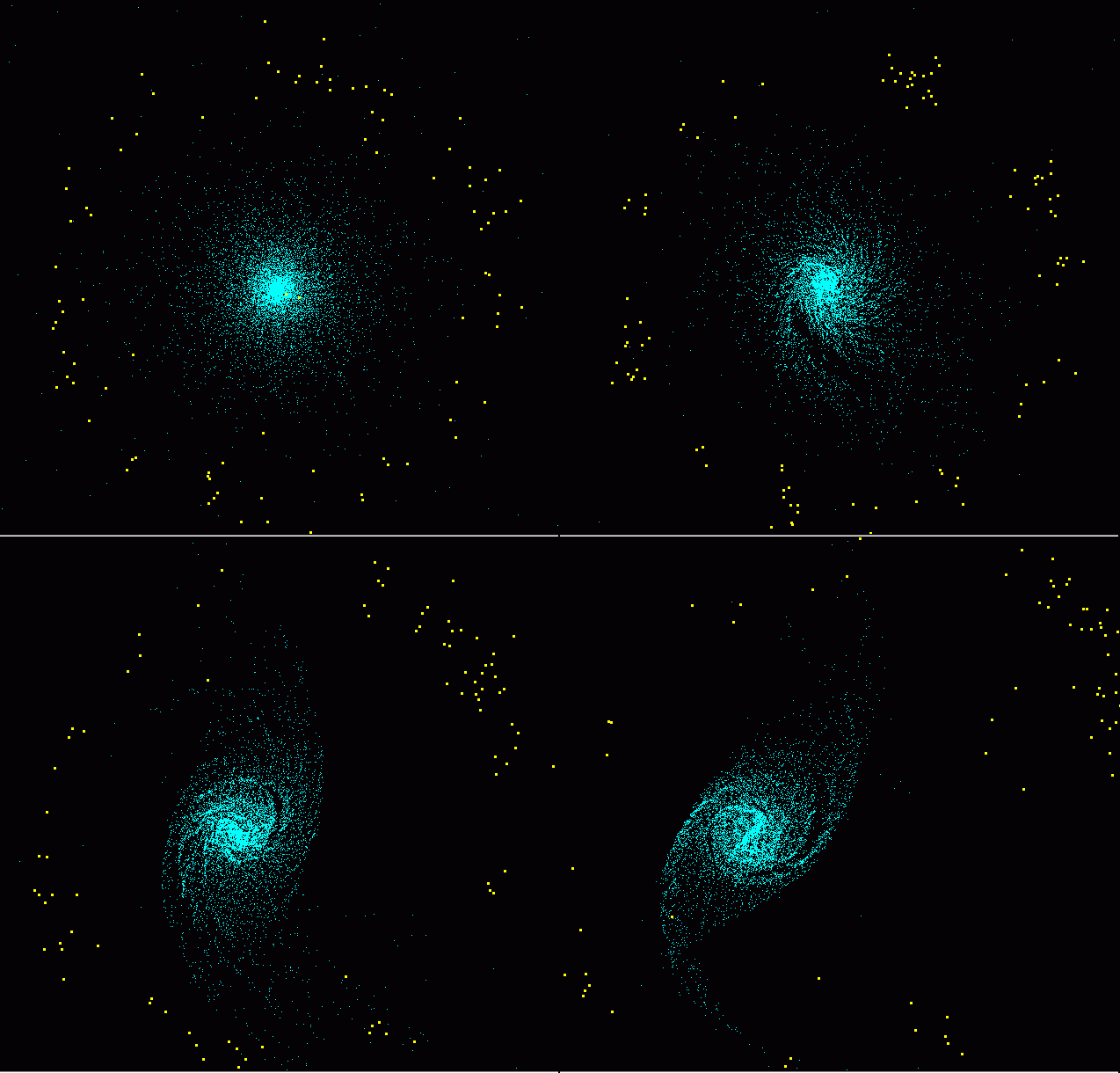
It's beautiful, spectacular—but is it meaningful? We would say it's encouraging, very encouraging, just as were the simulations I carried out in 1992 with another Frédéric. These were 2D simulations, not 3D. It's a "flat gas." We can hope that the "galactic fluid" will behave similarly when we equip its components...