Solar Eruption Triggered by a Comet
Solar Eruption Triggered by the Passage of a Comet
December 23, 2004
Frédéric Deroche pointed me toward a website:
http://www.jmccanneyscience.com
which belongs to Jim Mac Canney, who presents intriguing videos showing comets passing near the Sun. These images were captured using a coronagraph—a simple device that blocks the Sun’s direct image with a disk mounted at the end of a rod (visible in the image). This allows the structure of the solar corona to be observed. A comet represents an extremely small mass on the scale of the Sun; Halley’s Comet, for instance, is only hill-sized and less massive. Therefore, gravitational and tidal effects can be considered negligible. However, as a comet approaches the Sun, it passes through an intense solar wind. It is therefore plausible that it acquires a significant electrical charge. In the video, one can observe that at the moment the comet is very close to the Sun, a powerful solar eruption occurs. One might speculate that the trigger could be electromagnetic in nature. Here are some images extracted from the film:
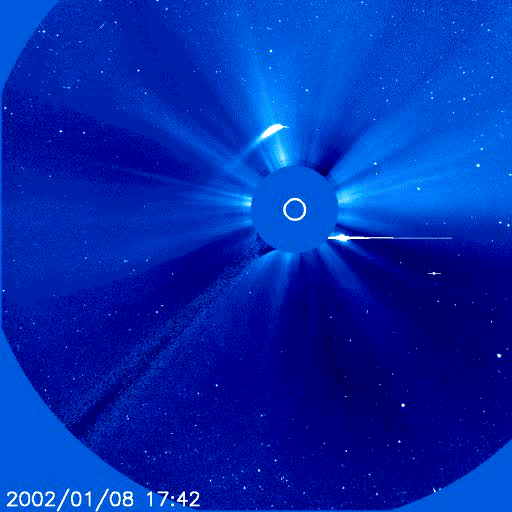
Just before the phenomenon triggers
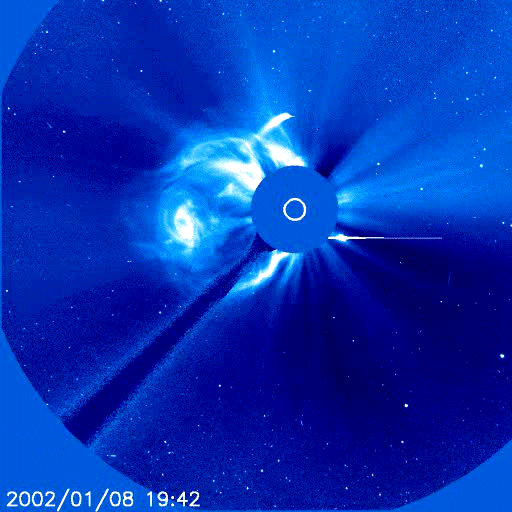
Very rapid onset of the solar eruption
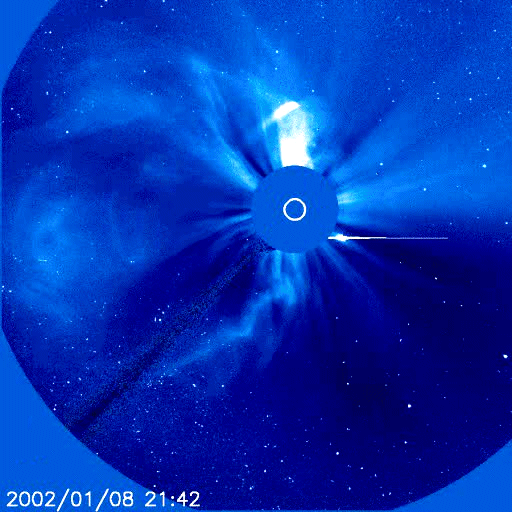
Before the eruption completes
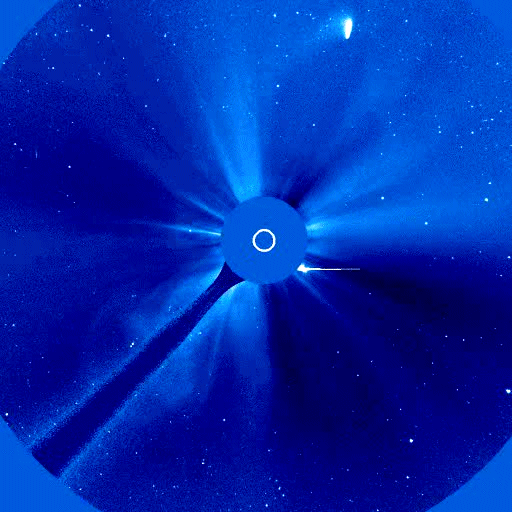
The comet moves away
To view the film (mpeg, 2 megabytes)
This is a triggered solar eruption. We know such events can affect Earth’s climate. It is not impossible that debris from an object fragmented by tidal forces might one day mass together and strongly interact with the Sun, temporarily triggering intense—perhaps even damaging—activity. We still understand very little about this entire set of phenomena, just as we poorly assess electromagnetic interactions between planets and wandering objects. Paleomagnetic studies show that Earth’s magnetic geometry has undergone significant variations. What could be responsible for these phenomena? First, we should recall that the origin of Earth’s magnetic field remains undetermined. The reader has likely heard the term "magnetohydrodynamic effect"—but that remains... just a word. A few years ago, I attended a conference in Marseille given by an astrophysicist specializing in such studies. It became clear that, over half a century, theorists had made no real progress. If we don’t even understand why Earth has a magnetic field, how could we possibly imagine the mechanism that might reverse it?
Personally, I believe we understand only partially the objects composing the solar system. We have data on objects that remain calm in their orbits—planets and satellites—but we know little about potential wandering objects capable of causing disturbances. What we do know, thanks to the work of J.M. Souriau, is where the solar system tends: toward a relaxed state, in which the golden ratio also plays a role. In this relaxed state, planets tend to align in the same plane—the ecliptic. Orbits become circular. The spins of planets and satellites align. The driving forces are tidal effects, which are dissipative—unfortunately difficult to evaluate and model. Computer simulations of the solar system have been conducted, representing planets and other bodies as spheres of constant density. These simulations then produce "chaotic phenomena," which could cause planetary axes to tilt unpredictably. Some have even claimed that life could not develop on a planet without a satellite like Earth’s, because such chaotic effects might lead to unpredictable axial tilts.
I agree with Souriau that this approach is invalid because it fails to account for dissipative phenomena. What does this mean? Let’s consider a binary system assumed a priori to be non-dissipative: the Pluto-Charon pair. These bodies are thought to orbit a common center of gravity "looking each other in the eyes," in a "quasi-stationary" way. Each body deforms the other into an ellipsoid whose major axis points toward it.
But if two bodies orbit a common center of gravity and also rotate on their own axes, then their surface—and even their entire mass—is traversed by what might be called a "density wave." This is... a vague concept. The Moon, for example, deforms Earth’s surface, creating a tidal wave about one meter high (which circles Earth every 24 hours). The Moon constantly gives Earth the shape of a slightly elongated ellipsoid. If the Moon orbited at 40,000 kilometers from Earth, it would be geosynchronous. The tidal wave would be stationary, and no dissipative effect would occur. But that’s not the case. The Moon orbits Earth in 28 days, while Earth rotates on its axis 28 times faster. Thus, the Moon drags this "tidal wave" along with it. Incidentally, this slight dipole slightly alters the Moon’s trajectory, much like a carousel rider pulling on a horse’s reins to make it speed up. Earth transfers energy to the Moon, causing it to recede from us at a rate of 4 cm per year. Conversely, the Moon slows Earth’s rotation. Days were shorter in the past.
The relative motion of this density wave—this tidal wave sweeping across Earth every 24 hours—implies mixing, hence heating, and ultimately energy dissipation through radiation.
The two bodies interact. Currently, the Moon exhibits a slight oscillation called libration, meaning it shows not 50% of its surface, but 59%. Previously, the Moon likely rotated on its own axis. If it formed as ejecta from a collision with Earth, it may have initially possessed a magma layer, or at least greater fluidity. The evolution of the Earth-Moon system remains to be modeled. Indeed, it is only relatively recently that the hypothesis of the Moon’s formation following a collision between Earth and an object the size of Mars has gained renewed credibility. The Moon’s mass distribution is not spherically symmetric. It has a "mass concentration" or "mascon." This fits the hypothesis that, when the Moon formed, it may have been a relatively fluid body. Thus, denser materials could have migrated toward its center and, as a consequence, toward the hemisphere facing Earth. Over time, the lunar magma could only cool and solidify, as indicated by the lack of observed lunar seismic activity.
Returning to the solar system: Io orbits very close to Jupiter and also rotates on its own axis. Jupiter tends to give Io a slightly elliptical shape (always an elongated ellipsoid). Io’s rotation causes internal mixing within the body. Here, the dissipative effect is immediately visible: it sustains intense volcanic activity on Io. The magma within Io never...