Jeans Instability and Cosmological Gravity
Epistémotron Project 2
Gravitational instability or
Jeans Instability
May 6, 2004
Consider a sphere filled with "dust," meaning a constant density of stationary point masses. The sphere has radius R and represents mass M. Consider a mass m located on the surface of this sphere. Applying Newton's law, we obtain—within two lines of calculation—the Friedmann equation, the one governing cosmological models of the same name:
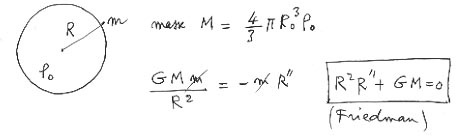
You can recover the three types of solutions to this second-order differential equation, which yield the following models:
- Cyclic (R following a cycloid)
- Hyperbolic (R approaching an asymptote)
- Einstein-de Sitter model (in tq)
In 1934, Milne and McCrea showed that the master equation of General Relativity could emerge from Newtonian mechanics. In the 1970s, I achieved the same result using the Maxwellian solution of the Boltzmann equation coupled to Poisson's equation. Let's move on...
We will focus on the tm solution constructed by Einstein and de Sitter:
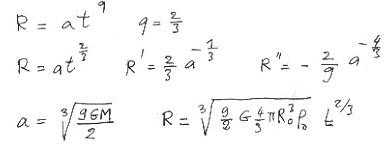
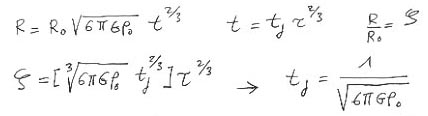
We will make this equation dimensionless by introducing a characteristic length, simply taken as the initial value of the radius. A characteristic time then emerges:
If the Einstein-de Sitter solution describes a decelerating expansion starting from explosive initial conditions, it is symmetric under the transformation t → -t. This yields two parabolas symmetric about an arbitrary time t = 0. Reading the left curve thus gives a description of a gravitational collapse, which self-accelerates.
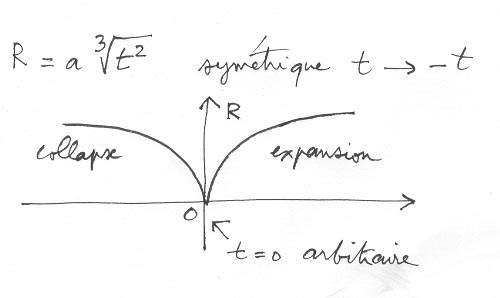
This phenomenon is associated with the characteristic time known as the Jeans time. We thus see that a dust mass (a collection of particles with no thermal motion), regardless of its size 2R, collapses in a time* that depends only on the value of the density*.
Now let us consider the reverse phenomenon: a cloud of masses m, of size L, undergoing thermal agitation. We neglect gravitational forces. The cloud will disperse in a characteristic time equal to L divided by the average thermal velocity , which is linked to the absolute temperature T (see previous dossier on kinetic theory of gases). We will call this dispersion time td. In a spherical gas cloud, these two phenomena oppose each other. We then realize that the dispersion time exceeds the characteristic collapse or accretion time if the size of the "clump" under consideration exceeds a certain characteristic length—the Jeans length Lj.
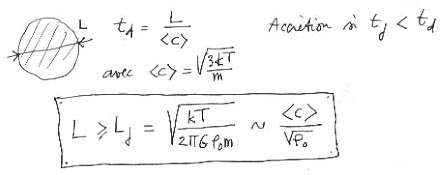
This length is proportional to the thermal agitation velocity and inversely proportional to the square root of the density ρ. Thus: "if you heat it, you stabilize it."
-
What heats it (e.g., an interstellar gas cloud)? Answer: hot stars emitting UV radiation.
-
What cools it? Radiative losses (the gas emits infrared radiation).
An interstellar gas cloud thus functions like a toilet tank, serving as the site of a homeostatic process. If the gas cools (radiatively), it becomes gravitationally unstable and gives birth to stars, which, by emitting UV, reheat and reinflate the gas. This is an "anti-depression" mechanism. Stellar activity plays the role of an antidepressant with respect to the gas. In a spiral galaxy, this gas is confined in a very thin disk, only a few hundred light-years thick—small compared to the galaxy's 100,000-light-year diameter. The gas layer has the geometry of a microgroove. Its thickness remains constant precisely because this thickness is regulated by the same anti-depression mechanism everywhere.
Some of you have attempted to simulate gravitational instability without success. This was due to the gas being too hot, or the point masses not being massive enough. In such cases, the Jeans length exceeded the diameter of the initial clump. A similar phenomenon occurs in 2D when working on a sphere, which some of you have done. You may enjoy constructing the 2D equivalent of Jeans theory. We would then find a characteristic length proportional to the 2D thermal agitation velocity on the "surface" of the sphere. The role of density remains analogous to that in 3D, but I admit I lack the energy tonight to clarify this issue, which has little real interest since the universe is 3D, not 2D. Qualitatively, however, the phenomena are similar. We should then obtain a 2D Jeans length. If this length exceeds the circumference of a great circle on the sphere, no clumps form. If the Jeans length is much smaller than this circumference, many clumps form. Once you have the 2D spherical calculation programs, you can experiment with this. D'Agostini created a superb program, which I will install in the next folder. You will have both the executable and the source code, so you can tinker with it. It is written in Pascal.
Expansion cools. Isentropic expansion is destabilizing.
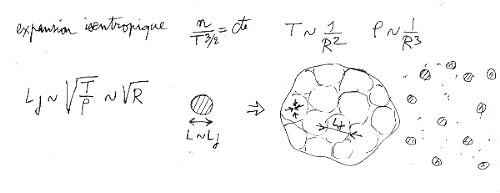
We see that the Jeans length increases with the square root of R. Therefore, inevitably, something undergoing isentropic expansion becomes unstable and fragments. Had there been no photons, no cosmic radiation, the universe would have formed clumps from its earliest moments. However, the matter-radiation coupling suppressed gravitational instability until the universe became neutralized around t = 100,000 years. If we take the thermal agitation velocity of hydrogen just below 3000°, and the density prevailing at that time, we find a certain value for the Jeans length. Calculating the mass contained in these clumps yields the associated Jeans mass, which at that time was about 100,000 solar masses. It is therefore logical to suppose that at the time of decoupling, clumps equivalent to globular cluster masses formed.
A final remark. When I arrived at the Marseille Observatory, I was fleeing an abominable mess—the Institute of Fluid Mechanics (alias "ploutomechanics laboratory"). The lab, located near the current bus station in Marseille, close to Saint Charles train station, was demolished a few years ago. Its director is now six feet under. It was there, in 1966, that I eliminated the Vélikhov instability, which caused quite a stir. One day, sitting in front of my pulsed MHD generator shaped like a gas cannon, I thought to myself: "Mate, if you don't get out of here, you'll end up like the others." I then devoured, within a few months, a treatise on kinetic theory of gases—Chapman and Cowling’s "The Mathematical Theory of Non-Uniform Gases," published by Cambridge University Press. An excellent book I cannot recommend highly enough, which will introduce those wishing to go further into the theory to calculations using dyads and dyadic matrices. While digesting it, I had one or two ideas and built a doctoral thesis—a life raft.