Some small things about the solar system
About the Solar System
May 12, 2004
A small preliminary, interesting remark:
We have mentioned elsewhere simulations on 2D spheres and projects on S3 spheres. Everything that follows refers to planetary systems and can therefore be handled in a three-dimensional Euclidean computational space, in "R3". If an object leaves the system by the slingshot effect, it is part of the game, of the planetary life's hazards. Many objects have been ejected from the solar system, at the time of its creation, by the slingshot effect and have never returned.
The solar system holds many mysteries. We do not know how it formed. We do not know "why it is in this state, with so many singular aspects" and we also do not know where it is heading, nor what will happen in the near or distant future. All of this can be explored within the Epistémotron project, and even now. To do this, you need:
- Planet models - Star models
Here they are. These celestial bodies formed under the effect of gravitational force. Therefore, we need to define mass points that attract each other according to Newton's law. But planets are not totally gaseous objects. When you go deeper into Jupiter, you find a gaseous state, then, 100 kilometers lower, liquid, then solid and even ... metallic. Gravitational anomalies even suggest that giant planets like Jupiter and Saturn might have swallowed a "telluric" planet in their insides, swallowed at an indeterminate time.
How to create a spheroidal system that maintains its cohesion under the effect of gravitational force but refuses to collapse under the effect of repulsive forces? Answer: by introducing a force:
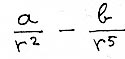
Why the power 5? The collision cross section (see the chapter on the kinetic theory of gases) is an integral:
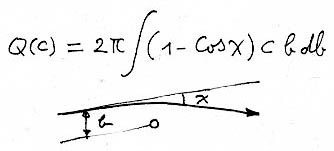
Incidentally, when the force is Newtonian, it ... diverges, which implies creating a "cut off". I won't bore you with that, we won't need it. Later, if the Epistémontron project develops and we consider phenomena involving "self-gravitating plasmas" with applications to quasars. Read or reread "We have lost half the universe" (Hachette, Pluriel collection). All the ideas in there are suitable for simulations. I believe I would have had enough to keep a good number of students from the "Sciences of the Universe" section of the CNRS busy. But the time is no longer for these university strategies. Too complicated, too slow, too heavy. Let the trinkets stay on their shelves. If things go as I hope, these ideas will escape from their Pandora's box and spread across the globe.
I have always thought one thing and wrote it in one of my first books: it is not the researchers who take hold of the ideas, but rather the ideas that take hold of the researchers. If the "graft" takes, everything will go quite quickly. What we can conjecture is that astrophysicists (and planetologists) will probably be the last to react. Well, if it happens that way, so much the worse for them. But let's go back to this 1/r5 law. The cross section is generally variable according to the relative velocity of the two objects interacting. We have:
Q = Q (C) where C is the thermal agitation velocity used.
We can define an average value which will generally be very close to Q ( ). The particularity of the 1/r5 law is that the cross section does not depend on the velocity. It is therefore very suitable for a model called "billiard balls". The force law proposed above thus evokes the dynamics of billiard balls held together by gravitational force. Let the reader try to define the parameters a and b. It is a virgin territory where everything is a matter of feeling. Depending on the choices, you can create a kind of star where the density increases as you go deeper into the center or a sort of "liquid drop", or a fairly viscous solid, with a density almost constant everywhere. Initial conditions: place the N points according to a spherical distribution, with constant density, then release everything. It can oscillate. It is even possible to simulate energy dissipation by canceling all thermal agitation velocity of the particles located on the surface, which would simulate cooling by infrared emission. You can then converge towards a "cold planet", like the Moon.
In a shared computing system, there is material for multiple investigations. You can even reproduce convection currents, the ... plate tectonics. By creating an energy injection at the core, you can simulate the functioning of a star (or even the explosion of a supernova) as you can simulate temperature maintenance by the energy release linked to the decomposition of radioactive elements.
Among the phenomena that interest us, there is one, quite fascinating: the tidal effect. It's simple. When you have recreated your "planet", approach a point mass M. It should deform into an elongated ellipsoid. It is the setting of your parameters a and b that will determine the "response" of your planet, or your star, to such a solicitation. And it is there that we come across one of the multiple ideas of Souriau. See his planetary work that I present on my site, which has never been published! Do not make a mistake: the great specialist in planetary science in France is not André Brahic, it is Jean-Marie Souriau. The second will take his place in the history of science. For the first, it seems less likely to me.
If you do not look at these pages, a few words. The starting point of Souriau is the analysis of the orbital periods of the different planets. He then retains that of the Earth: 365 days and that of Venus: 225 days and calculates, both downstream and upstream, the corresponding Fibonacci sequence (or of the Fibonacci type, where each term is the sum of the two preceding ones). We know that under these conditions, the ratio of two successive numbers in this sequence tends towards the golden ratio.
Souriau then obtains this:
30 Sun (29 days) 55 Nothing 85 Mercury (88 days) 140 Nothing 225 Venus 365 Earth 590 (1 year and
seven months) Mars (1 year and 10 months) 955 Nothing 1545 (4 years and 3 months) Ceres-Pallas (asteroid belt )
2500 Nothing
4045 (11 years)
Jupiter
( 11 years and 10 months)
6545 Nothing
10590 (29 years)
Saturn
( 29 years and 5 months)
17135 Nothing
27725 (76 years)
Uranus
(84 years)
44860 Nothing
72585 (199 years)
Neptune
(164.765 years),
Pluto
(274 years)
Then comes the concept of resonance. Take a string instrument. In any school you will have the possibility to measure the frequency of two strings. Let T1 and T2 be the periods of these frequencies. If the ratio is unity and you pluck one of the strings, the response of the second will be maximal. It will remain acceptable if the ratio of these periods is
a rational fraction
Pythagoras, to us!
Then adjust the tension of one of the strings so that this ratio is close to an irrational number like
1.41421....
You will see the resonance effect collapse. It will be minimal if the ratio is equal to the golden ratio:

Take two planets like Neptune-Pluto. The ratio of their "years" is close to

Souriau deduces that the two orbits of Neptune and Pluto will influence each other. But how? According to him, it is the Sun that serves as a "resonator". Each planet creates a tidal effect on its surface. If you create your model of a spheroidal object and you want its behavior to approach that of the Sun, you will have to have a planet like Saturn raise its surface by a centimeter. You will have to check, in passing, that your tidal effect varies in 1/r3, which makes the tidal effect created by this planet comparable to that of the tiny Mercury, but which is closer to the solar star.
Limit your solar system to the triad Sun - Neptune - Pluto. Let it simmer for a certain time, as Fernand Reynand said. Numerical simulations allow this kind of thing. The orbits will change and tend towards a ratio where the energy exchange will be minimal, that is to say towards 1.6180...
At least this is what we conjecture. An interesting computational experiment.
Planetary scientists line up the nonsense by simply neglecting dissipative phenomena in their calculations, although they are obviously present. This is how you could read conclusions given by the "chaoticians". But, according to Souriau:
The Chaos theory does not include dissipative processes, which are the key to the constitution and evolution of planetary systems.
As Science et vie once said, with this title on its cover:
Chaos governs thought
With well-configured N-body systems, integrating tidal effects and dissipative processes, there is a way to highlight a lot of things. You can create a table:
Planet
Mass
Orbital velocity
Distance from the Sun
Angular momentum
Mercury 0.005 M T, 3 10 22 k, 4.789 10 4 m/s, 0.387 UA, 5.76 10 10 m, 8.27 10 36
| Venus | 0.815 M | T | 4.87 10 | 24 | 3.5 10 | 4 | m/s | 0.723 UA, 1.1 10 | 11 | m | 1.87 10 | 40 | |
Earth 5.98 10 24 k = M T 2.98 10 4 m/s 1 UA = 1.49 10 11 m 2.65 10 40
Mars 0.107 M T, 6.4 10 23 k, 2.414 10 4 m/s, 1.524 UA, 2.27 10 11 m, 3.9 10 39
Jupiter 317 M T, 1.9 10 27, 1.306 10 4 m/s, 5.2 UA, 7.75 10 11 m, 1.92 10 42
Saturn 92.2 M T, 5.51 10 27 k, 9.64 103 m/s, 9.55 UA, 1.43 10 12 m, 7.59 10 42
Uranus 14.5 M T, 8.67 10 25, 6.81 10 3 m/s, 19.22 UA, 2.86 10 12, 1.72 10 42
Pluto 0.002 M T (?) 1.2 10 22 4.74 10 3 m/s 39.4 UA, 5.9 10 12 m, 3.35 10 39
- Mass of the Sun: 2 10 30 k
- Radius: 7 108 m. Periphery: 4.4 10 9 m - Sidereal rotation period: 30 days at the equator, 2.6 106 sec
Angular velocity:
w = 3.85 10 -7 radian / second
The moment of inertia of a homogeneous sphere, of mass M and radius R is:
I = 2/5 M R2 = 1.55 10 49
The angular momentum is:
I w = 5.96 10 42
Compare to the angular momentum M R V of Jupiter.
- Mass of Jupiter: 1.9 10 27 kilos - Orbital radius: R = 7.78 10 11 meters - Orbital velocity: 1.3 10 4 M/s
Angular momentum:
MRV = 1.92 10 43
Three times higher than the value of the Sun.
Calculate the MRV for Saturn:
- Mass of Saturn: 5.68 19 26 kilos - Average orbital radius: 1.43 10 123 meters - Orbital velocity: 9.137 10 3 m/s
MRV = 7.37 10 42
*Jupiter is indeed the King of the Gods. *
It is he who will bring all the planets to be placed in his orbital plane, which will become the plane of the ecliptic. It will straighten the axis of rotation of the Sun, which currently makes an angle of 7° 25 with the plane of the ecliptic. The axis of rotation of the Sun precesses. According to what period: that is a mystery.
There would be a nice doctoral thesis to be done by simulating all this. The machines are powerful enough to represent the Sun as a fluid sphere, made up of N mass points. You can represent the different planets as mass points and place them more or less anywhere, but on orbits close to circles. This fluid sun then plays the role of a resonator. The orbits will circularize and lie in the orbital plane of the dominant body: Jupiter. The Sun will straighten its axis.
If you have enough mass points, linked by the appropriate force law, you can model all the celestial bodies. You can even simulate dissipative processes by periodically canceling all agitation velocity of the points on the surface. Such a digital machine could allow to reconstruct the entire history of the formation of the solar system. The general idea is that the Sun plus planets system itself gets into a minimal resonance state. This is Souriau's idea. Shared computing simulations should allow these ideas to take shape. The delicate part is the simulation of dissipation, a phenomenon during which the agitation movements inside the celestial bodies, whatever they are, powered by tidal effects, result in heating and finally in radiation emission, which is lost in the cosmos. In this aspect, a planetary system is "a machine to convert gravitational energy into radiation". All of this is not simple because at the time the solar system was formed, the magmas of the young planets must have been still fluid and this medium must have been subject to convection currents. It is also likely that many things happen in the process. The planets increase their masses by devouring what is in their way. Conversely, they eject by slingshot effect, either completely out of the solar system, or in its outer suburbs, the small objects that will become the future comets and asteroids. All of this must be very amusing to simulate.
Personally, the fact that the angular momentum of the solar system is mainly held by the outer planets makes me think that it could have been acquired during collisions between proto-planetary systems (forming stars, plus gas and dust disks, kept at a distance by radiation pressure). This is the "three-dimensional fried egg" model. It is by a similar mechanism that spiral galaxies acquire, in my opinion, the rotational movement that affects "the disk population" (the "white") and not the "halo" population, that is to say the "yellow" which does not rotate. The fossil image of the galaxy is the entire 500 globular clusters which is ... static and takes on a spherical shape. According to this idea, the gas and dust halo would quickly form a flat disk (in a toroidal structure that deflates as it loses energy by radiation, which is also simulable). All of this constitutes a rather fascinating cosmic Meccano.
I take this opportunity to tell the galaxy manufacturers in 2d or 3d that a simple two-population model consists of associating a non-rotating central clump, where gravitational forces are balanced by pressure forces and which represents 90% of the visible mass, with a rotating gas disk. They will also find the shape of the rotation curves, with peripheral super-velocities made possible by the presence of repulsive twin matter nearby.
Another remark about 2d simulations on a sphere. Some, in "computational experiments", see the twin matter, confined, gather at the antipodes of the galaxy, on the S2 sphere. It is because it is not hot enough and its 2d Jeans distance is smaller than the perimeter of the sphere. Increase the agitation velocity in this population and you will see it spread out on the sphere, forming a quasi-constant density layer up to the "gap" inside which the galaxy will fit (in 3d, in a "hole in the cheese").
With these numerical planetoids, you can simulate the dislocation of objects by tidal effect, during a passage within the Roche limit of a planet. Elementary theory, but widely sufficient for this link. It is simple to understand, but seeing it must also be quite nice. We do not know the age of Saturn's rings, nor if they are structures that formed a billion years ago or only a thousand years ago. All we know is that their outer limit corresponds to the Roche limit of the planet (2.5 times its radius). Bombarding Saturn with fragmentable objects (the suggested model) we could see the formation of Saturn's rings.
Why not also make the Earth meet an object the size of Mars and simulate the birth of the Moon? It is beginning to happen, but the shared computing technique allows to compete with the pros, or even to leave them far behind, if we have better ideas.
By playing with all this, different scenarios of the formation of the solar system can emerge. But what is interesting is to reconstruct its current state. Indeed, according to Souriau, this set has been configured, in fact, to become "as non-resonant as possible" (otherwise it would evolve). Under non-resonance, the irrational numbers, starting with the most irrational of all, the golden ratio.
By analyzing the solar system in terms of non-resonance and excluding the Neptune-Pluto pair, which seems to play a different game (it is a very "resonant" couple), Souriau has revealed the distribution corresponding to the following curve:
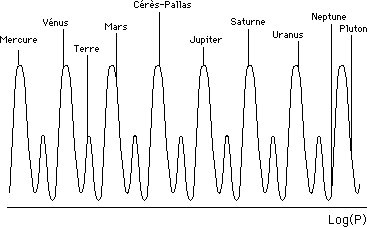
The predictions, corresponding to a "Golden Law", fit quite well. w being the golden ratio

The orbital radii then follow a geometric progression whose ratio is:
1.9n
Below are the two curves: Bode's Law and the Golden Law. Bode's Law being:
2.4 ( 0.4 + 0.3 2n)
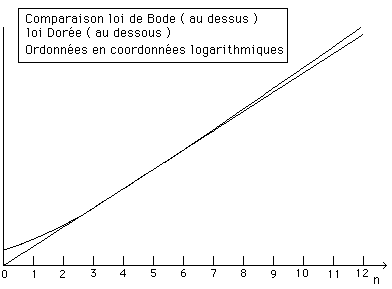
**Comparison of the two laws giving the
orbital radii (in logarithmic coordinates) **
There is therefore work to be done to show why and how the planetary system could have evolved to adjust according to Souriau's "Golden Law". In case people are interested in the adventure, Souriau would presumably agree to pilot this kind of work. I asked him the question.
The solar system poses many problems:
-
Why is Uranus's rotation axis tilted to the point of being ... in the plane of the ecliptic?
-
Why does Venus rotate "backwards"?
-
Why is the Neptune-Pluto pair "resonant"?
-
Etc....
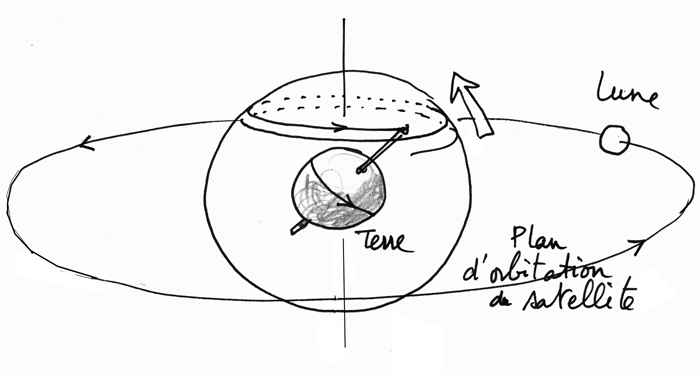
**Simulation of the precession of the equinoxes: ** - Mass of the Earth: 6 1024 kilograms - Radius: 6.4 106 meters
Moment of inertia:
I = 2/5 M R2 = 9.83 1037
The Earth rotates on itself in 24 hours, that is to say it covers 6.28 radians in 86400 seconds. The angular velocity w is therefore 7.27 10-5 radians/second
The angular momentum is
I w = 7.14 10 33
- Mass of the Moon: 7.34 1022 kilograms - Distance to the Earth: 3.84 108 meters
- Orbital velocity: 1034 m/s
Angular momentum
MRV = 2.88 10 34
The lunar "MRV" is higher than the Earth's angular momentum, by a factor of 4. Most of the angular momentum of the Earth-Moon system is held by the satellite. Therefore, it is the Moon that will tend to straighten the Earth, so that the axis of rotation of the latter tends to become perpendicular to the plane of the lunar orbit
When a top falls on a table, its rotation axis undergoes a precession movement. Suppose that the contact point of the top and the table is fixed. The end of the top's axis will describe a spiral drawn on a hemisphere.
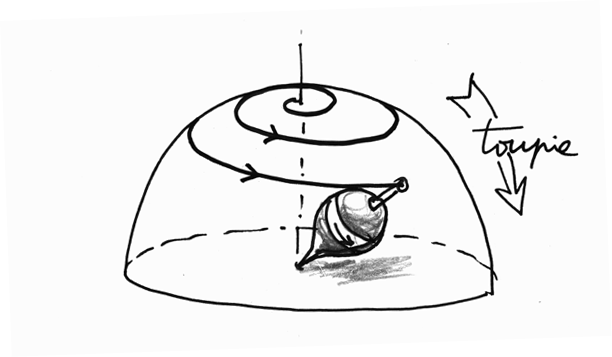
**Precession phenomenon: how a top falls on the table **
The Earth's rotation axis straightens, but precesses. Hence the precession of the equinoxes. There, it is also a precession movement, related to the straightening of the Earth's rotation axis. We can imagine a system that will precess by straightening its axis. Suspend a gyroscope like this:
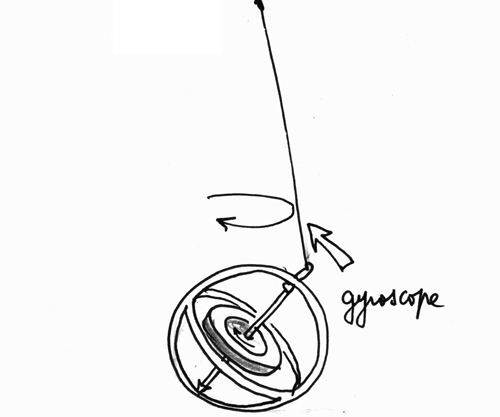
**Suspended, the gyroscope's axis precesses and gradually approaches the vertical **
The precession of the Earth's rotation axis, which causes "the precession of the equinoxes" is of the same nature and reflects the Earth's rotation axis's tendency to straighten to become perpendicular to the Moon's orbital plane. Why this? Because the Earth is not a perfect sphere but an ellipsoid (slightly) flattened. The equilibrium situation is therefore that the equatorial plane of this ellipsoid coincides with the Moon's orbital plane.
Precession of the Earth's rotation axis
Everything is damped due to dissipative processes. Can we estimate the time after which the Earth's rotation axis will be well perpendicular to the Moon's orbital plane?
At the end of times, obviously.
**Have fun: simulate the end of the world: **
I do not consider it at all impossible that during the creation of the solar system a large body, say four times the size of the Earth, could have been placed on a very elliptical orbit and in a plane quite different from the plane of the ecliptic, by simple slingshot effect (close encounter with a giant planet). If this produces a body with a period of several thousand years, it would not stay in the solar system long enough to "settle down" by interacting with other planets by tidal effect (resonator: the Sun). Its orbit could thus remain very far from the plane of the ecliptic and not be circularized.
Absurd, say astronomers. Such an object would have been observed! No, if, while passing close to the giant planet that sent it to the depths by slingshot effect, it passed through its "Roche sphere". Then it would not be a planet that would occasionally cause a nice mess in our solar system, but a nice handful of gravel mixed with large hailstones. Occasionally, this dangerous swarm would brush past us at varying distances. If one of these rocks or ice blocks hit a continent, we would be sent back to the dinosaur era with an 18-month nuclear winter (the time it takes for particles of one micron in diameter to fall back from the stratosphere where the impact would have sent them. If the object falls into the sea, it is a lesser evil. The energy creates a giant cloud cover. As in cumulus, the lack of light cools the base of the cloud, the water vapor gathers into drops and it rains ... 40 days and 40 nights.
Have you noticed that more and more asteroids are passing near the Earth and getting closer and closer? Could they be "precursors", blocks scattered along an orbit that we might cross some day?
**Incidentally, I remember an idea I had a few years ago that could also be a thesis topic in planetary science. **
Many exoplanets have been discovered. Generally, these are massive, like Jupiter. There is an immediate tidal effect between a body and a satellite. Thus the Moon, "passing daily", every 24 hours, over the Earth creates a "terrestrial tide, of 50 cm. It deforms the Earth into an ellipsoid. The Earth has a plasticity that we are not aware of at our ant-like scales. Thus, a "wave" is created on the surface of the Earth that travels across the Earth's surface. It "kneads" the Earth as it passes, this phenomenon heats the magma (very little). A dissipative phenomenon accompanies this process. The Earth makes a rotation on itself in 24 hours. The Moon orbits in 28 days. It is much slower. Therefore, this elliptical shape that the Earth affects is in advance of a phase, compared to the Moon. You can compare this to the driving of a horse in a carousel, when the trainer pulls on the lead rope in a direction that tells the horse to speed up. The Earth does the same with the Moon. This very slight acceleration increases the Moon's orbital radius by 4 cm per year. Knowing that the Earth-Moon distance is on the order of 400,000 km, what is the characteristic time of the Moon's recession.
We find that this time is on the order of 10 billion years. It is just an order of magnitude, since the closer the Moon was to the Earth, the faster the phenomenon was. Knowing that the tidal effect and the inverse of the cube of the distance, we could recalculate this time of recession and, perhaps, locate in time the period when the Moon, which had just been torn from the Earth, was much closer to it.
Conversely, the satellite Phobos orbits faster than Mars. It is therefore slowed down by its planet and approaches it. Same phenomenon. The bulge corresponding to the Martian tidal effect is "late". We have the image of the trainer pulling on the lead rope to slow down the horse. What is the speed of Phobos' approach. When will it collide with the planet. Interesting question.
The "lunar month" was therefore shorter in the past, because the Moon was closer to the Earth. Conversely, the tidal effect slows down the Earth's rotation. The days were shorter. By how much?
The Sun also rotates faster than, for example, Jupiter. "The year" of Mercury is 87 days. The Sun rotates on itself in a time that is on the order of 25-30 days. Therefore, it tends to accelerate all the planets that orbit around it. All the orbits increase in radius. Mercury, Jupiter and others move away from the Sun. At what speed? At the same time, this tidal effect slows down the Sun's rotation? What was its rotation period x billion years ago? How was the solar system in its early childhood? Did the planetary scientist André Brahic, a real word machine, ask himself this question?
Return to Guide Return to Home Page
Number of visits to this page since May 12, 2004 :