Astrophysics and N-body Systems
Epistémotron Project 1
Generalities on the N-body Problem
Some Concepts from Kinetic Theory of Gases
Astrophysics is, in principle, a science whose aim is to understand the phenomena occurring throughout the cosmos at various scales. For example, the formation of the solar system—a fascinating subject never before fully explored—will be one of the goals pursued within the Epistémotron project, concretizing the theory developed by mathematician Jean-Marie Souriau.
On a larger scale, galactic dynamics remains entirely opaque to date. We lack any viable galaxy model. We do not know how these objects form or how they evolve. From a purely theoretical standpoint, these "self-gravitating N-body systems" are governed by a system of differential equations (Vlasov plus Poisson). To date, these approaches—unknown even to current "theorists," incidentally—have also hit insurmountable walls.
We believe the solution lies in a new, twin-like vision of the cosmos. Interested readers will find an introduction to this theme in a dossier available on my website for many years. Concretely, this implies considering the universe as having two components:
- Particles with positive energy, our own
- Twin particles with negative energy
Since E = mc², negative-energy particles behave as if they possess negative mass. This leads to the following dynamical picture:
- Two positive masses attract each other according to Newton’s law
- Two negative masses attract each other according to Newton’s law
- Two masses of opposite signs repel each other according to "anti-Newton"
Why don't we observe negative-energy particles optically? Because electromagnetic interaction between two particles of opposite energy is simply impossible. As recently demonstrated by a young and brilliant researcher, quantum field theory shows that if such particles interact, they must exchange "virtual particles" or "carriers"—photons with positive energy and photons with negative energy. The inclusion of all possible interactions via Feynman’s path integral in this case leads to a result of zero. Thus, the interaction is fundamentally impossible, and twin particles remain invisible to us. They can pass through us without interacting except via gravity (or rather, antigravity). This idea is key to solving major current problems in astrophysics and cosmology (missing mass effect, flat galaxy rotation curves, galaxy formation, origin of large-scale cosmic structure). Readers will find a popularized presentation of these ideas in my 1997 book:
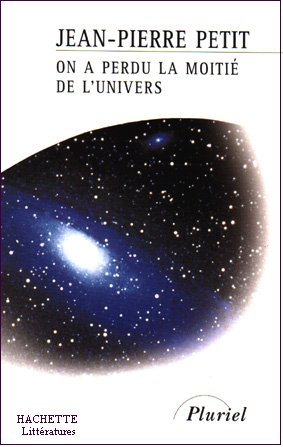
General information, including references to gravitational instability, can be found in my comic strip "A Thousand Billion Suns," available on the CD-ROM "Lanturlu1" in PDF format, printable (the 18 comic strips can be obtained by sending 16 euros to J.P. PETIT, at Jacques Legalland, Lou Garagai, 13770 Venelles).
Beyond gravity, various other mechanisms operate in the cosmos. However, in everything that follows, we will focus exclusively on gravity, neglecting radiative exchanges and energy production via fusion. The systems we will study are self-gravitating N-body systems, immersed in their own gravitational field. It becomes clear that to study the behavior of such a system, one must, step by step, analyze the motion of each "point mass" (positive or negative mass) by computing the vector sum of all gravitational forces—both attractive and repulsive—arising from the other N−1 particles. Thus, the computation time grows roughly as N(N−1) or N² when N is large—a condition that will always hold.
In planetary or protoplanetary systems, the number of objects is relatively small and can be managed by a single "domestic" computer. This is not the case for galaxies. Our galaxy contains between 100 and 200 billion stars, each approximated as a point mass. This stellar mass can then be treated as a gas, where the molecules are the stars themselves, treated as simple point masses. To approach reality as closely as possible, we must therefore aim to manage the largest possible number of point masses. These techniques were already implemented by the late 1960s. Fortunately, computer speed and computational power have only increased over the years. In the early 1990s, I was able to run calculations on a large computer at the German center DAISY (particle accelerator), which managed data from experiments. At that time, such a machine—considered exceptionally powerful—could handle 5,000 point masses. Readers will find the key results of this numerical experiment in the book mentioned above.
It turns out that in twelve years, computing has advanced so dramatically that these problems can now be tackled on "domestic" machines, thanks to a massive increase in processing speed (clock speeds up to 2 gigahertz) and memory capacity. Readers like Olivier le Roy have thus been able to recover essential, simple aspects—such as the mechanism of gravitational instability—by programming their own machines in C++. While, out of frustration, I had completely abandoned astrophysics in 2001, these individual initiatives have inspired me to attempt relaunching fundamental research based on the efforts of amateurs. Indeed, as noted by Academician and Astrophysicist Jean-Claude Pecker after my lecture at the Collège de France on February 25, it is astonishing and regrettable that teams with appropriate resources have not picked up this idea, continuing instead to clumsily work with "cold dark matter."
I therefore feel compelled to provide all these individuals—those who truly want to engage in this endeavor—with all the necessary elements to advance in this direction. Many calculations are possible using a single machine with fewer than 2,000 to 5,000 points. This limits work to two-dimensional simulations. In three dimensions, one cannot treat a few thousand points as a "gas." Beyond this, a fantastic project emerges: connecting N machines using a "shared computing" technique. This presents a delicate software development challenge, pure computer science.
Handling an N-body Problem
We have point masses and initial conditions summarized by six numbers in three dimensions (three position coordinates and three velocity components), and four numbers in two dimensions (two position coordinates and two velocity components). We also need to define a computational space and manage boundary conditions (a computer cannot handle an infinite space). Then, we must carefully set the calculation interval and the time step Δt. Let us begin with a highly schematic view. Imagine an space...