Why is the solar corona so hot?

January 12, 2001: I hear people say, I read that we don't know why the solar corona—the gaseous environment surrounding the Sun—is at a temperature of about a million degrees, while its surface is only at six thousand degrees. This morning, an idea emerged.
...There is an observed fact: the Sun periodically emits large-scale arches of plasma. The attachment points of these arches on the Sun's surface are sunspots. The plasma surrounding the Sun is in a state, unless I'm mistaken, of "high magnetic Reynolds number." That is, magnetic field lines are "frozen in" (frozen) to the plasma. Imagine women's hair in a swimming pool, and a comb smoothing it. The hair and the comb are tightly linked: one drags the other, and vice versa.
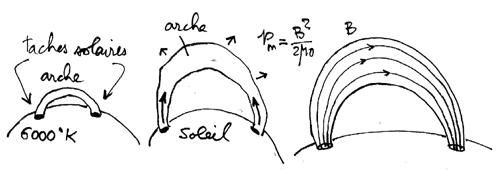
...These plasma arches, a new observational fact, extend over great distances, then break apart. In the right-hand diagram, magnetic field lines are schematically represented. At every point in space, one can associate with the value of B a corresponding value of "magnetic pressure," indicated.
...There is also conservation of magnetic flux:
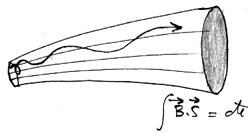
...The magnetic field strength is therefore maximum near sunspots and minimum at the farthest point of the arch's extension. This results in a magnetic field gradient. The arch thus acts as a natural particle accelerator. Gas will therefore lift off from the solar surface, from each sunspot, and, propelled by this magnetic field gradient—far stronger than gravity—rise and accelerate toward the region of minimal field, where the arch is most extended and its cross-section largest. It seems to me that these masses of plasma could then collide. The result would be the conversion of magnetic energy (used to accelerate the two plasma masses) into thermal energy. The following diagram illustrates the concept. Acceleration of particles by a magnetic pressure gradient, especially over very large distances, is a highly efficient process. All of this could be numerically modeled more precisely, but I believe this phenomenon could explain such intense heating of the corona. One must not forget that, since thermal agitation velocity varies with the square root of temperature, going from 6,000 to a million degrees represents only a 12-fold increase in thermal agitation speed.
...That said, where the plasma masses collide (the arches would then be sites of fascinating magnetohydrodynamic phenomena worth studying), the plasma pressure could become so high that it escapes confinement by the magnetic field lines. Hence, the arches break apart, releasing their hot contents. Subsequently, two scenarios arise. Moderate heating would feed the Sun's gaseous environment—the corona. The gas at the Sun's surface is effectively pinned down. At six thousand degrees, the thermal agitation speed is significantly lower than the speed a particle needs to escape noticeably from the solar surface. This is why the surface is roughly spherical. But faster particles, accelerated within the arches and released upon their disintegration, then form the Sun's "atmosphere," extending much farther out.
...More violent solar eruptions (which are actually secondary effects of a magnetohydrodynamic (MHD) instability at high magnetic Reynolds number) produce the stellar wind (in the Sun's case, the solar wind). Indeed, it is known that a high abundance of sunspots correlates with intense bombardment of Earth by gas emitted by the Sun.
...For non-specialists in plasma physics, this acceleration via magnetic field gradient may be somewhat difficult to grasp. But many people are familiar with Earth's magnetosphere:
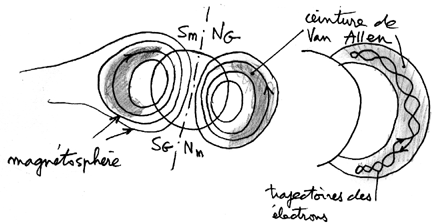
...On the left, the Earth as a sphere, with its magnetic dipole axis tilted. In fact, Earth's "magnetic north" is actually a south pole, since it attracts the north poles of compass needles. Charged particles (mainly electrons) emitted by the Sun (the solar wind) become trapped in Earth's magnetic field line network. On the right: they oscillate back and forth between regions of high magnetic field, spiraling around the field lines. These spiral trajectories illustrate how the plasma is bound to the magnetic field. This plasma, forming the "Van Allen belts" named after the astrophysicist who discovered them, travels back and forth between the northern and southern polar regions of Earth, with particles being "kicked" like tennis balls (simply due to the magnetic pressure gradient). In plasma physics, this is called a "magnetic mirror." On the left: the trailing part of Earth's magnetosphere, opposite the Sun.
...Under normal conditions, charged particles reverse direction at very high altitudes, above Earth's atmosphere—whose boundary we can define at about 80 km altitude. When a particularly powerful solar wind surge reaches Earth, the particles, despite the braking effect of the magnetic field gradient, manage to penetrate the upper atmosphere. All astronomers know this is the cause of the aurora borealis. A Van Allen belt thus seems to me quite similar to the solar arches associated with solar eruptions, at least in certain aspects.
...Well, this seems like an idea worth exploring further. But I have so much else to do...
See the dossier "The Sun's Anger," September 16, 2005
Back to Alphabetical Guide Back to Homepage
Views between January 16, 2001, and September 16, 2005: 11,882