The Dangers of Breath-Hold Diving, Part 2
Last updated (end of file) on October 13, 2002


File started on October 16, 2002. Continuation of the general file on breath-hold diving.
Last updated on December 24, 2005
October 15, 2002:
10/15/2002 at 05:40. Associated Press Dispatch:
International Association for Free Diving recognizes Audrey Mestre's record in a posthumous tribute
SANTO DOMINGO, Dominican Republic (AP) -- In a posthumous tribute, the International Association for Free Diving decided on Monday to award French breath-hold diver Audrey Mestre, who died Saturday off the coast of the Dominican Republic, the world record in "no limits" diving.
Audrey Mestre drowned Saturday off La Romana, a town located 130 km east of Santo Domingo, while attempting to break the 162-meter world record set by her husband, the legendary Cuban breath-hold diver Francisco "Pipin" Ferreras, certified off Cozumel, Mexico, in January 2000. He witnessed the accident.
Tied to a line running through a pulley and pulled down by a 90-kilogram weight called "the gueuse," the 28-year-old woman dove below the surface without oxygen at 2:30 PM local time (6:30 PM GMT), then apparently lost consciousness, according to Carlos Serra, president of the International Association for Free Diving, based in Miami.
For Audrey Mestre's dive to be certified, she would have had to return safely to the surface, according to Carlos Serra, but the Federation decided to recognize the 170-meter world record achieved by the diver during a trial session last Wednesday.
"As a posthumous tribute, we are going to recognize her 170-meter record, because it contained all the necessary elements to do so," he stated. The judges and the 13 divers responsible for monitoring and safety were all present during Wednesday's training session.
Audrey Mestre's parents, who arrived in the Dominican Republic, wish to return their daughter's body to Miami on Tuesday, where she will be buried, Carlos Serra specified.
"No limits" is the diving discipline where the deepest records are set, but it is also considered the most dangerous. It was the discipline depicted by Luc Besson in his film "The Big Blue." After reaching their target, "no limits" divers ascend directly to the surface. A decompression phase is not necessary since the diver has not inhaled any air underwater.
AP
Horrifying. The worst part is that we won't find a single journalist brave enough to voice any criticism regarding this matter. One does not criticize the extreme; it pays off. "Safety" doesn't sell well. When I think that this poor girl was only twenty-eight years old. This reminds me of the first microlight competition organized by "the Federation" in Millau. These people couldn't find anything better than to introduce a "landing accuracy" event, even though microlights had neither flaps nor airbrakes. The aircraft then had to approach at a speed near the stall speed to try to land within a rectangle marked by colored bands. What happened? One competitor stalled and broke his spine, but another went into a spin and died on camera. I tried to intervene by calling television channels. No response. In these matters, journalists are merely impassive witnesses to completely idiotic circus games organized by utterly irresponsible people.
November 14, 2002
Hello,
Following up on your writings about the dangers of breath-hold diving and the predictability of human stupidity, the breath-hold diving record that cost Audrey Mestre her life has been certified:
This means one can sink one's feet into concrete, descend to the bottom, and still break a record, since staying alive is apparently no longer part of the conditions for record certification.
Yannick Langard
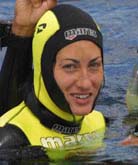
October 20, 2002. Loïc Leferme becomes the "no limit" breath-hold diving descent record holder. He dedicates his record to Audrey Mestre. A portrait of him in Libération.
December 20, 2002. A message:
Hello,
At the age of 8, I was already swimming back and forth across the local municipal pool (50 meters) underwater, without fins, with the appearance of a black veil before my eyes in the last 15 meters, accompanied by spasms from holding my breath. I think I held a record of unconsciousness worthy of my young age at the time.
Today, at 35, I continue to practice this selfish hobby, sometimes in pools, often in quarries (and there are very deep ones in my region), and obviously in the sea.
I dare not specify here under what conditions I practice breath-hold diving, as they are so unreasonable...
Your file on breath-hold diving is so complete, so personal, with the passing of your son who would be my age today, that I can only testify to the awareness it brings me.
To put it simply: THANK YOU
Sincerely, E.L.
My file may have saved some lives, it seems.
July 14, 2004:
Hello,
My name is Mathieu, I am 30 years old, and I wanted to thank you for your articles on breath-hold diving. Because like many, I took risks (over 3 minutes 30 seconds) and now, thanks to you, I will try to take fewer, or perhaps none at all. I would like to say (forgive me for allowing myself) that the death of your son was not in vain...
Because thanks to him and to you (your exposition and your articles), dozens, if not hundreds, of lives will be spared. I know, it is a meager consolation, because the death of a loved one is irreplaceable, but thanks to you and to him, perhaps one day I will owe you my life...
Thank you, sincerely... Mathieu
December 24, 2005. The press is not fulfilling its role of informing about the dangers involved.
My son died fifteen years ago in breath-hold diving. He was 23 and was the victim of a fatal blackout during a free dive at a depth of 30 meters, diving off Marseille. I vainly tried to draw people's attention to this subject and to develop a safety system, "The Guardian Angel," that could save lives, foolishly lost, by triggering an [automatic ascent]. There remains on my site a very comprehensive file that enlightens readers on the terrifying dangers due to the suddenness of the blackout, which is preceded by no warning signs. Readers should therefore read the entire file to inform themselves.
I stopped fighting on this front long ago. From time to time, I receive various types of messages.
-
Either they are activists who defend this extreme sport (which is not a sport) and send me often insulting letters. But, faced with a proposal to defend their arguments on my site under their own names, they all backed out, without exception.
-
Or, as in the message above, or the following one, they are people who admit they were not informed and who are grateful to have been providentially informed. Here is the latest one:

Sender:
Date: December 23, 2005
Sir,
I wish to thank you for putting your file on the dangers of breath-hold diving online. I am myself passionate about spearfishing and dive to depths of 25–30 meters.
Reading your file had the effect of an electric shock on me.
I live in Cameroon, where we have formed a small group of hunters. Here, we go under oil platforms, tankers, and along the pipes of old oil wells. The catches are fantastic: Barracudas of 15 kg, Jacks of 18 kg, Carp and Snappers of 20 kg, Groupers, etc... The depth of our sites varies between 15 and 35 meters. So far, nothing extraordinary, but here, there is no visibility between zero and 5–10 meters; we are forced to pass through the layer of "soup" in which most of the time we cannot even see the stock of our speargun 50 cm in front of our mask. Past this layer and the thermoclines, we arrive in light green water, but it remains very dark nonetheless.
You can imagine the chills your file gave me.
For several months, something told me I needed to look for some kind of inflatable safety buoy. I knew the dangers of blackouts, and that is why I always refused to practice hyperventilation. I thought that would protect me from the risk of blackout, or at least that I would feel the precursor signs of this blackout (I realize my ignorance!!!). So I started looking for an inflatable vest equipped with a CO2 cartridge to trigger in an emergency, and I came across your site.
I am going to completely revise my philosophy and try to reason with the rest of the group.
I will apply your safety rules from now on, but remain convinced that your "Guardian Angel" is the best insurance. They invented CYPRES in parachuting, and you know how many lives it must have saved! What about the Guardian Angel? Have you found a way to finance it? Are there other products on the market that fulfill this function?
Sir, I am sorry for what happened to your son. It is horrible.
I renew my profound gratitude for the file you put online and took care to maintain.
I hope to receive a reply from you.
Sincere Greetings
Arnaud CHEBAUT
Douala, CAMEROON.
-
Sometimes, more rarely, they are diving school managers who announce their intention to include this introduction to the problems related to breath-hold diving in all the courses they teach their students.
-
Sometimes, too, they are fathers or children who have lost a loved one and for whom, alas, it is too late. You will find one of these testimonials, a poignant one, from a young girl who saw her uncle die before her eyes, in this file.
The fact remains that for 15 years*, the press has remained totally deaf to any proposal to warn people about these dangers, while it will willingly echo new records. *This reminds me of the response I received from the Beuchat company, in Marseille, when I demonstrated to them in 1991 a system for the automatic ascent of a blacked-out diver after a given immersion duration:
Safety is not a profitable niche
For people in the media, and especially television, extreme breath-hold diving "provides beautiful images," but themes related to safety are not "media-friendly." Indeed, a death by blackout does not have a spectacular character, like a suicide bombing, for example. It is just a lifeless body, that's all. There isn't even any blood.
As time passes, my contempt grows for those who call themselves editors-in-chief. I do not criticize the profession of journalist itself. Some, and indeed many, would like to practice their profession correctly. But, in editorial board meetings, the verdict falls regularly, to the point that I have completely stopped making approaches to these people:
- No. It's not profitable. It will drop the ratings. People are fed up with safety. Look instead at people who experience this as an extreme sport. The public likes this heroic, gladiator-of-the-extreme side. There is the little thrill of the "Big Blue generation." The film still has its fans. Do a studio segment inviting Petit to explain the dangers of breath-hold diving, plus people who would testify to deaths caused by it? Surely not. People would change the channel and goodbye to the audience share.
Awareness is spreading. People are increasingly realizing that their media does not inform them; it intoxicates and stupefies them. A lot of "background noise" completely drowns out important information. And beyond that, there is disinformation or outright lying. Machiavellianism, complicity with money powers, or simple stupidity: you have only the embarrassment of choice. If necessary, it is a mixture of all three.
And I cannot be on all fronts at once. Due to lack of information, many divers will continue to drown "quietly," while at the beginning of summer, TV stations will do a report on schools introducing young people to "extreme diving," which incidentally has ... its own federation. But programs warning people about the inherent dangers of this activity, you have never seen and never will.
And your kids will continue to die in general indifference. ---
March 17, 2006. Breath-hold diving, a reader testifies
Mr. Petit,
I spent long hours browsing your site, and I wanted to express my admiration for all your talents, whether in plasma physics, sports, or drawing. I may resemble you a little, even if I have only a tenth of your qualities.
I was twenty years old when The Big Blue came out; I lived near Toulon and practiced breath-hold diving, alone, like a hero. I was a member of a local hunting club. 4 minutes 30 seconds of breath-hold on average, and dives down to 35 meters to contemplate the mud and the bottom of my unfathomable stupidity.
That year, one of my friends, who was a diving specialist doctor at the Port-Cros National Park, pulled out a summer visitor who was setting "a record" at the foot of his boat's anchor, at a depth of fifteen meters. An accomplished athlete, his very long breath-hold eventually worried his friends. He was only recovered after fifteen minutes underwater. He was still alive but died a few hours later in Marseille, where he had been airlifted with his lungs full of water.
That year, I taught breath-hold diving to one of my friends, a nurse by profession, who proved to be "very aquatic," as they used to say in this small circle. I taught him never to dive alone, not to hyperventilate, and to descend without weighting himself beyond what was necessary to compensate for the buoyancy of the wetsuit. I was probably a mediocre teacher. He drowned while spearfishing in less than 8 meters of water, a few months later.
That year, I had a blackout in my living room while trying to train to push my limits. After 6 minutes without oxygen, I lost consciousness. I woke up a bit drunk, without realizing anything, and started staring at my watch after resuming my breathing, believing I had shattered the duration record, when I had only shattered the record for stupidity.
I met Jacques Mayol several times, notably at the underwater image festival in Toulon. I found him solitary, sad, and bitter. He did not make me want to dive again. Extreme sports, as you demonstrate well, are the preserve of loners who find there a therapy that is too often fatal.
More than wearing a trigger vest that would protect against blackouts, I believe we must tell aspiring breath-hold divers, climbers, motorcyclists, or off-piste snowboarders that the natural environment and physical laws are harsh, and that no intense physical activity should be practiced without an acute awareness of its danger. I have always been afraid, afraid of dying, when entering the water; perhaps that is what saved me, along with luck. If the innocent who rides a motocross bike without a helmet, the beginner who surfs in powder snow, or the breath-hold diver who tries to exceed 5 meters were to ask themselves, "What are the dangers, and what must I learn to face them?", how many idiotic deaths would be spared? This is what emerges from reading your texts, whether it concerns those two Swiss men who froze to death against the wall, or that microlight pilot who could not recover from a spin. Ignorance kills. Thank you for what you do to dispel it.
Sincere greetings
Gilles Lancrey.
July 28, 2011:
So it will never end:
Death of breath-hold diver Patrick Musimu in his swimming pool in Brussels. Belga Journal, July 22, 2011. Belgian breath-hold diver Patrick Musimu died on Thursday afternoon in an accident in his swimming pool in Watermael-Boitsfort (Brussels Region), police and judicial sources confirmed on Friday. Police discovered his unconscious body on Thursday around 1:40 PM. According to the rtlinfo.be website, Patrick Musimu died in his swimming pool at the end of a training session.
The athlete, born in Kinshasa in 1970, suffered a medical episode and drowned. The Belgian diver was the first man to descend to more than 200 meters in depth in breath-hold diving, reaching 209.60 meters in "No Limit" during a training session in June 2005 in Hurghada, Egypt.
He discovered diving late, following a television report. After a few months of initiation, the holder of a degree in physiotherapy had already broken two world records in Belgium, during a World Cup of breath-hold diving: 65 m in free immersion and 63 m in constant weight.
In April 2002, he dethroned the famous Italian Umberto Pelizzari, the reigning world champion, by descending to 87 m in constant weight, and established the world record in variable weight at 120 meters a few months later.
Patrick Musimu had developed a technique consisting of filling his nasal and sinus cavities with seawater, filling the void normally occupied by air, which allowed him to no longer have to compensate for the pressure difference during the dive.
Patrick Musimu leaves behind a seven-year-old daughter and his wife.
Return to the general file on breath-hold diving Return to Dangers Return to homepage
Number of views of this page since December 24, 2005: