Quit smoking: health and cigarette addiction
How to quit smoking
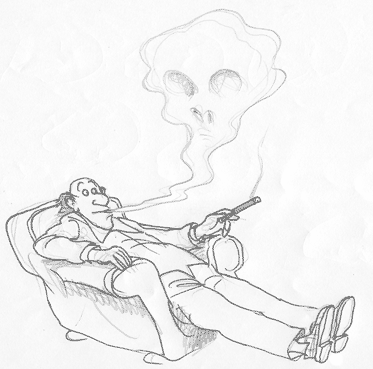
One of my closest friends just called me: heart attack. Cause: tobacco abuse and its consequence—clogging of his cardiovascular system.
I've smoked occasionally in my life. But I definitively quit a few years ago, because, unlike what dentists usually refrain from telling you, tobacco has a very harmful effect on gums (as it does on the entire vascular system in general). A friend of mine, Denis, once told me at that time: "My grandfather smoked until his last tooth." It cost me four teeth, which became loose and had to be extracted. But that's just the lesser evil. We all know tobacco can have much more serious effects on the body.
Enough with moralizing—how can one quit?
Smoking satisfies various needs. Among them is the need for a buccal activity rooted deeply in infancy. Sucking, chewing, eating, drinking—these activities can all be forms of coping with nervousness or anxiety. The pipe, cigarette, and cigar are "adult" versions of the pacifier and the comforting maternal breast. Those who quit smoking usually tend to compensate by eating—this is well known—and gain weight. How can one replace this "buccal-dental" activity? (Dental, in the case of the pipe, which I practiced for many years.)
Personally, I chew on white wooden toothpicks, easily found in large supermarkets. Here are these toothpicks, at a 1:1 scale.
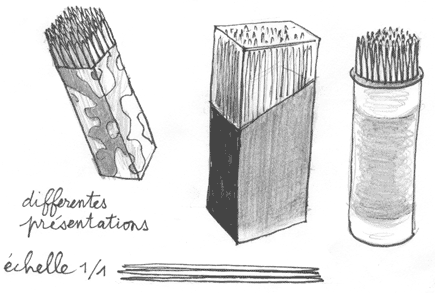
This activity produces paper pulp, which I haven't tried to quantify. It's non-toxic. There are no side effects or dependency: you stop whenever you want. If handled carefully, they can even be used to... clean your teeth, but without force (for this purpose, water jet systems are effective and harmless to our delicate gums). The paper pulp produced by chewing the wooden toothpicks digests easily. The strong pressure from chewing may damage teeth with roots, that's true. But compared to the risks of heart attack or lung cancer, the negative effects of chewing toothpicks can be considered negligible. Even when used in large quantities, the amount of wood remains small, so the impact on deforestation is minimal: if humans replaced cigarettes with chewing toothpicks, the Amazon rainforest wouldn't be threatened.
If I were Minister of Public Health, I'd launch a large-scale campaign to replace cigarettes, pipes, and cigars with toothpicks, which could even be infused with different wood essences or vitamins.
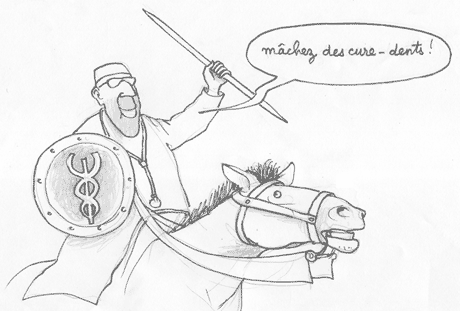
Toothpick packets could be discreetly included with magazine covers, offered as freebies in CD or toilet paper packaging.
October 22, 2003: Following reader feedback, chewing toothpicks is not without risk. Accidental inhalation of wood fibers may lead to their lodging in the lungs, potentially causing abscesses. Moreover, the strong pressure exerted on the wood constitutes a strain on dental supports, risking tooth loosening. Under these conditions, from a dental standpoint, the patient merely switches from one problem to another. With nicotine, one destroys one's gums (as one friend said: "My grandfather smoked until his last tooth"). With constant, excessive chewing, especially with age, one risks loosening one's teeth.
Still, tobacco is undeniably a highly harmful pathogenic agent (cancers, cardiovascular and pulmonary diseases). The rise in lung cancer rates is strictly parallel to tobacco consumption. Having completely quit smoking in 2000, at... 60 years old, I was still a significant smoker (a pack of cigarillos per day). Furthermore, tobacco is a drug, where the amount of nicotine absorbed (as a stimulant of psychoactive substances) increases over time in smokers.
What should one do? Choose a substitute. Perhaps chew thick paper or licorice sticks. But in any case, anything is better than smoking—an act whose consequences are entirely predictable. One can live without teeth, but not without lungs. Ideally, one should keep both. Recently, a TV program revealed the strategies used by cigarette manufacturers to mislead consumers: "light" cigarettes, filters, etc.
Why do people smoke? To cope with stress. The same applies to overeating, which leads to obesity. This obesity is worsened by what de Rosnais called "junk food" (obesity that inevitably leads to cardiovascular and joint problems). Yes, while people in poor countries suffer from hunger, those in wealthy countries overeat to relieve their anxiety. The leader in this regard is America, where ice cream vendors offer containers the size of beach buckets.
Back to the table of contents "Dangers"
Counter initialized on December 27, 2001. Number of visits: