Breath-Hold Diving Safety Vest
Safety vest for breath-hold divers
Automatic activation after 120 seconds.
...The guardian angel.
This device had to be lightweight and unobtrusive: a light, elegant harness.
...Free diving has something heroic about it. It would not suit the burden of a bulky "Mae West" lifejacket. The inflatable bladders therefore had to be concealed within the shoulder straps, on the front. A Velcro system was needed to allow them to deploy easily.
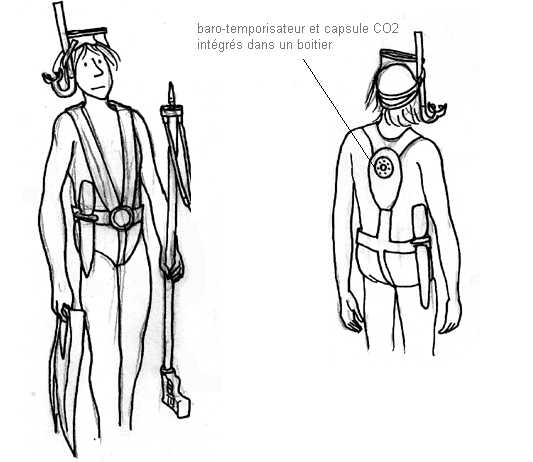
...It seemed essential to avoid electrical systems due to the effects of seawater. The diver had to be able to test the system’s functionality with simple gestures. Such a system should "go unnoticed." In fact, "the guardian angel" was meant to be a device positioned between the diver’s shoulder blades. When at the surface, this placement allowed it to be practically at atmospheric pressure.
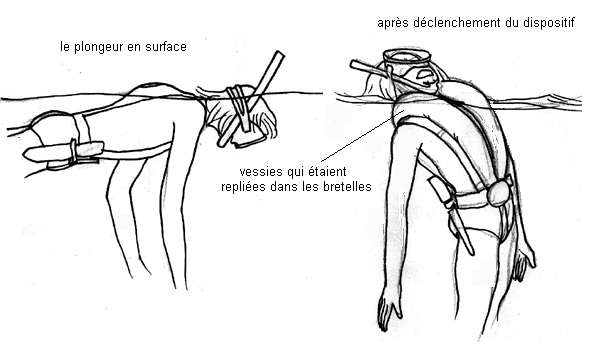
...We opted for a "fluidics"-based timing system. This system was successfully built and tested. The preliminary study was expensive. So I went to ask for help from a friend, Albina du Bousvouvray, who had also lost her son at nearly the same age under dramatic circumstances. François-Xavier Bagnoux had earned his helicopter pilot's licenses. He became the private pilot for Thierry Sabine, co-founder of the Paris-Dakar Rally. When Sabine was scouting in the desert with singer Balavoine as a passenger, all three died in a fatal accident whose cause was never fully clarified. Overwhelmed by grief, Albina decided henceforth to dedicate herself solely to humanitarian causes through a foundation she named after her son. She immediately agreed to fund the construction of a prototype. The device shown in the drawings, nearly full-scale 1:1, was therefore built and successfully tested by the company Disk from Bourg-lez-Valence, led by the dynamic Mr. Koenig. The financial envelope had been planned to cover the entire project—from preliminary study to final product development in collaboration with an industrial partner to be found. We all hoped this venture could be completed. A patent was prepared, and I felt it natural to appoint someone who had handled my son’s affairs during his lifetime. Jean-Christophe was a brilliant designer of diving equipment. Unfortunately, this person turned out to be a fraud of the worst kind, who, through clever manipulation of documents, diverted most of the funds, as she had previously done with several humanitarian organizations. This individual even managed to obtain substantial sums paid to my son for the sale of a model, in Italy, pretending to be appointed as executor of his will. There are people capable of severing a finger from a corpse just to retrieve its ring. It is well known (and the ARC affair and its unscrupulous director, Crozemarie, serve as proof) that humanitarian activities are a favorite hunting ground for fraudsters, since people involved tend to be less suspicious. With what remained after this person’s theft, we were able to complete a prototype and test it successfully—but we could not go further. We are therefore seeking an industrial partner willing to take over this project. I simply wish that, if sales of these safety devices generate any revenue, the François-Xavier Bagnoux Foundation be compensated first for the money it lost in this affair, most of which was stolen through fraud.
...The tests were conducted on the so-called "baro-timer" system. We designed it to limit breath-hold dives to two minutes (120 seconds), and after that time, it would automatically puncture a CO2 capsule, inflating the vest’s two bladders and bringing the diver back to the surface automatically. The system functioned satisfactorily and repeatedly. The simplest way forward is to describe it now. The drawings below depict a prototype with the size and volume of two VHS video cassettes glued together. Optimized, the device would obviously have a different, more compact shape, made of molded plastic parts. Here, we built the prototype by machining aluminum alloy plates, solely for the purpose of demonstrating feasibility.
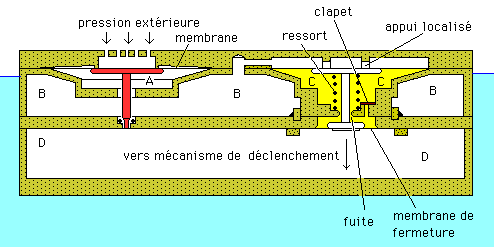
...Initially (before diving), the system (which is meant to be positioned between the diver’s shoulder blades) is at water level. External pressure acts through the orifices indicated in the drawing. The system is in contact with the outside environment via a rubber membrane similar to those used in scuba tank regulators. This membrane is attached to a movable assembly (shown in red in this drawing), which has rotational symmetry. The system contains several chambers. Let’s call B the upper chamber and D the lower chamber. Under normal conditions (outside of pressurization due to the diver’s descent), the membrane is flat. The turret, shown here in red, is in the position indicated. Its point is not engaged, and chambers B and D communicate freely. The entire system is at equilibrium.
...The yellow color represents oil filling. A second turret (white in the upper drawing) is also attached to the two very flexible membranes, both made of rubber. This turret consists of a central cylindrical body attached to two disks on which the upper and lower membranes are fixed. A light spring keeps this second movable assembly in contact with upper stops through the rubber membrane at rest. No oil leakage is possible. Oil can flow in two ways:
- Slowly downward, along the central axis, depending on the clearance of the axis within an orifice.
- Rapidly upward, via a check valve (brown in the drawings).
...The device is ready to function. If the diver submerges completely, as soon as they are one meter underwater, the pressure acting on the rubber membrane in contact with seawater becomes sufficient to isolate chamber D using the point of the left movable assembly, which comes into contact with the O-ring shown.
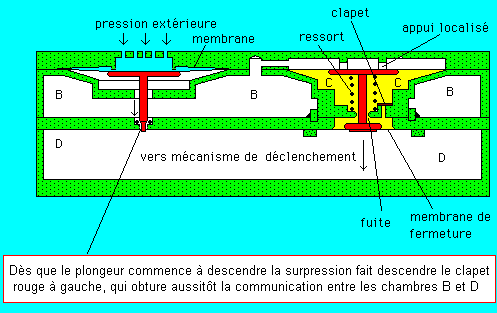
...The color of the environment is meant to evoke depth. Here, we are at one meter depth. As soon as the diver descends further, even just a few more meters, the pressure acting on the left membrane, attached to the left movable assembly, pushes it into contact with its stop. See the next drawing:
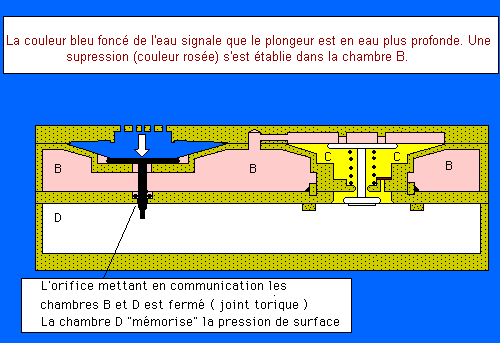
...The air in chamber B becomes slightly pressurized (indicated by the pink color) relative to the air in chamber D, which has "memorized" the atmospheric pressure at the moment of immersion (plus the equivalent of one meter of water, i.e., one-tenth of a bar). The air in chamber B therefore presses down on the upper membrane of the second movable assembly (shown here in white). This assembly tends to descend. To do so, it must expel a certain amount of oil from the upper section (C) into the lower section, the fluid flowing along the axis, with a specific clearance having been created during machining. It is the value of this clearance that determines the timing duration.
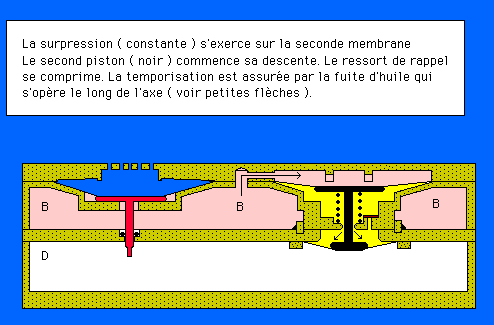
...The drawing above shows the second movable assembly in the process of descending. The small arrows indicate oil flow. The time it takes for this assembly to reach its stop depends on the overall design of the system. What happens if the diver returns to the surface before the 120 seconds have elapsed?
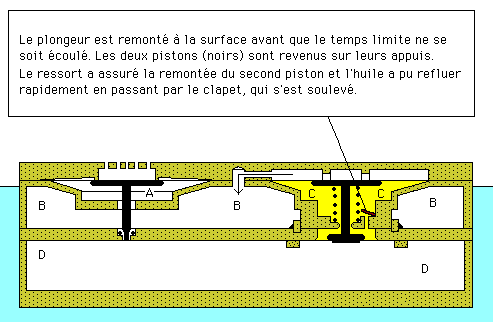
...The device is shown after returning to the surface. Note that as long as this return to the surface (or very near it) has not occurred, the countdown continues. Only when less than one meter deep does the upward movement of the left movable assembly expose the light, re-establishing communication between chambers B and D. The right spring rapidly pulls the right movable assembly back to its "rest" position. This movement is very fast, allowing oil to pass through the orifice equipped with the check valve (visible here in the raised position).
...But what would have happened if the diver had remained submerged beyond the critical 120 seconds?
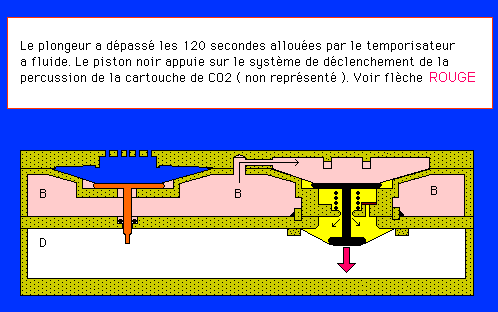
...The right movable assembly (shown in black) would have come into contact with the striker’s release mechanism (armed by a powerful spring). It is this system (not shown) that then punctures the CO2 capsule, rapidly inflating the two safety bladders and bringing the diver back to the surface, face up. Excess CO2 is vented through a loud whistle, intended to alert bystanders and help bring the diver back to consciousness.
...To avoid overloading the drawing, neither the striking mechanism nor the system for testing the device’s functionality are shown: a safety pin prevents accidental puncturing of the CO2 capsule. The diver, in their boat or on the beach, first arms the spring. Then, by pressing a button, they push and hold the red left movable assembly (simulating a dive). This action triggers oil flow—the "baro-timer." Holding a watch, they can verify that the system functions properly after the indicated time. They then need only re-arm the striker, remove the safety pin this time, and go diving without further concern for the device. Their "guardian angel" watches over them and prevents any dive exceeding 120 seconds (though this timing could be adjusted simply by shortening the right movable assembly’s travel before triggering the striker).
...The system resists shocks and corrosion since it contacts seawater only through a simple rubber membrane. The right movable assembly cannot accidentally engage the striking mechanism during a shock—the viscosity of the oil prevents it.
...My son had invented another interesting system, suitable for installation on any boat, lightweight and unobtrusive—about the size of a briefcase. This colorful plastic box, easily identifiable and equipped with a deployable flag, served as an air reserve allowing a diver to operate at a limited depth (up to 20 meters) via a "narghile" hose. A system that could, for example, allow a sailboat or motorboat captain to dislodge a stuck anchor between rocks, retrieve an object, or simply allow crew members to take a look at the seabed.
..."Is this an autonomous diving suit?" One might ask. Yes and no.
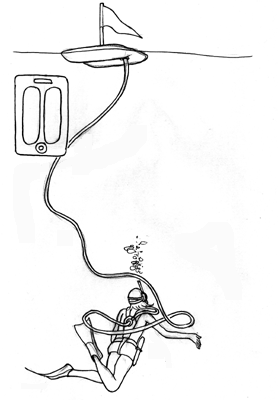
...The fact that the air reserve remains at the surface (lightweight alloy scuba tanks can float) allows people staying on the surface to keep an eye on the diver. The diver operates in "semi-apnea." Technically, this is what is called a "narghile," but psychologically, it allows an ordinary person to feel like the hero of "The Big Blue." The harness includes the baro-timer, which automatically starts its countdown as soon as the diver stops breathing. The device can then be set for much shorter times, for example 60 seconds.
...A minute without breathing: once triggered, the cartridge brings the diver back to the surface. But as soon as they breathe air through their narghile, the pneumatic timer resets.
...I have a heartfelt thought for my friend Yves Girault, now deceased, with whom I made nearly my first dives, who knew my son well and helped me during the design and development of this rescue device.
Reactions:
May 1, 2000: Benjamin Rottier, aged twenty, wrote to suggest an improvement to this safety system. I admit I hadn’t thought of it. It’s simply a matter of adding, for example on one of the shoulder straps, on the front, a ring or handle (similar to parachute opening handles), connected via a plastic-coated cable running through a sheath to the CO2 capsule striking mechanism. Pulling it instantly punctures the CO2 capsule, inflating the safety bladders. This could apply in various situations:
- It might be a diver who, while submerged, feels unwell (chill, sense of having overestimated their abilities).
- But this device could also allow someone with limited apnea skills to dive toward another person lying unconscious at depth—depths that would make reaching and rescuing them problematic. A parent could thus attempt to save a child who has just gone under. There are many people capable of splashing around and submerging, but unable to exceed five or six meters. What should one do when a loved one lies fifteen or twenty meters down and quick action is needed? It’s faster to equip oneself with this device and rush to the accident site than to bring a boat overhead to attempt recovery using a rope. In cases of syncope, every minute counts. The brain cannot survive more than five minutes of anoxia. That’s too short a time to raise an anchor or start an engine. With this system, one simply dives toward the unconscious person, grabs them, and activates the inflation device, bringing both back to the surface.
...It’s not just those who faint who might need help. Putting on such a harness and swimming toward someone in distress guarantees that, upon reaching them, you’ll have a buoyant life preserver—without having had to tow it with you on the way.
...In fact, danger isn’t limited to diving. Every year, countless people drown simply due to cold shock or exhaustion when caught in a current. Swimmers wouldn’t want to go out to sea with an unattractive "Mae West" lifejacket on their back, accompanied by a CO2 bottle bouncing on their belly. In this project for developing the "guardian angel," emphasis would be placed on design—on a "James Bond" aesthetic. Beautiful bronze buckle, knife attachment, hydrodynamic shape, very "in" colors. And why not, rescue gadgets: whistle, small flashing waterproof flashlight the size of a pen.
...Traditional harnesses used on boats are unattractive and hard to adjust. The "undercut" belt hangs lamentably between the legs. It’s unreasonable to bring people who can’t swim onto a sailboat or pleasure craft. Vessels should be equipped with life vests. But often, except in rough weather, people don’t wear these bulky, unattractive accessories. They wear the harness—but not the life vest. These vests are mostly present on board to avoid fines during inspections, or so one assumes, for use in case of shipwreck. How many good swimmers have died after falling overboard, day or night?
...No one seems to have imagined that the design of such equipment could be a factor in increasing safety. In fact, there is a seamless continuity between the rescue system for a diver who has just lost consciousness and the simple harness worn by a crew member on a sailboat. If an industrialist were to take interest in this issue, some components could be shared. This would expand the potential market and lead to production savings.
...When on a sailboat, safety requires wearing a harness and securing oneself to a lifeline. In such cases, a moment of inattention can be fatal. What good is a crew member’s harness if they aren’t attached at that exact moment, and a "boom strike" sends them overboard? (When Tabarly was thrown overboard by such a boom, he wasn’t wearing a harness.)
...After an accident, several scenarios are possible:
- The person who fell into the water can trigger inflation of their safety bladders by pulling the handle.
- But this inflation could be made automatic upon even slight overpressure, for example via a hidden pressure capsule in the waist belt.
- The fact that this vest is convenient and attractive may encourage people to wear it routinely. A harness wearer with inflatable bladders won’t hesitate to dive to rescue a crew member who has fallen overboard, knowing they can ensure their own rescue and won’t immediately become an additional burden for the boat’s captain.
- The vest could have two positions: "sailing safety" and "diving safety." In "sailing safety": swimming is forbidden. In "diving safety": no more than 120 seconds of immersion.
Another note from Benjamin Rottier:
Aviation regulations for tourist aircraft state:
"A life vest or equivalent individual device for each person on board, stored in such a way that it can be easily reached from their seat or berth, must be on board every aircraft when it may be operated more than 50 nautical miles from the coast, or, if the aircraft cannot maintain level flight in the event of engine failure, when used for flights that might carry it beyond a distance greater than it could cover under gliding or with engines still running. Life vests or individual devices must be equipped with at least one electric light that operates upon contact with water, or alternatively, a waterproof electric light and a whistle." (General Operating Conditions for Civil Aircraft, Annex to the Order of June 19, 1984, amended by the Order of July 30, 1985, Chapter VIII Equipment, § 8.10)
And Benjamin, who holds a pilot’s license, adds:
...Imagine this scenario: A light aircraft with four people on board crashes into the water after engine failure. Panic ensues—everyone scrambles to put on their large orange life vests, contorting in the narrow cabin. The pilot lets go of the controls to don his vest. The aircraft crashes: evacuation is then required. Not easy, cluttered by these large life vests.
...The situation could be even worse. There are runways facing the sea. An engine failure during takeoff could lead to a crash much more quickly. Moreover, ditching is no small matter. Even slight waves mean certain disaster. For such use, an "angel guardian" version adapted for aviation—featuring inflatable bladders housed in the front of the shoulder straps and a mini CO2 bottle mounted on the chest—could be activated in two ways:
- Either manually.
- Or automatically when a small pressure capsule located on the crotch strap (at lower abdomen level) experiences slight overpressure.
...This automatic system could save lives when aircraft passengers are ejected during a crash. In both cases, this unobtrusive device could be worn throughout the flight by passengers and the pilot.
...Also worth noting is that such a system might eventually replace current systems used on commercial airliners. As currently designed, they can only be used if the aircraft performs a perfect ditching—landing gear retracted, on calm water. Then one imagines passengers, having donned their vests as the aircraft lost altitude, orderly and disciplined moving to evacuation points guided by flight attendants. In reality, other scenarios may occur—where the fuselage breaks apart and passengers are thrown into the sea unconscious, unable to inflate their vests. In such cases, automatic inflation via a barometric capsule could prove invaluable.
